Compare commits
| Author | SHA1 | Date | |
|---|---|---|---|
 LeoVasanko LeoVasanko
|
5d1ba2f58c | ||
|
LeoVasanko
|
cf2957ab8d | ||
|
LeoVasanko
|
fbfd2ba1bb | ||
|
LeoVasanko
|
ff33df0ebc | ||
|
LeoVasanko
|
dec5191157 | ||
|
LeoVasanko
|
baab37ae2d | ||
|
LeoVasanko
|
ab2d721723 | ||
|
LeoVasanko
|
2d7e119161 | ||
|
LeoVasanko
|
d4f835428b | ||
|
LeoVasanko
|
1a22ec9dce | ||
|
LeoVasanko
|
02b3890cd3 | ||
|
LeoVasanko
|
4c0be1bfa7 | ||
|
LeoVasanko
|
beca6806ef | ||
|
LeoVasanko
|
c25835f467 | ||
|
LeoVasanko
|
38d5402045 | ||
|
LeoVasanko
|
4f09622241 | ||
|
LeoVasanko
|
372d91bf49 | ||
|
LeoVasanko
|
b0b216b784 | ||
|
LeoVasanko
|
475a2cdc3c | ||
|
LeoVasanko
|
8774224545 | ||
|
LeoVasanko
|
cb742000a8 | ||
|
LeoVasanko
|
be8dc0c513 | ||
|
LeoVasanko
|
e4c21109d9 | ||
|
LeoVasanko
|
1287ba4077 | ||
|
LeoVasanko
|
9c51b89226 | ||
|
LeoVasanko
|
d5e94a2186 | ||
|
LeoVasanko
|
c65d8eaa12 | ||
|
LeoVasanko
|
cb0b1f067d | ||
|
LeoVasanko
|
5dbe9a0dcd | ||
|
LeoVasanko
|
0bba199376 | ||
|
LeoVasanko
|
4232304a00 | ||
|
LeoVasanko
|
77a34753d9 | ||
|
LeoVasanko
|
52ca3f4f49 | ||
|
LeoVasanko
|
ebc13c0ee4 | ||
|
LeoVasanko
|
7a64d8f73b | ||
|
LeoVasanko
|
a5b7d88a89 | ||
|
LeoVasanko
|
03aa31cedb | ||
|
LeoVasanko
|
ec6a084969 | ||
|
LeoVasanko
|
15a6710c17 | ||
|
LeoVasanko
|
dcaf415032 | ||
|
LeoVasanko
|
79316eebd4 | ||
|
LeoVasanko
|
682d70cb23 | ||
|
LeoVasanko
|
1aaf040db7 |
@@ -1,96 +1,131 @@
|
||||
# fastapi-vue-setup
|
||||
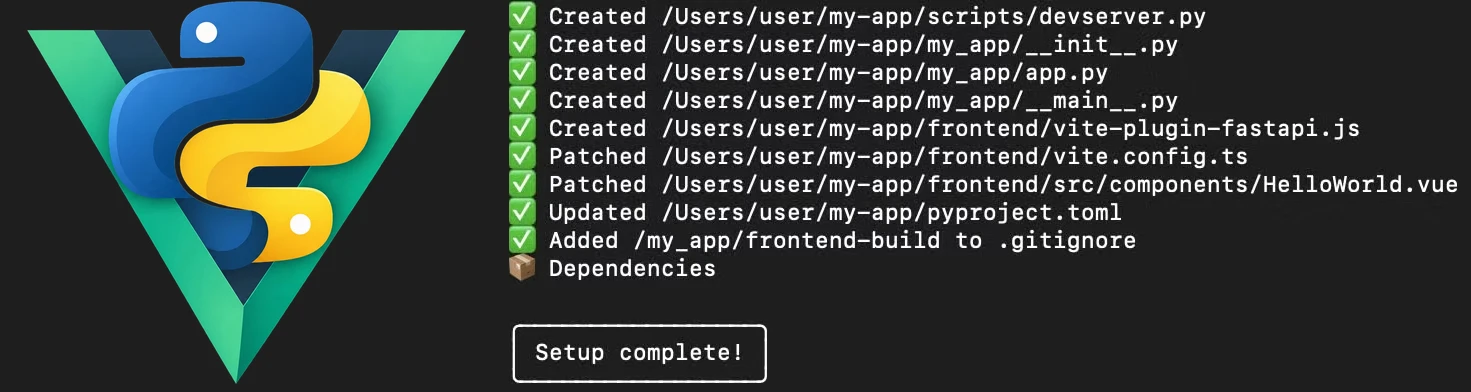
|
||||
|
||||
Create or patch a FastAPI + Vue project with an integrated dev/build workflow.
|
||||
# FastAPI-Vue Full Stack Setup
|
||||
|
||||
- Development: one command runs Vite + FastAPI (reloads)
|
||||
- Production: `uv build` bakes the built Vue assets into the Python package (no Node/JS runtime needed to *run* the installed package)
|
||||
Build and develop **FastAPI + Vue** as a single project, while keeping production purely Python — **JavaScript tooling is only needed during development!**
|
||||
|
||||
Unlike a template repository or a tutorial, the setup adapts to the application you already have and can keep that integration up to date as the stack evolves. It also fills in the practical gaps around FastAPI itself, providing a production-ready application runtime with a CLI command to start the server with integrated pretty logging and tracebacks — giving your project a running start.
|
||||
|
||||
Start a new project with your preferred setup, integrate an existing FastAPI or Vue codebase, or upgrade an already integrated project to the latest simply by running the script.
|
||||
|
||||
## Quick start
|
||||
|
||||
Install [UV](https://docs.astral.sh/uv/) and any JS runtime (node, deno, or bun).
|
||||
|
||||
This README uses `my-app` as the example project name:
|
||||
|
||||
- project directory: `my-app/`
|
||||
- Python module: `my_app`
|
||||
- env prefix: `MY_APP`
|
||||
- CLI command: `my-app`
|
||||
|
||||
Create a new project in `./my-app`:
|
||||
|
||||
```sh
|
||||
Install [UV](https://docs.astral.sh/uv/getting-started/installation/) and Node ([nvm](https://github.com/nvm-sh/nvm#installing-and-updating)), and create your project:
|
||||
```
|
||||
uvx fastapi-vue-setup my-app
|
||||
```
|
||||
|
||||
Once in your source tree, you will typically use `.` for the path. If there is an existing project, `fastapi-vue-setup` will do its best to find and patch a backend module and create or patch a Vue project in `frontend/`. The integration can be upgraded by running a new version of `fastapi-vue-setup` on it, preserving earlier default ports and user customizations.
|
||||
Inside the new project, start the development server with live reloads and debug aids:
|
||||
```sh
|
||||
uv run scripts/devserver.py
|
||||
```
|
||||
|
||||
## In your project
|
||||
Or build a release package, and run anywhere:
|
||||
```sh
|
||||
uv build # a dist Python package
|
||||
uvx --with dist/my_app-0.1.0.tar.gz my-app --help
|
||||
```
|
||||
|
||||
ℹ️ Everything below is meant to be run within your project source tree.
|
||||
Or install as a proper executable:
|
||||
```sh
|
||||
uv tool install dist/my_app-0.1.0.tar.gz
|
||||
my-app --help
|
||||
```
|
||||
|
||||
The setup creates a CLI entry for your package, so that it becomes a command to run, not a Python module nor `fastapi myapp...`. The CLI main can be customized, although --listen should be kept for devserver compatibility.
|
||||
<img src="https://raw.githubusercontent.com/LeoVasanko/fastapi-vue-setup/main/docs/hello.webp" alt='"You did it" with Vue-FastAPI connection.' width="500">
|
||||
|
||||
You can choose the JS runtime with environment `JS_RUNTIME` (e.g. `node`, `deno`, `bun`, or path to one). This is used by the build and the devserver scripts. By default any available runtime on the system is chosen.
|
||||
## Working in your project
|
||||
|
||||
### Setup and upgrades
|
||||
|
||||
The setup command handles new projects, existing FastAPI or Vue projects, and projects previously configured by an older version. Use a project directory to create or migrate it, or `.` when already inside the source tree:
|
||||
|
||||
```sh
|
||||
uvx fastapi-vue-setup [project-dir] [options]
|
||||
```
|
||||
|
||||
| Option | Purpose |
|
||||
| -------------------------- | ------------------------------------------------------------------------------------------------------------ |
|
||||
| `--module-name NAME` | Override the Python module name, normally detected automatically |
|
||||
| `--ports BACKEND,VITE,DEV` | Set the production backend, development frontend and development backend ports; defaults to `3100,3100,3200` |
|
||||
| `--health PATH` | Endpoint used to wait for the development backend to become ready; use `--health=""` to disable the check |
|
||||
| `--dry`, `--dry-run` | Preview the changes without modifying the project |
|
||||
| `--version` | Print the setup version |
|
||||
| `-- ARGS` | Pass the remaining arguments to `create-vue` when a frontend needs to be created non-interactively |
|
||||
|
||||
Existing projects are inspected rather than replaced: the Python module, FastAPI application, CLI entry point and Vue project are reused where found, with missing pieces created as needed. Running a newer setup version on the project upgrades the generated integration while retaining configured ports and health checks unless explicitly overridden.
|
||||
|
||||
ℹ️ Generated files marked `auto-upgrade@fastapi-vue-setup` may be refreshed automatically on later runs. Remove that marker when taking ownership of a generated file; where an updated version is still useful, the setup writes a `.new.py` file for manual merging instead of overwriting your changes. Internal files under `scripts/fastapi-vue/` belong to the setup itself and are updated automatically.
|
||||
|
||||
### Main CLI (my-app)
|
||||
|
||||
The setup gives your application its own CLI command. This becomes the normal way to start it, rather than invoking via FastAPI CLI or by other means, except perhaps via `uv run` or `uvx` to run the latest version directly and avoid installation completely.
|
||||
|
||||
The generated `__main__.py` is yours to customize. Keep its `--listen` option if you want it to remain compatible with the development server that also passes arguments to your CLI entry point.
|
||||
|
||||
### Development server (Vite + FastAPI)
|
||||
|
||||
```sh
|
||||
uv run scripts/devserver.py [args]
|
||||
scripts/devserver.py [args]
|
||||
```
|
||||
|
||||
ℹ️ Arguments are forwarded to the main CLI, except that `--listen` controls where Vite listens, and `--backend` is passed to main CLI as `--listen`.
|
||||
ℹ️ Windows users have to use `uv run scripts/devserver.py`, while Linux and Mac users can just run the script directly.
|
||||
|
||||
This runs the Vite development server and FastAPI together, with reloads on both sides and the environment configured so they can communicate directly. Vite serves the Vue app and proxies specific paths to the FastAPI backend. The paths default to `/api/` only, and can be configured in your `vite.config.js` (or `vite.config.ts` if you chose TypeScript). In dev mode the browser only connects via Vite, and trying to load frontend assets from the backend is blocked.
|
||||
|
||||
- `--listen` set Vite listening port
|
||||
- `--backend` set FastAPI port (forwarded as `--listen`)
|
||||
- `--help` see help; any other arguments are passed directly to your CLI
|
||||
|
||||
JavaScript tooling is used only from the source tree, by the devserver and build commands. An available runtime is selected automatically; set `JS_RUNTIME` to `node`, `deno`, `bun`, or an executable path to choose one explicitly.
|
||||
|
||||
### Production
|
||||
|
||||
Build the Python package (this compiles the Vue frontend) and run the production server:
|
||||
Building the Python package also builds the Vue frontend, ensuring the source repository has a fresh build. If you wish to run production mode in your source repo, with a fresh build:
|
||||
|
||||
```sh
|
||||
```
|
||||
uv build && uv run my-app [args]
|
||||
```
|
||||
|
||||
Once happy with it, publish the package
|
||||
Publishing alike follows `uv build` and involves either copying the `dist/*.tar.gz` archive to where you need it, or `uv publish` to make it a public release that can be run directly by `uvx my-app`.
|
||||
|
||||
```sh
|
||||
uv build && uv publish
|
||||
```
|
||||
ℹ️ Other Python build and installation methods like `pip install` work equally well, we just prefer using UV.
|
||||
|
||||
Afterwards, you can easily run it anywhere, no JS runtimes required:
|
||||
## Project Layout
|
||||
|
||||
```sh
|
||||
uvx my-app [args]
|
||||
```
|
||||
|
||||
ℹ️ Instead of `uvx` you may consider `uv tool install`, oldskool `pip install` or whatever best suits you.
|
||||
|
||||
### Vite plugin
|
||||
|
||||
The generated Vite plugin lives in `frontend/vite-plugin-fastapi.js` and defaults to proxying `/api`.
|
||||
|
||||
It reads `MY_APP_BACKEND_URL` to know where to proxy; if unset it falls back to your configured default backend port.
|
||||
|
||||
## Project layout (typical)
|
||||
A newly created project typically looks like this:
|
||||
|
||||
```
|
||||
my-app/
|
||||
├── frontend/ # Vue app (Vite)
|
||||
├── frontend/ # Vue source (Node, Vite)
|
||||
│ ├── src/
|
||||
│ ├── vite-plugin-fastapi.js
|
||||
│ ├── vite-plugin-fastapi.js # Helper plugin
|
||||
│ ├── vite.config.js # Loads the plugin with app setup
|
||||
│ └── package.json
|
||||
├── my_app/ # Python package
|
||||
│ ├── __main__.py # CLI entrypoint
|
||||
│ ├── app.py # FastAPI app
|
||||
│ └── frontend-build/ # built assets (included in distributions)
|
||||
├── pyproject.toml
|
||||
└── scripts/
|
||||
├── devserver.py # Run Vite and FastAPI together in dev mode
|
||||
└── fastapi-vue/ # Dev utilities (only on the source tree)
|
||||
├── build-frontend.py
|
||||
├── buildutil.py
|
||||
└── devutil.py
|
||||
├── my_app/ # Python package
|
||||
│ ├── __init__.py
|
||||
│ ├── __main__.py # Application CLI
|
||||
│ ├── app.py # FastAPI app
|
||||
│ └── frontend-build/ # Generated production frontend
|
||||
├── scripts/
|
||||
│ ├── devserver.py # Vite + FastAPI development server
|
||||
│ └── fastapi-vue/ # Generated build/dev support
|
||||
│ ├── buildhook.py
|
||||
│ ├── buildutil.py
|
||||
│ └── devutil.py
|
||||
└── pyproject.toml
|
||||
```
|
||||
|
||||
## The fastapi-vue runtime module
|
||||
Existing projects retain their own layout wherever possible; this is only the default structure.
|
||||
|
||||
The backend runs the FastAPI app and serves the frontend build using the companion package in [fastapi-vue/README.md](fastapi-vue/README.md). Your project will depend on Fastapi and this lightweight module.
|
||||
## Runtime and build tooling
|
||||
|
||||
ℹ️ Development functionality is in `scripts/fastapi-vue/` directly in your source tree, and is not to be confused with this runtime module. Only the runtime is installed with your package.
|
||||
There are deliberately two separate pieces to the integration.
|
||||
|
||||
The files under `scripts` written by the setup script belong to the source tree. They handle development and package building, and are not part of the Python package.
|
||||
|
||||
The installed application instead depends on the lightweight [fastapi_vue](https://pypi.org/project/fastapi-vue/) runtime module. It serves the built frontend and provides the server runner, logging and traceback integration used by the generated application.
|
||||
|
||||
This keeps the development tooling where it belongs while leaving the distributed application as a normal, self-contained Python package.
|
||||
|
||||
ℹ️ The version numbering between the runtime and setup packages is synchronized, and the setup script always bumps the version in `pyproject.toml` to ensure compatible updates.
|
||||
|
||||

Binary file not shown.
|
After Width: | Height: | Size: 76 KiB |

Binary file not shown.
|
After Width: | Height: | Size: 19 KiB |
+48
-17
@@ -1,13 +1,13 @@
|
||||
# fastapi-vue
|
||||
# FastAPI-Vue Runtime
|
||||
|
||||
Runtime helpers for FastAPI + Vite/Vue projects.
|
||||
Runtime utilities for making FastAPI apps standalone, with their own CLI entry point and facilities that make the FastAPI + Vue stack pleasant to use.
|
||||
|
||||
## Overview
|
||||
ℹ️ Use [fastapi-vue-setup](https://pypi.org/project/fastapi-vue-setup/) to set up your project. Everything below is configured automatically by it.
|
||||
|
||||
This package provides:
|
||||
## Main Components
|
||||
|
||||
- `fastapi_vue.Frontend`: serves built SPA assets (with SPA support, caching, and optional zstd)
|
||||
- `fastapi_vue.server.run`: a small Uvicorn runner with convenient `listen` endpoint parsing
|
||||
- **Frontend**: Serves static files with proper caching, compression and SPA support
|
||||
- **Server**: Runs the FastAPI app from your own CLI entry point with uvicorn facilities vastly augmented
|
||||
|
||||
## Quickstart
|
||||
|
||||
@@ -34,16 +34,16 @@ app = FastAPI(lifespan=lifespan)
|
||||
frontend.route(app, "/")
|
||||
```
|
||||
|
||||
## Frontend
|
||||
If SPA mode is disabled, we only route the paths that actually exist, leaving anything else to your own handlers that come after and may themselves wish to catch all that remains.
|
||||
|
||||
`Frontend` serves a directory with:
|
||||
## Frontend (fastapi_vue.Frontend)
|
||||
|
||||
- RAM caching, with zstd compression when smaller than original
|
||||
- Browser caching: ETag + Last-Modified, Immutable assets
|
||||
- Favicon mapping (serve PNG or other images there instead)
|
||||
- SPA routing (serve browsers index.html at all paths not otherwise handled)
|
||||
- Designed to serve at `/`, living together with your other routes
|
||||
- SPA routing: serves `index.html` for paths not otherwise handled
|
||||
- RAM caching with zstd compression
|
||||
- Browser caching with ETag, Last-Modified and immutable assets
|
||||
|
||||
Dev-mode behavior with `FastAPI(debug=True)`: requests error HTTP 409 with a message telling you to use the Vite dev server instead. Avoids accidentally using outdated `frontend-build` during development.
|
||||
With `FastAPI(debug=True)`, frontend requests return HTTP 409 with a message directing you to the Vite dev server. This prevents accidentally serving an outdated frontend build during development.
|
||||
|
||||
- `directory`: Path on local filesystem
|
||||
- `index`: Index file name (default: `index.html`)
|
||||
@@ -53,11 +53,13 @@ Dev-mode behavior with `FastAPI(debug=True)`: requests error HTTP 409 with a mes
|
||||
- `favicon`: Optional path or glob (e.g. `/assets/logo*.png`)
|
||||
- `zstdlevel`: Compression level (default: 18)
|
||||
|
||||
ℹ️ Even when your page has a meta tag giving favicon location, browsers still try loading `/favicon.ico` whenever looking at something else. We find it more convenient to simply serve the image where the browser expects it, with correct MIME type. This also allows having a default favicon for your application that can be easily overriden at the reverse proxy (Caddy, Nginx) to serve the company branding if needed in deployment.
|
||||
ℹ️ Browsers commonly request `/favicon.ico` even when another icon is specified in HTML. The favicon option lets you serve an SVG or PNG there instead. This also provides a convenient application default that a deployment reverse proxy such as Caddy or Nginx can override with company branding.
|
||||
|
||||
## Server runner
|
||||
## Server runner (fastapi_vue.server)
|
||||
|
||||
When you need more flexibility than `fastapi` CLI can provide (e.g. CLI arguments to your own program), you may use this convenience to run FastAPI app with Uvicorn startup on given `listen` endpoints. Runs in the same process if possible but delegates to `uvicorn.run()` for auto-reloads and multiple workers. This would typically be called from your CLI main, which can set its own env variables to pass information to the FastAPI instances that run (Python imports only work in same-process mode).
|
||||
When you need more flexibility than the `fastapi` CLI provides—for example, to support arguments in your own CLI—you can use the bundled server runner.
|
||||
|
||||
It starts the FastAPI app, running directly in the current process when possible and delegating to Uvicorn supervisors for reloads and multiple workers. The `server.run` is modeled after `uvicorn.run` that you would otherwise have to use to run FastAPI.
|
||||
|
||||
```python
|
||||
from fastapi_vue import server
|
||||
@@ -65,4 +67,33 @@ from fastapi_vue import server
|
||||
server.run("my_app.app:app", listen=["localhost:8000"])
|
||||
```
|
||||
|
||||
- As a deployment option, environment `FORWARDED_ALLOW_IPS` controls `X-Forwarded` trusted IPs (default: `127.0.0.1,::1`).
|
||||
Endpoints are plain strings: `host:port`, a bare port (localhost only), `:port` (all interfaces), or a unix socket path. Multiple endpoints can be served simultaneously. This also avoids Uvicorn's localhost limitation, where localhost may bind only to either 127.0.0.1 or ::1.
|
||||
|
||||
A single `reload` argument replaces Uvicorn's separate reload arguments and may directly specify paths to watch.
|
||||
|
||||
A startup box with the app name, version and connect URL is printed before serving. Pass a `startup_box` template (`{name}`, `{version}`, `{listen}`, `{url}`, ...) to customize it, None to disable, or use `server.print_startup_box` on its own.
|
||||
|
||||
Printed by `server.run("my_app.app:app", listen=["localhost:3100"])`:
|
||||
|
||||
```
|
||||
╭──────────────────────────────────────────╮
|
||||
│ My App 0.1.0 @ 127.0.0.1:3100 [::1]:3100 │
|
||||
│ http://localhost:3100 │
|
||||
╰──────────────────────────────────────────╯
|
||||
```
|
||||
|
||||
Logging is integrated as well: removes noisy uvicorn logging, replacing it with prettified log formatting, a colored access log and tracebacks rendered by [tracerite](https://pypi.org/project/tracerite/). Note that HTTP responses also include tracerite formatting when `FastAPI(debug=True)` is used.
|
||||
|
||||
Other arguments are generally passed to `uvicorn.run`, although some like `log_config` receive our modifications.
|
||||
|
||||
> As a deployment option, environment `FORWARDED_ALLOW_IPS` controls `X-Forwarded` trusted IPs (default: `127.0.0.1,::1` works for typical setups).
|
||||
|
||||
### Environment (fastapi_vue.env)
|
||||
|
||||
We use environment variables to pass values between program components, from devserver script setting dev mode and telling backend and frontend URLs, to your CLI, which in turn runs the FastAPI app that may also need access to this information. The variables are prefixed by the current application name to avoid conflicts. The CLI entry point should set one like `os.environ["FASTAPI_VUE"] = "MY_APP"`, before using `server.run`
|
||||
|
||||
The following properties read the environment and return `None` when variables haven't been set:
|
||||
|
||||
- `fastapi_vue.env.prefix` — the prefix itself
|
||||
- `fastapi_vue.env.dev` — running in development mode, from e.g. `MY_APP_DEV=1`
|
||||
- `fastapi_vue.env.vite_url`, `fastapi_vue.env.backend_url` — URLs set by the devserver
|
||||
|
||||
@@ -1,3 +1,6 @@
|
||||
"""FastAPI Vue integration - serve Vue frontend from FastAPI."""
|
||||
|
||||
from .environ import env
|
||||
from .staticfiles import Frontend
|
||||
|
||||
__all__ = ["Frontend"]
|
||||
__all__ = ["Frontend", "env"]
|
||||
|
||||
@@ -0,0 +1,418 @@
|
||||
"""HTTP/WebSocket access logging ASGI middleware."""
|
||||
|
||||
from __future__ import annotations
|
||||
|
||||
import http
|
||||
import itertools
|
||||
import logging
|
||||
import time
|
||||
from ipaddress import IPv6Address
|
||||
from typing import TYPE_CHECKING, cast
|
||||
|
||||
from .termwidth import pad_display
|
||||
|
||||
if TYPE_CHECKING:
|
||||
from uvicorn._types import (
|
||||
ASGI3Application,
|
||||
ASGIReceiveCallable,
|
||||
ASGIReceiveEvent,
|
||||
ASGISendCallable,
|
||||
ASGISendEvent,
|
||||
Scope,
|
||||
WWWScope,
|
||||
)
|
||||
|
||||
logger = logging.getLogger("fastapi_vue.access")
|
||||
|
||||
# Terminal color codes
|
||||
_RESET = "\033[0m"
|
||||
_STATUS_INFO = "\033[32m" # 1xx (green)
|
||||
_STATUS_OK = "\033[1;92m" # 2xx (bright green)
|
||||
_STATUS_REDIRECT = "\033[32m" # 3xx (green)
|
||||
_STATUS_CLIENT_ERR = "\033[0;31m" # 4xx (red)
|
||||
_STATUS_SERVER_ERR = "\033[1;91m" # 5xx (bold bright red)
|
||||
_METHOD_READ = "\033[0;34m" # GET, HEAD, OPTIONS (blue)
|
||||
_METHOD_WRITE = "\033[1;94m" # POST, PUT, DELETE, PATCH (bold bright blue)
|
||||
_HOST = "\033[38;5;242m" # hostname (dark grey)
|
||||
_PATH = "\033[38;5;250m" # path (white)
|
||||
_TIMING = "\033[38;5;242m" # timing/devmode (dark grey)
|
||||
_WS_OPEN = "\033[38;5;226m" # WebSocket connect (brightest yellow)
|
||||
_WS_CLOSE = "\033[38;5;142m" # WebSocket disconnect (dimmer yellow)
|
||||
|
||||
|
||||
def _format_duration(duration: float) -> str:
|
||||
ms = int(duration * 1000)
|
||||
if ms < 2000:
|
||||
return f"{ms}ms"
|
||||
|
||||
total_seconds = ms // 1000
|
||||
if total_seconds < 60:
|
||||
return f"{total_seconds}s"
|
||||
|
||||
if total_seconds < 3600:
|
||||
minutes, seconds = divmod(total_seconds, 60)
|
||||
return f"{minutes}m{seconds}s"
|
||||
|
||||
hours, remainder = divmod(total_seconds, 3600)
|
||||
minutes = remainder // 60
|
||||
return f"{hours}h{minutes}m"
|
||||
|
||||
|
||||
def _status_color(status: int) -> str:
|
||||
if status < 200:
|
||||
return _STATUS_INFO
|
||||
if status < 300:
|
||||
return _STATUS_OK
|
||||
if status < 400:
|
||||
return _STATUS_REDIRECT
|
||||
if status < 500:
|
||||
return _STATUS_CLIENT_ERR
|
||||
return _STATUS_SERVER_ERR
|
||||
|
||||
|
||||
def _method_color(method: str) -> str:
|
||||
return _METHOD_READ if method in ("GET", "HEAD", "OPTIONS") else _METHOD_WRITE
|
||||
|
||||
|
||||
def _format_extra_timing(extra: str = "", duration: float | None = None) -> tuple[str, str]:
|
||||
timing = _format_duration(duration) if duration is not None else ""
|
||||
return (f"{extra} " if extra else "", f"{_TIMING}{timing}{_RESET}" if timing else "")
|
||||
|
||||
|
||||
def _format_ipv6_network(ip: str) -> str:
|
||||
try:
|
||||
ip = ip.strip("[]")
|
||||
if "%" in ip:
|
||||
ip = ip.split("%")[0]
|
||||
addr = IPv6Address(ip)
|
||||
|
||||
if addr.is_loopback:
|
||||
return "::1"
|
||||
if addr.is_unspecified:
|
||||
return "::"
|
||||
if addr.ipv4_mapped:
|
||||
return str(addr.ipv4_mapped)
|
||||
if addr.is_link_local:
|
||||
return str(addr)
|
||||
|
||||
network_int = int(addr) >> 64
|
||||
groups: list[str] = []
|
||||
for _ in range(4):
|
||||
groups.insert(0, format(network_int & 0xFFFF, "x"))
|
||||
network_int >>= 16
|
||||
result = ":".join(groups) + "::"
|
||||
return str(IPv6Address(result + "0")).removesuffix("::")
|
||||
except ValueError:
|
||||
return ip
|
||||
|
||||
|
||||
def _format_client_ip(ip: str) -> str:
|
||||
if not ip or ip == "-":
|
||||
return "-"
|
||||
stripped = ip.strip("[]")
|
||||
if ":" in stripped:
|
||||
return _format_ipv6_network(ip)
|
||||
return ip
|
||||
|
||||
|
||||
def _header(scope: WWWScope, name: str) -> str | None:
|
||||
name_bytes = name.lower().encode("latin-1")
|
||||
for key, value in scope["headers"]:
|
||||
if key.lower() == name_bytes:
|
||||
return value.decode("latin-1")
|
||||
return None
|
||||
|
||||
|
||||
def _client_host(scope: WWWScope) -> str:
|
||||
client = scope["client"]
|
||||
return client[0] if client else "-"
|
||||
|
||||
|
||||
def _path(scope: WWWScope) -> str:
|
||||
path = scope["path"]
|
||||
query = scope["query_string"]
|
||||
if query:
|
||||
return f"{path}?{query.decode('latin-1')}"
|
||||
return path
|
||||
|
||||
|
||||
# WebSocket connection counter (mod 100)
|
||||
_ws_counter = itertools.count()
|
||||
|
||||
|
||||
def _next_ws_id() -> str:
|
||||
return f"{next(_ws_counter) % 100:02d}"
|
||||
|
||||
|
||||
WS_CLOSE_CODES = {
|
||||
1000: "ok",
|
||||
1001: "going away",
|
||||
1002: "protocol error",
|
||||
1003: "unsupported",
|
||||
1005: "no status",
|
||||
1006: "abnormal",
|
||||
1007: "invalid data",
|
||||
1008: "policy violation",
|
||||
1009: "too large",
|
||||
1010: "extension required",
|
||||
1011: "server error",
|
||||
1012: "restarting",
|
||||
1013: "try again",
|
||||
1014: "bad gateway",
|
||||
1015: "tls error",
|
||||
}
|
||||
|
||||
|
||||
def _http_access_log_extra(
|
||||
scope: WWWScope,
|
||||
status: int,
|
||||
duration: float,
|
||||
extra: str = "",
|
||||
method: str | None = None,
|
||||
) -> dict[str, object]:
|
||||
client_addr = _client_host(scope)
|
||||
full_path = _path(scope)
|
||||
method = method if method is not None else cast("str", scope.get("method", "-"))
|
||||
method = cast("str", scope.get("state", {}).get("access_log_method") or method)
|
||||
|
||||
try:
|
||||
status_phrase = http.HTTPStatus(status).phrase
|
||||
except ValueError:
|
||||
status_phrase = ""
|
||||
|
||||
extra, timing = _format_extra_timing(extra, duration)
|
||||
|
||||
return {
|
||||
"client": _format_client_ip(client_addr).ljust(19),
|
||||
"status": f"{_status_color(status)}{str(status).rjust(3)}{_RESET}",
|
||||
"method": (
|
||||
f"{_METHOD_READ}{pad_display('🔌', 7)}{_RESET}"
|
||||
if method == "🔌"
|
||||
else f"{_method_color(method)}{pad_display(method, 7)}{_RESET}"
|
||||
),
|
||||
"host": f"{_HOST}{_header(scope, 'host') or '-'}{_RESET}",
|
||||
"path": f"{_PATH}{full_path}{_RESET}",
|
||||
"extra": extra,
|
||||
"timing": timing,
|
||||
"client_addr": client_addr,
|
||||
"status_code": f"{status} {status_phrase}",
|
||||
"request_line": f"{method} {full_path} HTTP/{scope.get('http_version', '-')}",
|
||||
"http_version": scope.get("http_version", "-"),
|
||||
"full_path": full_path,
|
||||
}
|
||||
|
||||
|
||||
def _ws_open_extra(
|
||||
scope: WWWScope,
|
||||
ws_id: str,
|
||||
origin: str | None,
|
||||
extra: str = "",
|
||||
) -> dict[str, object]:
|
||||
client_addr = _client_host(scope)
|
||||
path = scope.get("path", "")
|
||||
full_path = _path(scope)
|
||||
|
||||
origin_host = origin.split("://", 1)[-1] if origin else None
|
||||
extra, timing = _format_extra_timing(extra)
|
||||
|
||||
host = _header(scope, "host")
|
||||
path = f"{_PATH}{path}{_RESET}"
|
||||
if origin_host and origin_host != host:
|
||||
path += f" {_RESET}from {_HOST}{origin_host}{_RESET}"
|
||||
return {
|
||||
"client": _format_client_ip(client_addr).ljust(19),
|
||||
"status": f"{_WS_OPEN} {ws_id}{_RESET}",
|
||||
"method": f"{_METHOD_READ}{pad_display('🔌', 7)}{_RESET}",
|
||||
"host": f"{_HOST}{host}{_RESET}" if host else "",
|
||||
"path": path,
|
||||
"extra": extra,
|
||||
"timing": timing,
|
||||
"client_addr": client_addr,
|
||||
"status_code": "",
|
||||
"request_line": f"WebSocket {path}",
|
||||
"http_version": scope.get("http_version", "-"),
|
||||
"full_path": full_path,
|
||||
}
|
||||
|
||||
|
||||
def _ws_close_extra(
|
||||
scope: WWWScope,
|
||||
ws_id: str,
|
||||
close_code: int | None,
|
||||
duration: float,
|
||||
extra: str = "",
|
||||
) -> dict[str, object]:
|
||||
client_addr = _client_host(scope)
|
||||
path = scope.get("path", "-")
|
||||
full_path = _path(scope)
|
||||
|
||||
if close_code is None:
|
||||
code, status_text = "----", "unknown"
|
||||
else:
|
||||
code = str(close_code)
|
||||
status_text = WS_CLOSE_CODES.get(close_code, f"code {close_code}")
|
||||
|
||||
extra, timing = _format_extra_timing(extra, duration)
|
||||
|
||||
return {
|
||||
"client": " " * 19,
|
||||
"status": f"{_WS_CLOSE} {ws_id}{_RESET}",
|
||||
"method": f"{_TIMING}{pad_display('closed', 7)}{_RESET}",
|
||||
"host": "",
|
||||
"path": f"{code} {status_text}",
|
||||
"extra": extra,
|
||||
"timing": timing,
|
||||
"client_addr": client_addr,
|
||||
"status_code": f"{code} {status_text}",
|
||||
"request_line": f"WebSocket {path}",
|
||||
"http_version": scope.get("http_version", "-"),
|
||||
"full_path": full_path,
|
||||
}
|
||||
|
||||
|
||||
def _ws_reject_extra(
|
||||
scope: WWWScope,
|
||||
close_code: int | None,
|
||||
duration: float,
|
||||
extra: str = "",
|
||||
) -> dict[str, object]:
|
||||
"""Open-format line for a connection closed before accept.
|
||||
|
||||
Replaces the open line (which never happened), so the client IP, host and
|
||||
path stay visible. No connection id is printed (ids are only assigned on
|
||||
accept); the status column shows a dim ``--`` and the close reason rides
|
||||
in the extra column.
|
||||
"""
|
||||
if close_code is None:
|
||||
code, status_text = "----", "unknown"
|
||||
else:
|
||||
code = str(close_code)
|
||||
status_text = WS_CLOSE_CODES.get(close_code, f"code {close_code}")
|
||||
|
||||
fields = _ws_open_extra(scope, "--", _header(scope, "origin"))
|
||||
reason = f"closed {code} {status_text}"
|
||||
extra, timing = _format_extra_timing(f"{reason} {extra}" if extra else reason, duration)
|
||||
fields.update(
|
||||
{
|
||||
"status": f"{_WS_CLOSE} --{_RESET}",
|
||||
"extra": extra,
|
||||
"timing": timing,
|
||||
"status_code": f"{code} {status_text}",
|
||||
}
|
||||
)
|
||||
return fields
|
||||
|
||||
|
||||
def _assemble_access_log(fields: dict[str, object]) -> str:
|
||||
return (
|
||||
f"{fields['client']} {fields['status']} {fields['method']}"
|
||||
f"{fields['host']}{fields['path']}{fields['extra']}{fields['timing']}"
|
||||
)
|
||||
|
||||
|
||||
class AccessLogMiddleware:
|
||||
"""ASGI middleware logging HTTP and WebSocket access with colored fields."""
|
||||
|
||||
def __init__(self, app: ASGI3Application) -> None:
|
||||
"""Store the wrapped app."""
|
||||
self.app = app
|
||||
|
||||
async def __call__(
|
||||
self, scope: Scope, receive: ASGIReceiveCallable, send: ASGISendCallable
|
||||
) -> None:
|
||||
"""Dispatch by scope type to HTTP/WebSocket access logging."""
|
||||
if scope["type"] == "http":
|
||||
return await self._handle_http(scope, receive, send)
|
||||
if scope["type"] == "websocket":
|
||||
return await self._handle_websocket(scope, receive, send)
|
||||
return await self.app(scope, receive, send)
|
||||
|
||||
async def _handle_http(
|
||||
self, scope: Scope, receive: ASGIReceiveCallable, send: ASGISendCallable
|
||||
) -> None:
|
||||
start = time.perf_counter()
|
||||
www_scope = cast("WWWScope", scope)
|
||||
|
||||
async def wrapped_send(message: ASGISendEvent) -> None:
|
||||
if message["type"] == "http.response.start":
|
||||
fields = _http_access_log_extra(
|
||||
www_scope,
|
||||
status=message["status"],
|
||||
duration=time.perf_counter() - start,
|
||||
extra=www_scope.get("state", {}).get("log_extra", ""),
|
||||
)
|
||||
logger.info(
|
||||
'%s - "%s" %s',
|
||||
fields["client_addr"],
|
||||
fields["request_line"],
|
||||
fields["status_code"],
|
||||
extra=fields,
|
||||
)
|
||||
await send(message)
|
||||
|
||||
return await self.app(scope, receive, wrapped_send)
|
||||
|
||||
async def _handle_websocket(
|
||||
self, scope: Scope, receive: ASGIReceiveCallable, send: ASGISendCallable
|
||||
) -> None:
|
||||
start = time.perf_counter()
|
||||
ws_id: str | None = None # assigned on accept; rejects print "--"
|
||||
accepted = False
|
||||
closed = False
|
||||
|
||||
www_scope = cast("WWWScope", scope)
|
||||
origin = _header(www_scope, "origin")
|
||||
|
||||
def _extra() -> str:
|
||||
return www_scope.get("state", {}).get("log_extra", "")
|
||||
|
||||
def _close_fields(message: ASGIReceiveEvent | ASGISendEvent) -> dict[str, object]:
|
||||
if accepted:
|
||||
assert ws_id is not None # noqa: S101 # guaranteed once accepted
|
||||
return _ws_close_extra(
|
||||
www_scope,
|
||||
ws_id,
|
||||
message.get("code"),
|
||||
time.perf_counter() - start,
|
||||
_extra(),
|
||||
)
|
||||
return _ws_reject_extra(
|
||||
www_scope,
|
||||
message.get("code"),
|
||||
time.perf_counter() - start,
|
||||
_extra(),
|
||||
)
|
||||
|
||||
async def wrapped_send(message: ASGISendEvent) -> None:
|
||||
nonlocal accepted, closed, ws_id
|
||||
if message["type"] == "websocket.accept" and not accepted:
|
||||
accepted = True
|
||||
ws_id = _next_ws_id()
|
||||
fields = _ws_open_extra(www_scope, ws_id, origin, _extra())
|
||||
logger.info(_assemble_access_log(fields), extra=fields)
|
||||
elif message["type"] == "websocket.http.response.start" and not closed:
|
||||
closed = True
|
||||
fields = _http_access_log_extra(
|
||||
www_scope,
|
||||
status=message["status"],
|
||||
duration=time.perf_counter() - start,
|
||||
extra=_extra(),
|
||||
method="🔌",
|
||||
)
|
||||
logger.info(_assemble_access_log(fields), extra=fields)
|
||||
elif message["type"] == "websocket.close" and not closed:
|
||||
closed = True
|
||||
fields = _close_fields(message)
|
||||
logger.info(_assemble_access_log(fields), extra=fields)
|
||||
await send(message)
|
||||
|
||||
async def wrapped_receive() -> ASGIReceiveEvent:
|
||||
nonlocal closed
|
||||
message = await receive()
|
||||
if message["type"] == "websocket.disconnect" and not closed:
|
||||
closed = True
|
||||
fields = _close_fields(message)
|
||||
logger.info(_assemble_access_log(fields), extra=fields)
|
||||
return message
|
||||
|
||||
return await self.app(scope, wrapped_receive, wrapped_send)
|
||||
@@ -0,0 +1,46 @@
|
||||
"""Access to the project's fastapi-vue environment variables.
|
||||
|
||||
The project entry point (generated __main__.py) sets FASTAPI_VUE to the
|
||||
project-specific prefix (e.g. "MY_APP"). Project settings are then passed
|
||||
as "<PREFIX>_*" environment variables; this module is the single place
|
||||
that resolves those names.
|
||||
"""
|
||||
|
||||
import os
|
||||
|
||||
PREFIX_VARIABLE = "FASTAPI_VUE"
|
||||
|
||||
|
||||
class _Env:
|
||||
"""Lazy accessors for the project's "<PREFIX>_*" environment variables.
|
||||
|
||||
Evaluated on each access. Value accessors return None when FASTAPI_VUE
|
||||
or the variable itself is not set.
|
||||
"""
|
||||
|
||||
@property
|
||||
def prefix(self) -> str | None:
|
||||
"""Return the project prefix from the FASTAPI_VUE environment variable."""
|
||||
return os.environ.get(PREFIX_VARIABLE) or None
|
||||
|
||||
def _get(self, name: str) -> str | None:
|
||||
prefix = self.prefix
|
||||
return os.environ.get(f"{prefix}_{name}") if prefix else None
|
||||
|
||||
@property
|
||||
def dev(self) -> bool:
|
||||
"""Check whether running under the devserver (<PREFIX>_DEV=1)."""
|
||||
return self._get("DEV") == "1"
|
||||
|
||||
@property
|
||||
def vite_url(self) -> str | None:
|
||||
"""Return the vite devserver URL (<PREFIX>_VITE_URL), if set."""
|
||||
return self._get("VITE_URL")
|
||||
|
||||
@property
|
||||
def backend_url(self) -> str | None:
|
||||
"""Return the backend URL (<PREFIX>_BACKEND_URL), if set."""
|
||||
return self._get("BACKEND_URL")
|
||||
|
||||
|
||||
env = _Env()
|
||||
@@ -1,8 +1,60 @@
|
||||
"""Parse endpoint strings for uvicorn server configuration."""
|
||||
|
||||
import contextlib
|
||||
import ipaddress
|
||||
from urllib.parse import urlparse
|
||||
|
||||
|
||||
def _parse_all_interfaces(value: str) -> list[dict] | None:
|
||||
"""Parse ':port' format to bind all interfaces."""
|
||||
if not (value.startswith(":") and value != ":"):
|
||||
return None
|
||||
port_part = value[1:]
|
||||
if not port_part.isdigit():
|
||||
msg = f"Invalid port in '{value}'"
|
||||
raise SystemExit(msg)
|
||||
port = int(port_part)
|
||||
return [{"host": "0.0.0.0", "port": port}, {"host": "::", "port": port}] # noqa: S104
|
||||
|
||||
|
||||
def _parse_unix_socket(value: str) -> list[dict] | None:
|
||||
"""Parse UNIX domain socket paths."""
|
||||
if value.startswith("/"):
|
||||
return [{"uds": value}]
|
||||
if value.startswith("unix:"):
|
||||
uds_path = value[5:] or None
|
||||
if uds_path is None:
|
||||
msg = "unix: path must not be empty"
|
||||
raise SystemExit(msg)
|
||||
return [{"uds": uds_path}]
|
||||
return None
|
||||
|
||||
|
||||
def _parse_unbracketed_ipv6(value: str, default_port: int) -> list[dict] | None:
|
||||
"""Parse unbracketed IPv6 addresses."""
|
||||
if value.count(":") <= 1 or value.startswith("["):
|
||||
return None
|
||||
try:
|
||||
ipaddress.IPv6Address(value)
|
||||
except ValueError as e:
|
||||
msg = f"Invalid IPv6 address '{value}': {e}"
|
||||
raise SystemExit(msg) from e
|
||||
return [{"host": value, "port": default_port}]
|
||||
|
||||
|
||||
def _parse_host_port(value: str, default_port: int) -> list[dict]:
|
||||
"""Parse host[:port] or [ipv6][:port] using urlparse."""
|
||||
parsed = urlparse(f"//{value}") # // prefix lets urlparse treat it as netloc
|
||||
host = parsed.hostname or "localhost"
|
||||
port = parsed.port or default_port
|
||||
|
||||
# Validate IP literals (optional; hostname passes through)
|
||||
with contextlib.suppress(ValueError):
|
||||
ipaddress.ip_address(host)
|
||||
|
||||
return [{"host": host, "port": port}]
|
||||
|
||||
|
||||
def parse_endpoint(value: str | None, default_port: int = 0) -> list[dict]:
|
||||
"""Parse an endpoint string into uvicorn bind configurations.
|
||||
|
||||
@@ -23,6 +75,7 @@ def parse_endpoint(value: str | None, default_port: int = 0) -> list[dict]:
|
||||
- [ipv6]:port -> [{host: ipv6, port}]
|
||||
- ipv6 (unbracketed) -> [{host: ipv6, port: default_port}]
|
||||
- /path or unix:/path -> [{uds: path}]
|
||||
|
||||
"""
|
||||
if not value:
|
||||
return [{"host": "localhost", "port": default_port}]
|
||||
@@ -31,51 +84,33 @@ def parse_endpoint(value: str | None, default_port: int = 0) -> list[dict]:
|
||||
if value.isdigit():
|
||||
return [{"host": "localhost", "port": int(value)}]
|
||||
|
||||
# Leading colon :port -> bind all interfaces (0.0.0.0 + ::)
|
||||
if value.startswith(":") and value != ":":
|
||||
port_part = value[1:]
|
||||
if not port_part.isdigit():
|
||||
raise SystemExit(f"Invalid port in '{value}'")
|
||||
port = int(port_part)
|
||||
return [{"host": "0.0.0.0", "port": port}, {"host": "::", "port": port}] # noqa: S104
|
||||
# Try specialized parsers in order
|
||||
result = _parse_all_interfaces(value)
|
||||
if result is not None:
|
||||
return result
|
||||
|
||||
# UNIX domain socket (unix:/path or just /path)
|
||||
if value.startswith("/"):
|
||||
return [{"uds": value}]
|
||||
if value.startswith("unix:"):
|
||||
uds_path = value[5:] or None
|
||||
if uds_path is None:
|
||||
raise SystemExit("unix: path must not be empty")
|
||||
return [{"uds": uds_path}]
|
||||
result = _parse_unix_socket(value)
|
||||
if result is not None:
|
||||
return result
|
||||
|
||||
# Unbracketed IPv6 (cannot safely contain a port) -> detect by multiple colons
|
||||
if value.count(":") > 1 and not value.startswith("["):
|
||||
try:
|
||||
ipaddress.IPv6Address(value)
|
||||
except ValueError as e:
|
||||
raise SystemExit(f"Invalid IPv6 address '{value}': {e}") from e
|
||||
return [{"host": value, "port": default_port}]
|
||||
result = _parse_unbracketed_ipv6(value, default_port)
|
||||
if result is not None:
|
||||
return result
|
||||
|
||||
# Use urllib.parse for everything else (host[:port], [ipv6][:port])
|
||||
parsed = urlparse(f"//{value}") # // prefix lets urlparse treat it as netloc
|
||||
host = parsed.hostname or "localhost"
|
||||
port = parsed.port or default_port
|
||||
|
||||
# Validate IP literals (optional; hostname passes through)
|
||||
with contextlib.suppress(ValueError):
|
||||
ipaddress.ip_address(host)
|
||||
|
||||
return [{"host": host, "port": port}]
|
||||
# Fallback: host[:port], [ipv6][:port]
|
||||
return _parse_host_port(value, default_port)
|
||||
|
||||
|
||||
def parse_endpoints(
|
||||
listen: str | list[str] | None = None, default_port: int = 8000
|
||||
listen: str | list[str] | None = None,
|
||||
default_port: int = 8000,
|
||||
) -> list[dict]:
|
||||
"""Parse listen strings into a list of endpoint dicts.
|
||||
|
||||
Args:
|
||||
listen: Endpoint string(s) (see parse_endpoint for formats).
|
||||
default_port: Port to use when not specified in listen args.
|
||||
|
||||
"""
|
||||
if listen is None:
|
||||
listen = [f"localhost:{default_port}"]
|
||||
|
||||
@@ -0,0 +1,405 @@
|
||||
"""Logging integration: tracerite loading and colored access log formatting.
|
||||
|
||||
The access log middleware supplies colored fields (``client``, ``status``,
|
||||
``method``, ``host``, ``path``, ``extra``, ``timing``) via ``extra=``. When
|
||||
colors are disabled the ANSI escape codes are stripped from the assembled
|
||||
output so the same formatting code path produces plain text.
|
||||
"""
|
||||
|
||||
from __future__ import annotations
|
||||
|
||||
import io
|
||||
import logging
|
||||
import os
|
||||
import re
|
||||
import sys
|
||||
from contextlib import suppress
|
||||
from copy import deepcopy
|
||||
from typing import TYPE_CHECKING, Literal
|
||||
|
||||
import tracerite
|
||||
from starlette.middleware.errors import ServerErrorMiddleware
|
||||
from starlette.responses import HTMLResponse, JSONResponse, PlainTextResponse, Response
|
||||
from uvicorn.config import Config
|
||||
from uvicorn.lifespan.on import LifespanOn
|
||||
|
||||
if TYPE_CHECKING:
|
||||
from typing import Any
|
||||
|
||||
from starlette.requests import Request
|
||||
from uvicorn._types import LifespanScope
|
||||
from uvicorn.lifespan.on import LifespanSendMessage
|
||||
|
||||
from .accesslog import AccessLogMiddleware
|
||||
|
||||
ANSI_ESCAPE_RE = re.compile(r"\x1b\[[0-9;]*m")
|
||||
|
||||
ACCESS_LOG_FMT = "%(client)s %(status)s %(method)s %(host)s%(path)s %(extra)s%(timing)s"
|
||||
|
||||
ACCESS_LOGGER = "fastapi_vue.access"
|
||||
|
||||
|
||||
def strip_ansi(text: str) -> str:
|
||||
"""Remove ANSI escape codes from text."""
|
||||
return ANSI_ESCAPE_RE.sub("", text)
|
||||
|
||||
|
||||
def use_color(stream: io.TextIOBase = sys.stderr) -> bool:
|
||||
"""Test if the stream supports color codes."""
|
||||
if os.environ.get("NO_COLOR"): # Non empty means no (no-color.org)
|
||||
return False
|
||||
if os.environ.get("FORCE_COLOR", "") not in {"", "0"}: # force-color.org, node
|
||||
return True
|
||||
if hasattr(stream, "isatty") and stream.isatty():
|
||||
return True
|
||||
with suppress(KeyError, ValueError, OSError): # Journald does color (-ocat)
|
||||
dev, ino = map(int, os.environ["JOURNAL_STREAM"].split(":", 1))
|
||||
st = os.fstat(stream.fileno())
|
||||
return st.st_dev == dev and st.st_ino == ino
|
||||
return False
|
||||
|
||||
|
||||
_LEVEL_EMOJI = {
|
||||
logging.DEBUG: "🐛",
|
||||
logging.INFO: "🔷",
|
||||
logging.WARNING: "❗",
|
||||
logging.ERROR: "🛑",
|
||||
logging.CRITICAL: "🚨",
|
||||
}
|
||||
|
||||
|
||||
def _level_prefix(record: logging.LogRecord) -> str:
|
||||
emoji = _LEVEL_EMOJI.get(record.levelno)
|
||||
return f"{emoji} " if emoji else f"{record.levelname}: "
|
||||
|
||||
|
||||
class Formatter(logging.Formatter):
|
||||
"""Formatter for both access records and ordinary log messages.
|
||||
|
||||
Records with the middleware's access fields (``client`` etc.) are
|
||||
formatted from those; anything else gets an emoji level prefix
|
||||
(``LEVEL: `` fallback for unknown levels) in place of uvicorn's
|
||||
``levelprefix``.
|
||||
|
||||
Instantiation always loads tracerite, and with ``access=True`` also
|
||||
installs the access-log middleware: ``dictConfig`` builds formatters while
|
||||
uvicorn applies ``log_config``, which happens before the app is loaded —
|
||||
including in reload/worker subprocesses that re-import the config without
|
||||
calling ``fastapi_vue.server.run()`` again. Patching the server error
|
||||
middleware here likewise propagates it to those subprocesses.
|
||||
"""
|
||||
|
||||
def __init__(
|
||||
self,
|
||||
fmt: str | None = None,
|
||||
datefmt: str | None = None,
|
||||
style: Literal["%", "{", "$"] = "%",
|
||||
use_colors: bool | None = None, # noqa: FBT001 # mirrors logging.Formatter
|
||||
*,
|
||||
access: bool = False,
|
||||
) -> None:
|
||||
"""Load tracerite, optionally install the access log, detect color support."""
|
||||
tracerite.load()
|
||||
tracerite.load_suppressions(
|
||||
extra={"starlette.routing": "until", "fastapi.routing": "until"}
|
||||
)
|
||||
patch_lifespan_logging()
|
||||
patch_server_error_middleware()
|
||||
if access:
|
||||
install_access_log()
|
||||
if use_colors in (True, False):
|
||||
self.use_colors = use_colors
|
||||
else:
|
||||
self.use_colors = use_color(sys.stdout)
|
||||
super().__init__(fmt=fmt, datefmt=datefmt, style=style)
|
||||
|
||||
def formatMessage(self, record: logging.LogRecord) -> str: # noqa: N802
|
||||
"""Format access records via middleware fields, others with an emoji prefix."""
|
||||
if "client" not in record.__dict__:
|
||||
return _level_prefix(record) + record.getMessage()
|
||||
formatted = super().formatMessage(record)
|
||||
if not self.use_colors:
|
||||
formatted = strip_ansi(formatted)
|
||||
return formatted
|
||||
|
||||
|
||||
class WebSocketChatterFilter(logging.Filter):
|
||||
"""Drop stock uvicorn WebSocket handshake/chatter records.
|
||||
|
||||
Stock uvicorn logs WS handshakes (``'%s - "WebSocket %s" ...'``) and the
|
||||
websockets library's "connection open/closed" chatter to ``uvicorn.error``,
|
||||
ungated by ``access_log``. Our middleware logs WebSockets itself.
|
||||
"""
|
||||
|
||||
_PREFIXES = ('%s - "WebSocket ', "connection open", "connection closed", "connection rejected")
|
||||
|
||||
def filter(self, record: logging.LogRecord) -> bool:
|
||||
"""Keep records not matching stock WebSocket chatter prefixes."""
|
||||
msg = record.msg
|
||||
if not isinstance(msg, str):
|
||||
return True
|
||||
return not msg.startswith(self._PREFIXES)
|
||||
|
||||
|
||||
class UvicornQuietFilter(logging.Filter):
|
||||
"""Silence uvicorn's routine chatter (startup/shutdown lines, etc.).
|
||||
|
||||
Handler-side, not a logger level: uvicorn's ``configure_logging``
|
||||
re-applies ``log_level`` to its loggers after ``dictConfig``, which would
|
||||
override a level lifted in the config dict.
|
||||
"""
|
||||
|
||||
def filter(self, record: logging.LogRecord) -> bool:
|
||||
"""Drop uvicorn records below WARNING."""
|
||||
return not (record.name.startswith("uvicorn") and record.levelno < logging.WARNING)
|
||||
|
||||
|
||||
_installed = False
|
||||
|
||||
|
||||
def install_access_log() -> None:
|
||||
"""Wrap apps loaded by uvicorn with AccessLogMiddleware, once per process.
|
||||
|
||||
The guard is deliberately module-level: reload/worker subprocesses
|
||||
re-import this module, resetting it so the patch is re-applied there.
|
||||
"""
|
||||
global _installed # noqa: PLW0603 # deliberately module-level, see docstring
|
||||
if _installed:
|
||||
return
|
||||
_installed = True
|
||||
|
||||
original_load = Config.load
|
||||
|
||||
def load(self): # noqa: ANN001, ANN202
|
||||
original_load(self)
|
||||
if not isinstance(self.loaded_app, AccessLogMiddleware):
|
||||
self.loaded_app = AccessLogMiddleware(self.loaded_app)
|
||||
|
||||
Config.load = load # type: ignore[method-assign]
|
||||
|
||||
|
||||
_lifespan_patched = False
|
||||
|
||||
|
||||
def patch_lifespan_logging() -> None:
|
||||
"""Patch uvicorn's LifespanOn to log lifespan failures with exc_info.
|
||||
|
||||
Starlette formats lifespan exceptions into a plain-text ASGI message,
|
||||
which uvicorn logs as-is without exc_info, while the exc_info-carrying
|
||||
log in ``LifespanOn.main()`` is skipped when a failure message was sent.
|
||||
This suppresses the text message and always logs the exception with
|
||||
exc_info, so tracerite (or any exc_info-aware handler) renders the
|
||||
traceback. Monkeypatches uvicorn internals; written against uvicorn 0.52.
|
||||
"""
|
||||
global _lifespan_patched # noqa: PLW0603 # once-per-process, resets in subprocesses
|
||||
if _lifespan_patched:
|
||||
return
|
||||
_lifespan_patched = True
|
||||
|
||||
original_send = LifespanOn.send
|
||||
|
||||
async def send(self: LifespanOn, message: LifespanSendMessage) -> None:
|
||||
# Drop the pre-formatted traceback text; main() logs the exception itself.
|
||||
if message["type"] in ("lifespan.startup.failed", "lifespan.shutdown.failed"):
|
||||
message = dict(message) # type: ignore[assignment]
|
||||
message.pop("message", None)
|
||||
await original_send(self, message)
|
||||
|
||||
async def main(self: LifespanOn) -> None:
|
||||
"""Mirror upstream LifespanOn.main, but always log failures with exc_info."""
|
||||
try:
|
||||
app = self.config.loaded_app
|
||||
scope: LifespanScope = {
|
||||
"type": "lifespan",
|
||||
"asgi": {"version": self.config.asgi_version, "spec_version": "2.0"},
|
||||
"state": self.state,
|
||||
}
|
||||
await app(scope, self.receive, self.send)
|
||||
except BaseException:
|
||||
self.asgi = None
|
||||
self.error_occurred = True
|
||||
if self.startup_failed or self.shutdown_failed or self.config.lifespan != "auto":
|
||||
phase = "shutdown" if self.shutdown_failed else "startup"
|
||||
self.logger.exception("Uncaught exception during application %s", phase)
|
||||
else:
|
||||
self.logger.info("ASGI 'lifespan' protocol appears unsupported.")
|
||||
finally:
|
||||
self.startup_event.set()
|
||||
self.shutdown_event.set()
|
||||
|
||||
LifespanOn.send = send # type: ignore[method-assign]
|
||||
LifespanOn.main = main # type: ignore[method-assign]
|
||||
|
||||
|
||||
_server_error_patched = False
|
||||
|
||||
DEBUG_INGRESS = """This page is shown for your guidance because the application is \
|
||||
running in debug mode and has crashed handling this request."""
|
||||
|
||||
|
||||
def _generate_html(exc: Exception) -> str:
|
||||
return tracerite.html_page(
|
||||
exc,
|
||||
title="FastAPI debugger",
|
||||
heading="500 Server Error",
|
||||
ingress=DEBUG_INGRESS,
|
||||
)
|
||||
|
||||
|
||||
def _generate_plain_text(exc: Exception) -> str:
|
||||
buffer = io.StringIO()
|
||||
tracerite.tty_traceback(exc, file=buffer)
|
||||
return buffer.getvalue()
|
||||
|
||||
|
||||
def _generate_json(exc: Exception) -> dict[str, Any]:
|
||||
chain = tracerite.extract_chain(exc)
|
||||
return {"detail": "Internal Server Error", "traceback": chain}
|
||||
|
||||
|
||||
def patch_server_error_middleware() -> None:
|
||||
"""Patch Starlette's ServerErrorMiddleware to format debug errors with tracerite.
|
||||
|
||||
Starlette's debug responses use its own static HTML traceback template.
|
||||
This replaces ``debug_response`` with tracerite renderers (source
|
||||
context, locals, chained exceptions), adds ``accept: application/json``
|
||||
handling, and returns a JSON body also for non-debug errors when
|
||||
requested. Only apps running with ``debug=True`` produce traceback
|
||||
responses. Monkeypatches Starlette internals; written against
|
||||
starlette 1.6.
|
||||
"""
|
||||
global _server_error_patched # noqa: PLW0603 # once-per-process, resets in subprocesses
|
||||
if _server_error_patched:
|
||||
return
|
||||
_server_error_patched = True
|
||||
|
||||
def debug_response(
|
||||
self: ServerErrorMiddleware, # noqa: ARG001
|
||||
request: Request,
|
||||
exc: Exception,
|
||||
) -> Response:
|
||||
accept = request.headers.get("accept", "")
|
||||
if "text/html" in accept:
|
||||
return HTMLResponse(_generate_html(exc), status_code=500)
|
||||
if "application/json" in accept:
|
||||
return JSONResponse(_generate_json(exc), status_code=500)
|
||||
return PlainTextResponse(_generate_plain_text(exc), status_code=500)
|
||||
|
||||
def error_response(
|
||||
self: ServerErrorMiddleware, # noqa: ARG001
|
||||
request: Request,
|
||||
exc: Exception, # noqa: ARG001 # signature mirrors Starlette's
|
||||
) -> Response:
|
||||
if "application/json" in request.headers.get("accept", ""):
|
||||
return JSONResponse({"detail": "Internal Server Error"}, status_code=500)
|
||||
return PlainTextResponse("Internal Server Error", status_code=500)
|
||||
|
||||
ServerErrorMiddleware.debug_response = debug_response # type: ignore[method-assign]
|
||||
ServerErrorMiddleware.error_response = error_response # type: ignore[method-assign]
|
||||
|
||||
|
||||
def patch_log_config(log_config, *, access_log: bool = True): # noqa: ANN001, ANN201
|
||||
"""Patch a uvicorn log_config dict for our logging, best-effort.
|
||||
|
||||
Users presumably base their config on uvicorn's default dict, but any
|
||||
shape is tolerated: pieces that do not fit the config's structure are
|
||||
silently skipped. Non-dict configs (e.g. an ini file path) pass through
|
||||
untouched.
|
||||
|
||||
Always adds an unreferenced NullHandler whose Formatter instantiation
|
||||
loads tracerite in every process uvicorn applies the config in, filters
|
||||
on the default handler dropping stock uvicorn's WebSocket chatter and
|
||||
routine INFO lines, an emoji-level-prefix Formatter in place of
|
||||
uvicorn's stock ``default`` formatter (a user-supplied one wins), a root
|
||||
logger entry so ``logging.info()`` et al. print through the default
|
||||
handler, and a no-prefix ``kanta`` logger entry (likewise). The
|
||||
``watchfiles.main`` logger is lifted to WARNING so its INFO "N changes
|
||||
detected" line is dropped while the WARNING "Reloading..." line (logged
|
||||
to ``uvicorn.error``) still shows; a user-supplied level wins.
|
||||
With ``access_log``, additionally rewires the ``access`` formatter to
|
||||
our Formatter and attaches its handler to our ``fastapi_vue.access``
|
||||
logger. We must not
|
||||
attach handlers to ``uvicorn.access``: uvicorn gates its own
|
||||
protocol-level access logging on ``uvicorn.access.hasHandlers()``.
|
||||
"""
|
||||
if not isinstance(log_config, dict):
|
||||
return log_config
|
||||
config = deepcopy(log_config)
|
||||
|
||||
with suppress(Exception):
|
||||
config["formatters"]["fastapi_vue"] = {"()": "fastapi_vue.logging.Formatter"}
|
||||
config["handlers"]["fastapi_vue"] = {
|
||||
"class": "logging.NullHandler",
|
||||
"formatter": "fastapi_vue",
|
||||
}
|
||||
|
||||
with suppress(Exception):
|
||||
filters = config.setdefault("filters", {})
|
||||
filters["ws_chatter"] = {"()": "fastapi_vue.logging.WebSocketChatterFilter"}
|
||||
filters["uvicorn_quiet"] = {"()": "fastapi_vue.logging.UvicornQuietFilter"}
|
||||
handler_filters = config["handlers"]["default"].setdefault("filters", [])
|
||||
for name in ("ws_chatter", "uvicorn_quiet"):
|
||||
if name not in handler_filters:
|
||||
handler_filters.append(name)
|
||||
|
||||
# Emoji level prefixes for ordinary logs, replacing uvicorn's stock
|
||||
# default formatter; a user-supplied default formatter is left alone.
|
||||
with suppress(Exception):
|
||||
default = config["formatters"]["default"]
|
||||
if default.get("()") in (None, "uvicorn.logging.DefaultFormatter"):
|
||||
config["formatters"]["default"] = {
|
||||
"()": "fastapi_vue.logging.Formatter",
|
||||
"fmt": "%(message)s",
|
||||
"use_colors": None,
|
||||
}
|
||||
|
||||
# uvicorn's default config leaves the root logger handlerless, eating
|
||||
# logging.info() et al.; route root through uvicorn's default handler.
|
||||
with suppress(Exception):
|
||||
root = config.setdefault("root", {})
|
||||
root.setdefault("level", "INFO")
|
||||
root_handlers = root.setdefault("handlers", [])
|
||||
if "default" not in root_handlers:
|
||||
root_handlers.append("default")
|
||||
|
||||
# watchfiles logs "N changes detected" to its own logger at INFO; only the
|
||||
# WARNING "Reloading..." line (uvicorn.error) should show.
|
||||
with suppress(Exception):
|
||||
config.setdefault("loggers", {}).setdefault("watchfiles.main", {}).setdefault(
|
||||
"level", "WARNING"
|
||||
)
|
||||
|
||||
# kanta-style output (diffs, colored headers) prints without prefixes,
|
||||
# like our access log. A user-supplied "kanta" logger entry wins.
|
||||
with suppress(Exception):
|
||||
config["formatters"].setdefault("plain", {"fmt": "%(message)s"})
|
||||
config["handlers"].setdefault(
|
||||
"plain",
|
||||
{
|
||||
"class": "logging.StreamHandler",
|
||||
"formatter": "plain",
|
||||
"stream": "ext://sys.stderr",
|
||||
},
|
||||
)
|
||||
config.setdefault("loggers", {}).setdefault(
|
||||
"kanta",
|
||||
{"handlers": ["plain"], "level": "INFO", "propagate": False},
|
||||
)
|
||||
|
||||
if access_log:
|
||||
with suppress(Exception):
|
||||
config["formatters"]["access"] = {
|
||||
"()": "fastapi_vue.logging.Formatter",
|
||||
"fmt": ACCESS_LOG_FMT,
|
||||
"use_colors": None,
|
||||
"access": True,
|
||||
}
|
||||
with suppress(Exception):
|
||||
if "access" in config["handlers"]:
|
||||
config.setdefault("loggers", {})[ACCESS_LOGGER] = {
|
||||
"handlers": ["access"],
|
||||
"level": "INFO",
|
||||
"propagate": False,
|
||||
}
|
||||
|
||||
return config
|
||||
@@ -1,40 +1,169 @@
|
||||
"""Uvicorn server runner with multi-endpoint support."""
|
||||
|
||||
import asyncio
|
||||
import importlib.metadata
|
||||
import logging
|
||||
import os
|
||||
import socket
|
||||
from contextlib import suppress
|
||||
from pathlib import Path
|
||||
from typing import Any
|
||||
|
||||
import tracerite
|
||||
import uvicorn
|
||||
from uvicorn import Config, Server
|
||||
from uvicorn.main import STARTUP_FAILURE
|
||||
from uvicorn.supervisors import ChangeReload, Multiprocess
|
||||
|
||||
from .environ import env
|
||||
from .hostutil import parse_endpoints
|
||||
from .logging import (
|
||||
install_access_log,
|
||||
patch_lifespan_logging,
|
||||
patch_log_config,
|
||||
patch_server_error_middleware,
|
||||
use_color,
|
||||
)
|
||||
from .startupbox import print_box
|
||||
|
||||
tracerite.load() # Early load on CLI load (import server); uvicorn workers reload via log config
|
||||
|
||||
# Install force color to aid tracerite and any external software to use full color when available
|
||||
# Define NO_COLOR or FORCE_COLOR beforehand to avoid this
|
||||
if "FORCE_COLOR" not in os.environ and use_color():
|
||||
os.environ["FORCE_COLOR"] = "3"
|
||||
|
||||
logger = logging.getLogger(__name__)
|
||||
|
||||
_WILDCARD_HOSTS = frozenset({"0.0.0.0", "::"}) # noqa: S104
|
||||
_LOOPBACK_HOSTS = frozenset({"127.0.0.1", "::1"})
|
||||
|
||||
def run(
|
||||
|
||||
def _bind_hosts(host: str) -> list[str]:
|
||||
"""Addresses bound for a configured host; localhost binds both loopbacks."""
|
||||
return sorted(_LOOPBACK_HOSTS) if host == "localhost" else [host]
|
||||
|
||||
|
||||
def _connect_url(endpoints: list[dict]) -> str:
|
||||
"""Return a URL the user can connect to for the first TCP endpoint.
|
||||
|
||||
When running under the devserver (<PREFIX>_VITE_URL is set), the vite
|
||||
devserver URL is shown instead, as that is where the page is served.
|
||||
Wildcard binds (0.0.0.0, ::) are shown as localhost, as that is the
|
||||
address a user can actually open. Unix-socket-only setups show plain
|
||||
http://localhost (the typical reverse-proxy target).
|
||||
"""
|
||||
if vite_url := env.vite_url:
|
||||
return vite_url
|
||||
for endpoint in endpoints:
|
||||
host = endpoint.get("host")
|
||||
if host is None:
|
||||
continue
|
||||
if host in _WILDCARD_HOSTS:
|
||||
host = "localhost"
|
||||
elif ":" in host: # IPv6 literal
|
||||
host = f"[{host}]"
|
||||
return f"http://{host}:{endpoint['port']}"
|
||||
return "http://localhost"
|
||||
|
||||
|
||||
def _listen_addresses(endpoints: list[dict]) -> str:
|
||||
"""Return space-separated listen addresses as bound (host:port or uds path).
|
||||
|
||||
localhost is expanded to both loopbacks, matching the actual binds.
|
||||
"""
|
||||
parts = []
|
||||
for ep in endpoints:
|
||||
if "uds" in ep:
|
||||
parts.append(ep["uds"])
|
||||
continue
|
||||
for addr in _bind_hosts(ep["host"]):
|
||||
shown = f"[{addr}]" if ":" in addr else addr # bracket IPv6 literals
|
||||
parts.append(f"{shown}:{ep['port']}")
|
||||
return " ".join(dict.fromkeys(parts))
|
||||
|
||||
|
||||
def print_startup_box(template: str, app: str, endpoints: list[dict]) -> None:
|
||||
"""Format the startup box template and print it.
|
||||
|
||||
Available fields: ``{module}`` (top-level package of the app path),
|
||||
``{name}`` (module with spaces instead of underscores), ``{Name}``
|
||||
(also capitalized), ``{version}`` (from installed package metadata,
|
||||
"dev" when not installed), ``{listen}`` (space-separated listen
|
||||
addresses as bound, localhost expanded to both loopbacks) and ``{url}``
|
||||
(vite devserver URL when set, else the first connectable backend URL).
|
||||
"""
|
||||
module = app.split(":", 1)[0].split(".", 1)[0]
|
||||
name = module.replace("_", " ")
|
||||
try:
|
||||
version = importlib.metadata.version(module)
|
||||
except importlib.metadata.PackageNotFoundError:
|
||||
version = ""
|
||||
values = {
|
||||
"module": module,
|
||||
"name": name,
|
||||
"Name": name.title(),
|
||||
"version": version,
|
||||
"listen": _listen_addresses(endpoints),
|
||||
"url": _connect_url(endpoints),
|
||||
}
|
||||
print_box(template.format_map(values))
|
||||
|
||||
|
||||
def run( # noqa: PLR0913
|
||||
app: str,
|
||||
*,
|
||||
listen: str | list[str] | None = None,
|
||||
default_port: int = 8000,
|
||||
reload: bool = False,
|
||||
reload: bool | Path = False,
|
||||
workers: int | None = None,
|
||||
**uvicorn_config,
|
||||
):
|
||||
access_log: bool = True,
|
||||
startup_box: str | None = "{Name} {version} @ {listen}\n{url}",
|
||||
log_config: Any = uvicorn.config.LOGGING_CONFIG, # noqa: ANN401
|
||||
**uvicorn_config: Any, # noqa: ANN401
|
||||
) -> None:
|
||||
"""Run uvicorn server(s) for the given app.
|
||||
|
||||
Args:
|
||||
app: The ASGI application path (e.g., "myapp.main:app")
|
||||
listen: Endpoint string(s) (see parse_endpoint for formats).
|
||||
default_port: Port to use when not specified in listen args.
|
||||
reload: Enable auto-reload (requires uvicorn.run, single endpoint only).
|
||||
reload: Enable auto-reload. If a Path is given, reload watches that
|
||||
directory. True enables reload without setting a reload directory.
|
||||
False disables reload and clears any reload_dirs.
|
||||
workers: Number of worker processes (requires uvicorn.run, single endpoint only).
|
||||
access_log: Enable our colored HTTP/WebSocket access logging middleware
|
||||
(uvicorn's own access logging is always bypassed).
|
||||
startup_box: Template for the startup box printed to stderr before
|
||||
serving (see print_startup_box for fields), None to not print it.
|
||||
log_config: Logging config passed to uvicorn. Dict configs are patched
|
||||
best-effort (see fastapi_vue.logging.patch_log_config): tracerite
|
||||
loading and WebSocket chatter filtering are always installed, and
|
||||
when access_log is enabled the access formatting is rewired too.
|
||||
**uvicorn_config: Additional uvicorn config options (overrides all other settings).
|
||||
|
||||
"""
|
||||
endpoints = parse_endpoints(listen, default_port)
|
||||
if not endpoints:
|
||||
raise ValueError("No endpoints to serve; check listen configuration")
|
||||
msg = "No endpoints to serve; check listen configuration"
|
||||
raise ValueError(msg)
|
||||
|
||||
conf: dict[str, object] = {"app": app, "reload": reload, "workers": workers}
|
||||
if startup_box:
|
||||
print_startup_box(startup_box, app, endpoints)
|
||||
|
||||
if isinstance(reload, Path):
|
||||
uvicorn_config["reload_dirs"] = [str(reload)]
|
||||
elif not reload:
|
||||
uvicorn_config.pop("reload_dirs", None)
|
||||
|
||||
if access_log:
|
||||
install_access_log()
|
||||
patch_lifespan_logging()
|
||||
patch_server_error_middleware()
|
||||
uvicorn_config["access_log"] = False # We always bypass uvicorn's own access logging
|
||||
uvicorn_config["log_config"] = patch_log_config(log_config, access_log=access_log)
|
||||
|
||||
conf: dict[str, object] = {"app": app, "reload": bool(reload), "workers": workers}
|
||||
proxy = os.getenv("FORWARDED_ALLOW_IPS", "127.0.0.1,::1")
|
||||
if proxy:
|
||||
conf["proxy_headers"] = True
|
||||
@@ -48,7 +177,68 @@ def run(
|
||||
asyncio.run(serve(endpoints, **conf))
|
||||
|
||||
|
||||
async def serve(endpoints: list[dict], **kwargs) -> None:
|
||||
def _bind_sockets(endpoints: list[dict]) -> list[socket.socket]:
|
||||
"""Bind sockets for all endpoints, expanding localhost to both loopbacks.
|
||||
|
||||
localhost is bound as 127.0.0.1 and ::1 explicitly, so resolver quirks
|
||||
(notably Windows resolving localhost to ::1 only) cannot make the server
|
||||
unreachable. Addresses that cannot be bound (e.g. IPv6 unavailable) are
|
||||
skipped with a warning; exits only if nothing could be bound.
|
||||
"""
|
||||
sockets: list[socket.socket] = []
|
||||
seen: set = set()
|
||||
for ep in endpoints:
|
||||
if "uds" in ep:
|
||||
uds = ep["uds"]
|
||||
if uds in seen:
|
||||
continue
|
||||
seen.add(uds)
|
||||
sock = socket.socket(socket.AF_UNIX, socket.SOCK_STREAM)
|
||||
try:
|
||||
sock.bind(uds)
|
||||
Path(uds).chmod(0o666)
|
||||
except OSError as e:
|
||||
logger.warning("Could not bind unix socket %s: %s", uds, e)
|
||||
sock.close()
|
||||
continue
|
||||
sock.set_inheritable(True)
|
||||
sockets.append(sock)
|
||||
continue
|
||||
|
||||
host, port = ep["host"], ep["port"]
|
||||
for addr in _bind_hosts(host):
|
||||
if (addr, port) in seen:
|
||||
continue
|
||||
seen.add((addr, port))
|
||||
family = socket.AF_INET6 if ":" in addr else socket.AF_INET
|
||||
sock = socket.socket(family, socket.SOCK_STREAM)
|
||||
sock.setsockopt(socket.SOL_SOCKET, socket.SO_REUSEADDR, 1)
|
||||
if family == socket.AF_INET6:
|
||||
with suppress(OSError):
|
||||
sock.setsockopt(socket.IPPROTO_IPV6, socket.IPV6_V6ONLY, 1)
|
||||
try:
|
||||
sock.bind((addr, port))
|
||||
except OSError as e:
|
||||
logger.warning("Could not bind %s:%d: %s", addr, port, e)
|
||||
sock.close()
|
||||
continue
|
||||
sock.set_inheritable(True)
|
||||
sockets.append(sock)
|
||||
|
||||
if not sockets:
|
||||
logger.error("Could not bind any endpoint")
|
||||
raise SystemExit(STARTUP_FAILURE)
|
||||
return sockets
|
||||
|
||||
|
||||
def _remove_uds_files(endpoints: list[dict]) -> None:
|
||||
"""Remove unix socket files we created (mirrors uvicorn.run cleanup)."""
|
||||
for ep in endpoints:
|
||||
if "uds" in ep:
|
||||
Path(ep["uds"]).unlink(missing_ok=True)
|
||||
|
||||
|
||||
async def serve(endpoints: list[dict], **kwargs: Any) -> None: # noqa: ANN401
|
||||
"""Serve the given endpoints in current process/loop. Does not spawn extra processes."""
|
||||
forbidden = {"reload", "workers"} & {k for k, v in kwargs.items() if v}
|
||||
if forbidden:
|
||||
@@ -56,19 +246,21 @@ async def serve(endpoints: list[dict], **kwargs) -> None:
|
||||
"Options %s have no effect in simple mode (multiple endpoints)",
|
||||
", ".join(sorted(forbidden)),
|
||||
)
|
||||
await asyncio.gather(*(Server(Config(**kwargs, **ep)).serve() for ep in endpoints))
|
||||
try:
|
||||
await Server(Config(**kwargs)).serve(sockets=_bind_sockets(endpoints))
|
||||
finally:
|
||||
_remove_uds_files(endpoints)
|
||||
|
||||
|
||||
def serve_multiprocess(endpoints: list[dict], **kwargs) -> None:
|
||||
"""Serve using uvicorn.run() for reload/workers support. Only first endpoint is used."""
|
||||
if len(endpoints) > 1:
|
||||
eps = [
|
||||
ep["uds"] if "uds" in ep else f"{ep['host']}:{ep['port']}"
|
||||
for ep in endpoints
|
||||
]
|
||||
logger.warning(
|
||||
"Current mode supports only one endpoint. Listening: %s, skipped: %s",
|
||||
eps[0],
|
||||
" ".join(eps[1:]),
|
||||
)
|
||||
uvicorn.run(**kwargs, **endpoints[0])
|
||||
def serve_multiprocess(endpoints: list[dict], **kwargs: Any) -> None: # noqa: ANN401
|
||||
"""Serve using uvicorn supervisors for reload/workers support."""
|
||||
config = Config(**kwargs)
|
||||
server = Server(config)
|
||||
sockets = _bind_sockets(endpoints)
|
||||
try:
|
||||
if config.should_reload:
|
||||
ChangeReload(config, target=server.run, sockets=sockets).run()
|
||||
else:
|
||||
Multiprocess(config, sockets=sockets).run()
|
||||
finally:
|
||||
_remove_uds_files(endpoints)
|
||||
|
||||
@@ -0,0 +1,20 @@
|
||||
"""Startup banner: a rounded unicode box printed to stderr (not via logging)."""
|
||||
|
||||
import sys
|
||||
|
||||
from .termwidth import display_width, pad_display
|
||||
|
||||
|
||||
def print_box(text: str) -> None:
|
||||
"""Print text in a rounded unicode box sized to its longest line.
|
||||
|
||||
The text is split on newlines as-is (not trimmed). Padding accounts
|
||||
for ANSI colors and unicode display width (see termwidth.display_width).
|
||||
"""
|
||||
lines = text.split("\n")
|
||||
width = max(map(display_width, lines))
|
||||
border = "─" * (width + 2)
|
||||
out = [f"╭{border}╮"]
|
||||
out.extend(f"│ {pad_display(line, width)} │" for line in lines)
|
||||
out.append(f"╰{border}╯")
|
||||
sys.stderr.write("\n".join(out) + "\n")
|
||||
@@ -19,13 +19,15 @@ from starlette.exceptions import HTTPException
|
||||
from starlette.routing import Route
|
||||
from zstandard import ZstdCompressor
|
||||
|
||||
from .environ import env
|
||||
|
||||
logger = logging.getLogger("uvicorn.error") # Use FastAPI logging style
|
||||
|
||||
__all__ = ["Frontend"]
|
||||
|
||||
|
||||
class Assets:
|
||||
"""Default cached value to /assets/"""
|
||||
"""Default cached value to /assets/."""
|
||||
|
||||
@staticmethod
|
||||
def parse(cached: str | list[str] | Assets) -> list[str]:
|
||||
@@ -37,7 +39,8 @@ class Assets:
|
||||
case list():
|
||||
return cached
|
||||
case _:
|
||||
raise ValueError(f"Invalid cached value: {cached!r}")
|
||||
msg = f"Invalid cached value: {cached!r}"
|
||||
raise ValueError(msg)
|
||||
|
||||
|
||||
class Frontend:
|
||||
@@ -55,27 +58,29 @@ class Frontend:
|
||||
index: Name of the index file (default: "index.html")
|
||||
spa: Enable SPA mode - serve index.html for unknown routes (default: False)
|
||||
cached: Path prefixes that are immutable (default: "/assets/")
|
||||
favicon: May use wildcards of full path. E.g. /assets/logo*.png matches logo.hash.png created by Vite
|
||||
favicon: Wildcard path to favicon. E.g. /assets/logo*.png matches Vite output
|
||||
zstdlevel: Zstd compression level (default: 18)
|
||||
|
||||
"""
|
||||
|
||||
def __init__(
|
||||
def __init__( # noqa: PLR0913
|
||||
self,
|
||||
directory: Path | str,
|
||||
*,
|
||||
index: str = "index.html",
|
||||
spa: bool = False,
|
||||
catch_all: bool | None = None,
|
||||
cached: str | list[str] | Assets = Assets(),
|
||||
cached: str | list[str] | Assets | None = None,
|
||||
favicon: str | None = None,
|
||||
zstdlevel: int = 18,
|
||||
) -> None:
|
||||
"""Initialize Frontend with given configuration."""
|
||||
self.www: dict[str, tuple[bytes, bytes | None, dict]] = {}
|
||||
self.base: Path = Path(directory)
|
||||
self.index = index
|
||||
self.spa = spa
|
||||
self._catch_all = spa if catch_all is None else catch_all
|
||||
self.cached_paths = Assets.parse(cached)
|
||||
self.cached_paths = Assets.parse(cached if cached is not None else Assets())
|
||||
self.zstdlevel = zstdlevel
|
||||
self.favicon = favicon
|
||||
self._app: FastAPI | None = None
|
||||
@@ -107,47 +112,48 @@ class Frontend:
|
||||
paths.add("/favicon.ico")
|
||||
return paths
|
||||
|
||||
def _load(self):
|
||||
def _load(self) -> dict[str, tuple[bytes, bytes | None, dict]]:
|
||||
"""Load static files from disk with compression."""
|
||||
www: dict[str, tuple[bytes, bytes | None, dict]] = {}
|
||||
if not self.base.exists():
|
||||
raise ValueError(f"Frontend folder {self.base} not found (try uv build)")
|
||||
paths = [PurePath()]
|
||||
while paths:
|
||||
current = self.base / paths.pop(0)
|
||||
for p in current.iterdir():
|
||||
rel = p.relative_to(self.base)
|
||||
if p.is_dir():
|
||||
paths.append(rel)
|
||||
continue
|
||||
# Read file
|
||||
name = "/" + rel.as_posix()
|
||||
mime = mimetypes.guess_type(name)[0] or "application/octet-stream"
|
||||
name = name.removesuffix(self.index)
|
||||
data = p.read_bytes()
|
||||
etag = urlsafe_b64encode(blake3(data).digest(9)).decode()
|
||||
if mime.startswith("text/"):
|
||||
mime += "; charset=UTF-8"
|
||||
mtime = p.stat().st_mtime
|
||||
cached = any(name.startswith(prefix) for prefix in self.cached_paths)
|
||||
headers = {
|
||||
"etag": f'"{etag}"',
|
||||
"last-modified": format_date_time(mtime),
|
||||
"cache-control": (
|
||||
"max-age=31536000, immutable" if cached else "no-cache"
|
||||
),
|
||||
"content-type": mime,
|
||||
}
|
||||
zstd = ZstdCompressor(self.zstdlevel).compress(data)
|
||||
if len(zstd) >= len(data):
|
||||
zstd = None
|
||||
www[name] = data, zstd, headers
|
||||
if self.favicon:
|
||||
if m := fnmatch.filter(www, self.favicon):
|
||||
data, zstd, headers = www[m[0]]
|
||||
if "immutable" in headers.get("cache-control", ""):
|
||||
headers = {**headers, "cache-control": "max-age=86400"}
|
||||
www["/favicon.ico"] = data, zstd, headers
|
||||
logger.error(
|
||||
"Missing %s - no frontend (try uv build)",
|
||||
self.base,
|
||||
)
|
||||
else:
|
||||
paths = [PurePath()]
|
||||
while paths:
|
||||
current = self.base / paths.pop(0)
|
||||
for p in current.iterdir():
|
||||
rel = p.relative_to(self.base)
|
||||
if p.is_dir():
|
||||
paths.append(rel)
|
||||
continue
|
||||
# Read file
|
||||
name = "/" + rel.as_posix()
|
||||
mime = mimetypes.guess_type(name)[0] or "application/octet-stream"
|
||||
name = name.removesuffix(self.index)
|
||||
data = p.read_bytes()
|
||||
etag = urlsafe_b64encode(blake3(data).digest(9)).decode()
|
||||
if mime.startswith("text/"):
|
||||
mime += "; charset=UTF-8"
|
||||
mtime = p.stat().st_mtime
|
||||
cached = any(name.startswith(prefix) for prefix in self.cached_paths)
|
||||
headers = {
|
||||
"etag": f'"{etag}"',
|
||||
"last-modified": format_date_time(mtime),
|
||||
"cache-control": ("max-age=31536000, immutable" if cached else "no-cache"),
|
||||
"content-type": mime,
|
||||
}
|
||||
zstd = ZstdCompressor(self.zstdlevel).compress(data)
|
||||
if len(zstd) >= len(data):
|
||||
zstd = None
|
||||
www[name] = data, zstd, headers
|
||||
if self.favicon and (m := fnmatch.filter(www, self.favicon)):
|
||||
data, zstd, headers = www[m[0]]
|
||||
if "immutable" in headers.get("cache-control", ""):
|
||||
headers = {**headers, "cache-control": "max-age=86400"}
|
||||
www["/favicon.ico"] = data, zstd, headers
|
||||
if not www:
|
||||
msg = "Frontend files missing, check your installation.\n"
|
||||
www["/"] = (
|
||||
@@ -161,7 +167,7 @@ class Frontend:
|
||||
)
|
||||
return www
|
||||
|
||||
async def load(self, *, debug: bool | None = None, log: bool = True):
|
||||
async def load(self, *, debug: bool | None = None, log: bool = True) -> None:
|
||||
"""Load or reload static files from disk.
|
||||
|
||||
In debug mode, returns 409 instead of files (avoid accidental use of stale builds)
|
||||
@@ -187,13 +193,19 @@ class Frontend:
|
||||
ratio = comp / raw * 100 if raw else 100.0
|
||||
if log and self.www:
|
||||
logger.info(
|
||||
f"{self.base.name}: {len(self.www)} files in {1000 * duration:.1f} ms | "
|
||||
f"zstd {len(compfiles)} files {1e-6 * raw:.2f}->{1e-6 * comp:.2f} MB ({ratio:.0f} %)"
|
||||
"%s: %d files in %.1f ms | zstd %d files %.2f->%.2f MB (%.0f %%)",
|
||||
self.base.name,
|
||||
len(self.www),
|
||||
1000 * duration,
|
||||
len(compfiles),
|
||||
1e-6 * raw,
|
||||
1e-6 * comp,
|
||||
ratio,
|
||||
)
|
||||
if self.favicon and "/favicon.ico" not in self.www:
|
||||
logger.warning("Favicon not found: %s", self.favicon)
|
||||
|
||||
def route(self, app: FastAPI, mount_path="/"):
|
||||
def route(self, app: FastAPI, mount_path: str = "/") -> None:
|
||||
"""Register frontend routes with a FastAPI app.
|
||||
|
||||
In SPA/catch-all mode, this must only be called only after all other routes.
|
||||
@@ -204,6 +216,7 @@ class Frontend:
|
||||
Args:
|
||||
app: FastAPI application instance
|
||||
mount_path: Path where the frontend should be mounted (default: "/")
|
||||
|
||||
"""
|
||||
self._app = app
|
||||
self._mount_path = mount_path.rstrip("/")
|
||||
@@ -212,9 +225,11 @@ class Frontend:
|
||||
if self._catch_all:
|
||||
# Register catch-all immediately (works without load)
|
||||
path = self._mount_path + "{path:path}"
|
||||
app.api_route(path, methods=["GET", "HEAD"], name="frontend")(self.handle)
|
||||
app.api_route(path, methods=["GET", "HEAD"], name="frontend", response_model=None)(
|
||||
self.handle
|
||||
)
|
||||
|
||||
def _register_routes(self):
|
||||
def _register_routes(self) -> None:
|
||||
"""Register individual routes for each loaded file (non-catch_all mode)."""
|
||||
if self._app is None or self._catch_all:
|
||||
return
|
||||
@@ -240,18 +255,19 @@ class Frontend:
|
||||
for p in paths
|
||||
]
|
||||
|
||||
def _respond(self, request: Request, name: str):
|
||||
def _respond(self, request: Request, name: str) -> Response:
|
||||
"""Serve a static file with ETag and compression support."""
|
||||
data, zstd, headers = self.www[name]
|
||||
if request.headers.get("if-none-match") == headers["etag"]:
|
||||
return Response(status_code=304, headers=headers)
|
||||
if zstd and "zstd" in request.headers.get("accept-encoding", ""):
|
||||
return Response(
|
||||
content=zstd, headers={**headers, "content-encoding": "zstd"}
|
||||
content=zstd,
|
||||
headers={**headers, "content-encoding": "zstd"},
|
||||
)
|
||||
return Response(content=data, headers=headers)
|
||||
|
||||
def handle(self, request: Request, path: str):
|
||||
def handle(self, request: Request, path: str) -> Response | RedirectResponse:
|
||||
"""SPA catch-all handler with directory redirects and fallback to index."""
|
||||
name = path.removesuffix(self.index)
|
||||
debug = getattr(self._app, "debug", False)
|
||||
@@ -271,11 +287,10 @@ class Frontend:
|
||||
return (_devmode_respond if debug else self._respond)(request, name)
|
||||
|
||||
|
||||
def _devmode_respond(request: Request, name=""):
|
||||
def _devmode_respond(_request: Request, _name: str = "") -> JSONResponse:
|
||||
"""Return error response directing to Vite server."""
|
||||
at = f" at {env.vite_url}" if env.vite_url else ""
|
||||
return JSONResponse(
|
||||
status_code=409,
|
||||
content={
|
||||
"detail": "[devmode] Not serving frontend files here. Should you connect to Vite instead?"
|
||||
},
|
||||
content={"detail": f"[devmode] Use Vite devserver{at} instead."},
|
||||
)
|
||||
|
||||
@@ -0,0 +1,37 @@
|
||||
"""Terminal display width calculation for unicode and ANSI-colored text."""
|
||||
|
||||
import re
|
||||
import unicodedata
|
||||
|
||||
ANSI_ESCAPE_RE = re.compile(r"\x1b\[[0-9;:]*[A-Za-z]")
|
||||
|
||||
|
||||
def _is_wide(char: str) -> bool:
|
||||
"""Return True for characters rendered as two terminal columns."""
|
||||
if unicodedata.east_asian_width(char) in {"F", "W"}:
|
||||
return True
|
||||
cp = ord(char)
|
||||
return unicodedata.category(char) == "So" and (
|
||||
0x2600 <= cp <= 0x27BF or 0x1F300 <= cp <= 0x1F9FF or 0x1FA00 <= cp <= 0x1FAFF
|
||||
)
|
||||
|
||||
|
||||
def display_width(text: str) -> int:
|
||||
"""Calculate the display width of a string in terminal columns.
|
||||
|
||||
ANSI escape codes are ignored. Wide characters (East Asian F/W and
|
||||
emoji) count as two columns, combining marks and format characters
|
||||
(e.g. emoji variation selectors) as zero.
|
||||
"""
|
||||
plain = ANSI_ESCAPE_RE.sub("", text)
|
||||
width = 0
|
||||
for char in plain:
|
||||
if unicodedata.category(char) in {"Mn", "Mc", "Me", "Cf"}:
|
||||
continue
|
||||
width += 2 if _is_wide(char) else 1
|
||||
return width
|
||||
|
||||
|
||||
def pad_display(text: str, width: int) -> str:
|
||||
"""Pad text with trailing spaces to the given display width (no truncation)."""
|
||||
return text + " " * max(width - display_width(text), 0)
|
||||
@@ -8,11 +8,13 @@ dependencies = [
|
||||
"fastapi>=0.115.0",
|
||||
"zstandard>=0.23.0",
|
||||
"blake3>=1.0.8",
|
||||
"tracerite>=2.6.5",
|
||||
]
|
||||
|
||||
[project.urls]
|
||||
Homepage = "https://git.zi.fi/LeoVasanko/fastapi-vue"
|
||||
Repository = "https://github.com/LeoVasanko/fastapi-vue"
|
||||
Homepage = "https://vasanko.com/coders/fastapi-vue"
|
||||
Repository = "https://git.zi.fi/LeoVasanko/fastapi-vue-setup"
|
||||
Issues = "https://github.com/LeoVasanko/fastapi-vue-setup"
|
||||
|
||||
[build-system]
|
||||
requires = ["hatchling", "hatch-vcs"]
|
||||
|
||||
+277
-173
@@ -1,4 +1,4 @@
|
||||
"""FastAPI-Vue Integration Tool
|
||||
"""FastAPI-Vue Integration Tool.
|
||||
|
||||
Create new FastAPI+Vue projects or patch existing ones with integrated build/dev systems.
|
||||
|
||||
@@ -9,12 +9,16 @@ Options:
|
||||
--module-name NAME Python module name (auto-detected from pyproject.toml)
|
||||
--ports DEFAULT,VITE,DEV Port configuration (default: 3100,3100,3200)
|
||||
--dry Show what would be done without making changes
|
||||
-- ARGS Extra arguments forwarded to create-vue (e.g. -- --default)
|
||||
"""
|
||||
|
||||
import argparse
|
||||
import ast
|
||||
import contextlib
|
||||
import hashlib
|
||||
import importlib.metadata
|
||||
import os
|
||||
import platform
|
||||
import re
|
||||
import shutil
|
||||
import subprocess
|
||||
@@ -53,46 +57,60 @@ def ruff_format_content(
|
||||
temp_file = target_path.with_suffix(".new.py")
|
||||
try:
|
||||
temp_file.write_text(content, "UTF-8", newline="\n")
|
||||
# Sort imports first
|
||||
subprocess.run(
|
||||
[
|
||||
"uv",
|
||||
"run",
|
||||
"--with",
|
||||
"ruff",
|
||||
if mode == "isort":
|
||||
# Sort imports only (ignore exit code)
|
||||
result = subprocess.run( # noqa: S603
|
||||
[ # noqa: S607
|
||||
"ruff",
|
||||
"check",
|
||||
"--select",
|
||||
"I",
|
||||
"--fix",
|
||||
"--output-format=concise",
|
||||
str(temp_file),
|
||||
],
|
||||
cwd=target_path.parent,
|
||||
capture_output=True,
|
||||
check=False,
|
||||
)
|
||||
if result.returncode != 0:
|
||||
print(result.stdout.decode())
|
||||
return temp_file.read_text("UTF-8")
|
||||
# Full mode: fix all auto-fixable lint violations (ignore exit code)
|
||||
result = subprocess.run( # noqa: S603
|
||||
[ # noqa: S607
|
||||
"ruff",
|
||||
"check",
|
||||
"--select",
|
||||
"I",
|
||||
"--ignore=EXE001,INP001,N999,CPY001",
|
||||
"--fix",
|
||||
"--output-format=concise",
|
||||
str(temp_file),
|
||||
],
|
||||
cwd=target_path.parent,
|
||||
capture_output=True,
|
||||
check=False,
|
||||
)
|
||||
if mode == "isort":
|
||||
return temp_file.read_text("UTF-8")
|
||||
# Then format
|
||||
result = subprocess.run(
|
||||
["uv", "run", "--with", "ruff", "ruff", "format", str(temp_file)],
|
||||
if result.returncode != 0:
|
||||
print(result.stdout.decode())
|
||||
# Then format (ignore exit code)
|
||||
result = subprocess.run( # noqa: S603
|
||||
["ruff", "format", str(temp_file)], # noqa: S607
|
||||
cwd=target_path.parent,
|
||||
capture_output=True,
|
||||
check=False,
|
||||
)
|
||||
if result.returncode == 0:
|
||||
return temp_file.read_text("UTF-8")
|
||||
except Exception:
|
||||
if result.returncode != 0:
|
||||
print(result.stdout.decode())
|
||||
return temp_file.read_text("UTF-8")
|
||||
except OSError:
|
||||
pass
|
||||
finally:
|
||||
try:
|
||||
with contextlib.suppress(Exception):
|
||||
temp_file.unlink(missing_ok=True)
|
||||
except Exception:
|
||||
pass
|
||||
return content
|
||||
|
||||
|
||||
def uv_add_packages(
|
||||
packages: list[str], *, cwd: Path, group: str | None = None
|
||||
) -> None:
|
||||
def uv_add_packages(packages: list[str], *, cwd: Path, group: str | None = None) -> None:
|
||||
"""Add packages using uv."""
|
||||
cmd = ["uv", "add", "-q", "-U"]
|
||||
if group:
|
||||
@@ -100,7 +118,7 @@ def uv_add_packages(
|
||||
else:
|
||||
cmd.append("--no-sync")
|
||||
cmd.extend(packages)
|
||||
result = subprocess.run(cmd, cwd=cwd, check=False)
|
||||
result = subprocess.run(cmd, cwd=cwd, check=False) # noqa: S603
|
||||
if result.returncode != 0:
|
||||
label = f" ({group})" if group else ""
|
||||
print(f"⚠️ Failed to add{label} dependencies")
|
||||
@@ -110,6 +128,9 @@ def uv_add_packages(
|
||||
# If vite == dev, dev is incremented by 100
|
||||
DEFAULT_PORTS = (3100, 3100, 3200)
|
||||
|
||||
# Default health check path for devserver backend readiness check
|
||||
DEFAULT_HEALTH = "/api/health?from=devserver.py"
|
||||
|
||||
# Marker comment indicating file can be auto-upgraded
|
||||
# Users should remove this line to prevent automatic updates
|
||||
UPGRADE_MARKER = "auto-upgrade@fastapi-vue-setup"
|
||||
@@ -123,9 +144,7 @@ PYPROJECT_ADDITIONS = {
|
||||
"artifacts": ["MODULE_NAME/frontend-build"],
|
||||
"targets": {
|
||||
"sdist": {
|
||||
"hooks": {
|
||||
"custom": {"path": "scripts/fastapi-vue/build-frontend.py"}
|
||||
},
|
||||
"hooks": {"custom": {"path": "scripts/fastapi-vue/buildhook.py"}},
|
||||
}
|
||||
},
|
||||
"only-packages": True,
|
||||
@@ -134,17 +153,21 @@ PYPROJECT_ADDITIONS = {
|
||||
},
|
||||
}
|
||||
|
||||
# Old build hook path that should be migrated to the new name
|
||||
OLD_BUILD_HOOK_PATH = "scripts/fastapi-vue/build-frontend.py"
|
||||
NEW_BUILD_HOOK_PATH = "scripts/fastapi-vue/buildhook.py"
|
||||
|
||||
|
||||
# Frontend instantiation block for patching existing apps
|
||||
FRONTEND_BLOCK = """
|
||||
# Vue Frontend static files
|
||||
frontend = Frontend(Path(__file__).with_name("frontend-build"))
|
||||
frontend = fastapi_vue.Frontend(Path(__file__).with_name("frontend-build"))
|
||||
"""
|
||||
|
||||
# Lifespan block for patching apps that don't have one
|
||||
LIFESPAN_BLOCK = """
|
||||
@asynccontextmanager
|
||||
async def lifespan(app: FastAPI):
|
||||
async def lifespan(_app: FastAPI):
|
||||
\"\"\"Manage app startup and shutdown resources.\"\"\"
|
||||
await frontend.load()
|
||||
yield
|
||||
@@ -233,7 +256,8 @@ def parse_ports(ports_str: str | None) -> tuple[int, int, int]:
|
||||
vite = int(parts[1])
|
||||
dev = int(parts[2])
|
||||
else:
|
||||
raise ValueError(f"Invalid ports format: {ports_str}")
|
||||
msg = f"Invalid ports format: {ports_str}"
|
||||
raise ValueError(msg)
|
||||
|
||||
# Auto-adjust dev if it conflicts with vite
|
||||
if dev == vite:
|
||||
@@ -260,9 +284,7 @@ def find_import_insertion_line(source: str) -> int:
|
||||
return 2 if source.startswith("#!") else 1
|
||||
|
||||
|
||||
def extract_existing_ports(
|
||||
project_dir: Path, main: Path
|
||||
) -> tuple[int, int, int] | None:
|
||||
def extract_existing_ports(project_dir: Path, main: Path) -> tuple[int, int, int] | None:
|
||||
"""Extract existing port configuration from project files.
|
||||
|
||||
Returns (default, vite, dev) or None if not found.
|
||||
@@ -300,6 +322,30 @@ def extract_existing_ports(
|
||||
return None
|
||||
|
||||
|
||||
# Sentinel for "not found" in extract_existing_health
|
||||
_HEALTH_NOT_FOUND = object()
|
||||
|
||||
|
||||
def extract_existing_health(project_dir: Path) -> str | object:
|
||||
"""Extract existing health path configuration from devserver.py.
|
||||
|
||||
Returns:
|
||||
- The path string (may be empty to disable)
|
||||
- _HEALTH_NOT_FOUND sentinel if not found or file doesn't exist
|
||||
|
||||
"""
|
||||
devserver_file = project_dir / "scripts" / "devserver.py"
|
||||
if not devserver_file.exists():
|
||||
return _HEALTH_NOT_FOUND
|
||||
|
||||
content = devserver_file.read_text("UTF-8")
|
||||
# Match HEALTH = "/path" or HEALTH = ""
|
||||
match = re.search(r'^HEALTH\s*=\s*"([^"]*)"', content, re.MULTILINE)
|
||||
if match:
|
||||
return match.group(1)
|
||||
return _HEALTH_NOT_FOUND
|
||||
|
||||
|
||||
def load_template(path: str) -> str:
|
||||
"""Load a template file from the template directory."""
|
||||
return (TEMPLATE_DIR / path).read_text("UTF-8")
|
||||
@@ -320,9 +366,7 @@ def find_module_name(project_dir: Path) -> str | None:
|
||||
return None
|
||||
|
||||
|
||||
def find_fastapi_app(
|
||||
module_dir: Path, project_dir: Path | None = None
|
||||
) -> tuple[Path, str] | None:
|
||||
def find_fastapi_app(module_dir: Path, project_dir: Path | None = None) -> tuple[Path, str] | None:
|
||||
"""Find the FastAPI app in a module directory.
|
||||
|
||||
Returns (file_path, app_variable_name) or None if not found.
|
||||
@@ -360,9 +404,7 @@ def find_fastapi_app(
|
||||
return None
|
||||
|
||||
|
||||
def _find_app_via_entrypoint(
|
||||
module_dir: Path, project_dir: Path
|
||||
) -> tuple[Path, str] | None:
|
||||
def _find_app_via_entrypoint(module_dir: Path, project_dir: Path) -> tuple[Path, str] | None:
|
||||
"""Find FastAPI app by following the CLI entrypoint in pyproject.toml.
|
||||
|
||||
If pyproject.toml has a script like `myapp = "myapp.subpkg.__main__:main"`,
|
||||
@@ -374,7 +416,7 @@ def _find_app_via_entrypoint(
|
||||
|
||||
try:
|
||||
data = tomlkit.parse(pyproject.read_text("UTF-8"))
|
||||
except Exception:
|
||||
except (OSError, ValueError):
|
||||
return None
|
||||
|
||||
scripts = data.get("project", {}).get("scripts", {})
|
||||
@@ -384,7 +426,7 @@ def _find_app_via_entrypoint(
|
||||
module_name = module_dir.name
|
||||
|
||||
# Find script entries that reference this module
|
||||
for script_name, entry in scripts.items():
|
||||
for entry in scripts.values():
|
||||
if not isinstance(entry, str):
|
||||
continue
|
||||
# Parse entry like "module.subpkg.__main__:main"
|
||||
@@ -431,8 +473,8 @@ def _find_app_in_subpackage(subpkg_dir: Path) -> tuple[Path, str] | None:
|
||||
return None
|
||||
|
||||
|
||||
def _add_devmode_to_main(content: str) -> str:
|
||||
"""Add DEVMODE variable to an existing main module."""
|
||||
def _add_env_prefix_to_main(content: str) -> str:
|
||||
"""Add FASTAPI_VUE environment prefix setup to an existing main module."""
|
||||
lines = content.splitlines()
|
||||
|
||||
# Check if os is imported
|
||||
@@ -442,12 +484,12 @@ def _add_devmode_to_main(content: str) -> str:
|
||||
insert_idx = 0
|
||||
for i, line in enumerate(lines):
|
||||
stripped = line.strip()
|
||||
if stripped.startswith("import ") or stripped.startswith("from "):
|
||||
if stripped.startswith(("import ", "from ")):
|
||||
insert_idx = i + 1
|
||||
elif stripped and not stripped.startswith("#"):
|
||||
break
|
||||
|
||||
# Insert imports and DEVMODE after existing imports
|
||||
# Insert imports and env setup after existing imports
|
||||
new_lines = []
|
||||
if not has_os_import:
|
||||
new_lines.append("import os")
|
||||
@@ -455,7 +497,7 @@ def _add_devmode_to_main(content: str) -> str:
|
||||
[
|
||||
"",
|
||||
"# Added by fastapi-vue-setup",
|
||||
'DEVMODE = os.getenv("ENVPREFIX_DEV") == "1"',
|
||||
'os.environ["FASTAPI_VUE"] = "ENVPREFIX"',
|
||||
"",
|
||||
]
|
||||
)
|
||||
@@ -475,7 +517,7 @@ def _find_existing_cli_module_path(project_dir: Path, module_name: str) -> str |
|
||||
|
||||
try:
|
||||
data = tomlkit.parse(pyproject.read_text("UTF-8"))
|
||||
except Exception:
|
||||
except (OSError, ValueError):
|
||||
return None
|
||||
|
||||
scripts = data.get("project", {}).get("scripts", {})
|
||||
@@ -483,12 +525,11 @@ def _find_existing_cli_module_path(project_dir: Path, module_name: str) -> str |
|
||||
return None
|
||||
|
||||
# Look for any script that references our module
|
||||
for script_name, entry in scripts.items():
|
||||
if isinstance(entry, str) and entry.startswith(f"{module_name}."):
|
||||
for entry in scripts.values():
|
||||
if isinstance(entry, str) and entry.startswith(f"{module_name}.") and ":" in entry:
|
||||
# Extract module path from "module.subpkg.__main__:main"
|
||||
if ":" in entry:
|
||||
module_path, _ = entry.rsplit(":", 1)
|
||||
return module_path
|
||||
module_path, _ = entry.rsplit(":", 1)
|
||||
return module_path
|
||||
|
||||
return None
|
||||
|
||||
@@ -502,7 +543,7 @@ def _follow_init_reexport(init_file: Path, subpkg_dir: Path) -> tuple[Path, str]
|
||||
"""
|
||||
try:
|
||||
content = init_file.read_text("UTF-8")
|
||||
except Exception:
|
||||
except OSError:
|
||||
return None
|
||||
|
||||
# Look for: from .module import app (or similar variable names)
|
||||
@@ -536,7 +577,7 @@ def _find_app_in_file(path: Path) -> str | None:
|
||||
"""Find FastAPI app variable name in a file."""
|
||||
try:
|
||||
content = path.read_text("UTF-8")
|
||||
except Exception:
|
||||
except OSError:
|
||||
return None
|
||||
|
||||
# Look for FastAPI() instantiation patterns
|
||||
@@ -548,21 +589,43 @@ def _find_app_in_file(path: Path) -> str | None:
|
||||
return None
|
||||
|
||||
|
||||
def render_template(template: str, **kwargs) -> str:
|
||||
"""Simple template rendering replacing KEY with value."""
|
||||
def render_template(template: str, **kwargs: str) -> str:
|
||||
"""Render a template, replacing KEY with value."""
|
||||
result = template
|
||||
for key, value in kwargs.items():
|
||||
result = result.replace(key, value)
|
||||
return result
|
||||
|
||||
|
||||
def needs_app_migration(project_dir: Path) -> bool:
|
||||
"""Check if the project was set up with fastapi-vue older than 1.6.
|
||||
|
||||
Those versions patched app.py with `from fastapi_vue import Frontend` and
|
||||
a DEVMODE import from the main module; 1.6+ uses fastapi_vue.Frontend and
|
||||
fastapi_vue.env. Must be called before the dependency step rewrites the
|
||||
fastapi-vue requirement in pyproject.toml.
|
||||
"""
|
||||
pyproject = project_dir / "pyproject.toml"
|
||||
if not pyproject.exists():
|
||||
return False
|
||||
data = tomlkit.parse(pyproject.read_text("UTF-8"))
|
||||
for dep in data.get("project", {}).get("dependencies", []):
|
||||
match = re.match(r"\s*fastapi-vue(?:\[[^\]]*\])?\s*(.*)", str(dep))
|
||||
if match:
|
||||
version = re.search(r"(\d+)\.(\d+)", match.group(1))
|
||||
return version is not None and (int(version[1]), int(version[2])) < (1, 6)
|
||||
return False
|
||||
|
||||
|
||||
def patch_app_file(
|
||||
path: Path, main_module_path: str, app_var: str, dry: bool = False
|
||||
path: Path, main_module_path: str, app_var: str, *, migrate: bool = False, dry: bool = False
|
||||
) -> bool:
|
||||
"""Patch an existing app.py with frontend integration.
|
||||
|
||||
Inserts imports at top (ruff will sort them), route at bottom,
|
||||
and tries to patch lifespan with frontend.load().
|
||||
and tries to patch lifespan with frontend.load(). With migrate=True,
|
||||
pre-1.6 patching (plain Frontend, DEVMODE import) is first rewritten
|
||||
to the current format.
|
||||
|
||||
Returns True if patched, False if already patched or failed.
|
||||
"""
|
||||
@@ -573,24 +636,38 @@ def patch_app_file(
|
||||
original_content = path.read_text("UTF-8")
|
||||
content = original_content
|
||||
|
||||
# Check what's already patched
|
||||
has_frontend = "from fastapi_vue import Frontend" in content
|
||||
has_devmode = f"from {main_module_path} import DEVMODE" in content
|
||||
# Migrate pre-1.6 patching to the current format: Frontend via the
|
||||
# fastapi_vue module, DEVMODE via fastapi_vue.env
|
||||
if migrate:
|
||||
if "from fastapi_vue import Frontend\n" in content:
|
||||
content = content.replace("from fastapi_vue import Frontend\n", "")
|
||||
content = re.sub(r"(?<![\w.])Frontend\(", "fastapi_vue.Frontend(", content)
|
||||
old_import = f"from {main_module_path} import DEVMODE"
|
||||
if old_import in content:
|
||||
has_plain_import = re.search(r"^import fastapi_vue$", content, re.MULTILINE)
|
||||
content = content.replace(old_import, "" if has_plain_import else "import fastapi_vue")
|
||||
content = content.replace("debug=DEVMODE", "debug=fastapi_vue.env.dev")
|
||||
|
||||
# Check what's already patched; plain "Frontend(" so user modifications
|
||||
# of the integration (renames, different call shape) still count
|
||||
has_frontend = "Frontend(" in content
|
||||
has_debug_arg = re.search(r"FastAPI\s*\([^)]*debug\s*=", content) is not None
|
||||
has_lifespan = "await frontend.load()" in content
|
||||
|
||||
if has_frontend and has_devmode and has_debug_arg and has_lifespan:
|
||||
already_patched = has_frontend and has_debug_arg and has_lifespan
|
||||
if content == original_content and already_patched:
|
||||
print(f"✔️ {path} (already patched)")
|
||||
return False
|
||||
|
||||
route_line = f'frontend.route({app_var}, "/")'
|
||||
|
||||
# Add missing imports (using AST to find correct insertion point)
|
||||
# Add missing imports (using AST to find correct insertion point);
|
||||
# every patch path uses fastapi_vue.*, so always ensure the plain import
|
||||
imports = []
|
||||
if not has_frontend:
|
||||
imports.extend(["from pathlib import Path", "from fastapi_vue import Frontend"])
|
||||
if not has_devmode:
|
||||
imports.append(f"from {main_module_path} import DEVMODE")
|
||||
imports.append("from pathlib import Path")
|
||||
if not re.search(r"^import fastapi_vue$", content, re.MULTILINE):
|
||||
imports.append("import fastapi_vue")
|
||||
if imports:
|
||||
insert_line = find_import_insertion_line(content)
|
||||
lines = content.splitlines(keepends=True)
|
||||
@@ -602,9 +679,7 @@ def patch_app_file(
|
||||
content = content.rstrip("\n") + "\n" + import_text
|
||||
else:
|
||||
# Insert at the found position
|
||||
content = (
|
||||
"".join(lines[:insert_idx]) + import_text + "".join(lines[insert_idx:])
|
||||
)
|
||||
content = "".join(lines[:insert_idx]) + import_text + "".join(lines[insert_idx:])
|
||||
|
||||
# Insert FRONTEND_BLOCK after last import (only if Frontend wasn't already there)
|
||||
if not has_frontend:
|
||||
@@ -612,7 +687,7 @@ def patch_app_file(
|
||||
last_import_idx = 0
|
||||
for i, line in enumerate(lines):
|
||||
stripped = line.strip()
|
||||
if stripped.startswith("import ") or stripped.startswith("from "):
|
||||
if stripped.startswith(("import ", "from ")):
|
||||
last_import_idx = i
|
||||
elif stripped and not stripped.startswith("#") and last_import_idx > 0:
|
||||
break
|
||||
@@ -623,23 +698,18 @@ def patch_app_file(
|
||||
if route_line not in content:
|
||||
lines = content.split("\n")
|
||||
lines.append("")
|
||||
lines.append(
|
||||
"# Serve the Vue frontend (needs to be last if SPA catch-all is used)"
|
||||
)
|
||||
lines.append("# Serve the Vue frontend (needs to be last if SPA catch-all is used)")
|
||||
lines.append(route_line)
|
||||
content = "\n".join(lines)
|
||||
|
||||
# Try to patch FastAPI() call with debug=DEVMODE if no debug arg exists
|
||||
# Try to patch FastAPI() call with debug=fastapi_vue.env.dev if no debug arg exists
|
||||
if not has_debug_arg:
|
||||
fastapi_pattern = r"(\w+\s*=\s*FastAPI\s*\()([^)]*)\)"
|
||||
for match in re.finditer(fastapi_pattern, content, re.DOTALL):
|
||||
args = match.group(2)
|
||||
if "debug" not in args:
|
||||
# Add debug=DEVMODE as last argument
|
||||
if args.strip():
|
||||
new_args = f"{args}, debug=DEVMODE"
|
||||
else:
|
||||
new_args = "debug=DEVMODE"
|
||||
# Add debug=fastapi_vue.env.dev as last argument
|
||||
new_args = (f"{args}, " if args.strip() else "") + "debug=fastapi_vue.env.dev"
|
||||
content = (
|
||||
content[: match.start()]
|
||||
+ match.group(1)
|
||||
@@ -675,11 +745,7 @@ def patch_app_file(
|
||||
if insert_idx >= len(lines):
|
||||
content = content.rstrip("\n") + "\n" + import_text
|
||||
else:
|
||||
content = (
|
||||
"".join(lines[:insert_idx])
|
||||
+ import_text
|
||||
+ "".join(lines[insert_idx:])
|
||||
)
|
||||
content = "".join(lines[:insert_idx]) + import_text + "".join(lines[insert_idx:])
|
||||
|
||||
# Insert lifespan block before the FastAPI() call
|
||||
fastapi_line_pattern = r"^(\w+\s*=\s*FastAPI\s*\()"
|
||||
@@ -697,10 +763,7 @@ def patch_app_file(
|
||||
fastapi_match = re.search(fastapi_pattern, content, re.DOTALL)
|
||||
if fastapi_match and "lifespan" not in fastapi_match.group(2):
|
||||
args = fastapi_match.group(2)
|
||||
if args.strip():
|
||||
new_args = f"{args}, lifespan=lifespan"
|
||||
else:
|
||||
new_args = "lifespan=lifespan"
|
||||
new_args = f"{args}, lifespan=lifespan" if args.strip() else "lifespan=lifespan"
|
||||
content = (
|
||||
content[: fastapi_match.start()]
|
||||
+ fastapi_match.group(1)
|
||||
@@ -744,7 +807,7 @@ def patch_app_file(
|
||||
|
||||
def patch_vite_config(
|
||||
path: Path,
|
||||
module_name: str,
|
||||
*,
|
||||
dry: bool = False,
|
||||
) -> bool:
|
||||
"""Patch an existing vite.config.js/ts by adding fastapi-vue plugin.
|
||||
@@ -775,15 +838,13 @@ def patch_vite_config(
|
||||
# Insert after the last import line before non-import content
|
||||
if not import_inserted:
|
||||
stripped = line.strip()
|
||||
if stripped.startswith("import ") or stripped.startswith("from "):
|
||||
# Check if next line is not an import
|
||||
if i + 1 < len(lines):
|
||||
next_stripped = lines[i + 1].strip()
|
||||
if not next_stripped.startswith(
|
||||
"import "
|
||||
) and not next_stripped.startswith("from "):
|
||||
new_lines.append(import_line)
|
||||
import_inserted = True
|
||||
if stripped.startswith(("import ", "from ")) and i + 1 < len(lines):
|
||||
next_stripped = lines[i + 1].strip()
|
||||
if not next_stripped.startswith("import ") and not next_stripped.startswith(
|
||||
"from "
|
||||
):
|
||||
new_lines.append(import_line)
|
||||
import_inserted = True
|
||||
|
||||
if not import_inserted:
|
||||
# No imports found, add at top
|
||||
@@ -816,7 +877,7 @@ def patch_vite_config(
|
||||
return True
|
||||
|
||||
|
||||
def patch_frontend_health_check(frontend_dir: Path, dry: bool = False) -> bool:
|
||||
def patch_frontend_health_check(frontend_dir: Path, *, dry: bool = False) -> bool:
|
||||
"""Patch Vue app to include FastAPI backend health check.
|
||||
|
||||
Tries HelloWorld.vue first (full demo), then falls back to App.vue (minimal).
|
||||
@@ -858,9 +919,7 @@ def patch_frontend_health_check(frontend_dir: Path, dry: bool = False) -> bool:
|
||||
is_typescript = 'lang="ts"' in content
|
||||
|
||||
# Build the script content based on JS/TS
|
||||
script_addition = (
|
||||
TS_HEALTH_CHECK_SCRIPT if is_typescript else JS_HEALTH_CHECK_SCRIPT
|
||||
)
|
||||
script_addition = TS_HEALTH_CHECK_SCRIPT if is_typescript else JS_HEALTH_CHECK_SCRIPT
|
||||
|
||||
# Insert script addition before </script>
|
||||
script_end_match = re.search(r"</script>", content)
|
||||
@@ -878,9 +937,7 @@ def patch_frontend_health_check(frontend_dir: Path, dry: bool = False) -> bool:
|
||||
# Insert before closing </h3>
|
||||
h3_close = content.find(" </h3>")
|
||||
if h3_close == -1:
|
||||
print(
|
||||
f"⚠️ Skipping {target_file} (no </h3> tag found for status insertion)"
|
||||
)
|
||||
print(f"⚠️ Skipping {target_file} (no </h3> tag found for status insertion)")
|
||||
return False
|
||||
before, after = content[:h3_close], content[h3_close:]
|
||||
content = f"{before}{indent(STATUS_SPAN_TEMPLATE, ' ')}{after}"
|
||||
@@ -918,12 +975,10 @@ def patch_frontend_health_check(frontend_dir: Path, dry: bool = False) -> bool:
|
||||
|
||||
# SHA-256 of old vite-plugin-fastapi.js (before auto-upgrade marker was added)
|
||||
# with module name replaced by MODULE_NAME in the outDir path
|
||||
_OLD_VITE_PLUGIN_SHA256 = (
|
||||
"93713e879c15a25c750a70ce1de684adeaf11b0c723c38da56e5e7ba207f6632"
|
||||
)
|
||||
_OLD_VITE_PLUGIN_SHA256 = "93713e879c15a25c750a70ce1de684adeaf11b0c723c38da56e5e7ba207f6632"
|
||||
|
||||
|
||||
def _upgrade_old_vite_plugin(path: Path, module_name: str, dry: bool = False) -> None:
|
||||
def _upgrade_old_vite_plugin(path: Path, module_name: str, *, dry: bool = False) -> None:
|
||||
"""Remove old vite-plugin-fastapi.js that lacks auto-upgrade marker.
|
||||
|
||||
Old versions didn't have the upgrade marker, so write_file skips them as
|
||||
@@ -935,7 +990,6 @@ def _upgrade_old_vite_plugin(path: Path, module_name: str, dry: bool = False) ->
|
||||
content = path.read_text("UTF-8")
|
||||
if UPGRADE_MARKER in content:
|
||||
return # Already new format, write_file handles it
|
||||
import hashlib
|
||||
|
||||
normalized = content.replace(
|
||||
f"../{module_name}/frontend-build", "../MODULE_NAME/frontend-build"
|
||||
@@ -957,6 +1011,7 @@ _new_files_written: list[tuple[Path, Path]] = []
|
||||
def write_file(
|
||||
path: Path,
|
||||
content: str,
|
||||
*,
|
||||
overwrite: bool = True,
|
||||
dry: bool = False,
|
||||
executable: bool = False,
|
||||
@@ -994,7 +1049,7 @@ def write_file(
|
||||
if fallback_path is not None:
|
||||
# Write to fallback path instead
|
||||
return _write_fallback_file(
|
||||
path, fallback_path, content, dry, executable
|
||||
path, fallback_path, content, dry=dry, executable=executable
|
||||
)
|
||||
print(f"ℹ️ Skipping {path} (customized by user)")
|
||||
return False
|
||||
@@ -1017,6 +1072,7 @@ def _write_fallback_file(
|
||||
original_path: Path,
|
||||
fallback_path: Path,
|
||||
content: str,
|
||||
*,
|
||||
dry: bool,
|
||||
executable: bool,
|
||||
) -> bool:
|
||||
@@ -1074,8 +1130,6 @@ def merge_pyproject(
|
||||
if "requires-python" in data["project"]:
|
||||
req = data["project"]["requires-python"]
|
||||
# Parse minimum version from strings like ">=3.10" or ">=3.9,<4"
|
||||
import re
|
||||
|
||||
match = re.search(r">=\s*(\d+)\.(\d+)", req)
|
||||
if match:
|
||||
major, minor = int(match.group(1)), int(match.group(2))
|
||||
@@ -1121,9 +1175,12 @@ def merge_pyproject(
|
||||
if "custom" not in hatch_build["targets"]["sdist"]["hooks"]:
|
||||
hatch_build["targets"]["sdist"]["hooks"]["custom"] = tomlkit.table()
|
||||
if "path" not in hatch_build["targets"]["sdist"]["hooks"]["custom"]:
|
||||
hatch_build["targets"]["sdist"]["hooks"]["custom"]["path"] = hatch_additions[
|
||||
"targets"
|
||||
]["sdist"]["hooks"]["custom"]["path"]
|
||||
hatch_build["targets"]["sdist"]["hooks"]["custom"]["path"] = hatch_additions["targets"][
|
||||
"sdist"
|
||||
]["hooks"]["custom"]["path"]
|
||||
elif hatch_build["targets"]["sdist"]["hooks"]["custom"]["path"] == OLD_BUILD_HOOK_PATH:
|
||||
# Migrate old build hook path to new name
|
||||
hatch_build["targets"]["sdist"]["hooks"]["custom"]["path"] = NEW_BUILD_HOOK_PATH
|
||||
|
||||
return data
|
||||
|
||||
@@ -1167,7 +1224,7 @@ def find_js_runtime() -> tuple[str, str] | None:
|
||||
return None
|
||||
|
||||
|
||||
def ensure_python_project(project_dir: Path, dry: bool = False) -> bool:
|
||||
def ensure_python_project(project_dir: Path, *, dry: bool = False) -> bool:
|
||||
"""Ensure pyproject.toml exists, run uv init if needed."""
|
||||
pyproject = project_dir / "pyproject.toml"
|
||||
if pyproject.exists():
|
||||
@@ -1179,7 +1236,7 @@ def ensure_python_project(project_dir: Path, dry: bool = False) -> bool:
|
||||
|
||||
print("📦 No pyproject.toml found, initializing Python project...")
|
||||
print(">>> uv init")
|
||||
result = subprocess.run(["uv", "init", str(project_dir)], check=False)
|
||||
result = subprocess.run(["uv", "init", str(project_dir)], check=False) # noqa: S603, S607
|
||||
if result.returncode != 0:
|
||||
print("❌ uv init failed")
|
||||
return False
|
||||
@@ -1193,7 +1250,9 @@ def ensure_python_project(project_dir: Path, dry: bool = False) -> bool:
|
||||
return True
|
||||
|
||||
|
||||
def ensure_frontend(project_dir: Path, dry: bool = False) -> bool:
|
||||
def ensure_frontend(
|
||||
project_dir: Path, *, vue_args: list[str] | None = None, dry: bool = False
|
||||
) -> bool:
|
||||
"""Ensure frontend directory exists with a Vue project, run create-vue if needed."""
|
||||
frontend_dir = project_dir / "frontend"
|
||||
package_json = frontend_dir / "package.json"
|
||||
@@ -1216,6 +1275,10 @@ def ensure_frontend(project_dir: Path, dry: bool = False) -> bool:
|
||||
"bun": [js_tool, "create", "vue@latest", "frontend"],
|
||||
}
|
||||
create_cmd = create_vue_commands[js_name]
|
||||
if vue_args:
|
||||
# npm needs a `--` separator so it doesn't eat the arguments;
|
||||
# create-vue runs non-interactively when given feature flags (e.g. --default)
|
||||
create_cmd = [*create_cmd, *(["--"] if js_name == "npm" else []), *vue_args]
|
||||
|
||||
if dry:
|
||||
print(f"🎨 Would run: {' '.join(create_cmd)}")
|
||||
@@ -1223,13 +1286,10 @@ def ensure_frontend(project_dir: Path, dry: bool = False) -> bool:
|
||||
|
||||
print("🎨 No frontend/ found, creating Vue project...")
|
||||
print(f">>> {' '.join(create_cmd)}")
|
||||
print("(Follow the prompts to configure your Vue app)")
|
||||
if not vue_args:
|
||||
print("(Follow the prompts to configure your Vue app)")
|
||||
print()
|
||||
result = subprocess.run(
|
||||
create_cmd,
|
||||
cwd=project_dir,
|
||||
check=False,
|
||||
)
|
||||
result = subprocess.run(create_cmd, cwd=project_dir, check=False) # noqa: S603
|
||||
if result.returncode != 0:
|
||||
print("❌ create-vue failed")
|
||||
return False
|
||||
@@ -1251,10 +1311,7 @@ def cmd_setup(args: argparse.Namespace) -> int:
|
||||
project_path = Path(args.project_dir)
|
||||
|
||||
# Handle both "." and "/path/to/project"
|
||||
if project_path.is_absolute():
|
||||
project_dir = project_path
|
||||
else:
|
||||
project_dir = Path.cwd() / project_path
|
||||
project_dir = project_path if project_path.is_absolute() else Path.cwd() / project_path
|
||||
|
||||
project_dir = project_dir.resolve()
|
||||
dry = args.dry
|
||||
@@ -1274,11 +1331,11 @@ def cmd_setup(args: argparse.Namespace) -> int:
|
||||
print(f"🔧 Setting up project: {project_dir}")
|
||||
|
||||
# Step 1: Ensure frontend exists (do this first so cancellation doesn't leave partial setup)
|
||||
if not ensure_frontend(project_dir, dry):
|
||||
if not ensure_frontend(project_dir, vue_args=args.vue_args, dry=dry):
|
||||
return 1
|
||||
|
||||
# Step 2: Ensure Python project exists
|
||||
if not ensure_python_project(project_dir, dry):
|
||||
if not ensure_python_project(project_dir, dry=dry):
|
||||
return 1
|
||||
|
||||
# Detect module name
|
||||
@@ -1297,7 +1354,7 @@ def cmd_setup(args: argparse.Namespace) -> int:
|
||||
# Check if project already has a CLI entrypoint in pyproject.toml
|
||||
existing_cli_module = _find_existing_cli_module_path(project_dir, module_name)
|
||||
|
||||
# Determine main module path for DEVMODE import
|
||||
# Determine main module path (for migrating old DEVMODE imports)
|
||||
main_module_path = existing_cli_module or f"{module_name}.__main__"
|
||||
if existing_cli_module:
|
||||
print(f"ℹ️ Using existing CLI: {existing_cli_module}")
|
||||
@@ -1319,17 +1376,34 @@ def cmd_setup(args: argparse.Namespace) -> int:
|
||||
default_port, vite_port, dev_port = DEFAULT_PORTS
|
||||
ports_note = "(--ports to override)"
|
||||
|
||||
print(
|
||||
f"📡 Ports: default={default_port}, vite={vite_port}, dev={dev_port} {ports_note}"
|
||||
)
|
||||
print(f"📡 Ports: default={default_port}, vite={vite_port}, dev={dev_port} {ports_note}")
|
||||
|
||||
# Determine health path configuration
|
||||
# Priority: --health argument > existing project value > default
|
||||
if args.health is not None:
|
||||
health = args.health
|
||||
health_note = "(--health)" if health else "(disabled via --health)"
|
||||
else:
|
||||
existing_health = extract_existing_health(project_dir)
|
||||
if existing_health is not _HEALTH_NOT_FOUND:
|
||||
# Explicitly configured (path string, possibly empty to disable)
|
||||
health = existing_health
|
||||
health_note = "(kept for upgrade)"
|
||||
else:
|
||||
# Not found - use default
|
||||
health = DEFAULT_HEALTH
|
||||
health_note = "(--health to override)"
|
||||
|
||||
if health:
|
||||
print(f"🏥 Health check: {health} {health_note}")
|
||||
else:
|
||||
print(f"🏥 Health check: disabled {health_note}")
|
||||
|
||||
# Title for templates
|
||||
project_title = module_name.replace("_", " ").title()
|
||||
|
||||
# Find existing FastAPI app
|
||||
app_info = (
|
||||
find_fastapi_app(module_dir, project_dir) if module_dir.exists() else None
|
||||
)
|
||||
app_info = find_fastapi_app(module_dir, project_dir) if module_dir.exists() else None
|
||||
|
||||
# Template variables
|
||||
tpl_vars = {
|
||||
@@ -1338,6 +1412,7 @@ def cmd_setup(args: argparse.Namespace) -> int:
|
||||
"TEMPLATE_DEFAULT_PORT": str(default_port),
|
||||
"TEMPLATE_VITE_PORT": str(vite_port),
|
||||
"TEMPLATE_DEV_PORT": str(dev_port),
|
||||
"TEMPLATE_HEALTH": f'"{health}"',
|
||||
"ENVPREFIX": module_name.upper(),
|
||||
"PROJECT_CLI": module_name,
|
||||
"MAIN_MODULE": main_module_path,
|
||||
@@ -1347,7 +1422,7 @@ def cmd_setup(args: argparse.Namespace) -> int:
|
||||
app_file, app_var = app_info
|
||||
print(f"📍 Found FastAPI app: {app_var} in {app_file.name}")
|
||||
tpl_vars["APP_VAR"] = app_var
|
||||
# Dotted module path relative to project dir (e.g. "paskia.fastapi.mainapp")
|
||||
# Dotted module path relative to project dir (e.g. "{module_name}.api.main")
|
||||
app_module = ".".join(app_file.relative_to(project_dir).with_suffix("").parts)
|
||||
tpl_vars["APP_MODULE"] = app_module
|
||||
else:
|
||||
@@ -1376,9 +1451,27 @@ def cmd_setup(args: argparse.Namespace) -> int:
|
||||
obsolete_util.unlink()
|
||||
print(f"🗑️ Removed obsolete {obsolete_util}")
|
||||
|
||||
# Remove obsolete build-frontend.py if present (renamed to buildhook.py)
|
||||
obsolete_build_hook = fastapi_vue_scripts / "build-frontend.py"
|
||||
if obsolete_build_hook.exists():
|
||||
if dry:
|
||||
print(f"🗑️ Would remove obsolete {obsolete_build_hook}")
|
||||
else:
|
||||
obsolete_build_hook.unlink()
|
||||
print(f"🗑️ Removed obsolete {obsolete_build_hook}")
|
||||
|
||||
# Remove obsolete __init__.py if present (folder is no longer a module)
|
||||
obsolete_init = fastapi_vue_scripts / "__init__.py"
|
||||
if obsolete_init.exists():
|
||||
if dry:
|
||||
print(f"🗑️ Would remove obsolete {obsolete_init}")
|
||||
else:
|
||||
obsolete_init.unlink()
|
||||
print(f"🗑️ Removed obsolete {obsolete_init}")
|
||||
|
||||
# Copy all files from the template's fastapi-vue folder
|
||||
template_fastapi_vue_dir = TEMPLATE_DIR / "scripts" / "fastapi-vue"
|
||||
for template_file in template_fastapi_vue_dir.iterdir():
|
||||
for template_file in sorted(template_fastapi_vue_dir.iterdir()):
|
||||
if template_file.is_file():
|
||||
dest_path = fastapi_vue_scripts / template_file.name
|
||||
template = template_file.read_text("UTF-8")
|
||||
@@ -1408,7 +1501,9 @@ def cmd_setup(args: argparse.Namespace) -> int:
|
||||
# === Handle app module ===
|
||||
if app_file:
|
||||
# Existing app: patch with import, route, and try to patch lifespan
|
||||
patch_app_file(app_file, main_module_path, app_var, dry=dry)
|
||||
patch_app_file(
|
||||
app_file, main_module_path, app_var, migrate=needs_app_migration(project_dir), dry=dry
|
||||
)
|
||||
else:
|
||||
# No app: create full app.py
|
||||
# Create __init__.py if missing
|
||||
@@ -1454,7 +1549,7 @@ def cmd_setup(args: argparse.Namespace) -> int:
|
||||
)
|
||||
else:
|
||||
# Existing CLI entrypoint: write our template as .new.py beside the existing module
|
||||
# and also patch the existing module with DEVMODE if needed
|
||||
# and also patch the existing module with FASTAPI_VUE setup if needed
|
||||
_write_fallback_file(
|
||||
main,
|
||||
main_fallback,
|
||||
@@ -1464,8 +1559,8 @@ def cmd_setup(args: argparse.Namespace) -> int:
|
||||
)
|
||||
if main.exists():
|
||||
content = main.read_text("UTF-8")
|
||||
if "DEVMODE" not in content:
|
||||
new_content = _add_devmode_to_main(content)
|
||||
if "FASTAPI_VUE" not in content:
|
||||
new_content = _add_env_prefix_to_main(content)
|
||||
new_file = main.with_suffix(".new.py")
|
||||
_write_fallback_file(
|
||||
main,
|
||||
@@ -1483,7 +1578,7 @@ def cmd_setup(args: argparse.Namespace) -> int:
|
||||
# Install the vite plugin file (always update)
|
||||
plugin_file = frontend_dir / "vite-plugin-fastapi.js"
|
||||
# Upgrade old plugin versions that lack the auto-upgrade marker
|
||||
_upgrade_old_vite_plugin(plugin_file, module_name, dry)
|
||||
_upgrade_old_vite_plugin(plugin_file, module_name, dry=dry)
|
||||
template = load_template("frontend/vite-plugin-fastapi.js")
|
||||
content = render_template(template, **tpl_vars)
|
||||
write_file(plugin_file, content, overwrite=True, dry=dry)
|
||||
@@ -1493,15 +1588,15 @@ def cmd_setup(args: argparse.Namespace) -> int:
|
||||
vite_config_js = frontend_dir / "vite.config.js"
|
||||
|
||||
if vite_config_ts.exists():
|
||||
patch_vite_config(vite_config_ts, module_name, dry)
|
||||
patch_vite_config(vite_config_ts, dry=dry)
|
||||
elif vite_config_js.exists():
|
||||
patch_vite_config(vite_config_js, module_name, dry)
|
||||
patch_vite_config(vite_config_js, dry=dry)
|
||||
else:
|
||||
print("⚠️ No vite.config.ts or vite.config.js found in frontend/")
|
||||
print(" Run create-vue first to generate a Vite config to patch.")
|
||||
|
||||
# Patch Vue app with backend health check
|
||||
patch_frontend_health_check(frontend_dir, dry)
|
||||
patch_frontend_health_check(frontend_dir, dry=dry)
|
||||
|
||||
# === Update pyproject.toml ===
|
||||
pyproject_path = project_dir / "pyproject.toml"
|
||||
@@ -1540,9 +1635,7 @@ def cmd_setup(args: argparse.Namespace) -> int:
|
||||
else:
|
||||
nl = b"\r\n" if b"\r\n" in gitignore_content else b"\n"
|
||||
suffix = b"" if gitignore_content.endswith(nl) else nl
|
||||
gitignore_path.write_bytes(
|
||||
gitignore_content + suffix + gitignore_entry.encode() + nl
|
||||
)
|
||||
gitignore_path.write_bytes(gitignore_content + suffix + gitignore_entry.encode() + nl)
|
||||
print(f"✅ Added {gitignore_entry} to .gitignore")
|
||||
elif dry:
|
||||
print(f"✅ Would create .gitignore with {gitignore_entry}")
|
||||
@@ -1551,23 +1644,27 @@ def cmd_setup(args: argparse.Namespace) -> int:
|
||||
print("✅ Created .gitignore")
|
||||
|
||||
# === Add dependencies using uv ===
|
||||
# Pin fastapi-vue to the same major.minor.patch as this setup tool (both are
|
||||
# released from the same tags). This makes freshly set up projects request the
|
||||
# matching patch release directly, while `~=` still allows compatible updates.
|
||||
mmp = re.match(r"(\d+)\.(\d+)\.(\d+)", version)
|
||||
fastapi_vue_req = f"fastapi-vue~={mmp[1]}.{mmp[2]}.{mmp[3]}" if mmp else "fastapi-vue"
|
||||
if dry:
|
||||
print("📦 Would add: fastapi[standard], fastapi-vue, httpx (dev only)")
|
||||
print(f"📦 Would add: fastapi[standard], {fastapi_vue_req}")
|
||||
else:
|
||||
print("📦 Dependencies")
|
||||
uv_add_packages(["fastapi[standard]", "fastapi-vue"], cwd=project_dir)
|
||||
uv_add_packages(["httpx"], cwd=project_dir, group="dev")
|
||||
uv_add_packages(["fastapi[standard]", fastapi_vue_req], cwd=project_dir)
|
||||
|
||||
print()
|
||||
print_boxed("Setup complete!")
|
||||
|
||||
# Show cd command only if project is not in current directory
|
||||
cd_cmd = "" if project_dir == Path.cwd() else f"cd {project_dir}; "
|
||||
cd_cmd = "" if project_dir == Path.cwd() else f"cd {project_dir} && "
|
||||
script_name = module_name.replace("_", "-")
|
||||
|
||||
message = SETUP_COMPLETE_MESSAGE.replace("CD_CMD", cd_cmd).replace(
|
||||
"SCRIPT_NAME", script_name
|
||||
)
|
||||
message = SETUP_COMPLETE_MESSAGE.replace("CD_CMD", cd_cmd).replace("SCRIPT_NAME", script_name)
|
||||
if platform.system() == "Windows":
|
||||
message = message.replace(" && ", "; ")
|
||||
print(message)
|
||||
|
||||
# Show merge note if any .new.py files were written
|
||||
@@ -1592,25 +1689,19 @@ def cmd_setup(args: argparse.Namespace) -> int:
|
||||
|
||||
def is_uninitialized_folder(path: Path) -> bool:
|
||||
"""Check if a folder appears to be completely uninitialized."""
|
||||
return (
|
||||
not (path / "pyproject.toml").exists() and not (path / "package.json").exists()
|
||||
)
|
||||
return not (path / "pyproject.toml").exists() and not (path / "package.json").exists()
|
||||
|
||||
|
||||
def is_already_patched(path: Path) -> bool:
|
||||
"""Check if a folder has already been patched by fastapi-vue-setup."""
|
||||
# Check for our scripts directory
|
||||
if (path / "scripts" / "fastapi-vue").exists():
|
||||
return True
|
||||
|
||||
# Check for vite plugin in frontend
|
||||
if (path / "frontend" / "vite-plugin-fastapi.js").exists():
|
||||
return True
|
||||
|
||||
return False
|
||||
# Check for our scripts directory for vite plugin in frontend
|
||||
scriptdir = path / "scripts" / "fastapi-vue"
|
||||
viteplugin = path / "frontend" / "vite-plugin-fastapi.js"
|
||||
return scriptdir.exists() or viteplugin.exists()
|
||||
|
||||
|
||||
def main() -> int:
|
||||
"""CLI entry point."""
|
||||
parser = argparse.ArgumentParser(
|
||||
description=f"fastapi-vue-setup {version} - FastAPI + Vue project setup tool",
|
||||
formatter_class=argparse.RawDescriptionHelpFormatter,
|
||||
@@ -1620,6 +1711,8 @@ Examples:
|
||||
fastapi-vue-setup . Set up integration in current directory
|
||||
fastapi-vue-setup . --dry Preview what would be done
|
||||
fastapi-vue-setup . --ports=8000,5173,8080 Change default ports (backend, vite dev, backend dev)
|
||||
fastapi-vue-setup my-app -- --default Non-interactive create-vue (extra args after --
|
||||
are forwarded to create-vue, e.g. --default, --ts)
|
||||
""",
|
||||
)
|
||||
parser.add_argument(
|
||||
@@ -1636,10 +1729,21 @@ Examples:
|
||||
help="Port configuration as comma-separated values (default: 3100,3100,3200)",
|
||||
)
|
||||
parser.add_argument(
|
||||
"--dry", "--dry-run", action="store_true", help="Show what would be done"
|
||||
"--health",
|
||||
metavar="PATH",
|
||||
help='Health check endpoint (disable waiting for backend startup by setting "")',
|
||||
)
|
||||
parser.add_argument("--dry", "--dry-run", action="store_true", help="Show what would be done")
|
||||
|
||||
args = parser.parse_args()
|
||||
# Everything after a standalone `--` is forwarded verbatim to create-vue
|
||||
argv = sys.argv[1:]
|
||||
if "--" in argv:
|
||||
split = argv.index("--")
|
||||
ours, vue_args = argv[:split], argv[split + 1 :]
|
||||
else:
|
||||
ours, vue_args = argv, []
|
||||
args = parser.parse_args(ours)
|
||||
args.vue_args = vue_args
|
||||
|
||||
if args.project_dir is None:
|
||||
parser.print_help()
|
||||
|
||||
+20
-2
@@ -14,8 +14,9 @@ dependencies = [
|
||||
]
|
||||
|
||||
[project.urls]
|
||||
Homepage = "https://git.zi.fi/LeoVasanko/fastapi-vue-setup"
|
||||
Repository = "https://github.com/LeoVasanko/fastapi-vue-setup"
|
||||
Homepage = "https://vasanko.com/coders/fastapi-vue"
|
||||
Repository = "https://git.zi.fi/LeoVasanko/fastapi-vue-setup"
|
||||
Issues = "https://github.com/LeoVasanko/fastapi-vue-setup"
|
||||
|
||||
[project.scripts]
|
||||
fastapi-vue-setup = "fastapi_vue_setup:main"
|
||||
@@ -31,3 +32,20 @@ dev = ["ruff", "fastapi-vue"]
|
||||
|
||||
[tool.uv.sources]
|
||||
fastapi-vue = { path = "fastapi-vue", editable = true }
|
||||
|
||||
[tool.uv.workspace]
|
||||
members = [
|
||||
"f",
|
||||
]
|
||||
|
||||
[tool.ruff]
|
||||
line-length = 100
|
||||
|
||||
[tool.ruff.lint]
|
||||
select = ["ALL"]
|
||||
ignore = ["CPY", "D203", "D213", "COM812", "PLR2004"]
|
||||
|
||||
[tool.ruff.lint.per-file-ignores]
|
||||
"template/**" = ["F821"] # Undefined names are template placeholders
|
||||
"template/scripts/devserver.py" = ["N806"] # MODULE_NAME is a template variable
|
||||
"fastapi_vue_setup.py" = ["PLR", "C901", "T201", "RUF001"]
|
||||
|
||||
+4
-11
@@ -10,25 +10,18 @@ DIST = ROOT / "dist"
|
||||
FASTAPI_VUE = ROOT / "fastapi-vue"
|
||||
|
||||
|
||||
def main():
|
||||
def main() -> None:
|
||||
"""Build both packages to dist directory."""
|
||||
# Clear the dist directory
|
||||
if DIST.exists():
|
||||
shutil.rmtree(DIST)
|
||||
DIST.mkdir()
|
||||
|
||||
# Build fastapi-vue (subdirectory) to root dist
|
||||
subprocess.run(
|
||||
["uv", "build", "--out-dir", str(DIST)],
|
||||
cwd=FASTAPI_VUE,
|
||||
check=True,
|
||||
)
|
||||
subprocess.run(["uv", "build", "--out-dir", str(DIST)], cwd=FASTAPI_VUE, check=True) # noqa: S603, S607
|
||||
|
||||
# Build fastapi-vue-setup (root)
|
||||
subprocess.run(
|
||||
["uv", "build", "--out-dir", str(DIST)],
|
||||
cwd=ROOT,
|
||||
check=True,
|
||||
)
|
||||
subprocess.run(["uv", "build", "--out-dir", str(DIST)], cwd=ROOT, check=True) # noqa: S603, S607
|
||||
|
||||
|
||||
if __name__ == "__main__":
|
||||
|
||||
@@ -0,0 +1 @@
|
||||
"""Backend package with FastAPI application and Vue frontend integration."""
|
||||
|
||||
@@ -1,14 +1,19 @@
|
||||
# auto-upgrade@fastapi-vue-setup - remove this if you modify this file
|
||||
"""Command-line entry point for running the backend server."""
|
||||
|
||||
import argparse
|
||||
import os
|
||||
from pathlib import Path
|
||||
|
||||
import fastapi_vue
|
||||
from fastapi_vue import server
|
||||
|
||||
DEFAULT_PORT = TEMPLATE_DEFAULT_PORT
|
||||
DEVMODE = os.getenv("ENVPREFIX_DEV") == "1"
|
||||
os.environ["FASTAPI_VUE"] = "ENVPREFIX"
|
||||
|
||||
|
||||
def main():
|
||||
def main() -> None:
|
||||
"""Run the backend server with optional arguments."""
|
||||
parser = argparse.ArgumentParser(description="Run the MODULE_NAME server.")
|
||||
parser.add_argument(
|
||||
"-l",
|
||||
@@ -17,12 +22,12 @@ def main():
|
||||
help=(f"Endpoint (default: localhost:{DEFAULT_PORT})."),
|
||||
)
|
||||
args = parser.parse_args()
|
||||
dev = {"reload": True, "reload_dirs": ["paskia"]} if DEVMODE else {}
|
||||
server.run(
|
||||
"APP_MODULE:APP_VAR",
|
||||
listen=args.listen,
|
||||
default_port=DEFAULT_PORT,
|
||||
**dev,
|
||||
server_header=False,
|
||||
reload=Path(__file__).parent if fastapi_vue.env.dev else False,
|
||||
)
|
||||
|
||||
|
||||
|
||||
@@ -1,22 +1,24 @@
|
||||
"""FastAPI application module with Vue frontend integration."""
|
||||
|
||||
from collections.abc import AsyncGenerator
|
||||
from contextlib import asynccontextmanager
|
||||
from pathlib import Path
|
||||
|
||||
import fastapi_vue
|
||||
from fastapi import FastAPI
|
||||
from fastapi_vue import Frontend
|
||||
from MAIN_MODULE import DEVMODE
|
||||
|
||||
# Vue Frontend static files
|
||||
frontend = Frontend(Path(__file__).with_name("frontend-build"))
|
||||
frontend = fastapi_vue.Frontend(Path(__file__).with_name("frontend-build"))
|
||||
|
||||
|
||||
@asynccontextmanager
|
||||
async def lifespan(app: FastAPI):
|
||||
async def lifespan(_app: FastAPI) -> AsyncGenerator:
|
||||
"""Manage app startup and shutdown resources."""
|
||||
await frontend.load()
|
||||
yield
|
||||
|
||||
|
||||
app = FastAPI(title="PROJECT_TITLE", debug=DEVMODE, lifespan=lifespan)
|
||||
app = FastAPI(title="PROJECT_TITLE", debug=fastapi_vue.env.dev, lifespan=lifespan)
|
||||
|
||||
|
||||
# Add API routes here...
|
||||
@@ -24,7 +26,8 @@ app = FastAPI(title="PROJECT_TITLE", debug=DEVMODE, lifespan=lifespan)
|
||||
|
||||
# Health check endpoint for the Vue demo app to verify the backend is running
|
||||
@app.get("/api/health")
|
||||
async def health_check():
|
||||
async def health_check() -> dict:
|
||||
"""Return backend status for health monitoring."""
|
||||
return {"status": "ok"}
|
||||
|
||||
|
||||
|
||||
@@ -5,13 +5,14 @@
|
||||
* Configures Vite for FastAPI backend integration:
|
||||
* - Proxies /api/* requests to the FastAPI backend
|
||||
* - Builds to the Python module's frontend-build directory
|
||||
* - Disables Vite's screen clearing on startup
|
||||
*
|
||||
* Options:
|
||||
* paths - Array of paths to proxy (default: ["/api"])
|
||||
* paths - Array of paths to proxy (default: ['/api'])
|
||||
*/
|
||||
|
||||
export default function fastapiVue({ paths = ["/api"] } = {}) {
|
||||
const backendUrl = process.env.ENVPREFIX_BACKEND_URL || "http://localhost:TEMPLATE_DEV_PORT"
|
||||
export default function fastapiVue({ paths = ['/api'] } = {}) {
|
||||
const backendUrl = process.env.ENVPREFIX_BACKEND_URL || 'http://localhost:TEMPLATE_DEV_PORT'
|
||||
|
||||
// Build proxy configuration for each path
|
||||
const proxy = {}
|
||||
@@ -24,11 +25,12 @@ export default function fastapiVue({ paths = ["/api"] } = {}) {
|
||||
}
|
||||
|
||||
return {
|
||||
name: "vite-plugin-fastapi-MODULE_NAME",
|
||||
name: 'vite-plugin-fastapi-MODULE_NAME',
|
||||
config: () => ({
|
||||
clearScreen: false,
|
||||
server: { proxy },
|
||||
build: {
|
||||
outDir: "../MODULE_NAME/frontend-build",
|
||||
outDir: '../MODULE_NAME/frontend-build',
|
||||
emptyOutDir: true,
|
||||
},
|
||||
}),
|
||||
|
||||
@@ -5,13 +5,15 @@
|
||||
import argparse
|
||||
import asyncio
|
||||
import os
|
||||
import subprocess
|
||||
import sys
|
||||
from contextlib import suppress
|
||||
from pathlib import Path
|
||||
|
||||
import tracerite
|
||||
|
||||
# Import util.py from scripts/fastapi-vue (not a package, so we adjust sys.path)
|
||||
sys.path.insert(0, str(Path(__file__).with_name("fastapi-vue")))
|
||||
from devutil import ( # type: ignore
|
||||
from devutil import (
|
||||
ProcessGroup,
|
||||
check_ports_free,
|
||||
logger,
|
||||
@@ -22,11 +24,15 @@ from devutil import ( # type: ignore
|
||||
|
||||
DEFAULT_VITE_PORT = TEMPLATE_VITE_PORT
|
||||
DEFAULT_DEV_PORT = TEMPLATE_DEV_PORT
|
||||
HEALTH = TEMPLATE_HEALTH
|
||||
|
||||
|
||||
async def run_devserver(
|
||||
listen: str, backend: str, extra_args: list[str] | None = None
|
||||
listen: str,
|
||||
backend: str,
|
||||
extra_args: list[str] | None = None,
|
||||
) -> None:
|
||||
"""Start Vite and FastAPI dev servers with hot reload."""
|
||||
reporoot = Path(__file__).parent.parent
|
||||
front = reporoot / "frontend"
|
||||
if not (front / "package.json").exists():
|
||||
@@ -36,20 +42,22 @@ async def run_devserver(
|
||||
viteurl, npm_install, vite = setup_vite(listen, DEFAULT_VITE_PORT)
|
||||
backurl, MODULE_NAME = setup_cli("PROJECT_CLI", backend, DEFAULT_DEV_PORT)
|
||||
|
||||
# Tell the everyone by environment (vite proxy and backend devmode use these)
|
||||
# Tell everyone via environment (vite proxy and backend devmode use these)
|
||||
os.environ["ENVPREFIX_VITE_URL"] = viteurl
|
||||
os.environ["ENVPREFIX_BACKEND_URL"] = backurl
|
||||
os.environ["ENVPREFIX_DEV"] = "1"
|
||||
|
||||
async with ProcessGroup() as pg:
|
||||
pg.create_task(check_ports_free(viteurl, backurl))
|
||||
npm_i = await pg.spawn(*npm_install, cwd=front)
|
||||
await check_ports_free(viteurl, backurl)
|
||||
await pg.spawn(*MODULE_NAME, *(extra_args or []))
|
||||
await pg.wait(npm_i, ready(backurl, path="/api/health?from=devserver.py"))
|
||||
await pg.spawn(*vite, cwd=front)
|
||||
await pg.spawn(*MODULE_NAME, *(extra_args or []), vital=True)
|
||||
await pg.wait(npm_i, ready(backurl, path=HEALTH))
|
||||
await pg.spawn(*vite, cwd=front, vital=True)
|
||||
|
||||
|
||||
def main():
|
||||
def main() -> None:
|
||||
"""Parse CLI arguments and run the devserver."""
|
||||
tracerite.load()
|
||||
parser = argparse.ArgumentParser(
|
||||
description="Run Vite and FastAPI development servers",
|
||||
formatter_class=argparse.RawDescriptionHelpFormatter,
|
||||
@@ -67,8 +75,12 @@ def main():
|
||||
help=f"FastAPI (default: localhost:{DEFAULT_DEV_PORT})",
|
||||
)
|
||||
args, extra_args = parser.parse_known_args()
|
||||
with suppress(KeyboardInterrupt):
|
||||
try:
|
||||
asyncio.run(run_devserver(args.listen, args.backend, extra_args))
|
||||
except* KeyboardInterrupt:
|
||||
pass # user stopped the devserver: normal exit
|
||||
except* (subprocess.SubprocessError, RuntimeError):
|
||||
raise SystemExit(1) from None # logged in devutil already; exit 1
|
||||
|
||||
|
||||
HELP_EPILOG = """
|
||||
|
||||
+7
-3
@@ -1,15 +1,19 @@
|
||||
# ruff: noqa: INP001
|
||||
"""Hatch build hook for building Vue frontend during package build."""
|
||||
|
||||
import sys
|
||||
from pathlib import Path
|
||||
|
||||
from hatchling.builders.hooks.plugin.interface import BuildHookInterface # type: ignore
|
||||
from hatchling.builders.hooks.plugin.interface import BuildHookInterface
|
||||
|
||||
sys.path.insert(0, str(Path(__file__).parent))
|
||||
from buildutil import build
|
||||
|
||||
|
||||
class CustomBuildHook(BuildHookInterface):
|
||||
def initialize(self, version, build_data):
|
||||
class CustomBuildHook(BuildHookInterface): # type: ignore[misc]
|
||||
"""Hatch build hook that builds Vue frontend during package build."""
|
||||
|
||||
def initialize(self, version: str, build_data: dict) -> None: # type: ignore[override]
|
||||
"""Build frontend before package is built."""
|
||||
super().initialize(version, build_data)
|
||||
build("frontend")
|
||||
@@ -1,3 +1,4 @@
|
||||
# ruff: noqa: INP001
|
||||
"""Utilities used at build time and in devserver script. No dependencies."""
|
||||
|
||||
import logging
|
||||
@@ -7,6 +8,8 @@ import shutil
|
||||
import subprocess
|
||||
from pathlib import Path
|
||||
|
||||
MIN_NODE_VERSION = 20
|
||||
|
||||
|
||||
class _PrefixFormatter(logging.Formatter):
|
||||
"""Formatter that adds prefix based on log level."""
|
||||
@@ -30,82 +33,119 @@ def _check_node_version(node_path: str) -> None:
|
||||
Raises RuntimeError if version is too old or cannot be determined.
|
||||
"""
|
||||
try:
|
||||
result = subprocess.run(
|
||||
[node_path, "--version"], capture_output=True, text=True, check=True
|
||||
result = subprocess.run( # noqa: S603
|
||||
[node_path, "--version"],
|
||||
capture_output=True,
|
||||
text=True,
|
||||
check=True,
|
||||
)
|
||||
version_str = result.stdout.strip()
|
||||
# Parse version like "v20.10.0" or "v18.17.1"
|
||||
match = re.match(r"v(\d+)", version_str)
|
||||
if match:
|
||||
major_version = int(match.group(1))
|
||||
if major_version >= 20:
|
||||
if major_version >= MIN_NODE_VERSION:
|
||||
return
|
||||
raise RuntimeError(
|
||||
f"Node.js {version_str} found, but v20+ required (install with nvm)"
|
||||
)
|
||||
msg = f"Node.js {version_str} found, but v{MIN_NODE_VERSION}+ required"
|
||||
raise RuntimeError(msg)
|
||||
except (subprocess.CalledProcessError, FileNotFoundError, ValueError):
|
||||
pass
|
||||
raise RuntimeError("Could not determine Node.js version")
|
||||
msg = "Could not determine Node.js version"
|
||||
raise RuntimeError(msg)
|
||||
|
||||
|
||||
def _validate_npm_runtime(tool: str) -> bool:
|
||||
"""Validate npm runtime by checking Node.js version. Returns True if valid."""
|
||||
node_path = shutil.which("node", path=str(Path(tool).parent))
|
||||
if node_path is None:
|
||||
return False
|
||||
try:
|
||||
_check_node_version(node_path)
|
||||
except RuntimeError:
|
||||
return False
|
||||
return True
|
||||
|
||||
|
||||
def _find_runtime_from_env(options: list[str]) -> tuple[str, str] | None:
|
||||
"""Find runtime specified by JS_RUNTIME environment variable."""
|
||||
js_runtime_env = os.environ.get("JS_RUNTIME")
|
||||
if not js_runtime_env:
|
||||
return None
|
||||
|
||||
js_runtime = js_runtime_env
|
||||
js_path = Path(js_runtime)
|
||||
runtime_name = js_path.name
|
||||
|
||||
# Map node to npm
|
||||
if runtime_name == "node":
|
||||
runtime_name = "npm"
|
||||
js_runtime = str(js_path.parent / "npm") if js_path.parent.name else "npm"
|
||||
|
||||
for option in options:
|
||||
if option != runtime_name and not runtime_name.startswith(option):
|
||||
continue
|
||||
|
||||
tool = shutil.which(js_runtime)
|
||||
if tool is None:
|
||||
msg = f"JS_RUNTIME={js_runtime_env}: {option} not found"
|
||||
raise RuntimeError(msg)
|
||||
|
||||
if option == "npm":
|
||||
node_path = shutil.which("node", path=str(Path(tool).parent))
|
||||
if node_path is None:
|
||||
msg = f"JS_RUNTIME={js_runtime_env}: node not found"
|
||||
raise RuntimeError(msg)
|
||||
_check_node_version(node_path)
|
||||
|
||||
return tool, option
|
||||
|
||||
msg = f"JS_RUNTIME={js_runtime_env} not recognized"
|
||||
raise RuntimeError(msg)
|
||||
|
||||
|
||||
def _auto_detect_runtime(options: list[str]) -> tuple[str, str]:
|
||||
"""Auto-detect JavaScript runtime from available options."""
|
||||
node_version_error: RuntimeError | None = None
|
||||
|
||||
for option in options:
|
||||
tool = shutil.which(option)
|
||||
if not tool:
|
||||
continue
|
||||
|
||||
if option == "npm" and not _validate_npm_runtime(tool):
|
||||
try:
|
||||
node_path = shutil.which("node", path=str(Path(tool).parent))
|
||||
if node_path:
|
||||
_check_node_version(node_path)
|
||||
except RuntimeError as e:
|
||||
node_version_error = e
|
||||
continue
|
||||
|
||||
return tool, option
|
||||
|
||||
if node_version_error:
|
||||
raise node_version_error
|
||||
msg = "Node.js (v20+), Deno or Bun is required but none was found"
|
||||
raise RuntimeError(msg)
|
||||
|
||||
|
||||
def find_js_runtime() -> tuple[str, str]:
|
||||
"""Find a JavaScript runtime from JS_RUNTIME env or auto-detect.
|
||||
|
||||
Returns (tool_path, tool_name) where tool_name is "deno", "npm", or "bun".
|
||||
Raises JSRuntimeError if no suitable runtime is found.
|
||||
Raises RuntimeError if no suitable runtime is found.
|
||||
"""
|
||||
options = ["npm", "deno", "bun"]
|
||||
node_version_error: RuntimeError | None = None
|
||||
|
||||
# Check for JS_RUNTIME environment variable
|
||||
if js_runtime_env := os.environ.get("JS_RUNTIME"):
|
||||
js_runtime = js_runtime_env
|
||||
js_path = Path(js_runtime)
|
||||
runtime_name = js_path.name
|
||||
# Map node to npm
|
||||
if runtime_name == "node":
|
||||
runtime_name = "npm"
|
||||
js_runtime = str(js_path.parent / "npm") if js_path.parent.name else "npm"
|
||||
for option in options:
|
||||
if option == runtime_name or runtime_name.startswith(option):
|
||||
tool = shutil.which(js_runtime)
|
||||
if tool is None:
|
||||
raise RuntimeError(
|
||||
f"JS_RUNTIME={js_runtime_env}: {option} not found"
|
||||
)
|
||||
# Check Node.js version if using npm
|
||||
if option == "npm":
|
||||
node_path = shutil.which("node", path=str(Path(tool).parent))
|
||||
if node_path is None:
|
||||
raise RuntimeError(
|
||||
f"JS_RUNTIME={js_runtime_env}: node not found"
|
||||
)
|
||||
_check_node_version(node_path) # Raises on failure
|
||||
return tool, option
|
||||
raise RuntimeError(f"JS_RUNTIME={js_runtime_env} not recognized")
|
||||
if result := _find_runtime_from_env(options):
|
||||
return result
|
||||
|
||||
# Auto-detect
|
||||
for option in options:
|
||||
if tool := shutil.which(option):
|
||||
# Check Node.js version if using npm
|
||||
if option == "npm":
|
||||
node_path = shutil.which("node", path=str(Path(tool).parent))
|
||||
if node_path is None:
|
||||
continue
|
||||
try:
|
||||
_check_node_version(node_path)
|
||||
except RuntimeError as e:
|
||||
node_version_error = e
|
||||
continue # Try next runtime
|
||||
return tool, option
|
||||
|
||||
# No runtime found - provide helpful error
|
||||
if node_version_error:
|
||||
raise node_version_error
|
||||
raise RuntimeError("Node.js (v20+), Deno or Bun is required but none was found")
|
||||
return _auto_detect_runtime(options)
|
||||
|
||||
|
||||
def find_build_tool():
|
||||
def find_build_tool() -> tuple[list[str], list[str]]:
|
||||
"""Find JavaScript runtime and construct install/build commands.
|
||||
|
||||
Returns (install_cmd, build_cmd) tuples of command lists.
|
||||
@@ -143,7 +183,7 @@ def find_dev_tool() -> list[str]:
|
||||
|
||||
if name == "bun":
|
||||
logger.warning(
|
||||
"Bun has a bug in WS proxying (https://github.com/oven-sh/bun/issues/9882). Consider using npm instead."
|
||||
"Bun has a WS proxy bug (github.com/oven-sh/bun/issues/9882). Consider npm.",
|
||||
)
|
||||
|
||||
return [tool, *dev_args[name]]
|
||||
@@ -176,16 +216,16 @@ def build(folder: str = "frontend") -> None:
|
||||
install_cmd, build_cmd = find_build_tool()
|
||||
except RuntimeError as e:
|
||||
logger.warning(e)
|
||||
raise SystemExit(1)
|
||||
raise SystemExit(1) from None
|
||||
|
||||
def run(cmd):
|
||||
def run(cmd: list[str]) -> None:
|
||||
display_cmd = [Path(cmd[0]).stem, *cmd[1:]]
|
||||
logger.info("### %s", " ".join(display_cmd))
|
||||
subprocess.run(cmd, check=True, cwd=folder)
|
||||
subprocess.run(cmd, check=True, cwd=folder) # noqa: S603
|
||||
|
||||
try:
|
||||
run(install_cmd)
|
||||
logger.info("")
|
||||
run(build_cmd)
|
||||
except subprocess.CalledProcessError:
|
||||
raise SystemExit(1)
|
||||
raise SystemExit(1) from None
|
||||
|
||||
@@ -1,139 +1,149 @@
|
||||
# ruff: noqa: INP001
|
||||
"""Utilities meant for devserver script, used only in source repository with dev deps."""
|
||||
|
||||
from __future__ import annotations
|
||||
|
||||
import asyncio
|
||||
import subprocess
|
||||
import sys
|
||||
from collections.abc import Coroutine
|
||||
from asyncio.subprocess import Process
|
||||
from contextlib import suppress
|
||||
from pathlib import Path
|
||||
from typing import Any
|
||||
from subprocess import CalledProcessError
|
||||
from typing import TYPE_CHECKING, Any
|
||||
from urllib.parse import urlsplit
|
||||
|
||||
import httpx
|
||||
from buildutil import find_dev_tool, find_install_tool, logger
|
||||
from fastapi_vue.hostutil import parse_endpoint
|
||||
|
||||
if TYPE_CHECKING:
|
||||
from collections.abc import Awaitable
|
||||
|
||||
class ProcessGroup:
|
||||
"""Manage async subprocesses with automatic cleanup, like TaskGroup for processes."""
|
||||
|
||||
def __init__(self):
|
||||
self._procs: list[asyncio.subprocess.Process] = []
|
||||
self._cmds: dict[int, str] = {} # pid -> command name
|
||||
class ProcessGroup(asyncio.TaskGroup):
|
||||
"""TaskGroup with structured ownership of async subprocesses."""
|
||||
|
||||
async def spawn(
|
||||
self, *cmd: str, cwd: str | None = None
|
||||
) -> asyncio.subprocess.Process:
|
||||
"""Spawn a subprocess and track it."""
|
||||
cmd_name = Path(cmd[0]).stem
|
||||
logger.info(">>> %s", " ".join([cmd_name, *cmd[1:]]))
|
||||
proc = await asyncio.create_subprocess_exec(*cmd, cwd=cwd)
|
||||
self._procs.append(proc)
|
||||
self._cmds[proc.pid] = cmd_name
|
||||
return proc
|
||||
def __init__(self, *, terminate_timeout: float = 10) -> None:
|
||||
"""Set the grace period before terminate() escalates to kill()."""
|
||||
super().__init__()
|
||||
self._terminate_timeout = terminate_timeout
|
||||
self._cmds: dict[Process, tuple[str, ...]] = {}
|
||||
|
||||
async def wait(
|
||||
self, *waitables: "asyncio.subprocess.Process | Coroutine[Any, Any, Any]"
|
||||
) -> None:
|
||||
"""Wait for processes/coroutines to complete, raise SystemExit on failure."""
|
||||
async def spawn(self, *cmd: str, cwd: str | None = None, vital: bool = False) -> Process:
|
||||
"""Spawn and own a subprocess. If a vital process exits, the group cancels."""
|
||||
|
||||
async def wait_proc(proc: asyncio.subprocess.Process) -> None:
|
||||
returncode = await proc.wait()
|
||||
if returncode != 0:
|
||||
cmd_name = self._cmds.get(proc.pid, "unknown")
|
||||
raise subprocess.CalledProcessError(returncode, cmd_name)
|
||||
async def run() -> None:
|
||||
name = Path(cmd[0]).stem
|
||||
logger.info(">>> %s", " ".join([name, *cmd[1:]]))
|
||||
try:
|
||||
proc = await asyncio.create_subprocess_exec(*cmd, cwd=cwd)
|
||||
self._cmds[proc] = cmd
|
||||
started.set_result(proc)
|
||||
except Exception as e: # noqa: BLE001
|
||||
started.set_exception(e)
|
||||
return
|
||||
|
||||
tasks = [
|
||||
wait_proc(w) if isinstance(w, asyncio.subprocess.Process) else w
|
||||
for w in waitables
|
||||
]
|
||||
try:
|
||||
await asyncio.gather(*tasks)
|
||||
except subprocess.CalledProcessError as e:
|
||||
logger.warning("%s failed with exit status %d", e.cmd, e.returncode)
|
||||
raise SystemExit(1) from None
|
||||
|
||||
async def __aenter__(self):
|
||||
return self
|
||||
|
||||
async def __aexit__(self, exc_type, *_):
|
||||
"""Wait for one process to exit, terminate others, then wait for all."""
|
||||
await self._cleanup(immediate=exc_type is not None)
|
||||
|
||||
async def _cleanup(self, immediate: bool = False):
|
||||
running = [p for p in self._procs if p.returncode is None]
|
||||
if not running:
|
||||
return
|
||||
|
||||
if not immediate:
|
||||
# Wait for any one process to exit
|
||||
with suppress(asyncio.CancelledError):
|
||||
await asyncio.wait(
|
||||
[asyncio.create_task(p.wait()) for p in running],
|
||||
return_when=asyncio.FIRST_COMPLETED,
|
||||
)
|
||||
|
||||
# Terminate remaining processes
|
||||
for p in self._procs:
|
||||
if p.returncode is None:
|
||||
try:
|
||||
returncode = await proc.wait()
|
||||
finally:
|
||||
with suppress(ProcessLookupError):
|
||||
p.terminate()
|
||||
|
||||
# Wait for all to finish (with overall timeout), shielded from cancellation
|
||||
still_running = [p for p in self._procs if p.returncode is None]
|
||||
if still_running:
|
||||
with suppress(asyncio.CancelledError):
|
||||
proc.terminate()
|
||||
try:
|
||||
await asyncio.shield(
|
||||
asyncio.wait_for(
|
||||
asyncio.gather(*[p.wait() for p in still_running]),
|
||||
timeout=10,
|
||||
)
|
||||
)
|
||||
await asyncio.wait_for(proc.wait(), self._terminate_timeout)
|
||||
except TimeoutError:
|
||||
for p in self._procs:
|
||||
if p.returncode is None:
|
||||
with suppress(ProcessLookupError):
|
||||
p.kill()
|
||||
await p.wait()
|
||||
with suppress(ProcessLookupError):
|
||||
proc.kill()
|
||||
await proc.wait()
|
||||
|
||||
if vital:
|
||||
logger.warning("Vital process %s exited", name)
|
||||
raise CalledProcessError(returncode, cmd)
|
||||
|
||||
started = asyncio.get_running_loop().create_future()
|
||||
self.create_task(run())
|
||||
return await asyncio.shield(started)
|
||||
|
||||
async def wait(self, *waitables: Process | Awaitable) -> tuple[Any, ...]:
|
||||
"""Wait concurrently and return results in argument order."""
|
||||
|
||||
async def task(w: Process | Awaitable) -> Any: # noqa: ANN401
|
||||
if not isinstance(w, Process):
|
||||
return await w
|
||||
if retcode := await w.wait():
|
||||
cmd = self._cmds[w]
|
||||
logger.warning("Process %s exited with status %d", Path(cmd[0]).stem, retcode)
|
||||
raise CalledProcessError(retcode, cmd)
|
||||
return retcode
|
||||
|
||||
async with asyncio.TaskGroup() as group:
|
||||
tasks = [group.create_task(task(w)) for w in waitables]
|
||||
|
||||
return tuple(task.result() for task in tasks)
|
||||
|
||||
|
||||
async def http_get_server(url: str, timeout: float) -> str | None: # noqa: ASYNC109
|
||||
"""GET url with plain asyncio streams, return the response Server header.
|
||||
|
||||
Returns an empty string when the server responds without a Server header,
|
||||
and None when the server is unreachable or doesn't answer in time.
|
||||
"""
|
||||
parts = urlsplit(url)
|
||||
host = parts.hostname or "localhost"
|
||||
port = parts.port or (443 if parts.scheme == "https" else 80)
|
||||
path = parts.path or "/"
|
||||
if parts.query:
|
||||
path += f"?{parts.query}"
|
||||
try:
|
||||
async with asyncio.timeout(timeout):
|
||||
reader, writer = await asyncio.open_connection(host, port)
|
||||
try:
|
||||
writer.write(f"GET {path} HTTP/1.0\r\nHost: {host}\r\n\r\n".encode())
|
||||
await writer.drain()
|
||||
data = await reader.readuntil(b"\r\n\r\n")
|
||||
finally:
|
||||
writer.close()
|
||||
except (OSError, EOFError, ValueError, TimeoutError):
|
||||
return None
|
||||
for line in data.decode(errors="replace").split("\r\n"):
|
||||
if line.lower().startswith("server:"):
|
||||
return line[7:].strip()
|
||||
return ""
|
||||
|
||||
|
||||
async def check_ports_free(*urls: str) -> None:
|
||||
"""Verify URLs are not responding (ports are free). Raise SystemExit if any respond."""
|
||||
"""Verify URLs are not responding (ports are free).
|
||||
|
||||
async def check(client: httpx.AsyncClient, url: str) -> None:
|
||||
with suppress(httpx.RequestError):
|
||||
res = await client.get(url, timeout=0.1)
|
||||
server = res.headers.get("server", "server")
|
||||
logger.warning("Conflicting %s already running at %s", server, url)
|
||||
raise SystemExit(1)
|
||||
|
||||
async with httpx.AsyncClient() as client:
|
||||
await asyncio.gather(*[check(client, url) for url in urls])
|
||||
Meant to run as a task inside a TaskGroup. Logs the conflict and raises
|
||||
RuntimeError (handled like a failed process) if any URL responds.
|
||||
"""
|
||||
servers = await asyncio.gather(*(http_get_server(url, timeout=0.1) for url in urls))
|
||||
for url, server in zip(urls, servers, strict=True):
|
||||
if server is not None:
|
||||
logger.error("Conflicting %s already running at %s", server or "server", url)
|
||||
raise RuntimeError(url)
|
||||
|
||||
|
||||
async def ready(url: str, path: str = "") -> None:
|
||||
async def ready(url: str, path: str = "", max_attempts: int = 50) -> None:
|
||||
"""Wait for the server to be ready by polling an endpoint.
|
||||
|
||||
Raises SystemExit(1) if server doesn't start in time.
|
||||
Use empty path to disable the check and make this return immediately.
|
||||
Logs, then raises RuntimeError if the server doesn't start in time.
|
||||
"""
|
||||
max_attempts = 50
|
||||
full_url = f"{url}{path}"
|
||||
if not path:
|
||||
return
|
||||
|
||||
async with httpx.AsyncClient() as client:
|
||||
for attempt in range(max_attempts):
|
||||
try:
|
||||
await client.get(full_url, timeout=1.0)
|
||||
logger.info("✓ Backend ready!")
|
||||
return
|
||||
except httpx.RequestError:
|
||||
if attempt == max_attempts - 1:
|
||||
logger.warning("Backend didn't start in time")
|
||||
raise SystemExit(1)
|
||||
await asyncio.sleep(0.1)
|
||||
for attempt in range(max_attempts):
|
||||
if await http_get_server(f"{url}{path}", timeout=1.0) is not None:
|
||||
logger.info("✓ Backend ready!")
|
||||
return
|
||||
if attempt == max_attempts - 1:
|
||||
logger.error("Backend at %s didn't start in time", url)
|
||||
raise RuntimeError(url)
|
||||
await asyncio.sleep(0.1)
|
||||
|
||||
|
||||
def setup_vite(
|
||||
endpoint: str, default_port: int = 5173
|
||||
endpoint: str,
|
||||
default_port: int = 5173,
|
||||
) -> tuple[str, list[str], list[str]]:
|
||||
"""Parse frontend endpoint and build commands.
|
||||
|
||||
@@ -159,7 +169,9 @@ def setup_vite(
|
||||
|
||||
|
||||
def setup_fastapi(
|
||||
endpoint: str, module: str, default_port: int = 8000
|
||||
endpoint: str,
|
||||
module: str,
|
||||
default_port: int = 8000,
|
||||
) -> tuple[str, list[str]]:
|
||||
"""Parse backend endpoint and build uvicorn command.
|
||||
|
||||
@@ -174,7 +186,7 @@ def setup_fastapi(
|
||||
|
||||
host = endpoints[0]["host"]
|
||||
port = endpoints[0]["port"]
|
||||
reload_dir = module.split(".")[0] # Don't reload on frontend changes
|
||||
reload_dir = module.split(".", maxsplit=1)[0] # Don't reload on frontend changes
|
||||
|
||||
cmd = [
|
||||
sys.executable,
|
||||
@@ -191,7 +203,9 @@ def setup_fastapi(
|
||||
|
||||
|
||||
def setup_cli(
|
||||
cli: str, endpoint: str, default_port: int = 8000
|
||||
cli: str,
|
||||
endpoint: str,
|
||||
default_port: int = 8000,
|
||||
) -> tuple[str, list[str]]:
|
||||
"""Parse backend endpoint and build CLI command.
|
||||
|
||||
@@ -207,5 +221,7 @@ def setup_cli(
|
||||
host = endpoints[0]["host"]
|
||||
port = endpoints[0]["port"]
|
||||
|
||||
cmd = [cli, f"--listen={host}:{port}"]
|
||||
# Run the package as a module with the current interpreter, instead of
|
||||
# relying on a PATH-installed CLI entry point.
|
||||
cmd = [sys.executable, "-m", cli, f"--listen={host}:{port}"]
|
||||
return f"http://{host}:{port}", cmd
|
||||
|
||||
Reference in New Issue
Block a user