 LeoVasanko
b1ce15f3cc
LeoVasanko
b1ce15f3cc
- translate.py: new "nav" job mode (Hello.modes opt-in) — the whole
  navigation hierarchy crosses as one nested Markdown list of pending
  titles, decomposed back by align_nav: item count/depth must match or
  the job is rejected wholesale (titles fall back to scoped jobs);
  items failing title checks individually are skipped to scoped jobs.
  Dispatched ahead of per-title jobs; a lone pending title stays scoped.
- article jobs carry the already-translated menu title and parent title
  as contexts, so the injected heading can match the menu while the
  model may adapt the in-article title to the content.
- llm_translator.py: nav mode + nav_prompt; article prompt takes the
  title/location context; API keys from per-provider env vars only
  (KIMI/MOONSHOT/OPENAI_API_KEY, each sent only to its own host;
  LLM_API_KEY generic) — no CLI flag, no config file; Kimi Code /coding
  endpoint support (sampling fields dropped, reasoning_effort from
  config, field-proven with k3-256k at low effort); errors include the
  response body; verbose per-job logging with the raw response incl.
  thinking (stripped from results); Kimi models announce all languages.

Pagerite
A CMS for people who are done patching WordPress. There's no PHP or Node.js to exploit — the whole editing surface sits behind your own SSO proxy, so the server the internet can talk to just renders plain pages that search engines and social media can read too.
The articles have rich layout and don't look boxed in like with most web publishing platforms. The software is lightweight and fast enough to serve any number of visitors you have. We run our own site vasanko.com on it, in case you wish to have a quick look.
Run it
uvx pagerite localhost
That serves a demo site on localhost using uv. When you take it to production, pass your domain name instead. Our setup guide walks through the whole production arrangement. Read it before running this online.
What it's like
You write, Pagerite renders. Articles are Markdown with the extensions that matter — tables, footnotes, task lists, callouts, highlighted code, aside boxes — and raw HTML goes through untouched when Markdown runs out. Long articles reflow into a proper two-column composition on wide screens without you doing anything.
Editing happens on the page. Click the pen next to a heading and an editor docks beside the live article, previewing server-side as you type. Site name, theme, fonts, banner, custom CSS — changed in a panel, applied immediately. New pages grow from a ➕ in the structure tree; drag or rename rows to reorder your whole navigational hierarchy. Entirely custom or premade top banner designs per category or page are available, animations included.
Full scripting and styling is available for editors who wish to implement more complex functionality on their articles. This also means you should only let trusted users write on your site: this is by no means a public blog platform.
The worst case scenario when a hacker gains access to your admin accounts (say if you didn't read the setup guide): they can take over the entire site and run scripts on users' browsers, but the damage is limited to same domain. All your articles can be restored to the state prior to that hack or that one user's edits undone, and no data is irrecoverably lost. This is much better than other platforms that also let hackers run code on your server (WordPress).
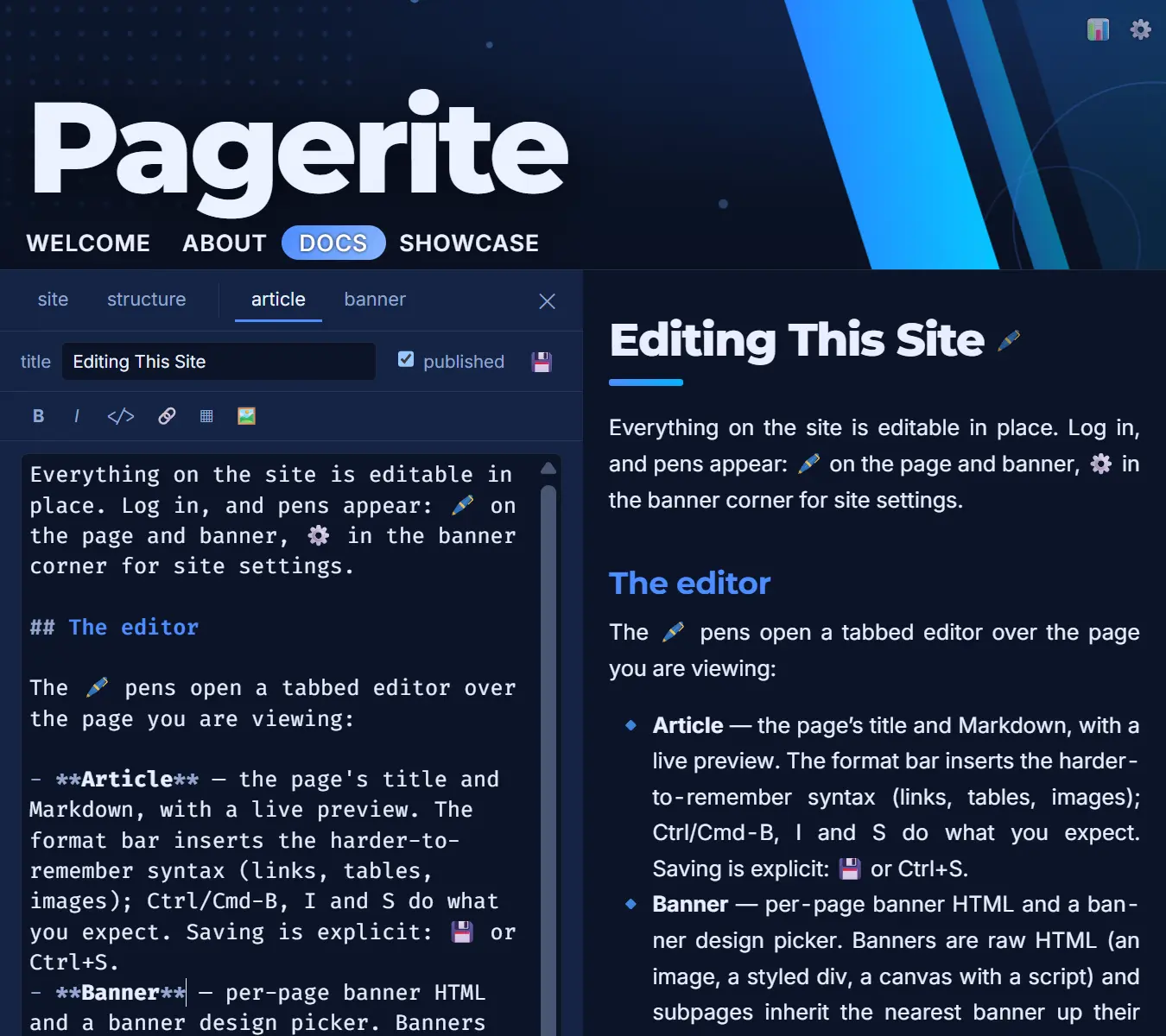
Theme just every part to your liking. Themes, banner designs and page transitions are included — pick one from the site editor or copy a folder and make it yours. Several high quality fonts are included among with other assets: your site never phones a third party or us for anything. And if after all you need to customize, additional site and banner code may be provided by the admin panel.
Search engines and social cards come free. Every page gets a proper description, canonical link and Open Graph/Twitter card metadata derived from the article — including a card image picked from your own figures — without a single "SEO plugin". Category index pages, if you wish to have those, also get their sub pages shown automatically in card format.
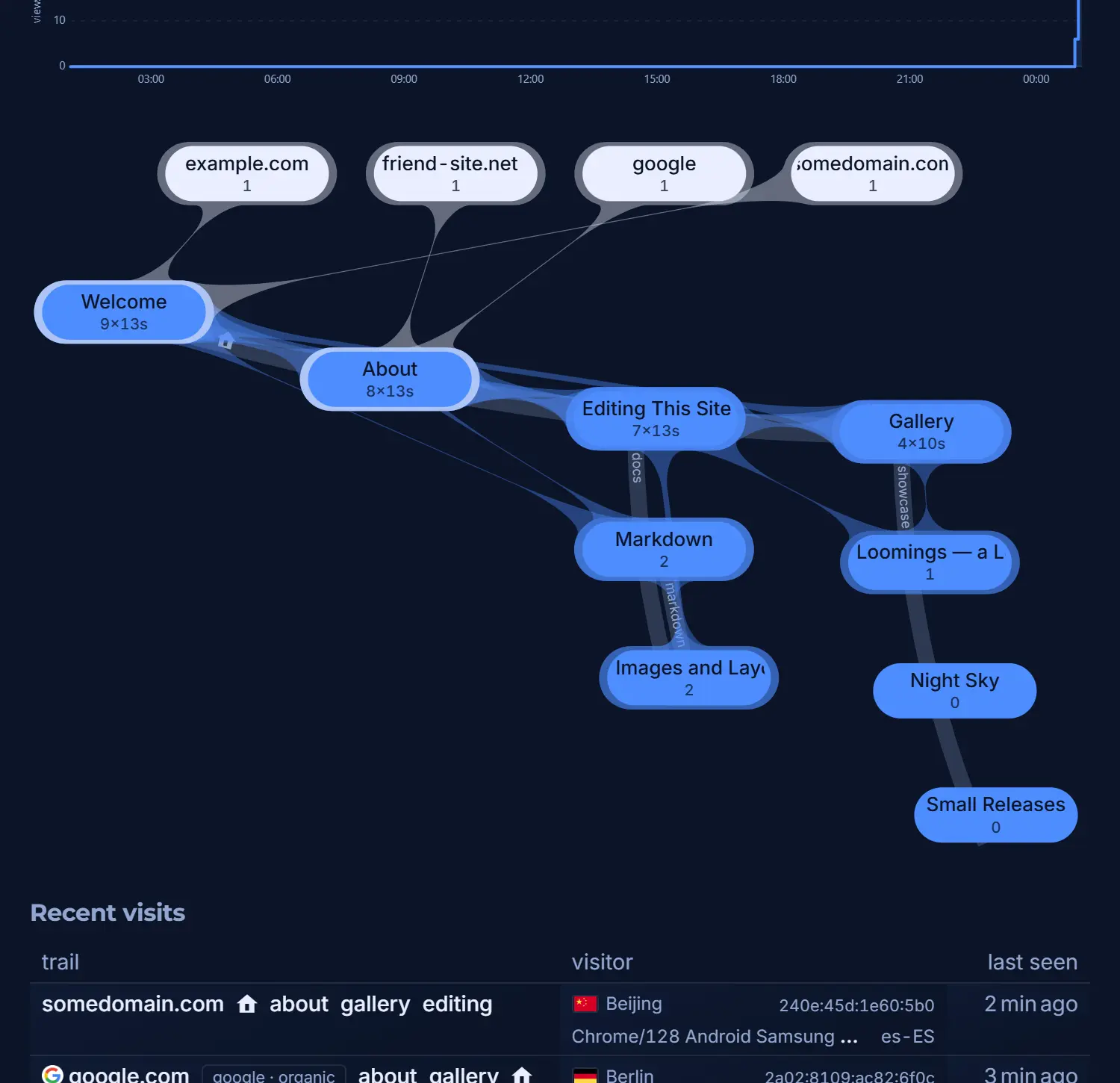 You can see your readers. Built-in analytics need no cookies and no third-party tracker: visits, referers, reading time and a live map of how people move between your pages, plus separate ledgers for crawlers and the abusers probing for wordpress PHP files — who are, of course, wasting their time here.