Compare commits
| Author | SHA1 | Date | |
|---|---|---|---|
 LeoVasanko LeoVasanko
|
e6a0c57446 | ||
|
LeoVasanko
|
d6d07db2c5 | ||
|
LeoVasanko
|
38af57218a | ||
|
LeoVasanko
|
eb2e8f8273 | ||
|
LeoVasanko
|
792b9e7aa9 | ||
|
LeoVasanko
|
4c6ab3dde6 | ||
|
LeoVasanko
|
9d70f17587 | ||
|
LeoVasanko
|
029bfe105e | ||
|
LeoVasanko
|
62031fd5dd | ||
|
LeoVasanko
|
13cf716bb1 | ||
|
LeoVasanko
|
cbd50cfece | ||
|
LeoVasanko
|
85ef968cd6 | ||
|
LeoVasanko
|
7631c9f0a3 | ||
|
LeoVasanko
|
d7d03754d1 | ||
|
LeoVasanko
|
65fec6c519 | ||
|
LeoVasanko
|
dc55445ae0 | ||
|
LeoVasanko
|
b133ad6dd6 | ||
|
LeoVasanko
|
4413c7efdf | ||
|
LeoVasanko
|
2f533eaf09 | ||
|
LeoVasanko
|
1d46843c76 | ||
|
LeoVasanko
|
d3e2196c83 | ||
|
LeoVasanko
|
b6e6e46cfb | ||
|
LeoVasanko
|
7a4544731d | ||
|
LeoVasanko
|
fd1987c9b3 | ||
|
LeoVasanko
|
85a306296f | ||
|
LeoVasanko
|
2b9c7635d3 | ||
|
LeoVasanko
|
7e8e0a2ea7 | ||
|
LeoVasanko
|
8fc5dd7b9b | ||
|
LeoVasanko
|
fbebddeaa9 | ||
|
LeoVasanko
|
31895065f8 | ||
|
LeoVasanko
|
447a565b05 | ||
|
LeoVasanko
|
399aa95d44 | ||
|
LeoVasanko
|
f793d21c5e | ||
|
LeoVasanko
|
fb3e6d1a04 | ||
|
LeoVasanko
|
fd75a260b5 | ||
|
LeoVasanko
|
6058853341 | ||
|
LeoVasanko
|
9adc48479f | ||
|
LeoVasanko
|
864492b897 | ||
|
LeoVasanko
|
515c6e1435 | ||
|
LeoVasanko
|
daa1670653 | ||
|
LeoVasanko
|
e3fbce8ece | ||
|
LeoVasanko
|
775dc3f65a | ||
|
LeoVasanko
|
d21c3edbfc | ||
|
LeoVasanko
|
794e1ba26e | ||
|
LeoVasanko
|
b8d2b9f32c | ||
|
LeoVasanko
|
ad03216e93 | ||
|
LeoVasanko
|
1d64d1e653 | ||
|
LeoVasanko
|
72e722c094 | ||
|
LeoVasanko
|
22c4f0e752 | ||
|
LeoVasanko
|
5101a5c5bf | ||
|
LeoVasanko
|
c801fdc929 | ||
|
LeoVasanko
|
8df6594432 | ||
|
LeoVasanko
|
7743639812 | ||
|
LeoVasanko
|
f659f5f6be | ||
|
LeoVasanko
|
f962d70e3b | ||
|
LeoVasanko
|
6910ccad73 | ||
|
LeoVasanko
|
2060dc815c | ||
|
LeoVasanko
|
ffa7200a6e | ||
|
LeoVasanko
|
bdac75e70a | ||
|
LeoVasanko
|
a116d78951 | ||
|
LeoVasanko
|
825379ca2a | ||
|
LeoVasanko
|
ddf323bf41 | ||
|
LeoVasanko
|
f708e1dbca | ||
|
LeoVasanko
|
1d0bc3f59d | ||
|
LeoVasanko
|
60d5155fd2 | ||
|
LeoVasanko
|
3518ac9ac7 | ||
|
LeoVasanko
|
5c2433b766 | ||
|
LeoVasanko
|
2959f971bc | ||
|
LeoVasanko
|
8ee22de060 | ||
|
LeoVasanko
|
9be1491f0e | ||
|
LeoVasanko
|
29c1dc64ed | ||
|
LeoVasanko
|
a27958117f | ||
|
LeoVasanko
|
56fd5f854d | ||
|
LeoVasanko
|
932aee4404 | ||
|
LeoVasanko
|
ca1c0d5a6f | ||
|
LeoVasanko
|
9cbc4ab59d | ||
|
LeoVasanko
|
7aa2abbf8f | ||
|
LeoVasanko
|
eddb3f22f3 | ||
|
LeoVasanko
|
1702281dbf | ||
|
LeoVasanko
|
38b894a789 | ||
|
LeoVasanko
|
06409cdaac | ||
|
LeoVasanko
|
7ba6094360 | ||
|
LeoVasanko
|
c59ab2f058 | ||
|
LeoVasanko
|
078e80591b | ||
|
LeoVasanko
|
6563eebdba | ||
|
LeoVasanko
|
cac74ebb6b | ||
|
LeoVasanko
|
8b1bb6f994 | ||
|
LeoVasanko
|
3173a113b6 | ||
|
LeoVasanko
|
a21f919601 | ||
|
LeoVasanko
|
158b5f1961 | ||
|
LeoVasanko
|
f9ce0a4f3b | ||
|
LeoVasanko
|
2d595f8c15 | ||
|
LeoVasanko
|
b1fc8e24d7 | ||
|
LeoVasanko
|
c5cf799f68 | ||
|
LeoVasanko
|
a5edc7b3b6 | ||
|
LeoVasanko
|
09ebc63690 | ||
|
LeoVasanko
|
2868843028 | ||
|
LeoVasanko
|
6fcebaea3f | ||
|
LeoVasanko
|
4a48d08a19 | ||
|
LeoVasanko
|
e3e29251ca | ||
|
LeoVasanko
|
8affc41289 | ||
|
LeoVasanko
|
2de4717230 | ||
|
LeoVasanko
|
563e8fcaf2 | ||
|
LeoVasanko
|
921a5484a2 | ||
|
LeoVasanko
|
0e2e52fa45 | ||
|
LeoVasanko
|
075848f782 | ||
|
LeoVasanko
|
7b8899af92 |
+1
-2
@@ -1,8 +1,7 @@
|
||||
.*
|
||||
!.gitignore
|
||||
*.lock
|
||||
*.kantadb
|
||||
pagerite.analytics.json
|
||||
/localhost
|
||||
dbip-*.mmdb*
|
||||
/pagerite/frontend-build
|
||||
package-lock.json
|
||||
|
||||
@@ -10,24 +10,37 @@ Please instead ask the user to see from dev tools what you need, e.g. to look up
|
||||
Pagerite is a CMS. See `docs` for the full design and implementation details. Key files for code changes:
|
||||
|
||||
- `pagerite/` — Python backend package (hatchling build target).
|
||||
- `app.py` — FastAPI app and route registration.
|
||||
- `app.py` — thin FastAPI assembly: lifespan, `FastAPI(...)`, router includes (route ordering: api/tracking/files routers, then `frontend.route(app, "/")`, then the pages catch-all last).
|
||||
- `state.py` — shared core, no routes: env-derived site constants, `data`/`kanta`, `analytics_store`, the fastapi-vue `frontend`, the render cache (`_html_response`, `_invalidate_pages`), the translator `dispatcher`, slug helpers, `@kanta.bootstrap` hooks.
|
||||
- `files.py` — `FileStore` (content-addressed, RAM-cached), image derivative helpers (`store_image`), file routes (`/_api/files`, `/_f/`, `/_themes/`, `/_fonts/`, favicon settings).
|
||||
- `api.py` — editor REST + WS: `/_api/pages`, `/_api/structure`, `/_api/settings`, `/_api/toggle-task`, `/_api/translations`, `/_api/ws/editor`, `/_translate/{key}`.
|
||||
- `tracking.py` — visit analytics: GeoIP, client enrichment, favicon fetch, `/_ws`, `/_api/ws/analytics`, the `/_a` page (docs/analytics.md).
|
||||
- `pages.py` — public content pages: `/`, `/sitemap.xml`, `/robots.txt`, the `/{path:path}` catch-all.
|
||||
- `data.py` — msgspec Structs for the kanta database.
|
||||
- `chunks.py` — block-level Markdown chunking and content-hash keys for the chunk stores (docs/migrate.md).
|
||||
- `i18n.py` — language selection, translation assembly (chunks + patches) and translated-edit recording (user patches, per-language title overrides, refresh).
|
||||
- `translate.py` — translator service protocol (msgspec structs), the connected-client `Dispatcher` (job pipeline, result validation) and pending/store core for the `/_translate/{key}` WebSocket (docs/localization.md); api.py only registers the route.
|
||||
- `segments.py` — the translation round trip: fragments split into pure-prose wire segments (via markdown.make_md's verbatim parser; link- and formatting-carrying blocks stay whole, link/formatted texts inline, Markdown stripped) and translations spliced back by source offset, link/formatting markdown re-inserted at weight-mapped positions (docs/localization.md).
|
||||
- `migrations.py` — kanta migrations (`migrate_vN`); ALL schema/storage upgrades live here (raw state dict before struct decoding), never in the app lifespan: v1 moves legacy in-db file blobs to the on-disk store and rebuilds the legacy flat `pages` as the menu tree, v2 rewrites `/_f/{hash}.ext` image links to the extension-less form, backfills AVIF/WebP/JPEG derivatives on disk and drops the obsolete `version` field.
|
||||
- `markdown.py` — markdown-it-py renderer.
|
||||
- `views.py` — shared page layout and rendering.
|
||||
- `views.py` — shared page layout and rendering; theme/user-font resolution across `THEME_DIRS` / `FONT_DIRS` (cwd, site, platform data roots, then built-in `pagerite/themes/`, see `docs/themes-and-assets.md`).
|
||||
- `seed.py` — demo content, written only on first database creation.
|
||||
- `analytics.py` — visit analytics collection (see `docs/analytics.md`).
|
||||
- `frontend/src/` — Vue editor and public-page JS entries.
|
||||
- `main.js` — Vue editor app entry.
|
||||
- `analytics-main.js` — analytics page entry (mounts `AnalyticsView` at `/_a`).
|
||||
- `pagerite.js` — public page entry.
|
||||
- `editorLang.js` + `LangSelect.vue` — the editor shell's shared language selection and its selector component (page + structure tabs; drives the page preview while the panel is open, via `swapdoc.setLangOverride`).
|
||||
- `reconnect.js` — shared WebSocket pacing for all sockets (staggered connect slots, stuck-CONNECTING watchdog, exponential backoff): bursts and rapid retries trip the browser's WebSocket throttling.
|
||||
- `assets/` — base CSS, Pygments styles, fonts.
|
||||
- `scripts/devserver.py` — dev server with auto reload (the user mostly uses this; avoid running the server yourself, ask the user to test).
|
||||
- `scripts/translator.py` — Seed-X translator service client for the `/_translate/{key}` socket (reference client, runs in its own uv env via PEP 723); stays connected full time, unloads the model after 60 s idle and reloads on the next job.
|
||||
|
||||
Server run by CLI entry point `uv run pagerite` (no auto reloads, build needed). Dev mode is `scripts/devserver.py` (auto reloads, no build needed).
|
||||
|
||||
## Toolchain
|
||||
|
||||
- Python >= 3.14, managed with **uv**. Dependencies: `fastapi[standard]`, `fastapi-vue`, `html5tagger`, `kanta`, `markdown-it-py`, `mdit-py-plugins`, `pygments`, `tracerite`; dev group has `httpx`. Run anything via `uv run ...` (the venv is `.venv`).
|
||||
- Python >= 3.14, managed with **uv**. Dependencies: `fastapi[standard]`, `fastapi-vue`, `html5tagger`, `kanta`, `markdown-it-py`, `mdit-py-plugins`, `platformdirs`, `pygments`, `tracerite`; dev group has `httpx`. Run anything via `uv run ...` (the venv is `.venv`).
|
||||
- Key libraries:
|
||||
- **html5tagger** — all HTML generation (`E`, `Document`, `Template`, `HTML` for trusted/raw HTML).
|
||||
- To create stand alone pages, begin with `doc = Document(...)` that gives a HTML5 page header
|
||||
@@ -45,11 +58,12 @@ Server run by CLI entry point `uv run pagerite` (no auto reloads, build needed).
|
||||
- Maintaining and owning the app's own `Data` object is preferable; Kanta never copies this, only edits in place
|
||||
- Note: besides opening it every access is immediate direct variable access: no `await`, no locks, no delays
|
||||
- **fastapi-vue** — template glue for serving/building the Vue frontend; keep its integration points (`Frontend`, build hook) intact.
|
||||
- **markdown-it-py** — Markdown rendering with `html=True` raw passthrough; mdit-py-plugins for footnote/deflist/tasklists/attrs; **Pygments** for server-side code highlighting (`nowrap` spans, styled by `frontend/src/assets/pygments.css` which maps token classes 1:1 onto the `--code-*` variables; light/dark palette sets live in `pagerite.css` and resolve via `light-dark()` from the theme's `color-scheme` — themes pick a set, not individual colors).
|
||||
- **platformdirs** — platform user/system data dirs for the theme and font search roots (`views.THEME_DIRS` / `views.FONT_DIRS`; use `site_data_dir(..., multipath=True)`, not `site_data_path`, which collapses multipath).
|
||||
- **markdown-it-py** — Markdown rendering with `html=True` raw passthrough; mdit-py-plugins for footnote/deflist/tasklists/attrs; in-body h1/h2 headings get auto slug ids + self-links when the body has 3+ of them (`python-slugify`, mirroring `slugify.js`); **Pygments** for server-side code highlighting (`nowrap` spans, styled by `frontend/src/assets/pygments.css` which maps token classes 1:1 onto the `--code-*` variables; light/dark palette sets live in `pagerite.css` and resolve via `light-dark()` from the theme's `color-scheme` — themes pick a set, not individual colors).
|
||||
|
||||
## Conventions
|
||||
|
||||
- Keep dependencies minimal; add via `uv add` and mention it.
|
||||
- The public URL space belongs to content (pretty slugs at root). Reserve only `/_` for the machinery (`/_api/`, `/_f/`, `/_assets/`), plus `/favicon.ico` from the build. Slugs are lowercase ASCII letters, digits, hyphens and underscores `[a-z0-9_-]` (the site editor filters input live via `slugify.js`, built on the `transliteration` npm package — unicode folds to ASCII, spaces become hyphens; an empty slug on a new page is derived from its title), may not begin with `_` or `.`, and such URLs are never looked up as content.
|
||||
- No auth in core code; the SSO/reverse proxy gates all of `/_api` (forward-auth) and owns `/auth/` (login/logout, session validation). Pages render identically for everyone; pagerite.js adds the editing UI only after the auth server validates the session.
|
||||
- No auth in core code; the SSO/reverse proxy gates all of `/_api` (forward-auth) and owns `/auth/` (login/logout, session validation). Pages render identically for everyone; pagerite.js adds the editing UI only after the auth server validates the session. The one keyed exception is `/_translate/{key}` (translator service; `Data.translate_keys`, see docs/localization.md).
|
||||
- Update the relevant MarkDown files when architecture, tooling, or conventions change.
|
||||
|
||||
@@ -1,3 +1,34 @@
|
||||

|
||||
|
||||
# Pagerite
|
||||
|
||||
A single-user CMS/blog. FastAPI serves HTML rendered in Python with html5tagger, content is persisted in a kanta database and rendered on the fly per request. Vue is used only for the interactive editing tools, not for the public pages.
|
||||
A CMS for people who are done patching WordPress. There's no PHP or Node.js to exploit — the whole editing surface sits behind your own SSO proxy, so the server the internet can talk to just renders plain pages that search engines and social media can read too.
|
||||
|
||||
The articles have rich layout and don't look boxed in like with most web publishing platforms. The software is lightweight and fast enough to serve any number of visitors you have. We run our own site [vasanko.com](https://vasanko.com/) on it, in case you wish to have a quick look.
|
||||
|
||||
## Run it
|
||||
|
||||
```sh
|
||||
uvx pagerite localhost
|
||||
```
|
||||
|
||||
That serves a demo site on localhost using [uv](https://docs.astral.sh/uv/getting-started/installation/). When you take it to production, pass your domain name instead. Our [setup guide](https://git.zi.fi/LeoVasanko/pagerite/src/branch/main/docs/setup.md) walks through the whole production arrangement. **Read it before running this online.**
|
||||
|
||||
## What it's like
|
||||
|
||||
**You write, Pagerite renders.** Articles are Markdown with the extensions that matter — tables, footnotes, task lists, callouts, highlighted code, aside boxes — and raw HTML goes through untouched when Markdown runs out. Long articles reflow into a proper two-column composition on wide screens without you doing anything.
|
||||
|
||||
**Editing happens on the page.** Click the pen next to a heading and an editor docks beside the live article, previewing server-side as you type. Site name, theme, fonts, banner, custom CSS — changed in a panel, applied immediately. New pages grow from a ➕ in the structure tree; drag or rename rows to reorder your whole navigational hierarchy. Entirely custom or premade top banner designs per category or page are available, animations included.
|
||||
|
||||
Full scripting and styling is available for editors who wish to implement more complex functionality on their articles. This also means you should only let trusted users write on your site: this is by no means a public blog platform.
|
||||
|
||||
The worst case scenario when a hacker gains access to your admin accounts (say if you didn't read the setup guide): they can take over the entire site and run scripts on users' browsers, but the damage is limited to same domain. All your articles can be restored to the state prior to that hack or that one user's edits undone, and no data is irrecoverably lost. This is much better than other platforms that also let hackers run code on your server (WordPress).
|
||||
|
||||

|
||||
|
||||
**Theme just every part to your liking.** Themes, banner designs and page transitions are included — pick one from the site editor or copy a folder and make it yours. Several high quality fonts are included among with other assets: your site never phones a third party or us for anything. And if after all you need to customize, additional site and banner code may be provided by the admin panel.
|
||||
|
||||
**Search engines and social cards come free.** Every page gets a proper description, canonical link and Open Graph/Twitter card metadata derived from the article — including a share image picked from your own figures — without a single "SEO plugin". Category index pages, if you wish to have those, also get their sub pages shown automatically in card format.
|
||||
|
||||
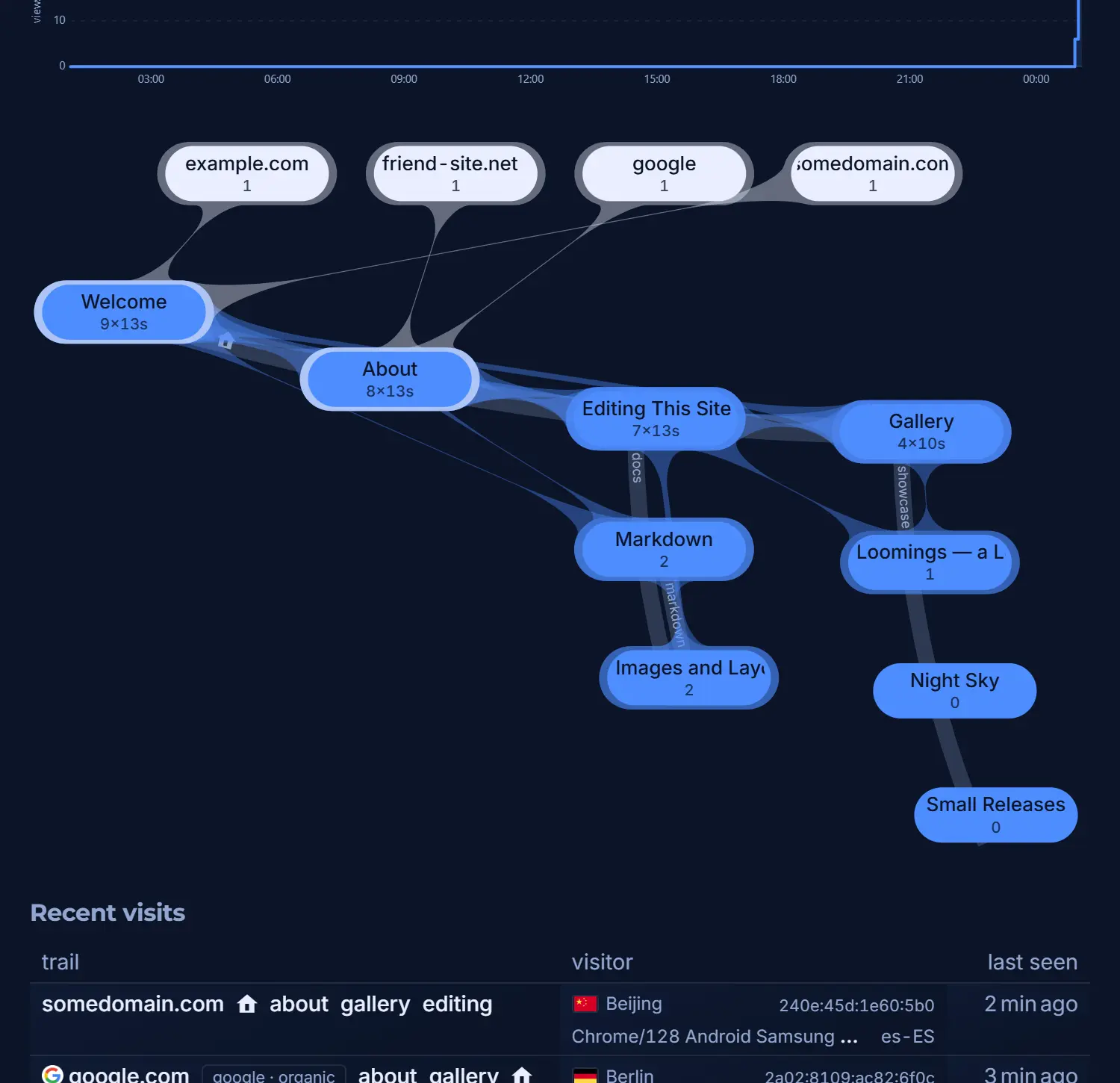
|
||||
_You can see your readers. Built-in analytics need no cookies and no third-party tracker: visits, referers, reading time and a live map of how people move between your pages, plus separate ledgers for crawlers and the abusers probing for wordpress PHP files — who are, of course, wasting their time here._
|
||||
|
||||
+282
-160
@@ -1,129 +1,59 @@
|
||||
# Analytics
|
||||
|
||||
Server-side visit analytics. Data lives in a plain JSON file — a msgspec
|
||||
Struct dumped to disk — separate from the kanta content database, path from
|
||||
`PAGERITE_ANALYTICS` (default: the database path with `.kantadb` replaced by
|
||||
`.analytics.json`, e.g. `pagerite.analytics.json`).
|
||||
Server-side visit analytics built on a **raw access-log-style event store**.
|
||||
Data lives in a plain JSON file — a msgspec Struct dumped to disk — separate
|
||||
from the kanta content database, path from `PAGERITE_ANALYTICS` (default:
|
||||
`analytics.json` in the per-site data directory, e.g. `localhost/analytics.json`).
|
||||
|
||||
- `pagerite/analytics.py` — data model (`Analytics`, `Client`, `Visit`,
|
||||
`CrawlerHit`, `AbuseHit`) and the `Store` (in-memory data + session map,
|
||||
atomic JSON persistence).
|
||||
- `pagerite/app.py` — entry-referer stashing in `show_page` (`_track_entry`),
|
||||
the `POST /_a` ping endpoint, and `WebSocket /_api/ws/analytics`
|
||||
(admin-gated like every `/_api` endpoint).
|
||||
- `frontend/src/pagerite.js` — client navigation pings and the 📊 pen.
|
||||
- `pagerite/analytics.py` — data model (`Analytics`, `Get`, `Msg`, `Client`,
|
||||
`Favicon`), the `Store` (raw log + atomic JSON persistence) and
|
||||
`Store.display()`, where **all** classification happens.
|
||||
- `pagerite/pages.py` — records every served document as one raw GET line
|
||||
(`_record_get`, in `pagerite/tracking.py`) with its true HTTP status.
|
||||
- `pagerite/tracking.py` — the `/_ws` activity WebSocket, and
|
||||
`WebSocket /_api/ws/analytics` (admin-gated like every `/_api` endpoint).
|
||||
- `frontend/src/pagerite.js` — the client activity channel and the 📊 pen.
|
||||
- `frontend/src/AnalyticsView.vue` — viewer component rendered inside the
|
||||
normal site layout on the `/_a` analytics page.
|
||||
- `frontend/src/analytics-main.js` — page entry that mounts `AnalyticsView`
|
||||
into `#analytics-app` inside `#main`.
|
||||
|
||||
## What is collected
|
||||
## Raw records
|
||||
|
||||
The client (`pagerite.js`) POSTs fire-and-forget pings to `/_a` with
|
||||
`{fr, to}` (`fr` = source path):
|
||||
The store is deliberately close to an access log: two append-only lists plus
|
||||
shared metadata. **Nothing is classified when recorded** — whether a client
|
||||
turns out to be a reader, a crawler or a scanner is decided by
|
||||
`Store.display()` from the raw events, so the stored data survives any future
|
||||
change to the classification rules.
|
||||
|
||||
- **Initial page load**: `to` is the loaded path. This ping is what starts
|
||||
the visit and counts the entry page view — the document GET alone records
|
||||
nothing, so bots and admin browsing never register. JS-running crawlers
|
||||
(Googlebot, GoogleOther, Applebot, ...) do ping, but their User-Agent
|
||||
gives them away: pings whose UA matches `_is_bot_ua` (anything calling
|
||||
itself a "bot", plus known exceptions such as GoogleOther) are ignored
|
||||
server-side, and their document GETs land in the crawler list instead.
|
||||
No source-IP verification is done: a spoofed bot UA merely lands in the
|
||||
crawler stats, and scanners that probe telltale paths are caught by the
|
||||
abuse rules regardless. Reloads are not
|
||||
visits: the ping is skipped (PerformanceNavigationTiming `reload`), so a
|
||||
refresh neither counts a second view nor logs a self-transition. The GET
|
||||
handler stashes a cross-origin https `Referer` (origin part only) and any
|
||||
`utm_*` query parameters in in-memory IP tables, consumed by the ping that
|
||||
starts the visit; internal or absent referers never touch the referer table.
|
||||
- **Internal fetch-navigations**: `to` is the target path, sent only after
|
||||
the swap actually happened (a failed swap falls back to a full load,
|
||||
whose initial ping counts the view instead — no gap, no double count).
|
||||
- **External links** (`https` only): `to` is the link's full URL. This is the
|
||||
exit-link record; the user may continue navigating afterwards (new tab,
|
||||
back), so the exit URL is not necessarily the last trail entry. Outbound
|
||||
links are stored by full URL so several links to the same domain remain
|
||||
distinct.
|
||||
- **Excluded**: back/forward (popstate) navigations, navigation involving
|
||||
the analytics page itself (`/_a`), and everything while the user has the
|
||||
editor open (`body.editing`). Admin noise, not visits.
|
||||
- **Admins**: when SSO is in use and the session is known to be an admin,
|
||||
the client still pings but adds `hide=1`. The server then records
|
||||
nothing — and if the same client session already had a visit from before
|
||||
logging in, that visit is removed from the JSON along with the counts
|
||||
recorded when it was created (site visit, entry view, entry transition).
|
||||
Views/transitions logged by later pings inside such a visit lack
|
||||
per-event timestamps and are left as-is. With no auth proxy (dev/test)
|
||||
"admin" is everyone's state, so `hide` stays 0 and everything is recorded.
|
||||
- The server validates `to`: internal paths must be valid slug paths
|
||||
("/" or `[a-z0-9_-]` segments), external ones are re-derived to the
|
||||
https origin and accepted only when the client sent exactly that.
|
||||
- **Client records**: the visitor's IP (IPv4 or IPv6 /64 network), raw
|
||||
`User-Agent` and extracted `Accept-Language` tag are hashed with blake3;
|
||||
the first 6 bytes identify a shared `Client` record. The `Client` stores
|
||||
the full IP, `User-Agent`, compact `ua_pretty`, `lang`, initial
|
||||
`country` from the language-region subtag, and asynchronously-filled
|
||||
`country`/`city` from DB-IP geoip plus reverse-DNS `host`. Visits,
|
||||
crawler hits and abuse hits all reference this record by its hash, so
|
||||
client metadata is stored once instead of repeated per event.
|
||||
- The visitor IP is stored in the `Client`. A reverse-DNS lookup is
|
||||
attempted for each new client and the result, when available, is stored as
|
||||
`host`; local/reserved/multicast addresses are skipped. If a DB-IP MMDB
|
||||
file (`dbip-*.mmdb` or `dbip-*.mmdb.gz`) is present in the repository
|
||||
root, it is loaded at startup and used to look up `country`/`city`. These
|
||||
lookups run in background tasks after the event is stored, so the `/_a`
|
||||
response is never delayed. The decompressed `dbip-*.mmdb` file is kept in
|
||||
the repository root and ignored by git. The CLI flag `--dbip`
|
||||
(`uv run pagerite --dbip`) downloads the latest
|
||||
`dbip-city-lite-YYYY-MM.mmdb.gz` from DB-IP before the server starts,
|
||||
skipping the download when the local database is already current and
|
||||
removing older versions after an update; without the flag only an existing
|
||||
file is used.
|
||||
- **Crawler hits**: every document GET is queued in RAM as a pending crawler
|
||||
hit — except idle-time link preloads from pagerite.js, which carry an
|
||||
`x-pagerite-preload` header and are not tracked at all (the ping sent when
|
||||
the user actually navigates to a preloaded page does the counting; forging
|
||||
the header only hides a GET from the crawler stats, the path-based abuse
|
||||
classification is unaffected). If a ping
|
||||
from the same client arrives within 10 seconds the hit is discarded;
|
||||
otherwise it is written to `crawlers`. Crawlers do not count as
|
||||
visits or views. The `Accept-Language` header is stored on the shared
|
||||
`Client` immediately; reverse-DNS host names and DB-IP geoip
|
||||
country/city are filled in asynchronously, just like for real visits. In
|
||||
the analytics viewer, crawler hits are grouped by client hash and shown as
|
||||
a trail of internal pages that crawler visited; the crawler table lists
|
||||
the most active crawlers first rather than the most recent hits.
|
||||
- **Abuse (scanner) hits**: a 404 for a telltale path — any URL segment
|
||||
starting with a dot (`/.env`, `/.git/config`) or ending in `.php` —
|
||||
classifies the source IP as abuse immediately, and ten plain 404s from one
|
||||
IP do too. Classification reclassifies history: all earlier crawler hits
|
||||
from that IP (persisted and pending) move to the `abuse` list, so a
|
||||
random-UA scanner no longer pollutes the crawler stats of the legitimate
|
||||
bot it impersonates. Once classified, every document GET and 404 from the
|
||||
IP is recorded as an abuse hit with the full request path (query string
|
||||
included), and its pings are ignored. The classified IP set (`abuse_ips`)
|
||||
is persisted in the JSON file; the plain-404 counters are RAM-only. In the
|
||||
viewer, abuse hits are grouped by IP (never by client/UA — scanners
|
||||
randomize theirs) in a separate "Abuse" table. Identical paths are
|
||||
collapsed into one entry with their hit count; flagged paths that
|
||||
triggered classification are lifted to the top, followed by other 404s and
|
||||
then document GETs from the abuser. Raw User-Agent strings are shown one
|
||||
per line with their occurrence counts, and the full lists are click-to-copy.
|
||||
Each `Get` record (one per served document):
|
||||
|
||||
## Visits and sessions
|
||||
- `t` — timestamp of the request,
|
||||
- `path` — full request path, query string included (e.g. `/.env?x=1`),
|
||||
- `status` — the true HTTP status of the response (200, or 404 for a category
|
||||
placeholder or a missing page),
|
||||
- `ref` — external https origin of the `Referer`, `""` for direct/internal
|
||||
(same-origin referers are dropped by the recorder),
|
||||
- `pre` — true for idle-time link preloads from pagerite.js
|
||||
(`x-pagerite-preload` header): never counted as a view, crawler hit or
|
||||
abuse — recorded only so a navigation later served from the in-memory page
|
||||
cache (which issues no GET at all) can be attributed this GET's status,
|
||||
- `client` — 6-byte blake3 hash referencing `Analytics.clients`.
|
||||
|
||||
There are no cookies. A visit is tied together by a client hash — the first
|
||||
6 bytes of a blake3 digest over the prettified IP (IPv4 unchanged, IPv6
|
||||
/64 network), the raw `User-Agent` string and the extracted
|
||||
`Accept-Language` tag. The first ping from a client hash starts a new
|
||||
visit; subsequent pings extend it. Pings arriving with no known session
|
||||
(server restart) start a fresh visit from the first ping — treated as
|
||||
missing data rather than dropped. The client-hash → visit map and the IP →
|
||||
entry-referer/UTM tables are in-memory only; client metadata is stored in
|
||||
`Analytics.clients` keyed by the client hash.
|
||||
304 revalidation responses return before recording and are not logged.
|
||||
|
||||
Each `Client` record:
|
||||
Each `Msg` record (one per pagerite.js activity message over `/_ws`):
|
||||
|
||||
- `t` — timestamp,
|
||||
- `client` — 6-byte blake3 hash referencing `Analytics.clients`,
|
||||
- `fr` — path of the page the activity happened on (`""` for the initial
|
||||
load),
|
||||
- `to` — navigation target (validated at record time: internal slug path or
|
||||
external https URL; anything else is dropped — sanitation, not
|
||||
classification),
|
||||
- `read` — active seconds spent on `fr` since the previous report.
|
||||
|
||||
Each `Client` record (shared by every event, keyed by hash):
|
||||
|
||||
- `ip` — visitor IP address (first `X-Forwarded-For` hop, or direct peer),
|
||||
- `host` — reverse-DNS host name for `ip` when resolvable, else `""`,
|
||||
@@ -134,51 +64,214 @@ Each `Client` record:
|
||||
- `city` — city name from the DB-IP MMDB lookup, when available,
|
||||
- `ua` — raw `User-Agent` string,
|
||||
- `ua_pretty` — compact display form of the UA (browser/OS/device) when
|
||||
parsable, otherwise the raw string.
|
||||
parsable, otherwise the raw string,
|
||||
- `hide` — true for admin clients (`hide` message field): everything this
|
||||
client ever did is recorded but excluded from every statistic and from the
|
||||
viewer payload. This is the one flag set at record time — it is a client
|
||||
property, not a classification.
|
||||
|
||||
Each `Visit` record:
|
||||
A reverse-DNS lookup is attempted for each new client and the result, when
|
||||
available, is stored as `host`; local/reserved/multicast addresses are
|
||||
skipped. If a DB-IP MMDB file (`dbip-*.mmdb` or `dbip-*.mmdb.gz`) is present
|
||||
in the repository root, it is loaded at startup and used to look up
|
||||
`country`/`city`. These lookups run in background tasks after the event is
|
||||
stored, so WebSocket message handling is never delayed. The decompressed
|
||||
`dbip-*.mmdb` file is kept in the repository root and ignored by git. The
|
||||
CLI flag `--dbip` (`uv run pagerite --dbip`) downloads the latest
|
||||
`dbip-city-lite-YYYY-MM.mmdb.gz` from DB-IP at startup (in the app lifespan,
|
||||
before the MMDB is opened), skipping the download when the local database is
|
||||
already current and removing older versions after an update; without the flag
|
||||
only an existing file is used.
|
||||
|
||||
- `start` — timestamp of the first event,
|
||||
## What the client sends
|
||||
|
||||
The client (`pagerite.js`) keeps a WebSocket connection to `/_ws` for the
|
||||
whole browsing session and sends activity messages over it — JSON text
|
||||
frames matching the server's `Ping` msgspec struct with the fields `fr`
|
||||
(source path), `to` (navigation target), `read` (active seconds on `fr`
|
||||
since the last report) and `hide`; falsy fields are omitted. One channel
|
||||
follows the session, so the activity of a visit stays tied together, and
|
||||
while the user is active the accumulated reading time is flushed every few
|
||||
seconds: the times are incremental, so a disconnection simply leaves the
|
||||
last reported time in place (no close beacon). After 5 minutes without
|
||||
any activity the client closes the socket itself — a sleeping browser tab
|
||||
would lose it anyway — and the next activity reconnects; reconnects are
|
||||
attempted only on user activity, with an exponential backoff between
|
||||
attempts so a failing endpoint is never hammered. Idle-time link preloads
|
||||
stay plain `fetch()` calls so the browser may cache the responses; the
|
||||
WebSocket reports actual navigations and active time spent on a page.
|
||||
|
||||
- **Initial page load**: only `to` — the loaded path — is sent, never `fr`
|
||||
(an `fr` equal to `to` would log a bogus self-transition when a session
|
||||
already exists, e.g. a second tab). Reloads are not
|
||||
visits: the message is skipped (PerformanceNavigationTiming `reload`), so a
|
||||
refresh neither counts a second view nor logs a self-transition.
|
||||
- **Internal fetch-navigations**: `to` is the target path, sent only after
|
||||
the swap actually happened (a failed swap falls back to a full load,
|
||||
whose initial message counts the view instead — no gap, no double count).
|
||||
- **External links** (`https` only): `to` is the link's full URL. This is the
|
||||
exit-link record; the user may continue navigating afterwards (new tab,
|
||||
back), so the exit URL is not necessarily the last trail entry. Outbound
|
||||
links are stored by full URL so several links to the same domain remain
|
||||
distinct.
|
||||
- **Excluded**: back/forward (popstate) navigations, navigating *to* the
|
||||
analytics page (`/_a` — its GET is untracked, and the server cannot
|
||||
record it as a navigation target anyway), and everything while the user has
|
||||
the editor open (`body.editing`). Admin noise, not visits. Navigating
|
||||
*away* from `/_a` does report.
|
||||
- **Admins**: when SSO is in use and the session is known to be an admin,
|
||||
the client still reports but adds `hide`. The activity is recorded as
|
||||
usual (navigations and all), but the `hide` flag is set on the **client
|
||||
record** — so it covers everything that client ever did, including the
|
||||
time before the login. Hidden clients never appear in the viewer payload:
|
||||
`Store.display()` drops their events and metadata, and computes every
|
||||
aggregate (site visits, page views, transitions) from the visible visits
|
||||
only, so nothing needs to be reversed or redacted. With no auth proxy
|
||||
(dev/test) "admin" is everyone's state, so `hide` stays 0 and everything
|
||||
is recorded.
|
||||
- **External-site favicons**: for every external https origin seen as a GET
|
||||
referer or an exit link, the server fetches `{origin}/favicon.ico` in a
|
||||
background task (httpx, 8 s timeout, ≤ 64 KB, image content-types only —
|
||||
SVG is sniffed from the body when served without an image type) and stores
|
||||
the icon content-hashed on disk in the FileStore (served at `/_f/{name}`,
|
||||
extension matching the actual MIME). The origin → file name mapping is
|
||||
recorded in `Analytics.favicons` (`Favicon.file`/`fetched`); misses are
|
||||
recorded too and retried only after 7 days. Fetches are scheduled after
|
||||
each activity message and once at startup, which backfills icons for
|
||||
already-recorded data. The viewer payload carries `favicons` (origin →
|
||||
`/_f/...` path), and the viewer shows the icon wherever an external site
|
||||
is mentioned: referer/exit trail links in the visit table and the
|
||||
source/exit pills of the transition map (UTM-attributed source nodes
|
||||
without an https origin stay text-only).
|
||||
|
||||
## Display-time classification
|
||||
|
||||
`Store.display(in_menu)` derives the viewer payload from the raw events on
|
||||
every (debounced) broadcast — O(n log n) over the log, cheap enough for a
|
||||
small CMS. `in_menu(path)` resolves a path against the current menu (passed
|
||||
in from `tracking.py`, which owns the content database import) so 404
|
||||
responses for real menu nodes — category placeholders — are not mistaken
|
||||
for misses.
|
||||
|
||||
- **Visits and sessions**: a client's messages are grouped into visits
|
||||
chronologically; a new visit starts after 30 minutes of inactivity
|
||||
(`_SESSION_GAP`). A fresh page load with an already-open visit (second
|
||||
tab) extends it, logging a `(direct)` transition. The visit's trail holds
|
||||
first-seen targets in order; `read` updates accumulate active seconds on
|
||||
the trail item matching `fr`. Each trail item's HTTP status comes from
|
||||
the client's latest GET for that path — preloads included, which is what
|
||||
allows 404 pages to render red in the viewer even when the navigation
|
||||
itself was served from the page cache. The entry page's referer and
|
||||
`utm_*` tags come from the GET that loaded it (within 10 s before the
|
||||
first message).
|
||||
- **Crawler hits**: a document GET no activity message matched within
|
||||
`_CRAWLER_TIMEOUT` (10 s) is a crawler hit — plain bots that only fetch
|
||||
documents never register as visits. JS-running crawlers (Googlebot,
|
||||
GoogleOther, Applebot, ...) do connect and send messages, but their UA
|
||||
gives them away (`_is_bot_ua`): their messages are ignored at display
|
||||
time, so their GETs never match and land in the crawler list too. Real-
|
||||
browser bots whose UA does not match are caught by engagement: a visit
|
||||
whose total reported reading time is under 5 seconds (`_MIN_VISIT_READ`;
|
||||
durations are client-provided and trusted — such bots report 0–2 s) is
|
||||
reclassified as crawler hits, one per internal trail page, and counts in
|
||||
no visit aggregate. No source-IP verification is done: a spoofed bot UA
|
||||
merely lands in the crawler stats, and scanners that probe telltale paths
|
||||
are caught by the abuse rules regardless. In the viewer, crawler hits are
|
||||
grouped by client hash and shown as a trail of pages, preceded by the
|
||||
referer when there is one (rendered with its favicon like visit
|
||||
referers). The crawler table lists the most recent crawler first, with
|
||||
the most active as a tie-breaker.
|
||||
- **Abuse (scanner) hits**: a 404 on a telltale path — an empty URL segment
|
||||
(`//foo` — no real client generates those), any segment starting with a
|
||||
dot (`/.env`, `/.git/config`) or ending in `.php` — classifies the source
|
||||
IP as abuse, and ten plain 404s within one hour (`_ABUSE_404_WINDOW`) on
|
||||
paths that don't resolve to a menu node do too. Two exemptions keep
|
||||
legitimate traffic out: RFC 8615 well-known URIs (`/.well-known/…` —
|
||||
browsers and services probe them, e.g. Chrome's devtools fetch of
|
||||
`appspecific/com.chrome.devtools.json`) are never telltale and never
|
||||
count toward the threshold, and category placeholders return 404 but are
|
||||
real menu nodes, so they never count either. The window keeps a
|
||||
long-time reader's slowly accumulating misses from ever crossing the
|
||||
threshold — scanners spray in bursts. Hidden (admin) clients never
|
||||
trigger classification: editing means visiting not-found pages, since
|
||||
that is where the create pen lives. Once an IP is classified, **all** its document GETs are shown in the abuse list —
|
||||
including any that arrived before classification, since the raw log keeps
|
||||
everything — and its activity messages are ignored. In the viewer, abuse
|
||||
hits are grouped by IP (never by client/UA — scanners randomize theirs)
|
||||
in a separate "Abuse" table, split by the recorded status: the 404 probes
|
||||
("paths abused" — flagged paths that triggered classification first, then
|
||||
other 404s, shown verbatim with query strings) versus the real articles
|
||||
the abuser actually read ("articles read" — the 200 document GETs,
|
||||
rendered as trail links like the visitor and crawler tables, query string
|
||||
stripped). Raw User-Agent strings are shown one per line with their
|
||||
occurrence counts, and the full lists are click-to-copy.
|
||||
|
||||
In the visitor and crawler tables, internal paths that returned a 404 status
|
||||
are shown in red and the link title includes the status code, so it is easy
|
||||
to tell misses from real pages at a glance.
|
||||
|
||||
## Derived shapes (the viewer payload)
|
||||
|
||||
The `Display` payload contains the derived `visits`, `crawlers` and `abuse`
|
||||
rows (structs `Visit`/`Nav`/`TrailItem`, `CrawlerHit`, `AbuseHit` — display
|
||||
DTOs only, never persisted), the visible `clients`, the fetched `favicons`,
|
||||
and the aggregates below.
|
||||
|
||||
Each derived `Visit`:
|
||||
|
||||
- `start` — timestamp of the first activity,
|
||||
- `entry` — first page (path) seen,
|
||||
- `referer` — external https origin of the initial load, `""` for direct,
|
||||
- `referer` — external https origin of the entry GET, `""` for direct,
|
||||
- `client` — 6-byte blake3 hash referencing `Analytics.clients`,
|
||||
- `trail` — everything seen afterwards in first-seen order: page paths and
|
||||
external exit URLs. Re-visiting an already seen page (incl. the entry)
|
||||
does not append.
|
||||
- `trail` — the entry page and everything seen afterwards, keyed by the
|
||||
timestamp of first sight (insertion order = first-seen order). Each item
|
||||
holds `to` (page path or external exit URL), the accumulated active
|
||||
reading time in seconds (`read`) and the most recent HTTP status seen
|
||||
for the target (`status`),
|
||||
- `navs` — every navigation (`fr`, `to`), keyed by its timestamp, repeats
|
||||
included. The aggregates are computed from this log,
|
||||
- `utm` — `utm_*` query parameters from the landing URL, as a dict.
|
||||
- `read` — active reading time per path (seconds), keyed by path.
|
||||
|
||||
Each `CrawlerHit` record:
|
||||
Each derived `CrawlerHit`:
|
||||
|
||||
- `start` — timestamp of the document GET,
|
||||
- `entry` — page path requested,
|
||||
- `client` — 6-byte blake3 hash referencing `Analytics.clients`,
|
||||
- `referer` — external https origin of the request, `""` for direct/none,
|
||||
- `query` — raw query string of the request.
|
||||
- `query` — raw query string of the request,
|
||||
- `status` — HTTP status of the served response (200 for a real page, 404
|
||||
for a category placeholder or missing page).
|
||||
|
||||
Each `AbuseHit` record:
|
||||
Each derived `AbuseHit`:
|
||||
|
||||
- `start` — timestamp of the request,
|
||||
- `path` — full request path including the query string (e.g. `/.env?x=1`),
|
||||
- `path` — full request path including the query string,
|
||||
- `client` — 6-byte blake3 hash referencing `Analytics.clients`,
|
||||
- `flag` — true for the path that triggered abuse classification (telltale
|
||||
path or the 404 that crossed the threshold),
|
||||
- `is_404` — true for 404 responses, false for document GETs from the
|
||||
abuser.
|
||||
- `flag` — true for the paths that triggered abuse classification (telltale
|
||||
paths, or the 404 that crossed the threshold),
|
||||
- `is_404` — true for 404 responses, false for real (200) document GETs.
|
||||
|
||||
Crawler hits are grouped by client hash in the analytics viewer; abuse hits
|
||||
are grouped by IP alone (resolved from the referenced `Client`). In the
|
||||
Abuse table identical paths are collapsed with their counts; flagged paths
|
||||
that triggered classification are lifted to the top, followed by other 404s
|
||||
and then document GETs from the abuser. Within each category paths are
|
||||
sorted by count descending, then by their earliest hit.
|
||||
are grouped by IP alone (resolved from the referenced `Client`). In the
|
||||
Abuse table identical requests (same path and status class) are collapsed
|
||||
with their counts — a path's 404 probes and its later 200 reads never
|
||||
merge. Within each list paths are sorted by count descending, then by their
|
||||
earliest hit.
|
||||
|
||||
## Aggregates
|
||||
|
||||
Aggregates are **not stored**; they are computed at display time by
|
||||
`Store.display()` from the derived visits (entry + `navs` log), skipping
|
||||
hidden clients and short visits reclassified as crawler hits. This is
|
||||
what allows a client to become hidden after navigations were already
|
||||
logged: no counts need reversing. The computed shapes, part of the
|
||||
WebSocket payload (`Display` struct alongside `visits`, `crawlers`, `abuse`
|
||||
and `clients`):
|
||||
|
||||
- `transitions`: time series of page transitions, sparse nested dict
|
||||
`from -> to -> bucket -> count` with the same 5-minute bucketing as
|
||||
`views`. `from` is the referer origin or `"(direct)"` for initial loads,
|
||||
a page path for pings.
|
||||
`from -> to -> bucket -> count` with 5-minute bucketing. `from` is the
|
||||
referer origin or `"(direct)"` for initial loads, a page path for
|
||||
navigations.
|
||||
- `views`: time series of page loads, `path -> bucket -> count`, sparse: only
|
||||
non-zero 5-minute buckets exist (bucket key is its floored ISO timestamp).
|
||||
Every load counts, including repeats within a visit; external exit origins
|
||||
@@ -187,13 +280,16 @@ sorted by count descending, then by their earliest hit.
|
||||
5-minute bucketing.
|
||||
|
||||
Sparseness keeps quiet sites small; dropping old data is a matter of deleting
|
||||
list/dict entries (`visits` is a plain append-only list, buckets plain keys).
|
||||
list entries (`gets`/`msgs` are plain append-only lists).
|
||||
|
||||
## Persistence
|
||||
|
||||
The whole `Analytics` struct is JSON-encoded and written atomically
|
||||
(temp file + rename) on every recorded event. Traffic on a small CMS makes
|
||||
this cheap enough; batching can be added later without changing the format.
|
||||
A file written by the pre-redesign schema (stored `visits`/`crawlers`/`abuse`
|
||||
lists) is not convertible; it is renamed to `analytics.json.bak-legacy` and
|
||||
recording starts fresh.
|
||||
|
||||
## Viewing
|
||||
|
||||
@@ -216,12 +312,11 @@ spans less than 24 hours, otherwise `week`.
|
||||
`AnalyticsView.vue` is no longer a full-screen overlay; the `body.analytics-open`
|
||||
page-chrome hiding and `#/analytics/<range>` hash routing have been removed.
|
||||
|
||||
Charts are SVG curves (Catmull-Rom over an edge-aware adaptive Gaussian —
|
||||
a change-point detector splits the series at traffic-level shifts, then
|
||||
each segment is smoothed with a bandwidth that ramps with a broad pilot
|
||||
estimate of the local rate: isolated events stay narrow (~0.4-unit sigma,
|
||||
peaking at ~1 event/unit), busy traffic widens to a 1-unit sigma. The raw
|
||||
series is drawn faint underneath). Values are
|
||||
Charts are SVG curves (Catmull-Rom over an edge-aware Gaussian — a
|
||||
change-point detector splits the series at traffic-level shifts, then each
|
||||
segment is smoothed independently with a fixed sigma chosen so N events in
|
||||
a single bucket peak at N events per unit. The raw series is drawn faint
|
||||
underneath). Values are
|
||||
**per-unit rates** — per hour on the week view (5-minute bucket counts × 12,
|
||||
plotted at native 5-minute resolution), per day on the month+ ranges — and
|
||||
the smoothing time scale follows the unit: the month+ sigmas are 24× the
|
||||
@@ -232,31 +327,58 @@ labeled intervals, minor lines at fifths when integral; the minimum y-axis
|
||||
range is 10 so tiny values such as a single visit are not stretched to a
|
||||
fractional scale).
|
||||
The week range is aligned to Monday 00:00 UTC and overlays up to 8 previous
|
||||
weeks in the same accent color at decreasing opacity (the current week is
|
||||
weeks in the muted color at decreasing opacity (the current week keeps the
|
||||
accent color and is
|
||||
truncated at the current bucket, never drawing fake zeroes for the future);
|
||||
its x labels are weekday names centered at midday UTC, without vertical grid
|
||||
a compact legend inside the top right of the visits chart marks the current
|
||||
ISO week in accent and the overlaid past weeks as "Week M" or "Week M–N" on
|
||||
a muted specimen. Its x labels are weekday names centered at midday UTC, without
|
||||
vertical grid
|
||||
lines (day boundaries would be misleading in the viewer's timezone). The
|
||||
month view labels days the same lineless way — day numbers at noon UTC,
|
||||
with the month name substituted for the 1st. Year is a rolling 365-day window ending at now, re-bucketed to daily points,
|
||||
with boundary lines at months/years. All uses the full data reach, but keeps
|
||||
at least the past 30 days so the chart never collapses to a tiny sliver when
|
||||
the site is young. Below the charts: a radial **transition map** (all pages from
|
||||
`/_api/pages` — front page at the center, each slug level on its own ring,
|
||||
siblings clockwise in navigation order from the top, radial gap equal to
|
||||
the arc spacing — opposite transition directions joined into organic
|
||||
tapered connections whose middle width grows logarithmically with the
|
||||
count (a single count renders as a ~1 px line, uncapped), connections
|
||||
with the month name substituted for the 1st. Month, year and all are
|
||||
rolling windows ending at now, aligned to UTC day boundaries at the start
|
||||
so the labels span the whole range; the bucket size follows the window —
|
||||
6 hours up to 31 days, daily beyond — with boundary lines at months/years
|
||||
on the longer ranges. All uses the full data reach, but keeps
|
||||
at least the past 30 days (identical to the month view when the site is
|
||||
younger than that, bucket size included) so the chart never collapses to a
|
||||
tiny sliver when the site is young. Below the charts: a **transition map** (all pages from
|
||||
`/_api/pages` — top-level menu items on a large-radius circular arc whose
|
||||
bottom point is the last item (each earlier item a bit higher), connected
|
||||
by a top lane labeled 🏠︎ beside the home pill (50% thicker than
|
||||
the branch lanes, its label font and guide offset scaled along), each item's
|
||||
subtree fanning out below it in menu order along a large-radius circular
|
||||
arc that leaves heading
|
||||
straight down and gradually bends right, index pages without views omitted
|
||||
and their children promoted in their place. The submenu structure is drawn
|
||||
as wide branch lanes: one per path prefix with at least two visible
|
||||
nodes, running behind the branch's node pills as circle arcs concentric
|
||||
with the fan (parent levels one radius step outward, so all lanes of a
|
||||
group share exactly one form), each labeled with its branch slug
|
||||
left-aligned just past the first pill and allowed to run along the lane to
|
||||
its end, disappearing under later pills when long — so the lanes reflect
|
||||
the path
|
||||
structure even where index pages are omitted — opposite transition
|
||||
directions joined into organic
|
||||
tapered connections whose middle width grows logarithmically (base 2)
|
||||
with the daily hit rate (uncapped), connections
|
||||
carrying less than 1% of the total traffic
|
||||
pruned; beads are simulated one by one in JS (requestAnimationFrame) and
|
||||
flow along each edge, emitted at a rate linearly proportional
|
||||
pruned, as are those whose thin middle would render below ~0.8 px —
|
||||
fainter strands are invisible and only their wide end flares would show; beads are simulated one by one in JS (requestAnimationFrame) and
|
||||
flow along each edge, persisting across data reloads (emitters are keyed
|
||||
per edge direction and beads tracked by progress, so an unrelated count
|
||||
change never reshuffles them), emitted at a rate linearly proportional
|
||||
to the directional count with no in-flight limit, opposing directions
|
||||
offset onto parallel lanes. External sources show as a node row above the
|
||||
offset onto parallel lanes. External sources and exits whose connectors are
|
||||
all culled by the width threshold are dropped from their rows themselves
|
||||
(the site's own page nodes always stay, connected or not). External sources show as a node row above the
|
||||
map: each visit is attributed to `utm_campaign`, then `utm_source`, then the
|
||||
referer origin, then any other `utm_*` tag, so UTM-tagged visits are grouped
|
||||
under their campaign/source value rather than the referer domain. A UTM
|
||||
source node only links to its referer when every visit carrying that tag
|
||||
came from the same origin. External exits are small nodes fanned outwards
|
||||
from their source page), per-page view
|
||||
came from the same origin. External exits are full-size nodes in a matching
|
||||
row centered below the map, so the site itself stays in the middle), per-page view
|
||||
counts, the top transitions and the 50 most recent visit trails. Data is
|
||||
streamed live over `WebSocket /_api/ws/analytics`, which pushes the latest
|
||||
JSON snapshot on connect and again whenever the analytics file is updated
|
||||
|
||||
+20
-6
@@ -4,11 +4,21 @@ The Python backend lives in `pagerite/`.
|
||||
|
||||
## `app.py`
|
||||
|
||||
The FastAPI app. FastAPI's built-in API docs are disabled (`docs_url`/`redoc_url`/`openapi_url=None`) because `/docs` belongs to our content. Our own routes (content pages, `/_api/...`, `/_f/...`) are registered BEFORE `frontend.route(app, "/")` is called: fastapi-vue inserts its file routes at the position where `route()` was called (during `load()` in the lifespan), so anything defined earlier wins. The one exception is the content catch-all `/{path:path}`, registered AFTER `frontend.route()` so that built frontend assets still take priority over content slugs. The `Frontend` is constructed with `spa=False` explicitly: it only serves the built files without a catch-all.
|
||||
Thin FastAPI assembly: lifespan (open the kanta database, load the file store, the frontend build and GeoIP), the `FastAPI(...)` instance with built-in API docs disabled (`docs_url`/`redoc_url`/`openapi_url=None`) because `/docs` belongs to our content, the `server` header middleware, and router includes. The routes themselves live in specialized modules:
|
||||
|
||||
- `state.py` — shared core, no routes: the environment-derived site constants (`HOSTNAME`, `SITE_URL`, `DB_PATH`, `FILES_DIR`, image/favicon tunables), the `data` root and its `kanta` handle (`Kanta(..., migrations="pagerite.migrations")`), the `analytics_store`, the fastapi-vue `frontend`, the page render cache and `_html_response`, the translator `dispatcher`, the slug charset helpers, and the `@kanta.bootstrap` hooks (demo seed, translator defaults).
|
||||
- `files.py` — the `FileStore` and image derivative helpers, and the file routes: `/_api/files`, `/_f/`, `/_themes/`, `/_fonts/`, the favicon settings endpoints.
|
||||
- `api.py` — the editor REST API and WebSockets: `/_api/pages`, `/_api/structure`, `/_api/settings`, `/_api/toggle-task`, `/_api/translations`, `/_api/ws/editor`, and the translator channel `/_translate/{clientkey}`.
|
||||
- `tracking.py` — visit analytics: GeoIP, client enrichment, favicon fetching, debounced broadcasts, the `/_ws` activity socket, the admin stream `/_api/ws/analytics`, and the `/_a` viewer page.
|
||||
- `pages.py` — the public content pages: `/`, `/sitemap.xml`, `/robots.txt` and the `/{path:path}` catch-all.
|
||||
|
||||
Route ordering is load-bearing and lives in `app.py`: the api/tracking/files routers are included BEFORE `frontend.route(app, "/")` is called — fastapi-vue inserts its file routes at the position where `route()` was called (during `load()` in the lifespan), so anything registered earlier wins. The content catch-all `/{path:path}` is included AFTER `frontend.route()` so that built frontend assets still take priority over content slugs. The `Frontend` is constructed with `spa=False` explicitly: it only serves the built files without a catch-all.
|
||||
|
||||
The build mirrors the URL space — hashed immutable assets under `/_assets/`, `favicon.ico` at the site root — and an `index.html` in the build would become a `/` route, so leave it out of the build to keep `/` ours.
|
||||
|
||||
Generated HTML pages (content pages, category/404 placeholders, `/_a`) go through `_html_response`: zstd-compressed per request at level 9 when the client sends `accept-encoding: zstd` (no gzip fallback; static assets are pre-compressed by the `Frontend`), with `vary: accept-encoding` set and the ETag kept identical across encodings so `if-none-match` revalidation still works. In production the rendered bodies are cached in an LRU keyed by everything the output depends on — page kind, path, the site origin (social meta), encoding, and `data.version`, which bumps on every content/settings change and so transparently invalidates the whole cache. The cache is bypassed in dev, where theme/design CSS is re-read from disk per request. Content pages carry an ETag built from the node's modified timestamp and `data.version`; `/_a` instead gets a blake3 hash of the rendered body (it has no Node), with matching `if-none-match` revalidations answered by a 304.
|
||||
Generated HTML pages (content pages, category/404 placeholders, `/_a`) go through `state.py`'s `_html_response`: zstd-compressed per request at level 9 when the client sends `accept-encoding: zstd` (no gzip fallback; static assets are pre-compressed by the `Frontend`), with `vary: accept-encoding` set and the ETag kept identical across encodings so `if-none-match` revalidation still works. In production the rendered bodies are cached in an LRU keyed by everything the output depends on — page kind, path, the site origin (social meta), encoding — and cleared wholesale by `_invalidate_pages()` on every content/settings change, which also bumps the in-memory render generation. The cache is bypassed in dev, where theme/design CSS is re-read from disk per request. Content pages carry an ETag built from the node's modified timestamp and the render generation; `/_a` instead gets a blake3 hash of the rendered body (it has no Node), with matching `if-none-match` revalidations answered by a 304.
|
||||
|
||||
Uploaded files, seed assets and fetched external-site favicons live in the `FileStore` (in `files.py`): content-addressed files on disk under `<hostname>/files/` (`PAGERITE_FILES`), fully cached in RAM at startup — both the raw body and a zstd-compressed copy (kept only when smaller). `GET /_f/{name}` serves from the RAM cache with immutable caching, answering the zstd variant when the client accepts it; the name is the ETag. Uploaded raster images (and rasterized SVGs) are stored as `<hash>.orig<ext>` (internal only, never served) plus AVIF, WebP and JPEG derivatives, and pages link the extension-less `/_f/{hash}`: the server serves a format only when the Accept header lists it explicitly (`image/avif` → AVIF, `image/webp` → WebP, otherwise — including `*/*` — JPEG), with `vary: accept`; an explicit extension pins the format. `migrate_v2` rewrites old `/_f/{hash}.avif` article links to the bare form, backfills missing derivatives on disk, and drops the obsolete `version` field. Legacy databases that still carry blobs in a `files` kanta field or a flat `pages` store are migrated by `pagerite/migrations.py::migrate_v1` (kanta's `migrate_vN` mechanism, wired via `Kanta(..., migrations="pagerite.migrations")`), which rewrites the raw state before struct decoding — all schema/storage upgrades live in that module, none in the app lifespan.
|
||||
|
||||
## `data.py`
|
||||
|
||||
@@ -16,16 +26,20 @@ msgspec Structs for the kanta database. See `docs/content-model.md` for the full
|
||||
|
||||
## `markdown.py`
|
||||
|
||||
markdown-it-py renderer (html passthrough + attrs, footnote, deflist, tasklists, admon, gfm_autolink, sub/superscript plugins; typographer + breaks on). Custom image rule: relative srcs resolve against the page path; an image standing alone in its paragraph becomes a figure (captioned when titled), while inline-with-text images and raw `<img>` HTML stay plain. A `{dates}` line expands to the article's published/updated dateline (`p.dateline`, from `Node.created`/`modified`; left literal in previews of unsaved pages).
|
||||
markdown-it-py renderer (html passthrough + attrs, footnote, deflist, tasklists, admon, gfm_autolink, sub/superscript plugins; typographer + breaks on). In bodies with at least three top-level h1/h2 headings (nested ones, e.g. inside `::: aside`, never participate), each gets a slug id (`python-slugify`, mirroring the editor's `slugify.js` — unicode folds to ASCII, separators become single hyphens) unless the author set `{#id}`, and their text is wrapped in a self-link (`a.anchor`) so section links are copyable; anchored headings also carry `data-line` with their markdown source line (the page editor's section pens and piecewise scroll sync key off it); the first in-body h1 is the article title — when the markdown has no h1, `render(title=...)` injects it as `# {title}` so implicit and explicit titles take the same path — it gets no id and doesn't count toward the three, its self-link is `href=""` (scroll to top); shorter articles stay anchor-free, h3+ is never navigable, and duplicates get `-2`/`-3` suffixes. Custom image rule: relative srcs resolve against the page path; an image standing alone in its paragraph becomes a figure (captioned when titled), while inline-with-text images and raw `<img>` HTML stay plain. A `{dates}` line expands to the article's published/updated dateline (`p.dateline`, from `Node.created`/`modified`; left literal in previews of unsaved pages). Code fences take pandoc-style brace attributes on the info line (` ```{.python .wide #id key=val} ` — the first class is the language when no bare language word precedes the braces) as well as a trailing `{...}` line; both land on the `<pre>`, the `<code>` keeps only the language class.
|
||||
|
||||
`render()` returns a `Rendered(html, multicol)`: the article content segmented for the column layout (there is no wrapper div — segments and bare blocks are direct `<article>` children) — h1/h2 headings and `.wide` blocks stand bare, the runs between them become `<div class="colseg">` (margin-breakout boxes — `.margin`, `::: aside` — stay inside the segment at their anchor point; the CSS positions them out of flow into the side zone) (plus `.cols` on segments with enough text in at least two paragraphs or one long enough to split across columns, `::: nocols` opting out; in column segments, paragraphs past `BREAKABLE_TEXT` visible characters are marked `.breakable` so they may split across columns), and `multicol` flags bodies long enough to columnize (visible-text thresholds, code excluded). `views.py` puts the class on the article; pagerite.css takes it from there (at most two columns, the left-margin breakout, all viewport adaptation).
|
||||
|
||||
## `views.py`
|
||||
|
||||
The shared page layout as an html5tagger `Template` with placeholders (`Title`, `Brand`, `Banner`, `Nav`, `Sidebar`, `Main`), nav rendering straight from the `Data.menu` tree (siblings sorted by `Node.order`; nav links to content-less labels point at their first child via `first_leaf`, the first published descendant with content), and page/404 rendering.
|
||||
|
||||
Content pages get SEO/social meta (description, canonical link, Open Graph + twitter card) from heuristics over the rendered article: the description is the first paragraph's text, the share image prefers a `{.hero}`-classed image, then the first raster `<img>`, then the first SVG; the first `<video>` yields `og:video`; URLs are made absolute with the site origin (`Data.site_url` — learned from admin browsers reporting their `location.origin` via `POST /_api/site-url`, correct even behind reverse proxies; until learned, the request's own base URL is the fallback); `article:published/modified_time` come from `Node.created`/`modified`. If the markdown contains its own h1, the page title is NOT rendered as an additional h1 (it still supplies `<title>` and nav labels).
|
||||
Content pages get SEO/social meta (description, canonical link, Open Graph + twitter card) from heuristics over the rendered article: the description is the first paragraph's text, the share image prefers a `{.hero}`-classed image, then the first raster `<img>`, then the first SVG; the first `<video>` yields `og:video`; URLs are made absolute with the site origin (`SITE_URL` — `https://<hostname>` from the CLI hostname argument; on localhost the request's own base URL is the fallback); `article:published/modified_time` come from `Node.created`/`modified`. Additionally `twitter:image` pins extension-less `/_f/{hash}` share images to the `.webp` variant — X only honors WebP via twitter:image (not og:image) and its scraper cannot be trusted to negotiate via Accept. The page title is injected as `# {title}` when the markdown has no h1 of its own, so it never appears twice (it always supplies `<title>` and nav labels).
|
||||
|
||||
The navbar holds top-level items only; the current section's subitems go to a left `#sidebar` as a nested list (the section's direct children plain, deeper levels indented with article-list-style markers), which is rendered when the section offers at least two published items, or exactly one while viewing anything other than that only page — the section index, a 404, a grandchild (so those pages can reach the child), and also on that only page itself when it has published children of its own; no aside element at all on the front page, leaf pages and the sole childless page of a one-page section. Also, category labels are nodes without content — None *or* empty markdown — and their nav links point at their first child page. Dynamic regions have stable ids (`#page-banner`, `#nav`, `#sidebar`, `#main`) for fetch-navigation swaps (`#sidebar` may be absent on either side of a swap).
|
||||
The navbar holds top-level items only; the current section's subitems go to a left `#sidebar` as a nested list (the section's direct children plain, deeper levels indented with article-list-style markers), rendered only from the second level down — main-level pages list their children as cards after the content instead. Below that, the sidebar renders when the section offers at least two published items, or exactly one while viewing anything other than that only page — the section index, a 404, a grandchild (so those pages can reach the child), and also on that only page itself when it has published children of its own; no aside element at all on the front page, main-level pages, leaf pages and the sole childless page of a one-page section. Also, category labels are nodes without content — None *or* empty markdown — and their nav links point at their first child page. Dynamic regions have stable ids (`#page-banner`, `#nav`, `#sidebar`, `#main`) for fetch-navigation swaps (`#sidebar` may be absent on either side of a swap).
|
||||
|
||||
Any page with published children — a category page — lists them as a card grid (`nav.cards`) after the markdown content, as does the content-less category 404. Each card links to the child page (a content-less child to its first leaf) and shows the child's share image (the same hero → first raster → first SVG heuristics as `og:image`) as a full-card cover with the title overlaid.
|
||||
|
||||
## `seed.py`
|
||||
|
||||
Demo content written only when the database is first created, via a `@kanta.bootstrap` handler in `app.py`.
|
||||
Demo content written only when the database is first created, via a `@kanta.bootstrap` handler in `state.py`.
|
||||
|
||||
@@ -6,15 +6,15 @@ The site structure is stored in the kanta database managed by `pagerite/data.py`
|
||||
|
||||
`Data.menu` maps top-level slugs to `Node`s, each with `children` keyed by slug — the URL path is the slug chain. The front page is whichever top-level node has slug "" (parallel to the other main level pages, not their parent); it cannot have children, and renaming its slug away leaves no front page ("/" redirects to the first nav item).
|
||||
|
||||
`Node.content` is the Markdown page, or None for a pure category label whose URL renders a placeholder page (while nav links to it point at its first child); every label's title and slug are editable.
|
||||
`Node.content` is the Markdown page, or None for a pure category label whose URL renders a 404 listing its children as cards (while nav links to it point at its first child); every label's title and slug are editable. A page with published children — a category page — lists them as cards after its markdown content; the sidebar sub-navigation renders only from the second level down, never on main-level pages.
|
||||
|
||||
Siblings order by the fractional `Node.order` key: a moved item gets a fresh key relative to its new siblings, all others keep theirs. `resolve`/`find_slot` walk the tree by path; moves are slot detach/attach carrying the whole subtree. Legacy flat `Data.pages` (pre-tree databases) migrates into `menu` on startup. The app owns the `Data` object; reads are plain attribute access, writes in `kanta.transaction(...)`.
|
||||
Siblings order by the fractional `Node.order` key: a moved item gets a fresh key relative to its new siblings, all others keep theirs. `resolve`/`find_slot` walk the tree by path; moves are slot detach/attach carrying the whole subtree. Legacy flat `pages` (pre-tree databases) migrates into `menu` via `migrate_v1`. The app owns the `Data` object; reads are plain attribute access, writes in `kanta.transaction(...)`.
|
||||
|
||||
`Data.version` is bumped on every write and embedded in page ETags so nav-affecting changes invalidate caches.
|
||||
Every content/settings write calls `_invalidate_pages()` in state.py, which clears the rendered-body LRU and bumps an in-memory render generation embedded in page ETags, so nav-affecting changes invalidate caches. (This used to be a persisted `Data.version` counter — cache invalidation is not database state, so the field was dropped; old databases lose the key on re-serialization.)
|
||||
|
||||
## Files
|
||||
|
||||
`Data.files` is a content-addressed store (blake3[:12] + extension) mapping file names to bytes, served at `/_f/{name}` with immutable caching; pages reference files by absolute `/_f/` URLs so hierarchy moves never break them.
|
||||
Files are content-addressed (blake3[:12] + extension) and stored **on disk** under `<hostname>/files/` (path from `PAGERITE_FILES`), served at `/_f/{name}` with immutable caching. Uploaded raster images (except GIF) and SVGs (rasterized) get a set of derivatives: the untouched original under `<hash>.orig<ext>` (internal only — it may carry EXIF data and is never served; SVG originals stay servable as `<hash>.svg`), a mediapreview-recompressed AVIF (`<hash>.avif`, thumbnailed to `IMAGE_MAXSIZE` at `IMAGE_QUALITY`), and WebP/JPEG fallbacks re-encoded from the AVIF at lower quality (`IMAGE_WEBP_QUALITY`/`IMAGE_JPG_QUALITY`, chosen for similar-or-smaller file size). Pages link the bare `/_f/<hash>` and the server negotiates by Accept header: a format is served only when listed explicitly (`image/avif` → AVIF, `image/webp` → WebP, anything else including `image/*` and `*/*` → JPEG); an explicit extension in the URL pins the format. Responses carry `vary: accept`. Favicons uploaded in settings go through the same pipeline at `FAVICON_MAXSIZE` (192px). Existing databases are updated by `migrate_v2` (link rewrite plus on-disk derivative backfill). Deleting any name of a hash removes the whole group. The `FileStore` in files.py caches every file in RAM, both uncompressed and zstd-compressed (the compressed copy only when smaller), so `/_f` answers both encodings without disk reads. Pages reference files by absolute `/_f/` URLs so hierarchy moves never break them. Pre-refactor databases kept the blobs in a `Data.files` kanta field; the kanta migration `pagerite/migrations.py::migrate_v1` writes them to disk on open and drops the field (removed from `Data`). Fetched favicons of external analytics sites live in the same store (see `docs/analytics.md`).
|
||||
|
||||
## Banners
|
||||
|
||||
@@ -26,10 +26,12 @@ Siblings order by the fractional `Node.order` key: a moved item gets a fresh key
|
||||
|
||||
`Data.brand` is the site name (header link + `<title>` suffix), editable in the site editor via `/_api/settings`; empty = no header link and no `<title>` suffix.
|
||||
|
||||
`Data.brand_html` is raw trusted HTML replacing the brand link entirely (rendered in a `#brand` div on top of the banner, next to the nav) — site-wide, not per-page like banners; edited in the site editor with image/video upload into `Data.files`.
|
||||
`Data.brand_html` is raw trusted HTML replacing the brand link entirely (rendered in a `#brand` div on top of the banner, next to the nav) — site-wide, not per-page like banners; edited in the site editor with image/video upload into the content-addressed file store.
|
||||
|
||||
`Data.theme` is the active theme name (empty = none/base only); themes are folders in `pagerite/themes/{name}` containing `theme.css` and/or `banner.css` (+ `banner.svg` artwork and any extra assets the CSS references, like summer's `grass.svg`), served by the backend at `/_themes/{name}/...` — read from disk per request (etag by mtime), never built, so on-disk edits show on the next page load even in prod. The theme selector and banner-design selector enumerate these folders via `GET /_api/settings`.
|
||||
|
||||
`Data.transition` is the page-transition design name (default `cube`): a theme folder shipping `transition.css`, injected as `#pagerite-transition` on every page and selected in the site editor (the selector enumerates `transition.css` folders via `GET /_api/settings`). See `docs/themes-and-assets.md`.
|
||||
|
||||
`Data.custom_css` is raw trusted CSS injected inline in every page `<head>` (id `pagerite-user`) and swapped during fetch-navigation; editable in the site editor. Font picks (heading/body/brand) in the site editor are stored as plain `:root` rows in `custom_css` (`--font-body: var(--font-source-sans);` format — parsed out and rewritten on change, the `:root` block added/removed as needed), referencing the per-family variables (`--font-source-sans` etc.) from `pagerite.css`; the base stylesheet's `--font-brand` defaults to `var(--font-heading)`.
|
||||
|
||||
`Data.favicon` names a file in the content-addressed `files` store, uploaded/cleared in the site editor via `PUT`/`DELETE /_api/settings/favicon`; when set it is linked as `<link rel="icon">` on every page, otherwise browsers fall back to the build's `/favicon.ico` by convention.
|
||||
`Data.favicon` names a file in the content-addressed store (on disk under `<hostname>/files/`), uploaded/cleared in the site editor via `PUT`/`DELETE /_api/settings/favicon`; when set it is linked as `<link rel="icon">` on every page, otherwise browsers fall back to the build's `/favicon.ico` by convention.
|
||||
|
||||
@@ -19,22 +19,22 @@ Pagerite is a single-user CMS/blog. This document records the initial high-level
|
||||
|
||||
- Content is written in **Markdown** with powerful extensions (tables, footnotes, code highlighting, etc.).
|
||||
- **Embedded HTML is passed through unfiltered**, including inline scripts and other dynamic content the author wants to post. This is safe by the single-trusted-author assumption above.
|
||||
- Renderer: **markdown-it-py** with mdit-py-plugins (footnotes, definition lists, task lists, brace-attributes; tables and strikethrough from the default preset), with `html=True` for raw passthrough, `typographer=True` for SmartyPants-style replacements in body text (curly quotes, `--` / `---` → en / em dashes, `...` → ellipsis, `(c)` → ©, etc.), and `breaks=True` so single line breaks inside paragraphs become `<br>`. Code spans/blocks and raw HTML are left untouched. Fenced code blocks are highlighted server-side with **Pygments** (`nowrap` spans styled by `/_assets/pygments-*.css`, which maps every token class onto the `--code-*` variables; the base stylesheet defines light and dark palette sets resolved via `light-dark()`, so each theme gets the set matching its `color-scheme` and may only retint `--code-bg` to keep the well in the page's color family); a JS copy button appears on hover. Should this prove limiting, we implement our own renderer on top of html5tagger, which we already use for all HTML generation.
|
||||
- **Files are content-addressed.** Uploads (`PUT /_api/files/{filename}`) are stored by content hash — blake3, first 6 bytes hex + original extension — and served immutable from `/_f/{hash}.ext`. Absolute URLs that survive page renames and dedupe identical content; pages no longer own files. An image standing alone in its paragraph becomes a block `<figure>` — with `<figcaption>` when it has a title; images inline with text and raw `<img>` HTML stay plain inline images. Positioning is by attribute classes: `{.right}` — `{.right}`, `{.left}` float at 30% of the text column (the caption wraps within it; an explicit `width=300` makes the figure shrink-wrap the image instead), `{.wide}` goes full bleed (viewport edge to edge, or up to the docked editor; the sidebar stacks on top of it); plain attributes like `width=300` work too. Headings (h1/h2) clear floats, so images never overflow into the next section.
|
||||
- Renderer: **markdown-it-py** with mdit-py-plugins (footnotes, definition lists, task lists, brace-attributes, admonitions and `::: name` containers — generic `<div class="name">` wrappers (the name may be followed by brace attributes: `::: aside {.right}`), of which `::: aside` floats as a muted side box and `{.margin}` / `::: margin` marks any block a margin note — on all but phone widths they are taken out of flow into the side zone at the article's start edge (left in LTR, right in RTL — the region the nav sidebar overlays, or the sidebar's own track when the layout reserves one) and the text never moves — and `::: nocols` opts its section out of column layout; tables and strikethrough from the default preset), GitHub-style alerts (`> [!NOTE]` / TIP / IMPORTANT / WARNING / CAUTION, rendered in the admonition callout styling), with `html=True` for raw passthrough, `typographer=True` for SmartyPants-style replacements in body text (curly quotes, `--` / `---` → en / em dashes, `...` → ellipsis, `(c)` → ©, etc.), and `breaks=True` so single line breaks inside paragraphs become `<br>` — including inside blockquotes, where every newline is kept and a blank `>` line starts a new paragraph. Code spans/blocks and raw HTML are left untouched. Fenced code blocks are highlighted server-side with **Pygments** (`nowrap` spans styled by `/_assets/pygments-*.css`, which maps every token class onto the `--code-*` variables; the base stylesheet defines light and dark palette sets resolved via `light-dark()`, so each theme gets the set matching its `color-scheme` and may only retint `--code-bg` to keep the well in the page's color family); a JS copy button appears on hover. Should this prove limiting, we implement our own renderer on top of html5tagger, which we already use for all HTML generation.
|
||||
- **Files are content-addressed.** Uploads (`PUT /_api/files/{filename}`) are stored on disk (`<hostname>/files/`, RAM-cached uncompressed + zstd) by content hash — blake3, first 6 bytes hex + original extension — and served immutable from `/_f/…`. Raster images (not GIF) and SVGs (rasterized) are recompressed via mediapreview: the original is kept as `{hash}.orig{ext}` (internal only, never served — it may carry EXIF data; SVG originals stay servable as `{hash}.svg`) while pages link the extension-less `/_f/{hash}` and the server picks from the derivatives (`{hash}.avif` / `{hash}.webp` / `{hash}.jpg`) by Accept header — a format only when listed explicitly (`image/avif` → AVIF, `image/webp` → WebP, otherwise JPEG), with `vary: accept`; an explicit extension in the URL pins the format. Absolute URLs that survive page renames and dedupe identical content; pages no longer own files. An image standing alone in its paragraph becomes a block `<figure>` — with `<figcaption>` when it has a title; images inline with text and raw `<img>` HTML stay plain inline images. Positioning is by attribute classes: `{.right}` — `{.right}`, `{.left}` float at 30% of the text column, to its end/start edge following the text direction (the caption wraps within it; an explicit `width=300` makes the figure shrink-wrap the image instead), `{.margin}` makes it a margin note, placed in the side zone at the text's start edge on all but phone widths, `{.wide}` goes full bleed (viewport edge to edge, or up to the docked editor; the sidebar stacks on top of it); plain attributes like `width=300` work too. The same brace syntax on a block's last line (no blank line between) applies to the whole block: a paragraph ending with `{.wide}` becomes a full-width element that breaks out of the column layout, and space-separated at the end of a text line (`some text {.small}`) the braces likewise belong to the block — a space is what keeps them off an image or link ending the line, which keep their own directly-attached attrs; text size classes `{.small}` / `{.large}` / `{.huge}` (em-based) work on any block; written on the line after a block it applies to that preceding block — this is how headings, `::: containers` and code fences take classes (a wide code fence goes full bleed like a wide figure). Headings (h1/h2) clear floats, so images never overflow into the next section.
|
||||
|
||||
## Page structure and navigation
|
||||
|
||||
- All pages share one static layout, defined once as an **html5tagger Template** with capitalized placeholders (`Title`, `Banner`, `Nav`, `Sidebar`, `Main`) filled per request. The dynamic regions carry stable ids (`#page-banner`, `#nav`, `#sidebar`, `#main`).
|
||||
- The page top is a **full-width banner header** with the site name and the navigation bar overlaid on it — no separate chrome header. The banner combines two layers, stacked in `#page-banner` (a grid, so they overlay): first the **banner design** — a named design living in a theme folder (`pagerite/themes/{name}/banner.css` plus artwork as `banner.html` — arbitrary markup like canvas + style + script — or `banner.svg`), chosen per page via `Node.banner_design` (a design name, "" for none, None to inherit from the nearest ancestor, then the front page, then the active theme's own design). The artwork is inlined into a `div[data-design]` wrapper: SVG artwork can be recolored from the theme stylesheet (corporate's single SVG serves both light and dark mode via `var()`-driven stops). Second, **per-page author code**: `Node.banner` holds an arbitrary trusted HTML snippet (an image, a styled div, canvas + script — anything), resolved by walking up the node's ancestors to the front page and rendered **after** the design artwork, so author styles always win over the design's own. The base stylesheet falls back to a plain gradient. There is deliberately no scrim fading the banner into the page background — any such fade would ruin user-supplied designs; themes that want one bake it into their SVG (purple does).
|
||||
- **Fetch-navigation.** Links are plain `<a href>`; a small script (`frontend/src/pagerite.js`) intercepts same-origin clicks, fetches the page, and swaps the `#page-banner`, `#nav`, `#sidebar` and `#main` regions, the document title, and the site-wide custom CSS (`<style id="pagerite-user">` in `<head>`), keeping the rest of `<head>` and the layout chrome. Without JS everything works as normal page loads. Scripts inside fetched banner and content regions are re-created so they execute. Swaps run inside `document.startViewTransition` for a rotating cube page transition (CSS adapted from termotohtori.fi — the `::view-transition*` block is fragile, do not tweak; skipped under `prefers-reduced-motion`). Navigation within the same top-level section crossfades instead of rotating; browser back navigation rotates in reverse.
|
||||
- **The site structure is a tree of labels.** `Data.menu` holds the top-level items by slug, each with `children` keyed by slug — the URL path is the slug chain. The front page is a top-level node with slug "" (an item *parallel* to the other main level pages, not their parent) and cannot have children. The header navbar holds only the top level; a top-level item is highlighted when viewing any of its subpages. When the current page is inside a main level section with children, those direct children are listed in a **left sidebar** (`#sidebar`), one level deep. The sidebar exists only when there is something to navigate — sections with fewer than two published items, leaf pages and the front page render no aside element at all. Other sections' subitems are never shown without navigating into them first.
|
||||
- **Landing pages are optional.** Every label can either have content (`Node.content`, a Markdown page) or none — a content-less label renders a placeholder page (404 with a pen to create it) instead of redirecting, while nav links to it point straight at its first child, so categories need no filler content and normal navigation never sees the placeholder. Title and slug of every label are editable; renaming a slug moves the whole subtree. The sidebar never lists the section itself, avoiding title duplication with the navbar.
|
||||
- **Fetch-navigation.** Links are plain `<a href>`; a small script (`frontend/src/pagerite.js`) intercepts same-origin clicks, fetches the page, and swaps the `#page-banner`, `#nav`, `#sidebar` and `#main` regions, the document title, and the site-wide custom CSS (`<style id="pagerite-user">` in `<head>`), keeping the rest of `<head>` and the layout chrome. Without JS everything works as normal page loads. Scripts inside fetched banner and content regions are re-created so they execute. Swaps run inside `document.startViewTransition` for the page transition selected in the site settings (`Data.transition`; the `cube` design — CSS adapted from termotohtori.fi, fragile, do not tweak — rotates, mirrored on browser back; `crossfade` fades; both skipped under `prefers-reduced-motion`). With `cube`, navigation within the same top-level section crossfades instead of rotating.
|
||||
- **The site structure is a tree of labels.** `Data.menu` holds the top-level items by slug, each with `children` keyed by slug — the URL path is the slug chain. The front page is a top-level node with slug "" (an item *parallel* to the other main level pages, not their parent) and cannot have children. The header navbar holds only the top level; a top-level item is highlighted when viewing any of its subpages. A page with published children lists them as **cards** after its content (the child page's share image as the cover, like the og tags, with the title overlaid); a **left sidebar** (`#sidebar`) with the section's sub-navigation appears only from the second level down, when there is something to navigate — main-level pages, sections with fewer than two published items, leaf pages and the front page render no aside element at all. Other sections' subitems are never shown without navigating into them first.
|
||||
- **Landing pages are optional.** Every label can either have content (`Node.content`, a Markdown page) or none — a content-less label renders a 404 page listing its children as cards (with a pen to create the landing page) instead of redirecting, while nav links to it point straight at its first child, so categories need no filler content and normal navigation never sees the 404. Title and slug of every label are editable; renaming a slug moves the whole subtree. The sidebar never lists the section itself, avoiding title duplication with the navbar.
|
||||
- **Menu order is manual.** Each node has a fractional `order` key among its siblings; reordering/moving writes only the moved node (it takes a fresh value halfway between its new siblings; all other items keep theirs). New pages append at the end of their menu. Structure edits (reorder, move/rename with the whole subtree, retitle) go through `POST /_api/structure` and the editor's structure panel.
|
||||
- Unpublished pages are hidden from both nav and URL access (404).
|
||||
|
||||
## Reading experience
|
||||
|
||||
- The article column is sized by the **viewport, never by content**: a symmetric grid (`1fr minmax(0, 78rem) 1fr`) with flexible gutters keeps the layout stable across navigation. The sidebar occupies the left gutter, the right gutter balances it; wide screens get columns inside long articles without changing the article's width.
|
||||
- The article column is sized by the **viewport, never by content**: a symmetric grid (`1fr minmax(0, 78rem) 1fr`) with flexible gutters keeps the layout stable across navigation. The sidebar occupies the left gutter, the right gutter balances it. Long articles (flagged `.multicol` by the backend render) lift the cap and become a bounded **composition**, centered in the available space with the surplus left vacant: a fluid text lane (up to 42rem) plus a 16rem **side zone at the article's left** — the region the nav sidebar overlays — which hosts margin boxes (`.margin`, `::: aside`, margin figures) at all but phone widths, without the text ever moving. On pages with a sidebar, the sidebar gets its own track at every width — flexible, 12rem when space is tight and growing up to 150% (18rem) once the viewport has room beyond the article, the sidebar keeping its left side on the viewport's edge — and the track is the left lane instead: no in-article zone, the text lane runs fluid up to 86rem leaning on the viewport's right edge (surplus extends the left lane), and the boxes hang into the lane off the article's left border (growing leftward with it, up to 18rem), sliding under the translucent sticky nav. Once two lanes fit beside the zone (≥96rem available in `main`), the text flows in two fluid lanes (36rem minimum, capped at 102rem total — technical content wants the wider lanes, and wider windows just add vacant space). The stages step by the space actually available in `main` (container queries + `cqw` units, so the docked editor's inset is automatic). `.wide` figures on multicol pages bleed to the viewport edges measured from `main` (`cqw`), sliding under the sidebar. The backend splits the body into `.colseg` segments at h1/h2 headings and `.wide` elements (full-width separators, never inside columns); margin boxes stay inside the segment at their anchor point and the CSS takes them out of flow — absolutely positioned off the article's left border into the zone, the columns flowing through unaffected — tagging segments that hold enough text in at least two paragraphs (or one long enough to split) with `.cols` — code blocks are excluded from that measure, a `::: nocols` container opts its whole section out, and column-filling paragraphs are marked `.breakable` so they may split across the column gap (shorter paragraphs stay whole). On wide single-column pages (≥104rem), margin boxes lean into the vacant left gutter as well, growing with it up to 18rem.
|
||||
- A gentle **scroll-reveal** of headings, figures and block-level elements (IntersectionObserver). It is layout-level: articles need no support for it, and `prefers-reduced-motion` disables all motion.
|
||||
|
||||
## Styling
|
||||
@@ -45,10 +45,10 @@ Pagerite is a single-user CMS/blog. This document records the initial high-level
|
||||
## Editing
|
||||
|
||||
- Editing happens **in place**, in two modes opened by two pens:
|
||||
- **Page mode** — the 🖊️ next to a page's heading (including 404s, which is how new pages start) opens a CodeMirror Markdown editor docked to the left of the article: the host sits inside `#content` (below the banner, never over the footer), the content shifts right and the sidebar hides while editing. Preview renders server-side per keystroke (no debouncing) straight into the visible article's heading and body.
|
||||
- **Site mode** — the 🖊️ on the banner opens a panel with the site **brand** (applied to the header live), a **theme** selector (swapping the theme stylesheet in place), **font** picks (heading/body/brand — stored as plain `:root` rows inside the custom CSS, referencing the base stylesheet's per-family font variables), a **site-wide custom CSS** field (injected into `<style id="pagerite-user">` in the live page head and swapped during fetch-navigation), the page's **banner design** selector (inherit / none / any design found on disk, inherited by children), the page's **banner HTML** field (supplementing the design, previewed into the real banner region, so you see exactly which banner you're editing) and the **structure tree**. Everything saves immediately as you edit — no save button, no edit mode.
|
||||
- **Page mode** — the 🖊️ next to a page's heading (including 404s, which is how new pages start) opens a CodeMirror Markdown editor docked to the left of the article: the panel is fixed to the viewport's left edge (its top tracks the banner's bottom until the banner scrolls away), the content shifts right and the sidebar hides while editing. Preview renders server-side per keystroke (no debouncing) and swaps the whole visible article content in one go (the edit pen and category cards survive the swap).
|
||||
- **Site mode** — the ⚙️ at the top right (after the 📊 analytics link, before login) opens a panel with the site **brand** (applied to the header live), a **theme** selector (swapping the theme stylesheet in place), a **page transition** selector (`cube`/`crossfade`, swapping `#pagerite-transition` in place), **font** picks (heading/body/brand — stored as plain `:root` rows inside the custom CSS, referencing the base stylesheet's per-family font variables), a **site-wide custom CSS** field (injected into `<style id="pagerite-user">` in the live page head and swapped during fetch-navigation), the page's **banner design** selector (inherit / none / any design found on disk, inherited by children), the page's **banner HTML** field (supplementing the design, previewed into the real banner region, so you see exactly which banner you're editing) and the **structure tree**. Everything saves immediately as you edit — no save button, no edit mode.
|
||||
- Clicking a pen again closes the editor (without saving; a dirty preview reloads the page). The pens are `<button>`s wired up by `pagerite.js` — editing is an action, not a navigation. The editor's WebSocket **reconnects automatically** with local text and pending saves preserved. (All users are trusted authors for now; access control later with SSO.)
|
||||
- **CodeMirror 6** for Markdown editing (no WYSIWYG), title/published controls. Images can be pasted straight into the editor or chosen via a file input: they upload to the content store (`PUT /_api/files/...`) and insert `` at the cursor.
|
||||
- **CodeMirror 6** for Markdown editing (no WYSIWYG), title/published controls. Images can be pasted straight into the editor or chosen via a file input: they upload to the content store (`PUT /_api/files/...`) and insert `` at the cursor.
|
||||
- The **structure panel** (vue-draggable tree of the whole site, in site mode) covers page management: reorder any menu level, drag across sections, add, delete (two clicks: the button arms, then deletes — no dialogs). Every node is a real label — content-less category rows offer a ➕ to give them a landing page. Deleting a category removes only its landing page (the label and its subpages stay). Every non-empty list ends with a ➕ row that starts a new page as a local-only tree row at that level; the row can be dragged into place before its title and slug are filled in and is persisted only on commit. While dragging, these ➕ rows double as "end of this list" drop targets; dropping ON the lower part of a row makes the page that row's first child (even a leaf's, creating a sublist), while a row's exposed top edge inserts a sibling before it. A dragged row's indentation previews the target list's depth. Rows are always editable: titles save while typing, slug edits commit on blur/Enter since they rename the path (moving the whole subtree). The front page is the root row with an empty slug — renaming it away leaves no front page ("/" redirects to the first nav item), and giving another top-level row the empty slug makes it the front page.
|
||||
- Preview and saving go over a **WebSocket** (`/_api/ws/editor`) with a stateless JSON protocol (`open`/`render`/`save`; on save all fields are optional and absent ones keep their old values, `move_from` renames), avoiding REST polling and races. Rendering always stays server-side.
|
||||
- A REST API also exists for scripting, all under `/_api/`: `GET pages` (the full tree), `PUT/DELETE pages/{path}`, `GET/PUT settings` (site brand, theme and custom CSS), `POST structure` (reorder/move/retitle), file upload/removal via `PUT/DELETE files/{name}`.
|
||||
|
||||
+13
-8
@@ -4,20 +4,25 @@ The Vue editor is a single tabbed `EditorShell.vue` mounted in a host div create
|
||||
|
||||
## Tabs
|
||||
|
||||
The shell hosts four kept-alive tabs (ordered site-wide first — site, structure — then, after a visual break, the per-page tabs — article, banner):
|
||||
The shell hosts five kept-alive tabs (ordered site-wide first — site, structure, localization — then, after a visual break, the per-page tabs — article, banner):
|
||||
|
||||
- `PageEditor.vue` — CodeMirror + server-rendered preview over WebSocket `/_api/ws/editor`, previewing into the visible article; editor scroll drives the article scroll — while any editor is open the window scroll is locked (`body.editing`), the panel exactly fills the available window height, and only `#main` scrolls; a format bar offers Markdown helpers — bold/italic/code/link/table/image upload, with Ctrl/Cmd-B/I/S bindings — for the hard-to-remember syntax. Edits content and title only, never the path.
|
||||
- `PageEditor.vue` — CodeMirror + server-rendered preview over WebSocket `/_api/ws/editor`, previewing into the visible article; editor and article scrolls are linked piecewise-linearly, keyed on the section anchors' `data-line` (markdown source line the backend stamps on top-level anchored h1/h2s): the page follows the cursor (fractional, wrap-aware, scrolling only when the cursor's page position leaves the viewport, with an edge margin), the editor follows page scroll with a progress-based viewport anchor, applied instantly (the window keeps scrolling normally while any editor is open — the panel is fixed to the viewport's left edge, its top tracking the banner's bottom edge until the banner scrolls away — and the panel scrolls internally); anchored h2s carry their own edit pens that open the editor scrolled to that section; a format bar offers Markdown helpers — bold/italic/code/link/table/image upload (always block-level on a fresh blank-separated line of its own — a cursor on a non-empty line, e.g. inside an existing image tag, inserts after that line, never into it; always with an empty `""` caption, cursor inside the quotes), toggling fences (` ``` ` code blocks and `::: aside` containers share the same machinery: clicked inside one they remove it and select the content, otherwise they wrap the selection or the cursor's line, keeping it selected), and `.left`/`.right`/`.wide`/`.margin` placement toggles plus `.small`/`.large`/`.huge` text-size toggles (brace attributes on the block at the cursor, mutually exclusive within each group; on `:::` containers a placement class replaces the container name instead — `::: aside` → `::: margin`), with Ctrl/Cmd-B/I/S bindings — for the hard-to-remember syntax. Edits content and title only, never the path.
|
||||
- `BannerEditor.vue` — per-page banner HTML + banner design selector, previewed into `#page-banner`.
|
||||
- `SiteEditor.vue` — site brand + optional custom brand HTML with image/video upload + theme selector + font picker + favicon upload — clicking the preview tile picks a new one — + site-wide custom CSS, CSS injected into `<head id="pagerite-user">`.
|
||||
- `StructureEditor.vue` — the vue-draggable structure tree with always-editable title/slug inputs per row.
|
||||
- `SiteEditor.vue` — site brand + optional custom brand HTML with image/video upload + theme selector + page-transition selector + font picker + favicon upload — clicking the preview tile picks a new one — + site-wide custom CSS, CSS injected into `<head id="pagerite-user">`.
|
||||
- `StructureEditor.vue` — the vue-draggable structure tree with always-editable title/slug inputs per row, plus a per-row flag dropdown setting the page's primary language (`Node.language`, inherited by the subtree).
|
||||
- `LocalizationEditor.vue` — the site-wide translation settings: target languages as a flag grid (toggles, grouped in geographic rows; see docs/localization.md), the refresh-all-translations button, and the translator service WebSocket URL(s) to connect `scripts/translator.py` to.
|
||||
|
||||
Media uploads everywhere use the image icon buttons (pasting into the editor works too). The article, banner and site-settings pens are shorthands that open the shell on the matching tab; once open, clicking a pen switches tabs (and retargets the editors to the current page) instead of closing/remounting. The close button in the tab bar closes the shell (Escape too); tabs have no close buttons of their own. Closing only HIDES the shell — the Vue app stays mounted, so page-editor state (unsaved text included) survives until a real page reload; saving there is explicit (Ctrl+S) and refreshes the page regions in place. Admin panels never reload the page.
|
||||
Media uploads everywhere use the image icon buttons (pasting into the editor works too). The article, banner and site-settings pens are shorthands that open the shell on the matching tab; once open, clicking a pen switches tabs (and retargets the editors to the current page) instead of closing/remounting. The close button in the tab bar closes the shell (deliberately NOT Escape — it fired too easily by accident); tabs have no close buttons of their own. Closing only HIDES the shell — the Vue app stays mounted, so page-editor state (unsaved text included) survives until a real page reload; the editor always follows the URL, so fetch-navigating with the shell open (or before re-opening it) retargets it to the new page — unsaved text is stashed per path for the session and restored when returning, cleared on save. Saving there is explicit (Ctrl+S) and refreshes the page regions in place. Admin panels never reload the page.
|
||||
|
||||
In-place page re-rendering shared by the banner/site/structure tabs lives in `swapdoc.js` (`runScripts`/`loadPlain`: fetch a page, swap the dynamic regions, replaceState). Placeholder texts are reserved for showing the actual default in effect when a field is left empty (e.g. the pending row's slug derived from its title); labels and help are real elements or tooltips, never placeholders.
|
||||
In-place page re-rendering shared by the banner/site/structure tabs lives in `swapdoc.js` (`runScripts`/`loadPlain`: fetch a page, swap the dynamic regions, replaceState). It also exports `dropPageCache`, which the editor tabs call after any save that can alter the rendered HTML of other pages (theme, headings, structure, banners, site brand/CSS, favicon). Dropping the cache while editing avoids re-fetching every page immediately; the public runtime re-preloads visible links once the editor panel closes.
|
||||
|
||||
The page and structure tabs share one language selector: `LangSelect.vue` (small flag + dropdown) v-modeled on the shell-wide selection in `editorLang.js` (`''` = primary). While the panel is open that selection overrides the page's normal language preferences: EditorShell calls `swapdoc.setLangOverride`, which pins every `loadPlain` fetch (`?lang=`, the primary by its own code) and pagerite.js's own fetches/prefetches (`pagerite:session-lang`), until the panel closes and the override clears.
|
||||
|
||||
All WebSockets (page/banner editors, analytics view, the pagerite.js activity channel) pace their connections through `reconnect.js`: new sockets are created a staggered slot apart (a page load opens Vite's HMR socket plus several of ours at the same moment, and such bursts — like rapid retries — trip the browser's WebSocket throttling, leaving every socket to the host "pending" for minutes), a watchdog closes sockets stuck CONNECTING so they reschedule instead of hanging forever, and retries follow an exponential backoff with jitter that only a healthy connection resets. While a socket is connecting or waiting to reconnect the panel says so (`ConnNote.vue`), and the CodeMirror editors stay locked until their document arrives (typing before the doc accept would be clobbered by it).
|
||||
|
||||
## Saving behavior
|
||||
|
||||
Everything saves immediately as you edit (brand/title/CSS debounced, slug on commit since it renames the path), theme change swaps the stylesheet in place, tree rows navigate in place without transitions when focused, and the front page is a root-only row whose empty slug is editable like any other.
|
||||
Everything saves immediately as you edit (brand/title/CSS debounced, slug on commit since it renames the path), theme change swaps the stylesheet in place, tree rows navigate in place without transitions when focused, and the front page is a root-only row whose empty slug is editable like any other. Saves that can affect other pages drop the prefetch cache; the cache is rebuilt when the editor panel closes so navigation stays instant.
|
||||
|
||||
Every non-empty list (and the root) ends with a non-draggable plus footer row (vuedraggable `#footer` slot): clicking it starts a new pending page at that level (its slug placeholder shows the slug derived live from the title being typed), and while dragging it is the list's "end of list" drop target. Committing a pending page PUTs it with empty markdown (creates an empty page that renders with its title — saving never deletes; deletion is the page editor's explicit choice: saving trimmed-empty text issues a REST DELETE), then switches to the page editor tab for the actual writing.
|
||||
|
||||
@@ -25,6 +30,6 @@ Dropping ON the lower part of a row moves the page under that row (the child lis
|
||||
|
||||
The shell is dynamic-imported onto the content page by pagerite.js when an edit pen is clicked (the pens are injected by pagerite.js after the session validates; they carry `data-editor-src`/`data-editor-css`/`data-editor-mode`). In dev, modules load from the Vite dev server (`PAGERITE_VITE_URL`), in prod from the hashed build assets resolved via `frontend-build/.vite/manifest.json`.
|
||||
|
||||
`vite.config.js` sets `appType: 'mpa'` (no SPA fallback) and builds with `manifest: true`, `assetsDir: '_/assets'` (so the build mirrors the URL space; `frontend/public/favicon.ico` lands at the build root and is served at `/favicon.ico`). JS inputs are `src/main.js` and `src/pagerite.js`, plus `src/assets/pagerite.css` as a separate stylesheet entry; theme and banner-design CSS are NOT built — they live in `pagerite/themes/{name}/` and are served by the backend. There is no `index.html` source (it would shadow `/` and turn missing dev paths into an empty Vue shell). All outputs are ES modules. The build sets `preserveEntrySignatures: 'exports-only'` because main.js is consumed via dynamic `import()` for its `openEditor`/`closeEditor` exports — Vite app builds otherwise strip unused entry exports, leaving dead edit pens. In dev the backend links theme/banner-design stylesheets like in prod (`/_themes/...`); only the base CSS is Vite-injected from JS, and pagerite.js then re-appends the `#pagerite-theme`/`#pagerite-banner`/`#pagerite-user` elements to restore the canonical order (base < theme < design < custom CSS). In production all page assets are inlined instead (styles as `<style id="pagerite-…">` in `<head>`, scripts at the end of the body). Theme switches in the site editor swap the `#pagerite-theme` element in place — the link href in dev, the inline style's text (fetched from `/_themes/...`) in prod.
|
||||
`vite.config.js` sets `appType: 'mpa'` (no SPA fallback) and builds with `manifest: true`, `assetsDir: '_assets'` (so the build mirrors the URL space; `frontend/public/favicon.ico` lands at the build root and is served at `/favicon.ico`). JS inputs are `src/main.js`, `src/pagerite.js` and `src/analytics-main.js`, plus `src/assets/pagerite.css` as a separate stylesheet entry; theme, banner-design and transition CSS are NOT built — they live in `pagerite/themes/{name}/` and are served by the backend. There is no `index.html` source (it would shadow `/` and turn missing dev paths into an empty Vue shell). All outputs are ES modules. The build sets `preserveEntrySignatures: 'exports-only'` because main.js is consumed via dynamic `import()` for its `openEditor`/`closeEditor` exports — Vite app builds otherwise strip unused entry exports, leaving dead edit pens. In dev the backend links theme/banner-design stylesheets like in prod (`/_themes/...`); only the base CSS is Vite-injected from JS, and pagerite.js then re-appends the `#pagerite-theme`/`#pagerite-banner`/`#pagerite-transition`/`#pagerite-user` elements to restore the canonical order (base < theme < design < transition < custom CSS). In production all page assets are inlined instead (styles as `<style id="pagerite-…">` in `<head>`, scripts at the end of the body). Theme switches in the site editor swap the `#pagerite-theme` element in place — the link href in dev, the inline style's text (fetched from `/_themes/...`) in prod.
|
||||
|
||||
`vite-plugin-fastapi.js` has an auto-upgrade marker — edit `vite.config.js`, not the plugin.
|
||||
|
||||
@@ -8,20 +8,25 @@ Vue editor app entry, mounts the tabbed `EditorShell`. See `docs/editing.md` for
|
||||
|
||||
## `pagerite.js`
|
||||
|
||||
Public page entry; runs fetch-navigation (backed by an in-memory page cache: every visible internal link is fetched once at load and clicks are then served from JS with no fetch — the current page itself is not refetched, it enters the cache when navigated to — and the editors' `loadPlain` keeps the cache current via a `pagerite:page-fetched` event; articles are `cache-control: no-cache` on the wire), scroll-reveal, OverlayScrollbars on `document.body` (floating, auto-hiding scrollbars that never reserve layout space or shift the page when appearing; native scroll APIs like `window.scrollTo` keep working; themed via the `--os-*` variables in pagerite.css), brand shrink-to-fit (the themed size is the maximum; JS reduces the font-size so a long brand or narrow viewport still fits one line), nav condense-to-fit (the top nav stays on one row: link gaps shrink first, then the side padding, then the font size; `flex-wrap: wrap` remains the no-JS fallback), code copy buttons, and the auth check.
|
||||
Public page entry; runs fetch-navigation (backed by an in-memory page cache: every visible internal link is fetched once at load and clicks are then served from JS with no fetch — the current page itself is not refetched, it enters the cache when navigated to — and the editors' `loadPlain` keeps the cache current via a `pagerite:page-fetched` event; articles are `cache-control: no-cache` on the wire). Editors can drop the entire cache with the `pagerite:drop-page-cache` event when site-wide or page changes (theme, headings, structure, banners, etc.) invalidate the cached HTML of other pages; `main.js` triggers a fresh `pagerite:preload-pages` pass when the editor panel closes so navigation is fast again. Navigation that starts while the editor is open bypasses the cache and fetches the target page on demand. Also runs scroll-reveal, a scroll-driven section hash (the location hash tracks the h1/h2 above the viewport middle via replaceState — removed above the first tagged heading and at the very top, never set on unscrollable pages), OverlayScrollbars on `document.body` (floating, auto-hiding scrollbars that never reserve layout space or shift the page when appearing; native scroll APIs like `window.scrollTo` keep working; themed via the `--os-*` variables in pagerite.css), brand shrink-to-fit (the themed size is the maximum; JS reduces the font-size so a long brand or narrow viewport still fits one line), nav condense-to-fit (the top nav stays on one row: link gaps shrink first, then the side padding, then the font size; `flex-wrap: wrap` remains the no-JS fallback), code copy buttons, click-to-enlarge on article figure images (a full-viewport lightbox with the caption, closed by click or Esc), and the auth check.
|
||||
|
||||
It first probes `GET /auth/api/settings` to detect whether Paskia SSO is available, then `GET /_api/settings` to learn the current session's admin status. The same reverse proxy that gates `/_api` returns 401 for anonymous users, 403 for users without the admin permission, and 200 for admins. When Paskia is detected, a login link (anonymous) or profile link (logged in) is shown in the banner corner; both are plain `<a href="/auth/">` links (Paskia does not support being iframed, so we navigate normally), and a `pageshow` handler re-probes auth when history navigation restores a cached page. Admins also get the page/banner edit pens and a site-settings pen, plus a `modulepreload` warm-up of the editor bundle (the hashed asset is immutable, so it costs nothing). If no Paskia SSO is detected (dev/no proxy), editing is left open. Pages themselves render identically for everyone; the real gate is the auth proxy in front of all of `/_api`.
|
||||
|
||||
Asset wiring differs by mode. In dev the backend links the Vite dev-server URLs (`pagerite:editor-src`/`-css`/`pagerite:analytics-src` meta tags, `<link>` stylesheets) and Vite injects the entry CSS from JS for hot reloads. In production there are no pagerite meta tags: all page assets are inlined into the document — stylesheets as `<style>` elements in `<head>` (fixed order: base, theme, banner design, entry sheets, custom CSS last), module scripts as inline `<script>`s at the end of the body (relative chunk imports are rewritten to absolute `/_assets/` paths) — and the on-demand bundles' URLs ride in a `<script type="application/json" id="pagerite-assets">` config. The editor bundle always stays external, imported on demand when a pen is opened. Every stylesheet element carries a stable id so fetch-navigation and the site editor can sync `<head>` positionally across swaps (the analytics sheet exists on `/_a` only and is added/removed as you navigate). The analytics entry is inlined into the `/_a` page itself; pagerite.js re-creates that script element after fetch-navigating there (inline scripts don't execute on a DOM swap) and calls the module's exposed unmount before swapping away.
|
||||
Asset wiring differs by mode. In dev the backend links the Vite dev-server URLs (`pagerite:editor-src`/`-css`/`pagerite:analytics-src` meta tags, `<link>` stylesheets) and Vite injects the entry CSS from JS for hot reloads. In production there are no pagerite meta tags: all page assets are inlined into the document — stylesheets as `<style>` elements in `<head>` (fixed order: base, theme, banner design, page transition, entry sheets, custom CSS last), module scripts as inline `<script>`s at the end of the body (relative chunk imports are rewritten to absolute `/_assets/` paths) — and the on-demand bundles' URLs ride in a `<script type="application/json" id="pagerite-assets">` config. The editor bundle always stays external, imported on demand when a pen is opened. Every stylesheet element carries a stable id so fetch-navigation and the site editor can sync `<head>` positionally across swaps (the analytics sheet exists on `/_a` only and is added/removed as you navigate). The analytics entry is inlined into the `/_a` page itself; pagerite.js re-creates that script element after fetch-navigating there (inline scripts don't execute on a DOM swap) and calls the module's exposed unmount before swapping away.
|
||||
|
||||
## `assets/`
|
||||
|
||||
Shared styles and data files built by Vite and served hashed under `/_assets/`: `pagerite.css` (base layout + conservative variables), `pygments.css`, and `fonts/` (self-hosted Source Sans 3/Source Serif 4/Fraunces/Literata/Cormorant/Playfair Display/Inter/Montserrat/Fira Code/Cause/Exo 2/New Rocker variable woff2).
|
||||
|
||||
The `::view-transition*` block at the end of `pagerite.css` (from termotohtori.fi) is fragile — do not tweak. Themes and banner designs are NOT built — they live in `pagerite/themes/{name}/` and are served by the backend. See `docs/themes-and-assets.md` for details.
|
||||
The `::view-transition*` rules live in the page-transition designs (`pagerite/themes/{cube,crossfade}/transition.css`), not in the base stylesheet. Themes, banner designs and transitions are NOT built — they live in `pagerite/themes/{name}/` and are served by the backend. See `docs/themes-and-assets.md` for details.
|
||||
|
||||
Vite builds ES-module `.js` outputs; in dev the backend links them as `<script type="module">` (module scripts defer by default), in production it inlines them at the end of the body.
|
||||
|
||||
## Database file
|
||||
## Data directory
|
||||
|
||||
The database file is `pagerite.kantadb` in the cwd (`PAGERITE_DB` overrides); gitignored. Do not delete it without asking.
|
||||
All site data lives under `<hostname>/` in the cwd — `content.kantadb`,
|
||||
`analytics.json` and `files/` — where `<hostname>` is the CLI's first
|
||||
positional argument (default `localhost`, passed to the app as JSON in
|
||||
`PAGERITE_CONFIG`, see `pagerite/config.py`;
|
||||
`PAGERITE_DB`/`PAGERITE_ANALYTICS`/`PAGERITE_FILES` override individual
|
||||
paths). gitignored. Do not delete it without asking.
|
||||
|
||||
@@ -0,0 +1,484 @@
|
||||
# Localization
|
||||
|
||||
Pages are served in the visitor's language based on a `?lang=` query
|
||||
parameter or the `Accept-Language` header.
|
||||
|
||||
- **Phase 1 (implemented):** negotiation, URL scheme, caching, rendering
|
||||
plumbing. Translations are consumed through a stub interface; the database
|
||||
still holds only the original language.
|
||||
- **Phase 2 (implemented):** gettext-style fragment storage in the
|
||||
database — machine-translated chunks plus user override patches, assembled
|
||||
at render time. Storage details in `docs/migrate.md`.
|
||||
|
||||
## Phase 1: negotiation and URLs
|
||||
|
||||
### The primary language
|
||||
|
||||
Each article has a primary (original) language: `Node.language`, inherited
|
||||
down the tree like `banner` — "" = the nearest ancestor's, the front page
|
||||
last (it doubles as the site default), with `en` as the final fallback
|
||||
(`ORIGINAL_LANGUAGE`, `primary_lang()` in `pagerite/i18n.py`). It is
|
||||
configured per row in the structure editor. Everything per-article keys
|
||||
off the resolved value: language selection, `<html lang>`, canonical URLs,
|
||||
what counts as a translation, and the translation targets (a node's own
|
||||
primary is never one — so the target set may include the site default, and
|
||||
a page in another language can be translated into it).
|
||||
|
||||
### Language selection
|
||||
|
||||
Deliberately simple — **q-values are ignored**:
|
||||
|
||||
- All known `Accept-Language` implementations send the header **in order of
|
||||
preference**, so we parse it as an ordered list and never reorder.
|
||||
- Selection rule (`select_language` in `pagerite/i18n.py`):
|
||||
1. If `?lang=<tag>` is present, use it (if a translation exists; otherwise
|
||||
fall through to header logic).
|
||||
2. If the article's original language appears anywhere in the header list,
|
||||
use the **original**. Rationale: an AI translation is strictly worse
|
||||
than the original for anyone who has that language configured at all
|
||||
(e.g. `fi-FI, fi, en-US, en` gets English, not machine-translated
|
||||
Finnish).
|
||||
3. Otherwise walk the header list in order and use the first language for
|
||||
which a translation exists.
|
||||
4. Fall back to the original.
|
||||
|
||||
Region tags normalize to their base subtag (`fi-FI` → `fi`).
|
||||
|
||||
### URLs: pretty for users, indexable for search engines
|
||||
|
||||
- Canonical URLs stay pretty (`/some-page`). Each language version is
|
||||
addressable as `/some-page?lang=fi` so search engines can index them.
|
||||
- `<link rel="canonical">` names the **actually served language**: the plain
|
||||
URL when serving the original (for SEO the non-query URL means the
|
||||
article's own language), `?lang=xx` when serving a translation — however
|
||||
the language was arrived at (query or header).
|
||||
- `<link rel="alternate" hreflang="…">` entries follow the canonical
|
||||
directly (before the social meta tags) and are the same set on every
|
||||
page — the site-wide configured languages (`translate_langs`, which the
|
||||
translator works to fill in): `x-default` first, pointing at the plain
|
||||
autodetecting URL, then every language explicitly with `?lang=`, the
|
||||
page's own primary language included.
|
||||
- The override sticks for the session of clicks: a page requested with
|
||||
`?lang=` replicates the query onto the navigation links it renders (nav,
|
||||
sidebar, cards, brand — in-article links are content and stay as
|
||||
authored), so plain clicks and no-JS navigation keep the language.
|
||||
pagerite.js additionally strips the query from the address bar via
|
||||
`history.replaceState` (pretty, shareable URLs), remembers the language,
|
||||
and adds it to every internal fetch that lacks one (preloads,
|
||||
fetch-navigations, history traversals); history entries stay query-less.
|
||||
- A full page refresh or a shared link resets to automatic selection (header
|
||||
only). This gives a clean one-time override without cookies.
|
||||
|
||||
### Response correctness
|
||||
|
||||
- Content responses carry `Vary: accept-language` (added to the existing
|
||||
`accept-encoding` vary).
|
||||
- `_cached_body` and the page ETag include the **selected language** (not the
|
||||
raw header, which would blow up the cache key space) and the **replicated
|
||||
link language**: a `?lang=fi` render and a header-selected Finnish render
|
||||
of the same page differ in their navigation links, so they are cached as
|
||||
separate variants.
|
||||
- `<html lang="…">` reflects the served language, and an RTL language
|
||||
(`i18n.RTL_LANGUAGES` — ar, fa, he, ur) also sets `dir="rtl"` on `<html>`
|
||||
(the editor panel carries its own `lang="en" dir="ltr"` so it stays LTR).
|
||||
Client-side page swaps (fetch navigation in pagerite.js, editor re-renders
|
||||
in swapdoc.js) copy both attributes from the fetched document, so a hot
|
||||
switch into or out of an RTL page flips the layout without a reload.
|
||||
|
||||
### Rendering
|
||||
|
||||
- The translated Markdown goes through the same `markdown.render` pipeline.
|
||||
- Navigation/sidebar titles come from the translation's title map, with
|
||||
per-node fallback to the original title (a partially translated tree must
|
||||
still render).
|
||||
- Category placeholder pages (the 404s for content-less labels) select a
|
||||
language like content pages, but over the **subtree's** combined
|
||||
availability (`subtree_languages`) — they have no chunks of their own;
|
||||
the heading, navigation and card text localize from the title map and
|
||||
the target articles' translations.
|
||||
- Card descriptions and cover picks run on the target article's hybrid
|
||||
Markdown where that page is available in the served language, with
|
||||
per-card fallback to the original.
|
||||
- Fixed UI strings ("Not Found" etc.) and the editor UI stay English for now.
|
||||
- The markdown typographer (SmartyPants) is English-centric; per-language
|
||||
typographer options are a possible follow-up, not blocking.
|
||||
|
||||
## Phase 2: fragment-based translation storage (implemented)
|
||||
|
||||
Phase 1 assumed whole-page translated Markdown delivered from outside. The
|
||||
refined model is gettext-style: an article has **one primary version** (its
|
||||
`content`, in its own language) plus, per target language, **machine
|
||||
fragments** (translated chunks of Markdown) and **user patches** (minimal
|
||||
editor overrides). Both are stored in the database and assembled into the
|
||||
served Markdown at render time.
|
||||
|
||||
### The scenario this must handle
|
||||
|
||||
1. Article written in English.
|
||||
2. Machine-translated into Spanish → fragments stored.
|
||||
3. Editor fixes one Spanish paragraph and changes a link elsewhere to point
|
||||
at a Spanish resource → user patch hunks stored.
|
||||
4. English article edited → the edited chunk's key changes; its Spanish
|
||||
fragment no longer matches.
|
||||
5. Page requested before the machine translation refreshes → served as a
|
||||
**hybrid**: old fragments for unchanged chunks, plain English for the
|
||||
edited chunk. User patches are attempted against this hybrid, best effort,
|
||||
each hunk independently: the text fix is stale (its search text no longer
|
||||
exists) and silently skipped; the link change still applies even though
|
||||
the link sits in the now-English paragraph.
|
||||
6. Machine translation refreshes → full Spanish again, with both patch hunks
|
||||
applying.
|
||||
|
||||
### Chunks
|
||||
|
||||
`chunk_markdown(markdown)` splits the source into block-level chunks —
|
||||
blank-line-separated blocks: headings, paragraphs, code fences (kept whole),
|
||||
list blocks, tables, HTML blocks. A chunk's identity is its **source text**,
|
||||
gettext-msgid style:
|
||||
|
||||
```python
|
||||
chunk_key = blake3(normalize(chunk_text)).digest(9) # bytes; base64 at the JSON level
|
||||
```
|
||||
|
||||
(`normalize`: strip trailing whitespace per line, collapse surrounding blank
|
||||
lines — so whitespace-only source edits don't invalidate translations.)
|
||||
|
||||
Consequences:
|
||||
|
||||
- Editing the English source invalidates exactly the edited chunks; all
|
||||
other fragments keep applying. Stale fragments are simply never referenced
|
||||
again and can be garbage-collected lazily (or left; they are tiny).
|
||||
- No explicit "source version" bookkeeping is needed — staleness falls out
|
||||
of the keys.
|
||||
|
||||
### User patches
|
||||
|
||||
Editors always edit **full Markdown** in the existing editor UX — never
|
||||
fragments. When editing a translated view (`?lang=es`), the editor is loaded
|
||||
with the *current hybrid Markdown*; on save, the server computes a minimal
|
||||
diff against that hybrid and stores it as a patch:
|
||||
|
||||
```python
|
||||
class Patch(msgspec.Struct, omit_defaults=True):
|
||||
"""One editing session's overrides, applied independently per hunk."""
|
||||
|
||||
hunks: list[tuple[str, str]] = [] # (search, replace) on hybrid Markdown
|
||||
```
|
||||
|
||||
Hunks are produced from `difflib.SequenceMatcher` on the hybrid vs. the
|
||||
edited text at block granularity: each `replace`/`delete`/`insert` opcode
|
||||
becomes one `(search, replace)` pair, with the preceding block's tail as
|
||||
left context for `insert` (pure inserts have empty search context otherwise).
|
||||
Application is dead simple:
|
||||
|
||||
```python
|
||||
def apply_patch(hybrid: str, patch: Patch) -> str:
|
||||
for search, replace in patch.hunks:
|
||||
if search and search in hybrid:
|
||||
hybrid = hybrid.replace(search, replace, 1)
|
||||
# missing search text = stale hunk -> silently skipped
|
||||
return hybrid
|
||||
```
|
||||
|
||||
Per-hunk independence is the robustness property from the scenario: a stale
|
||||
text fix does not block a still-valid link change. Patches are stored as an
|
||||
ordered list and applied in order.
|
||||
|
||||
### Storage
|
||||
|
||||
Full storage design and the `migrate_v3` restructuring live in
|
||||
`docs/migrate.md`. The short version, as it concerns this document:
|
||||
|
||||
- Originals **and** translations are content-addressed text chunks in flat
|
||||
stores: `Data.chunks: dict[bytes, str]` and
|
||||
`Data.trans: dict[bytes, dict[str, str]]` (chunk hash → lang → text) —
|
||||
path-independent, so repeated paragraphs and menu titles are translated
|
||||
once and article moves touch nothing. `Node.chunks: list[bytes]` gives
|
||||
each article its order.
|
||||
- `Node` gains **`language: str = ""`**, inherited down the tree like
|
||||
`banner` (empty = nearest ancestor, front page last, site default `en`
|
||||
final). `select_language` and `<html lang>` use the resolved value instead
|
||||
of the global `ORIGINAL_LANGUAGE` constant.
|
||||
- **Known weakness:** changing a page's (or subtree's) `language` after
|
||||
translations exist mis-keys everything — translations are keyed by
|
||||
*source* chunks, so old entries silently stop matching and user patches
|
||||
(searching for old-hybrid text) mostly go stale. That is acceptable:
|
||||
the orphaned data is harmless and translations regenerate. We do not
|
||||
migrate translations across a language change.
|
||||
- Article paths are stored and keyed **without leading slashes**
|
||||
(`"docs/setup"`, front page `""`); slashes are added only in hrefs.
|
||||
|
||||
### Render pipeline (the phase-1 `get_translation` stub, now real)
|
||||
|
||||
```python
|
||||
def get_translation(data, path, lang) -> Translation | None:
|
||||
if lang not in node.langs:
|
||||
return None
|
||||
hybrid = "\n\n".join(
|
||||
chunks[h] if h in node.no_trans else trans.get(h, {}).get(lang, chunks[h])
|
||||
for h in node.chunks
|
||||
)
|
||||
for patch in data.patches.get(f"{path}:{lang}", []):
|
||||
hybrid = apply_patch(hybrid, patch)
|
||||
return Translation(markdown=hybrid, titles=title_map(data, lang))
|
||||
```
|
||||
|
||||
- Availability is an article-level index: `node.langs: dict[lang, True]`,
|
||||
maintained by the translation writers (translator job, patch saves) in the
|
||||
same transaction as their data writes — rendering and language selection
|
||||
never probe the `trans` store chunk by chunk. A stale key is benign (the
|
||||
"translation" just renders as the original).
|
||||
- `titles` for nav/sidebar/cards: each node's translated title is
|
||||
`trans.get(hash(node.title), {}).get(lang)` with per-node fallback — one
|
||||
dict lookup per nav item at render time.
|
||||
- Cache invalidation: writes to `chunks` / `trans` / `patches` (translator,
|
||||
editor saves) call `_invalidate_pages()`, same as content writes.
|
||||
|
||||
### Editor flow
|
||||
|
||||
The page and structure editors share one language selector (`LangSelect.vue`:
|
||||
a small flag button opening a dropdown; the same country-flag-icons set as
|
||||
the analytics visitor cells), v-modeled on one shell-wide selection
|
||||
(`editorLang.js`, `''` = the primary language). The page editor lists the
|
||||
page's own primary language (`Node.language`, resolved through the
|
||||
hierarchy and echoed in the WS doc as `primary_lang`) plus the union of
|
||||
the page's translations (`node.langs`) and
|
||||
the site-wide `translate_langs`; it always opens in the primary language,
|
||||
even when the page itself was served in a translation. A note under the
|
||||
toolbar states the blast radius:
|
||||
edits to the primary language re-chunk the original (invalidating the
|
||||
affected translation fragments everywhere); edits to a translation stay
|
||||
local to that language.
|
||||
|
||||
While the editor panel is open, its language selection **overrides the
|
||||
normal language preferences** for the page preview: EditorShell pins every
|
||||
in-place re-render and pagerite.js fetch/prefetch to it (`?lang=` — a
|
||||
primary selection pins by the current page's own resolved primary, which
|
||||
`select_language` honors), and closing the panel restores the normal
|
||||
preferences.
|
||||
|
||||
- WS `open` with a `lang` returns the effective **hybrid** Markdown and
|
||||
title for that language (ungated by `node.langs` — a language without
|
||||
any fragments yet starts from the original text), plus the language
|
||||
metadata (`lang`, `primary_lang`, `langs`, `translate_langs`).
|
||||
- The editor keeps a **shadow copy** of the Markdown it opened. WS `save`
|
||||
with `lang` sends it as `base`; the server diffs `base` → submitted text
|
||||
(`make_patch`) and appends a `Patch`. Diffing against the shadow (rather
|
||||
than the current hybrid) keeps hunks correct when the original or the
|
||||
machine translation moved under an open editor; application against the
|
||||
then-current hybrid stays best-effort per hunk, as designed.
|
||||
- A changed **title** on a translated save becomes a fragment in
|
||||
`Data.trans` keyed by the original title's chunk hash — the same storage
|
||||
as machine title translations. An untouched title field (holding the
|
||||
served translation) is not sent, so saving never freezes a stale machine
|
||||
title into an override.
|
||||
- Saving never deletes; a translation additionally cannot be emptied (that
|
||||
would render as a blank page in that language).
|
||||
- The live preview renders the version being edited, whichever language
|
||||
the page itself was loaded in (the render is just the edited Markdown +
|
||||
title). A translated save keeps that preview in place — re-fetching the
|
||||
page would come back in the header-selected language.
|
||||
- Saving the primary-language version re-chunks the submitted Markdown and
|
||||
updates `Data.chunks` / `node.chunks` — only genuinely new text lands in
|
||||
the kanta change diff (see docs/migrate.md).
|
||||
|
||||
The **structure editor** selects from the same languages with the same
|
||||
`LangSelect` (the selection is shared — switching in either tab switches
|
||||
both, and the preview). It is also where a page's **primary language** is
|
||||
configured: each row carries a small flag dropdown (the resolved flag,
|
||||
dimmed while inherited) that sets `Node.language` via a structure op —
|
||||
'' = inherit, so setting it on a section covers the whole subtree. The
|
||||
tree it
|
||||
lists (`GET /_api/pages?lang=`) comes back with per-language titles where a
|
||||
translation exists (`translated` marks those rows; untranslated rows show
|
||||
the original title, dimmed). Retitling in a non-primary language posts the
|
||||
structure op with a `lang` and writes a per-language title fragment in
|
||||
`Data.trans` (keyed by the original title's chunk hash, exactly like a
|
||||
machine title translation — a user edit simply overwrites it); sending the
|
||||
original's text drops the override. The structure itself — slugs,
|
||||
hierarchy, order — is language-independent, so pending rows, slug edits,
|
||||
drag-and-drop and deletes work identically in every language.
|
||||
|
||||
### Translator service API
|
||||
|
||||
An external machine-translation service connects over WebSocket at
|
||||
`/_translate/{key}` — deliberately **not** under `/_api`: the SSO
|
||||
forward-auth does not cover that route, and the key in the path is the
|
||||
access control. Keys live in `Data.translate_keys` (key -> display name) —
|
||||
12 lowercase alphanumeric characters each; the first is generated at
|
||||
database bootstrap, further ones are managed in the editor's lang tab
|
||||
(add/rename/delete ride the `PUT /_api/settings` round-trip; the name is
|
||||
an inline display label only). The full WS URL(s) are printed in the
|
||||
startup log (`ws://localhost:{port}/_translate/{key}` locally,
|
||||
`wss://{hostname}/_translate/{key}` on a public hostname) and shown in the
|
||||
lang tab as click-to-copy links; the keys are also surfaced in
|
||||
`GET /_api/settings` as `translate_keys`. An unknown or empty key rejects
|
||||
the handshake (close-before-accept → HTTP 403). Transactions storing results record the connecting key as the kanta
|
||||
transaction `user`.
|
||||
|
||||
Frames are JSON-encoded tagged msgspec structs (`pagerite/translate.py`;
|
||||
`bytes` fields ride as base64):
|
||||
|
||||
- `{"type": "hello", "langs": [...]}` — client greeting announcing its
|
||||
**capabilities**: the language codes its model can produce (normalized
|
||||
to base subtags; `en`/empty dropped).
|
||||
- `{"type": "job", "lang", "key", "texts", "path", "kind", "contexts"}` —
|
||||
server push: ONE fragment to translate (an article title or a chunk), as
|
||||
a list of **prose segments** (see Segmentation below). `contexts` is
|
||||
parallel to `texts` ("" = none): the surround to translate the segment
|
||||
in — for clients that translate better with context (see below).
|
||||
Contexts are not part of the result.
|
||||
- `{"type": "result", "lang", "key", "texts"}` — client reply: the
|
||||
segments translated, same order and count, matching its job by (lang, key).
|
||||
|
||||
Which languages get translated is **server-configured**:
|
||||
`Data.translate_langs` (presence-key dict, bootstrapped to Spanish and
|
||||
Chinese — edited in the editor shell's localization tab, whose flag grid
|
||||
lists every language including English, or set via `/_api/settings` as
|
||||
`translate_langs`). A target equal to an article's own primary language is
|
||||
skipped per article (its original already is that language), so the set
|
||||
may freely contain the site default. The dispatcher offers a
|
||||
connection jobs only in `wanted ∩ capable`; a connection without overlap
|
||||
simply stays idle.
|
||||
|
||||
`DELETE /_api/translations` (the localization tab's "refresh all
|
||||
translations" button) drops every machine translation (`Data.trans`) and
|
||||
rebuilds the availability index (`node.langs`) from the surviving user
|
||||
patches, so the dispatcher re-translates everything from scratch; the
|
||||
run's validation skip-list is cleared with it, giving rejected fragments
|
||||
another chance.
|
||||
|
||||
Dispatch semantics (the `Dispatcher` in `pagerite/translate.py`; api.py only
|
||||
registers the route):
|
||||
|
||||
- **One job at a time per connection** — the next job is sent only after
|
||||
the current one's result. Clients wanting parallelism open multiple
|
||||
connections (e.g. several `scripts/translator.py` instances).
|
||||
- Pending work is derived from the `trans` store
|
||||
(`translate.pending_items`) minus the items in flight on any connection,
|
||||
so a **disconnect requeues** that connection's in-flight item and it is
|
||||
offered to any free capable connection.
|
||||
- Dispatch re-runs on every relevant event: Hello, result, disconnect and
|
||||
content change (`_invalidate_pages()` schedules it, so the pass runs
|
||||
after the writing transaction commits).
|
||||
- A result with no job in flight, a mismatched (lang, key), a duplicate
|
||||
hello, or any malformed frame closes the socket with a protocol error.
|
||||
|
||||
Results are stored into `trans` in one transaction and set
|
||||
`node.langs[lang]` on every article they touch (shared chunks make several
|
||||
pages gain a language from one fragment). Unknown keys are stored anyway
|
||||
and re-storing overwrites — results are idempotent.
|
||||
|
||||
#### Segmentation
|
||||
|
||||
Fragments cross the wire as **prose segments** (`pagerite/segments.py`): the
|
||||
fragment is parsed with the project's own markdown-it setup
|
||||
(`markdown.make_md(verbatim=True)` — all extensions, but no typographer or
|
||||
tasklist label wrapping, so token text stays byte-identical to the source)
|
||||
and split into the runs a model may touch: paragraph/heading/table-cell text
|
||||
(merged across soft line breaks), image alt texts and captions, footnote
|
||||
bodies. A block of plain text, inline **links and paired text formatting**
|
||||
(strong/em/s) **stays whole** — link and formatted texts cross inline, in
|
||||
sentence context, with the Markdown stripped (see below). Everything else
|
||||
never leaves the server: code spans and
|
||||
fences, URLs and autolinks, link/image *destinations*, `{...}` spans
|
||||
(placeholders like `{dates}` as well as attrs), reference and footnote
|
||||
labels, container fences, GFM alert markers (`[!NOTE]`), raw HTML — and the
|
||||
remaining markup punctuation (`|`, `:::`), which is a run boundary.
|
||||
Chunks with no segments (a lone `{dates}`, container fences, pure
|
||||
code/HTML) are never dispatched at all (`needs_translation`); every
|
||||
language renders them from the original chunk. Each segment is accompanied
|
||||
by a context string (a segment carved out of a larger block carries the
|
||||
block's plain text; a whole-block segment carries "") — context is a
|
||||
prompt aid only, never spliced into the result.
|
||||
|
||||
Reassembly is offset splicing, not text the model produced: each segment's
|
||||
source span was located at dispatch (sequential search; a run that is not a
|
||||
verbatim source substring — entity-decoded text, backslash escapes — is
|
||||
skipped and stays in the original language), and the returned translations
|
||||
are swapped in by offset. Markup corruption is therefore impossible by
|
||||
construction; the failure modes that remain are a wrong segment count, an
|
||||
empty segment, or markup injected INTO a segment (a `<br>` in a title
|
||||
translation would splice live HTML) — each returned segment must parse as
|
||||
pure prose, or the whole result is dropped and logged, and the (lang, key)
|
||||
pair is skipped for the rest of the server run (generation is
|
||||
near-deterministic, so an immediate retry would re-fail; the fragment stays
|
||||
pending and gets another chance on restart or `DELETE /_api/translations`).
|
||||
`Data.trans` therefore only ever holds clean translated Markdown.
|
||||
|
||||
Link- and formatting-carrying blocks are the one place a segment is not
|
||||
spliced verbatim: a label translated apart from its sentence comes back
|
||||
grammatically incompatible with it (case government, particles, word
|
||||
order), and shown the Markdown the model mangles it (Seed-X dropped the
|
||||
`**` and the glued-on colon in `**Pagerite**: …`), so the block crosses
|
||||
whole — all Markdown stripped — and the server re-inserts the link and
|
||||
formatting syntax into the translated block. The boundaries are found by
|
||||
**text processing alone** —
|
||||
markers on the wire are hopeless (an earlier sentinel-masking design let
|
||||
the model see and mangle exactly that punctuation: Seed-X renumbered the
|
||||
tokens and turned `` or `**`. Blocks mixing in any other inline
|
||||
markup (code spans, images, raw HTML) don't qualify and still split into
|
||||
runs at those boundaries.
|
||||
|
||||
Punctuation is the translator's own job: Seed-X tends to "finish" short
|
||||
labels (titles, nav items) with a comma or period the source never had.
|
||||
Prompt wording is NOT the fix — a punctuation-instruction clause made
|
||||
Seed-X slip into its `[COT]` reasoning mode (minutes-long generations with
|
||||
reasoning text in the output, observed for Chinese). The reference client
|
||||
enforces punctuation deterministically instead (`match_punctuation` in
|
||||
scripts/translator.py): a translation of a segment without terminal
|
||||
punctuation gets any added trailing marks (and a newly opened Spanish ¡/¿)
|
||||
stripped before the result goes back.
|
||||
|
||||
The same client-side enforcement covers markup bleed as a CLASS, not per
|
||||
artifact: `<` is the prose/markup boundary on the wire and never appears in
|
||||
a segment in either direction. Source pieces containing `<` are never
|
||||
dispatched (they stay in the original language — segments.py), and the
|
||||
reference client cuts the model's output at the first `<`
|
||||
(scripts/translator.py) — echoed language tags, stray `<br>`s and any
|
||||
future variant are one handled case. (The cut is post-decode, not a
|
||||
generation stop string: Seed-X opens every generation with its `<s>`
|
||||
framing token, which would trip a `<` stop immediately.)
|
||||
|
||||
Short fragments get more than a bare prompt: each segment may carry its
|
||||
surround in `Job.contexts` — a title carries the article's opening prose
|
||||
(its own block is just the title word), a segment carved out of a larger
|
||||
block (a partial run; a link text whose block didn't qualify for the
|
||||
whole-block treatment) carries the block's plain text, and a
|
||||
whole-block segment (a plain paragraph) is self-contextualizing and carries
|
||||
"". The reference client translates segment and surround together, stops
|
||||
generation at the blank line separating them, and keeps the segment's own
|
||||
part of the output (its line resp. paragraph; a hard-break `␣␣\n` separator
|
||||
works too). If the model merged them (no separator, or an empty first
|
||||
part), it falls back to translating the segment alone. The surround fixes
|
||||
context-free readings ("About" as "approximately" — with the opening it
|
||||
becomes "Tietoa"/"Acerca de"; "here" as "就在这里" → the idiomatic
|
||||
"点击这里") and, as a side effect, most stray trailing punctuation.
|
||||
|
||||
### Explicitly out of scope for phase 2
|
||||
|
||||
- The machine translation itself: the API above moves fragments in and out;
|
||||
the translating is external. `scripts/translator.py` is the reference
|
||||
client (Seed-X-PPO-7B only — its 28 languages are the ceiling).
|
||||
- Garbage collection of orphaned chunks/translations (see docs/migrate.md).
|
||||
- sitemap.xml per-language entries; translated UI chrome; per-language
|
||||
typographer options; multi-locale date/number formatting.
|
||||
+178
@@ -0,0 +1,178 @@
|
||||
# migrate_v3: content-addressed chunk storage
|
||||
|
||||
Status: **implemented**. `migrate_v3` restructures how article text and
|
||||
translations are stored, motivated by the localization model in
|
||||
`docs/localization.md` (phase 2). Since it is a full migration, it is free to
|
||||
break the current `Node.content: str | None` layout.
|
||||
|
||||
## Goals
|
||||
|
||||
- **Minimal change diffs.** kanta persists change diffs; editing one
|
||||
paragraph of a long article must not rewrite the whole article string, and
|
||||
a translation refresh must touch only the re-translated chunks.
|
||||
- **Fast, simple lookup.** Everything heavy lives in flat
|
||||
`dict[hash, content]` stores; ordering lives in `list[hash]`. No large
|
||||
nested structures, no deep paths.
|
||||
- **Path-independent text.** Chunks and their translations are keyed by
|
||||
content hash, not by article path — the same paragraph (or menu title)
|
||||
appearing in several articles is stored and translated once. Moving or
|
||||
renaming an article touches nothing.
|
||||
|
||||
## Design (chosen: global content-addressed stores)
|
||||
|
||||
Original articles are *also* stored as chunks; everything — originals and
|
||||
translations — lives in flat hash-keyed dicts. Costs accepted: rendering does
|
||||
one dict lookup per chunk (trivial), orphaned hashes need occasional garbage
|
||||
collection, and the editor save path re-chunks server-side (it already
|
||||
diffs). The rejected alternatives: per-article nested `LangVersion`
|
||||
structures (churn, duplication, whole-string originals) and a hybrid with
|
||||
whole originals plus global translations (keeps the worst change-diff
|
||||
property).
|
||||
|
||||
## Target layout
|
||||
|
||||
```python
|
||||
class Node(msgspec.Struct, omit_defaults=True):
|
||||
...
|
||||
#: Replaces `content: str | None`. None = pure category label;
|
||||
#: a list (possibly empty) = a page, as ordered chunk hashes.
|
||||
chunks: list[bytes] | None = None
|
||||
#: Primary language of the article (BCP-47 base tag). "" = inherit
|
||||
#: (nearest ancestor, front page last, site default "en" final).
|
||||
language: str = ""
|
||||
#: Chunk hashes the editor marked "do not translate" (always served
|
||||
#: from the original). Presence-keys, value always True.
|
||||
no_trans: dict[bytes, True] = {}
|
||||
#: Languages this article is available in (besides its primary
|
||||
#: language). Presence-keys, value always True — rendering, language
|
||||
#: selection and hreflang alternates read this set instead of probing
|
||||
#: the trans store chunk by chunk. Maintained by the writers (see
|
||||
#: "Language index maintenance" below).
|
||||
langs: dict[str, True] = {}
|
||||
|
||||
class Data(msgspec.Struct):
|
||||
...
|
||||
#: API keys gating the translator service WebSocket (/_translate/{key}):
|
||||
#: key -> display name; the first is generated at bootstrap (state.py).
|
||||
translate_keys: dict[str, str] = {}
|
||||
#: Wanted target languages for the translator service (presence-keys);
|
||||
#: jobs are offered only in these ∩ a connection's capabilities.
|
||||
translate_langs: dict[str, True] = {}
|
||||
#: All original-language text, content-addressed: blake3(normalized)
|
||||
#: digest[:9] -> Markdown chunk. Shared by every article. Keys are
|
||||
#: bytes; kanta/msgspec base64-encode them at the JSON level.
|
||||
chunks: dict[bytes, str] = {}
|
||||
#: Machine translations: chunk hash -> lang -> translated Markdown
|
||||
#: (nested, not tuple keys: msgspec's JSON serializer rejects them).
|
||||
#: Also used for node titles (hash of the title text).
|
||||
trans: dict[bytes, dict[str, str]] = {}
|
||||
#: User override patches per article and language:
|
||||
#: f"{path}:{lang}" -> ordered patches (see localization.md).
|
||||
patches: dict[str, list[Patch]] = {}
|
||||
```
|
||||
|
||||
Notes:
|
||||
|
||||
- **Article paths never carry a leading slash** in the DB or in lookup keys
|
||||
(`"docs/setup"`, front page `""`); the leading slash is added only when
|
||||
building hrefs. `migrate_v3` audits existing stored paths (translation
|
||||
keys, analytics references, any path-valued fields) and normalizes them.
|
||||
- **Titles are chunks too**, by hash only: the nav renderer looks up
|
||||
`trans.get(hash(node.title), {}).get(lang)`. No separate title storage;
|
||||
editing a title invalidates its translations automatically.
|
||||
- **Per-hunk options** live in two places: *inherent* options are derived at
|
||||
chunking time (code fences, HTML blocks and prose-free chunks are
|
||||
no-translate without storing anything — `needs_translation`, see
|
||||
docs/localization.md "Masking"); *editor-set* flags are `node.no_trans`
|
||||
(keyed by chunk
|
||||
hash, so a heavy edit silently drops the flag — acceptable and
|
||||
self-healing).
|
||||
- **Patch payloads stay inline** in `Patch.hunks` — patches are small by
|
||||
construction (minimal server-computed diffs). If a pathological case shows
|
||||
up, hunks can be hash-stored later without schema pain.
|
||||
|
||||
## Language index maintenance (`node.langs`)
|
||||
|
||||
`node.langs` is a denormalized index over the `trans`/`patches` stores so
|
||||
that article rendering, `select_language`'s availability check, and hreflang
|
||||
alternate links never enumerate chunks. It is written by whoever writes
|
||||
translation data, in the same transaction:
|
||||
|
||||
- **Translator service:** the WebSocket API at `/_translate/{key}` (see
|
||||
docs/localization.md) offers pending fragments (titles + translatable
|
||||
chunks lacking an entry for the language) as single-item jobs — one at
|
||||
a time per connection, in `Data.translate_langs` ∩ the connection's
|
||||
announced capabilities — and receives the matching result; storing it
|
||||
writes the `trans[h][lang]` entry, sets `node.langs[lang] = True` on
|
||||
every article that gained one and invalidates the page cache — all in
|
||||
one transaction.
|
||||
- **Translated-view save:** appending the first patch for `f"{path}:{lang}"`
|
||||
sets `node.langs[lang] = True` (patches alone make the version exist).
|
||||
- **Removals:** deleting a patch or GC'ing translations re-derives the key:
|
||||
keep `lang` if any `trans` entry for the article's current chunks/title or
|
||||
any patch remains, otherwise drop it. Stale `langs` keys are benign (an
|
||||
advertised language that renders as the original), so removal can lag.
|
||||
|
||||
## Render / save pipeline (summary)
|
||||
|
||||
- **Render:** `text = "\n\n".join(chunks[h] for h in node.chunks)` for the
|
||||
original; for language `L` (only ever attempted when `L in node.langs`),
|
||||
per chunk `trans.get(h, {}).get(L)` unless missing or `h in node.no_trans`,
|
||||
falling back to `chunks[h]`; then apply `patches.get(f"{path}:{L}", [])`
|
||||
in order (per-hunk, best effort); then `markdown.render` as today. All of
|
||||
this assembles the `Translation` the phase-1 plumbing already consumes.
|
||||
- **Availability:** `node.langs` is the availability index; `?lang=`
|
||||
handling uses exactly this set. (hreflang alternates are site-wide from
|
||||
`translate_langs` instead — see docs/localization.md.)
|
||||
- **Save (primary language):** server re-chunks the submitted Markdown,
|
||||
inserts new hashes into `Data.chunks`, replaces `node.chunks`. Unchanged
|
||||
chunks keep their hashes — only genuinely new text lands in the diff.
|
||||
- **Save (translated view):** diff against the served hybrid, append a
|
||||
`Patch` under `patches[f"{path}:{lang}"]`; `node.chunks` untouched.
|
||||
- **Invalidate:** any write to `chunks` / `trans` / `patches` calls
|
||||
`_invalidate_pages()`.
|
||||
|
||||
## migrate_v3 steps
|
||||
|
||||
1. Walk `menu`; for every node with a string `content`:
|
||||
`chunks = chunk_markdown(content)`; write each into the new `chunks`
|
||||
store; replace the field with the hash list (`None` stays `None`).
|
||||
2. Initialize empty `chunks` / `trans` / `patches` stores.
|
||||
3. Normalize stored paths: strip leading slashes anywhere paths are keys or
|
||||
values.
|
||||
4. `language`, `no_trans` and `langs` need nothing — struct defaults cover
|
||||
them (`langs` starts empty; the translator job fills it as translations
|
||||
land).
|
||||
|
||||
Chunking must be deterministic and shared with render/save, so
|
||||
`chunk_markdown` + `chunk_key` live in `pagerite/i18n.py` (or a small
|
||||
`pagerite/chunks.py`) and are imported by both `migrations.py` and
|
||||
`views.py`/`state.py`.
|
||||
|
||||
## Implementation notes (deviations from the plan above)
|
||||
|
||||
- Chunking lives in `pagerite/chunks.py`; hashing uses the `blake3` package
|
||||
(already a dependency), truncated to a 9-byte `bytes` digest (kanta's
|
||||
JSON persistence base64-encodes bytes keys to 12-char strings).
|
||||
- `trans` is keyed `hash -> lang -> text` (nested dict), not by
|
||||
`f"{hash}:{lang}"` tuples: msgspec's JSON serializer only supports
|
||||
str-like/number-like dict keys, and kanta persists as JSON lines.
|
||||
- `Translation.titles` stayed keyed by node path (phase-1 shape, views
|
||||
untouched): `get_translation` builds it by walking the menu with the same
|
||||
per-title `trans.get(chunk_key(node.title), {}).get(lang)` lookups.
|
||||
- Insert hunks anchor on the whole preceding block (not just its tail) —
|
||||
a stronger, simpler search context.
|
||||
- `make_patch` diffs with `SequenceMatcher(autojunk=False)` so patches are
|
||||
deterministic (popular lines like blank separators never become junk).
|
||||
- Step 3's path normalization is a no-op in practice: the only path-keyed
|
||||
store (`patches`) starts empty at v3; analytics paths live outside the
|
||||
kantadb. The code still strips leading slashes defensively.
|
||||
|
||||
## Garbage collection (later, manual or idle-time)
|
||||
|
||||
Orphaned entries accumulate: chunks no longer referenced by any
|
||||
`node.chunks`/`node.title`, translations whose chunk hash is orphaned, patch
|
||||
hunks that never match. All are harmless (never read). A GC pass is a single
|
||||
tree walk collecting live hashes, then deleting the rest from `chunks` and
|
||||
`trans`; patches whose every hunk is stale get pruned. Not part of
|
||||
migrate_v3.
|
||||

Binary file not shown.
|
After Width: | Height: | Size: 56 KiB |

Binary file not shown.
|
After Width: | Height: | Size: 104 KiB |

Binary file not shown.
|
After Width: | Height: | Size: 74 KiB |
@@ -0,0 +1,91 @@
|
||||
# Production setup
|
||||
|
||||
From a local demo to a real site: run Pagerite as a systemd service behind
|
||||
a reverse proxy that terminates HTTPS, with Paskia guarding the editing API.
|
||||
|
||||
The moving parts:
|
||||
|
||||
- **Pagerite** — serves the public site on `localhost:8100` and the editing
|
||||
API under `/_api`.
|
||||
- **Paskia** — the SSO server; owns `/auth/` and answers forward-auth
|
||||
subrequests.
|
||||
- **A reverse proxy** — Caddy below, but nginx or anything with
|
||||
forward-auth support works the same way.
|
||||
|
||||
## Pagerite as a systemd service
|
||||
|
||||
Install [uv](https://docs.astral.sh/uv/getting-started/installation/) on the
|
||||
system, create a user, and add a template unit:
|
||||
|
||||
```sh
|
||||
sudo useradd --system --home-dir /srv/pagerite --create-home pagerite
|
||||
curl -LsSf https://astral.sh/uv/install.sh | sudo env UV_INSTALL_DIR=/usr/local/bin sh
|
||||
sudo systemctl edit --force --full pagerite.service
|
||||
```
|
||||
|
||||
```ini
|
||||
[Unit]
|
||||
Description=Pagerite CMS
|
||||
|
||||
[Service]
|
||||
Type=simple
|
||||
User=pagerite
|
||||
SyslogIdentifier=pagerite
|
||||
WorkingDirectory=/srv/pagerite
|
||||
ExecStart=uvx pagerite example.com --dbip
|
||||
|
||||
[Install]
|
||||
WantedBy=multi-user.target
|
||||
```
|
||||
|
||||
Replace `example.com` with your actual domain name. `--dbip` keeps the local GeoIP database up to date: leave out if you don't want DBIP data for analytics.
|
||||
|
||||
```sh
|
||||
sudo systemctl enable --now pagerite
|
||||
sudo journalctl -ocat -fu pagerite
|
||||
```
|
||||
|
||||
## Running it on internet
|
||||
|
||||
We recommend Caddy for making your site publicly visible on the Internet. Presumably you already have some proxy, perhaps Nginx, but our setup is not much different of any other service you might already be running. ChatGPT and the likes can also help with the configuration because online documentation is limited. Note that Paskia also has extensive documentation on [running on various proxy servers](https://git.zi.fi/LeoVasanko/paskia/src/branch/main/docs/proxy/index.md)
|
||||
|
||||
Install [Caddy](https://caddyserver.com/) and follow the [Paskia setup guide](https://git.zi.fi/LeoVasanko/paskia) to get the SSO server running and its `auth` snippets copied to `/etc/caddy/auth` — that guide covers Paskia's own configuration and admin registration in detail.
|
||||
|
||||
Then the site config. Only the editing API needs gating; the site itself is public:
|
||||
|
||||
```caddyfile
|
||||
example.com {
|
||||
import auth/setup
|
||||
|
||||
reverse_proxy /auth/* localhost:4401
|
||||
|
||||
@api path /_api/*
|
||||
handle @api {
|
||||
import auth/require perm=pagerite:admin
|
||||
reverse_proxy localhost:8100
|
||||
}
|
||||
|
||||
handle {
|
||||
reverse_proxy localhost:8100
|
||||
}
|
||||
}
|
||||
```
|
||||
|
||||
Reload Caddy, then create a permission with scope `pagerite:admin` in the
|
||||
Paskia admin panel (`/auth/admin/`) and assign it to yourself, as the Paskia
|
||||
guide describes. Anonymous visitors now get 401 from `/_api`, logged-in
|
||||
users without the permission get 403, and admins get the editing pens.
|
||||
|
||||
## nginx or another proxy
|
||||
|
||||
The shape is identical everywhere:
|
||||
|
||||
- `/auth/` proxies to Paskia (`localhost:4401`).
|
||||
- `/_api` requires a forward-auth subrequest against Paskia — on nginx that
|
||||
is `auth_request` against Paskia's verify endpoint — before proxying to
|
||||
Pagerite (`localhost:8100`).
|
||||
- Everything else proxies straight to Pagerite.
|
||||
|
||||
Paskia ships per-proxy forward-auth guides covering
|
||||
[Caddy, nginx and others](https://git.zi.fi/LeoVasanko/paskia/src/branch/main/docs/proxy/index.md);
|
||||
adapt the matcher to `/auth/` and `/_api` as above and leave the rest public.
|
||||
@@ -8,14 +8,28 @@ Files under `frontend/src/assets/` are built by Vite and served hashed under `/_
|
||||
- `pygments.css` — Pygments token styles mapped onto the `--code-*` variables.
|
||||
- `fonts/` — self-hosted variable woff2 files for Source Sans 3, Source Serif 4, Fraunces, Literata, Cormorant, Playfair Display, Inter, Montserrat, Fira Code, Cause, Exo 2 and New Rocker.
|
||||
|
||||
The `::view-transition*` block at the end of `pagerite.css` (from termotohtori.fi) is fragile — do not tweak.
|
||||
The `::view-transition*` rules are not in the base stylesheet: they live in the page-transition designs (`pagerite/themes/{name}/transition.css`, see below).
|
||||
|
||||
## Themes
|
||||
|
||||
Themes are folders in `pagerite/themes/{name}/` containing `theme.css` and/or `banner.css` (+ `banner.svg` artwork and any extra assets the CSS references, like summer's `grass.svg`). They are served by the backend at `/_themes/{name}/...` — read from disk per request (etag by mtime), never built, so on-disk edits show on the next page load even in prod.
|
||||
|
||||
Themes are searched across several roots, most specific first (see `views.THEME_DIRS`):
|
||||
|
||||
1. `themes/` under the current working directory
|
||||
2. `<site-dir>/themes/` (the site's own folder, e.g. `localhost/themes/`)
|
||||
3. The platform user data dir's `pagerite/themes/` (Linux: `~/.local/share/pagerite/themes/`, Windows: `%LOCALAPPDATA%\pagerite\themes\`)
|
||||
4. The platform system data dirs' `pagerite/themes/` (Linux: `/usr/local/share/pagerite/themes/`, `/usr/share/pagerite/themes/`, ...; Windows: `%PROGRAMDATA%\pagerite\themes\`) — several combine
|
||||
5. `pagerite/themes/` (built-in package dir, fallback)
|
||||
|
||||
The data dirs come from `platformdirs` (`views._data_roots`).
|
||||
|
||||
All roots combine: listings are the union of folder names, and each file resolves from the first root that has it. So users can add completely new themes in any root, shadow a built-in file with their own (`<site>/themes/corporate/theme.css`), or extend a built-in theme with extra files (any files the user folder doesn't provide still come from the built-in). Since everything is read per request, new or changed folders take effect without a server restart.
|
||||
|
||||
`Data.theme` selects the active theme (empty = none/base only) and the site editor can switch it, choosing from the theme folders found on disk. Vue may add per-component styles on top where needed.
|
||||
|
||||
The site editor shows a light/dark-mode indicator in front of each theme name, read from the theme's `color-scheme` declaration in `theme.css`: ☀️ for light-only, 🌙 for dark-only, and 🌓 for themes that support both. The base theme (`none`) is light-only.
|
||||
|
||||
Current themes:
|
||||
|
||||
- `purple` — dark dusk palette with Fraunces/Literata and a tilted oversized gradient brand.
|
||||
@@ -23,6 +37,15 @@ Current themes:
|
||||
- `nitro` — racing/HUD style following `prefers-color-scheme` (warm light-grey page, deep violet in dark), Montserrat/Literata, black as an accent only, a straight orange blade under the banner, and an orange racing-tab nav clipped with a bezier `shape()`.
|
||||
- `summer` — light playful meadow, one palette sampled from its illustrated `banner.svg` (sky/grass/sun/flower pink), Fraunces/Literata, a tilted gradient brand, flower bullets, and a layered-parallax banner (sun rises, clouds drift, nearer hills move less) with idle animations (swaying flowers, floating clouds, breathing sun glow) wrapped in `prefers-reduced-motion: no-preference`.
|
||||
|
||||
## User fonts
|
||||
|
||||
Fonts are shared across themes, so user fonts live in `fonts/` folders next to the theme roots (same list minus the built-in fallback: `views.FONT_DIRS`, e.g. `localhost/fonts/` for the site; built-in fonts ship with the Vite build). A font is a folder `fonts/{name}/` with:
|
||||
|
||||
- `font.css` — `@font-face` rules with URLs relative to the folder (files served at `/_fonts/{name}/...`, per request like themes), plus a `:root { --font-{name}: "Family Name", serif; }` stack variable so themes and custom CSS reference it like the built-in `--font-*` variables.
|
||||
- the font files the CSS references (e.g. `{name}.woff2`).
|
||||
|
||||
Every font.css is linked on all pages (after the base stylesheet, before the theme). The site editor's font picker lists user fonts too, with label and serif/sans grouping parsed from the `--font-{name}` stack. Everything is read per request, so new fonts appear without a restart.
|
||||
|
||||
## Banner designs
|
||||
|
||||
A theme folder may also ship a banner design (`banner.css` + `banner.html` arbitrary markup or `banner.svg`), selectable per page independently of the active theme. Standalone banner designs (no theme.css) ship as:
|
||||
@@ -32,6 +55,17 @@ A theme folder may also ship a banner design (`banner.css` + `banner.html` arbit
|
||||
|
||||
The banner artwork has scroll parallax: pagerite.js sets the `--pry` scroll parameter on `<html>` (event-driven, so it is still when the page is idle), the banner contents drift within their window (with scale overscan so no edge shows), and designs may key their own effects off the same parameter.
|
||||
|
||||
## Page transitions
|
||||
|
||||
A theme folder may ship a page transition (`transition.css`, `::view-transition*` rules), selected site-wide by `Data.transition` in the site settings and injected as `#pagerite-transition` (after the banner design). Standalone transition designs ship as:
|
||||
|
||||
- `cube` — rotating cube (from termotohtori.fi; the block is fragile — do not tweak), mirrored on history-back (`html.nav-back`), crossfading within a section (`html.nav-fade`).
|
||||
- `slide` — plain sideways slide, old and new pages moving together; mirrored on history-back, crossfading within a section.
|
||||
- `reveal` — clip-path wipe revealing the new page over the stationary old one; mirrored on history-back, crossfading within a section.
|
||||
- `crossfade` — plain crossfade for all navigations.
|
||||
|
||||
pagerite.js toggles the `nav-back`/`nav-fade` classes on `<html>` around `document.startViewTransition` (skipped under `prefers-reduced-motion`); a transition design keys its `::view-transition*` rules off them as needed.
|
||||
|
||||
## Stylesheet order
|
||||
|
||||
The backend emits the stylesheets in a fixed order — base (Vite build), theme, banner design, entry sheets, custom CSS last — each with a stable id so fetch-navigation and the site editor can sync them in place. In dev they are `<link>`s (the base is Vite-injected from JS instead); in production they are inlined as `<style>` elements. The base stylesheet's `--font-brand` defaults to `var(--font-heading)`.
|
||||
The backend emits the stylesheets in a fixed order — base (Vite build), theme, banner design, page transition, entry sheets, custom CSS last — each with a stable id so fetch-navigation and the site editor can sync them in place. In dev they are `<link>`s (the base is Vite-injected from JS instead); in production they are inlined as `<style>` elements. The base stylesheet's `--font-brand` defaults to `var(--font-heading)`. Code text (Fira Code by default) is optically matched to the body font by x-height: `font-size-adjust: ex-height var(--code-x-height)` scales whatever code font is in use, so a theme that switches its body font sets `--code-x-height` to that font's x-height ratio (base: 0.478 for Source Sans 3; themes ship values for Inter, Montserrat, Literata and Cause).
|
||||
|
||||
@@ -5,7 +5,13 @@
|
||||
// visit/crawler tables. Read-only.
|
||||
// See docs/analytics.md for the data format.
|
||||
import { computed, onMounted, onUnmounted, ref, watch } from 'vue'
|
||||
import { RANGES } from './analytics/time.js'
|
||||
import {
|
||||
RANGES,
|
||||
rangeWindow,
|
||||
filterRecordsByRange,
|
||||
filterTransitionsByRange,
|
||||
filterViewsByRange,
|
||||
} from './analytics/time.js'
|
||||
import {
|
||||
calcReadStats,
|
||||
calcTotalViews,
|
||||
@@ -20,6 +26,13 @@ import TrailLink from './TrailLink.vue'
|
||||
import VisitorCell from './VisitorCell.vue'
|
||||
import TransitionGraph from './TransitionGraph.vue'
|
||||
import VisitorCharts from './VisitorCharts.vue'
|
||||
import { VIEW_W } from './analytics/chart.js'
|
||||
import { reconnectPolicy, socketSlot, watchConnecting } from './reconnect'
|
||||
import ConnNote from './ConnNote.vue'
|
||||
|
||||
// Same centering margin as the charts, so the totals row's left edge
|
||||
// aligns with the chart svg above the natural width.
|
||||
const CHART_MARGIN = `max(0px, calc(50% - ${VIEW_W / 2}px))`
|
||||
|
||||
const ABUSE_MAX_LINES = 5
|
||||
|
||||
@@ -29,8 +42,20 @@ const error = ref('')
|
||||
const now = ref(Date.now())
|
||||
let ws = null
|
||||
let reconnectTimeout = null
|
||||
let connectWatchdog = null
|
||||
const reconnects = reconnectPolicy()
|
||||
let timeInterval = null
|
||||
|
||||
// The panel is live data over its socket: while it is connecting or waiting
|
||||
// to reconnect, say so (ConnNote) instead of showing a silent stale view.
|
||||
const conn = ref('connecting') // connecting | open | waiting
|
||||
const retryIn = ref(0)
|
||||
const connNote = computed(() =>
|
||||
conn.value === 'connecting' ? 'connecting to the server…'
|
||||
: conn.value === 'waiting' ? `connection lost — reconnecting in ~${retryIn.value} s…`
|
||||
: '',
|
||||
)
|
||||
|
||||
// The initial range comes from the URL hash (shareable links); without one,
|
||||
// it is derived from the first analytics snapshot: day when the recorded
|
||||
// history is shorter than 24 h, week otherwise.
|
||||
@@ -40,9 +65,16 @@ let rangePinned = Boolean(RANGES[hashRange])
|
||||
|
||||
function connectAnalytics() {
|
||||
if (ws) return
|
||||
conn.value = 'connecting'
|
||||
const proto = location.protocol === 'https:' ? 'wss:' : 'ws:'
|
||||
ws = new WebSocket(`${proto}//${location.host}/_api/ws/analytics`)
|
||||
ws.onopen = () => { error.value = '' }
|
||||
clearTimeout(connectWatchdog)
|
||||
connectWatchdog = watchConnecting(ws, 'analytics')
|
||||
ws.onopen = () => {
|
||||
conn.value = 'open'
|
||||
reconnects.opened()
|
||||
error.value = ''
|
||||
}
|
||||
ws.onmessage = (event) => {
|
||||
try {
|
||||
data.value = JSON.parse(event.data)
|
||||
@@ -64,12 +96,19 @@ function connectAnalytics() {
|
||||
}
|
||||
ws.onclose = () => {
|
||||
ws = null
|
||||
reconnectTimeout = setTimeout(connectAnalytics, 2000)
|
||||
// The policy paces the retry: doubling backoff with jitter, reset only
|
||||
// by a healthy connection — a fixed rapid loop trips the browser's
|
||||
// WebSocket throttling (all sockets then sit "pending" for minutes).
|
||||
const wait = reconnects.closed()
|
||||
retryIn.value = Math.max(1, Math.round(wait / 1000))
|
||||
conn.value = 'waiting'
|
||||
reconnectTimeout = setTimeout(connectAnalytics, wait)
|
||||
}
|
||||
}
|
||||
|
||||
onMounted(async () => {
|
||||
connectAnalytics()
|
||||
// The first connection takes a staggered slot (see ./reconnect).
|
||||
reconnectTimeout = setTimeout(connectAnalytics, socketSlot())
|
||||
now.value = Date.now()
|
||||
timeInterval = setInterval(() => { now.value = Date.now() }, 1000)
|
||||
// The site tree for the transition map (all pages in menu order). Not
|
||||
@@ -82,6 +121,7 @@ onMounted(async () => {
|
||||
|
||||
onUnmounted(() => {
|
||||
if (reconnectTimeout) clearTimeout(reconnectTimeout)
|
||||
if (connectWatchdog) clearTimeout(connectWatchdog)
|
||||
if (timeInterval) clearInterval(timeInterval)
|
||||
if (ws) {
|
||||
ws.onclose = null
|
||||
@@ -90,27 +130,46 @@ onUnmounted(() => {
|
||||
}
|
||||
})
|
||||
|
||||
const visits = computed(() => data.value?.visits || [])
|
||||
const totalViews = computed(() => calcTotalViews(data.value?.views))
|
||||
const window = computed(() => rangeWindow(range.value))
|
||||
|
||||
// All non-chart stats follow the selected range; the charts keep their own
|
||||
// range-specific x windows (week overlays previous weeks aligned to Monday).
|
||||
const rangeData = computed(() => {
|
||||
if (!data.value) return null
|
||||
const { t0, t1 } = window.value
|
||||
return {
|
||||
...data.value,
|
||||
transitions: filterTransitionsByRange(data.value.transitions, t0, t1),
|
||||
views: filterViewsByRange(data.value.views, t0, t1),
|
||||
visits: filterRecordsByRange(data.value.visits, t0, t1),
|
||||
crawlers: filterRecordsByRange(data.value.crawlers, t0, t1),
|
||||
abuse: filterRecordsByRange(data.value.abuse, t0, t1),
|
||||
}
|
||||
})
|
||||
|
||||
const visits = computed(() => rangeData.value?.visits || [])
|
||||
const totalViews = computed(() => calcTotalViews(rangeData.value?.views))
|
||||
const readStats = computed(() => calcReadStats(visits.value))
|
||||
|
||||
// Keep the URL shareable when the range changes.
|
||||
watch(range, (r) => {
|
||||
const url = new URL(location.href)
|
||||
url.hash = r
|
||||
history.replaceState(null, '', url)
|
||||
history.replaceState(history.state, '', url)
|
||||
})
|
||||
|
||||
const clients = computed(() => data.value?.clients || {})
|
||||
const favicons = computed(() => data.value?.favicons || {})
|
||||
const visitRows = computed(() => formatVisitRows(visits.value, clients.value, pageTree.value, now.value))
|
||||
const crawlers = computed(() => data.value?.crawlers || [])
|
||||
const crawlers = computed(() => rangeData.value?.crawlers || [])
|
||||
const crawlerRows = computed(() => formatCrawlerRows(crawlers.value, clients.value, pageTree.value, now.value))
|
||||
const abuseRows = computed(() => formatAbuseRows(data.value?.abuse || [], clients.value, now.value))
|
||||
const abuseRows = computed(() => formatAbuseRows(rangeData.value?.abuse || [], clients.value, pageTree.value, now.value))
|
||||
|
||||
</script>
|
||||
|
||||
<template>
|
||||
<div class="analytics-view">
|
||||
<!-- Untranslated admin dashboard: always LTR, like the editor panel. -->
|
||||
<div class="analytics-view" lang="en" dir="ltr">
|
||||
<div class="analytics-panel">
|
||||
<header>
|
||||
<h1>Analytics</h1>
|
||||
@@ -122,18 +181,19 @@ const abuseRows = computed(() => formatAbuseRows(data.value?.abuse || [], client
|
||||
</nav>
|
||||
<a href="/" class="close" title="home">✕</a>
|
||||
</header>
|
||||
<ConnNote :text="connNote" />
|
||||
<p v-if="error" class="error">⚠️ {{ error }}</p>
|
||||
<p v-else-if="!data" class="loading">loading…</p>
|
||||
<template v-else>
|
||||
<section class="totals">
|
||||
<section class="totals" :style="{ marginLeft: CHART_MARGIN }">
|
||||
<div><strong :title="String(visits.length)">{{ formatCount(visits.length) }}</strong> visits</div>
|
||||
<div><strong :title="String(totalViews)">{{ formatCount(totalViews) }}</strong> page views</div>
|
||||
<div><strong>{{ readStats.avgMinPerVisit }}</strong> min/visit</div>
|
||||
<div><strong>{{ readStats.avgArticleMedianMin }}</strong> min article read</div>
|
||||
<div><strong>{{ readStats.avgArticleMedianMin }}</strong> min/read</div>
|
||||
</section>
|
||||
|
||||
<VisitorCharts :data="data" :range="range" />
|
||||
<TransitionGraph :data="data" :range="range" :page-tree="pageTree" />
|
||||
<TransitionGraph :data="rangeData" :window="window" :page-tree="pageTree" :favicons="favicons" />
|
||||
|
||||
<section>
|
||||
<h2>Recent visits</h2>
|
||||
@@ -149,9 +209,9 @@ const abuseRows = computed(() => formatAbuseRows(data.value?.abuse || [], client
|
||||
<tbody>
|
||||
<tr v-for="(v, i) in visitRows" :key="i">
|
||||
<td class="trail">
|
||||
<TrailLink v-if="v.refererStep" :step="v.refererStep" @close="$emit('close')" />
|
||||
<TrailLink v-if="v.refererStep" :step="v.refererStep" :favicons="favicons" @close="$emit('close')" />
|
||||
<span v-if="v.utm && v.utm !== '—'" class="utm-tag small muted" :title="v.utmTitle">{{ v.utm }}</span>
|
||||
<TrailLink v-for="(s, si) in v.trail" :key="si" :step="s" @close="$emit('close')" />
|
||||
<TrailLink v-for="(s, si) in v.trail" :key="si" :step="s" :favicons="favicons" @close="$emit('close')" />
|
||||
</td>
|
||||
<VisitorCell
|
||||
:ip="v.ip"
|
||||
@@ -185,6 +245,7 @@ const abuseRows = computed(() => formatAbuseRows(data.value?.abuse || [], client
|
||||
<tbody>
|
||||
<tr v-for="(c, i) in crawlerRows" :key="i">
|
||||
<td class="trail">
|
||||
<TrailLink v-if="c.refererStep" :step="c.refererStep" :favicons="favicons" @close="$emit('close')" />
|
||||
<TrailLink v-for="(s, si) in c.pages" :key="si" :step="s" :count="s.count" @close="$emit('close')" />
|
||||
</td>
|
||||
<VisitorCell
|
||||
@@ -205,13 +266,13 @@ const abuseRows = computed(() => formatAbuseRows(data.value?.abuse || [], client
|
||||
</tbody>
|
||||
</table>
|
||||
</div>
|
||||
<p v-else class="empty">no crawler hits recorded yet</p>
|
||||
|
||||
<div v-if="abuseRows.length" class="visit-table-wrap">
|
||||
<table class="visit-table">
|
||||
<thead>
|
||||
<tr>
|
||||
<th>paths abused</th>
|
||||
<th>articles read</th>
|
||||
<th>visitor</th>
|
||||
<th class="last-seen">last seen</th>
|
||||
</tr>
|
||||
@@ -228,6 +289,11 @@ const abuseRows = computed(() => formatAbuseRows(data.value?.abuse || [], client
|
||||
<small v-if="a.paths.length > ABUSE_MAX_LINES" class="muted">+{{ a.paths.length - ABUSE_MAX_LINES }} more</small>
|
||||
</div>
|
||||
</td>
|
||||
<td class="trail clickable-list"
|
||||
@click="copyList(a.allArticles, $event)">
|
||||
<TrailLink v-for="(s, si) in a.articles" :key="si" :step="s" :count="s.count" @close="$emit('close')" />
|
||||
<small v-if="!a.articles.length" class="muted">—</small>
|
||||
</td>
|
||||
<VisitorCell
|
||||
:ip="a.ip"
|
||||
:ip-display="a.ipDisplay"
|
||||
@@ -265,6 +331,8 @@ const abuseRows = computed(() => formatAbuseRows(data.value?.abuse || [], client
|
||||
width: 100%;
|
||||
/* Same 1.25rem side spacing as main's article padding. */
|
||||
padding: 1.5rem 1.25rem 4rem;
|
||||
/* Container for cqw-based shrink-to-fit (see .totals). */
|
||||
container-type: inline-size;
|
||||
}
|
||||
|
||||
.analytics-panel header {
|
||||
@@ -331,12 +399,15 @@ const abuseRows = computed(() => formatAbuseRows(data.value?.abuse || [], client
|
||||
.analytics-view :deep(.muted) { color: var(--muted); }
|
||||
.analytics-view :deep(.small) { font-size: 0.75em; }
|
||||
|
||||
/* One line at any width: the gap shrinks first, then the font (the number
|
||||
scales along in em), both following the panel's container width. */
|
||||
.totals {
|
||||
display: flex;
|
||||
gap: 2rem;
|
||||
font-size: 1.1rem;
|
||||
gap: clamp(0.5rem, 3cqw, 2rem);
|
||||
font-size: clamp(0.6rem, 2.2cqw, 1.1rem);
|
||||
white-space: nowrap;
|
||||
}
|
||||
.totals strong { font-size: 1.5rem; }
|
||||
.totals strong { font-size: 1.36em; }
|
||||
|
||||
.visit-table-wrap {
|
||||
overflow-x: auto;
|
||||
@@ -392,6 +463,11 @@ const abuseRows = computed(() => formatAbuseRows(data.value?.abuse || [], client
|
||||
margin-left: 0.5rem;
|
||||
}
|
||||
|
||||
.analytics-view :deep(.trail-link.error),
|
||||
.analytics-view :deep(.trail-link.error:hover) {
|
||||
color: var(--error, #c00);
|
||||
}
|
||||
|
||||
.visit-table .utm-tag {
|
||||
display: inline-block;
|
||||
max-width: 100%;
|
||||
|
||||
@@ -3,10 +3,14 @@
|
||||
// the real #page-banner region. Close and tab switching live in EditorShell.
|
||||
import { computed, onActivated, onMounted, onUnmounted, ref, watch } from 'vue'
|
||||
import { EditorView, basicSetup } from 'codemirror'
|
||||
import { EditorState } from '@codemirror/state'
|
||||
import { Compartment, EditorState } from '@codemirror/state'
|
||||
import { keymap } from '@codemirror/view'
|
||||
import { indentWithTab } from '@codemirror/commands'
|
||||
import { html } from '@codemirror/lang-html'
|
||||
import { cmHighlight, cmTheme } from './cmtheme'
|
||||
import { loadPlain, runScripts } from './swapdoc'
|
||||
import ConnNote from './ConnNote.vue'
|
||||
import { reconnectPolicy, socketSlot, watchConnecting } from './reconnect'
|
||||
import { dropPageCache, loadPlain, runScripts } from './swapdoc'
|
||||
|
||||
const props = defineProps({
|
||||
pagePath: { type: String, default: '' },
|
||||
@@ -23,9 +27,22 @@ const bannerEl = ref(null)
|
||||
let ws = null
|
||||
let pendingSave = null
|
||||
let reconnectTimer = null
|
||||
let reconnectDelay = 2000
|
||||
const MAX_RECONNECT_DELAY = 16000
|
||||
let connectWatchdog = null
|
||||
// Reconnection pacing lives in ./reconnect (shared with the other sockets).
|
||||
const reconnects = reconnectPolicy()
|
||||
let everConnected = false
|
||||
// Connection state drives the note at the top (ConnNote), and locks input
|
||||
// until the banner's document has arrived (typing before it would be
|
||||
// clobbered by the doc accept).
|
||||
const conn = ref('connecting') // connecting | open | waiting
|
||||
const retryIn = ref(0)
|
||||
const docReady = ref(false)
|
||||
const editable = new Compartment()
|
||||
const connNote = computed(() =>
|
||||
conn.value === 'connecting' ? 'connecting to the server…'
|
||||
: conn.value === 'waiting' ? `connection lost — reconnecting in ~${retryIn.value} s…`
|
||||
: docReady.value ? '' : 'loading the banner…',
|
||||
)
|
||||
let view = null // CodeMirror for the banner HTML
|
||||
let syncing = false // set while replacing the document programmatically
|
||||
|
||||
@@ -88,6 +105,9 @@ function save() {
|
||||
|
||||
function openPath(p) {
|
||||
path.value = p
|
||||
// Lock input until the doc arrives (typing would be clobbered by it).
|
||||
docReady.value = false
|
||||
view?.dispatch({ effects: editable.reconfigure(EditorView.editable.of(false)) })
|
||||
send({ type: 'open', path: p })
|
||||
}
|
||||
watch(() => props.pagePath, (p) => { openPath(normPath(p)) })
|
||||
@@ -207,6 +227,8 @@ function onMessage(ev) {
|
||||
const msg = JSON.parse(ev.data)
|
||||
if (msg.type === 'doc' && msg.path === path.value) {
|
||||
setDocument(msg.banner ?? '')
|
||||
docReady.value = true
|
||||
view.dispatch({ effects: editable.reconfigure(EditorView.editable.of(true)) })
|
||||
bannerDesign.value = msg.banner_design ?? null
|
||||
bannerDesignFrom.value = msg.banner_design_from ?? null
|
||||
bannerDesignInherited.value = msg.banner_design_inherited ?? ''
|
||||
@@ -215,6 +237,8 @@ function onMessage(ev) {
|
||||
} else if (msg.type === 'saved') {
|
||||
saveError.value = ''
|
||||
pendingSave = null
|
||||
// Banner HTML/design changes affect the rendered page; invalidate prefetches.
|
||||
dropPageCache()
|
||||
refreshOnSave?.()
|
||||
refreshOnSave = null
|
||||
} else if (msg.type === 'error') {
|
||||
@@ -230,12 +254,22 @@ function onKeydown(ev) {
|
||||
}
|
||||
|
||||
function connect() {
|
||||
clearTimeout(reconnectTimer)
|
||||
conn.value = 'connecting'
|
||||
if (ws) {
|
||||
// Replacing a stale socket: detach its handlers so its close is silent.
|
||||
ws.onopen = ws.onmessage = ws.onclose = ws.onerror = null
|
||||
if (ws.readyState !== WebSocket.CLOSED) ws.close()
|
||||
}
|
||||
ws = new WebSocket(
|
||||
`${location.protocol === 'https:' ? 'wss' : 'ws'}://${location.host}/_api/ws/editor`,
|
||||
)
|
||||
ws.onmessage = onMessage
|
||||
clearTimeout(connectWatchdog)
|
||||
connectWatchdog = watchConnecting(ws, 'banner')
|
||||
ws.onopen = () => {
|
||||
reconnectDelay = 2000
|
||||
conn.value = 'open'
|
||||
reconnects.opened()
|
||||
if (everConnected) {
|
||||
if (pendingSave) send(pendingSave)
|
||||
} else {
|
||||
@@ -244,25 +278,32 @@ function connect() {
|
||||
everConnected = true
|
||||
}
|
||||
ws.onclose = () => {
|
||||
clearTimeout(reconnectTimer)
|
||||
reconnectTimer = setTimeout(() => {
|
||||
connect()
|
||||
reconnectDelay = Math.min(reconnectDelay * 2, MAX_RECONNECT_DELAY)
|
||||
}, reconnectDelay)
|
||||
// The wait is the policy's: doubling backoff with jitter (./reconnect),
|
||||
// reset only by a healthy connection — rapid retries trip the browser's
|
||||
// WebSocket throttling (sockets stuck "pending" for minutes).
|
||||
const wait = reconnects.closed()
|
||||
retryIn.value = Math.max(1, Math.round(wait / 1000))
|
||||
conn.value = 'waiting'
|
||||
reconnectTimer = setTimeout(connect, wait)
|
||||
}
|
||||
}
|
||||
|
||||
onMounted(async () => {
|
||||
connect()
|
||||
// The first connection takes a staggered slot (see ./reconnect).
|
||||
reconnectTimer = setTimeout(connect, socketSlot())
|
||||
view = new EditorView({
|
||||
state: EditorState.create({
|
||||
doc: '',
|
||||
extensions: [
|
||||
basicSetup,
|
||||
// Tab/Shift-Tab indent and dedent instead of moving focus.
|
||||
keymap.of([indentWithTab]),
|
||||
html(),
|
||||
cmTheme,
|
||||
cmHighlight,
|
||||
EditorView.lineWrapping,
|
||||
// Locked until the banner's document arrives (docReady/ConnNote).
|
||||
editable.of(EditorView.editable.of(false)),
|
||||
EditorView.updateListener.of((u) => {
|
||||
if (u.docChanged && !syncing) {
|
||||
banner.value = view.state.doc.toString()
|
||||
@@ -280,6 +321,7 @@ onMounted(async () => {
|
||||
|
||||
onUnmounted(() => {
|
||||
clearTimeout(reconnectTimer)
|
||||
clearTimeout(connectWatchdog)
|
||||
for (const t of Object.values(timers)) clearTimeout(t)
|
||||
if (ws) {
|
||||
ws.onclose = null // intentional close, no reconnect
|
||||
@@ -294,6 +336,7 @@ onUnmounted(() => {
|
||||
<template>
|
||||
<div class="banner-editor">
|
||||
<div v-if="saveError">{{ saveError }}</div>
|
||||
<ConnNote :text="connNote" />
|
||||
|
||||
<section class="block" @paste="onBannerPaste">
|
||||
<div class="block-head">
|
||||
|
||||
@@ -0,0 +1,21 @@
|
||||
<script setup>
|
||||
// Connection-state note for the WebSocket-backed panels (page/banner
|
||||
// editors, analytics view): while the socket is connecting or waiting to
|
||||
// reconnect the panel cannot load or save, and this says so. An empty
|
||||
// text hides the note.
|
||||
defineProps({ text: { type: String, default: '' } })
|
||||
</script>
|
||||
|
||||
<template>
|
||||
<div v-if="text" class="conn-note" role="status">{{ text }}</div>
|
||||
</template>
|
||||
|
||||
<style scoped>
|
||||
.conn-note {
|
||||
padding: 0.2rem 1rem;
|
||||
border-bottom: 1px solid var(--line);
|
||||
background: var(--surface);
|
||||
color: var(--muted);
|
||||
font-size: 0.8rem;
|
||||
}
|
||||
</style>
|
||||
@@ -1,5 +1,5 @@
|
||||
<script setup>
|
||||
// Tabbed shell for the four admin editors. The individual pens are shorthands
|
||||
// Tabbed shell for the five admin editors. The individual pens are shorthands
|
||||
// that open the shell on a given tab; once open, tabs switch instantly without
|
||||
// closing the panel. Tabs are kept alive so switching preserves state.
|
||||
import { onMounted, onUnmounted, provide, ref, watch } from 'vue'
|
||||
@@ -7,6 +7,9 @@ import PageEditor from './PageEditor.vue'
|
||||
import BannerEditor from './BannerEditor.vue'
|
||||
import SiteEditor from './SiteEditor.vue'
|
||||
import StructureEditor from './StructureEditor.vue'
|
||||
import LocalizationEditor from './LocalizationEditor.vue'
|
||||
import { editorLang, pagePrimary } from './editorLang'
|
||||
import { loadPlain, setLangOverride } from './swapdoc'
|
||||
|
||||
const props = defineProps({
|
||||
pagePath: { type: String, default: '' },
|
||||
@@ -17,11 +20,37 @@ const emit = defineEmits(['close'])
|
||||
const currentPath = ref(props.pagePath)
|
||||
const activeMode = ref(props.initialMode)
|
||||
|
||||
// Tab order: site-wide settings first (site, structure), then — after a
|
||||
// visual break — the per-page editors (article, banner).
|
||||
// The shared language selection (./editorLang, v-modeled by the tabs'
|
||||
// LangSelects) also drives the page preview: while the shell is open it
|
||||
// overrides the normal language preferences (?lang= / Accept-Language),
|
||||
// so the page renders in the language being edited; closing restores.
|
||||
// The primary selection pins by the CURRENT PAGE's own primary language
|
||||
// (pages may differ — Node.language is inherited down the tree).
|
||||
let pinned = false
|
||||
function pinPreviewLang() {
|
||||
pinned = true
|
||||
// '' pagePrimary = not yet learned: pin 'en', the server's final fallback
|
||||
// (i18n.ORIGINAL_LANGUAGE).
|
||||
setLangOverride(editorLang.value || pagePrimary.value || 'en')
|
||||
loadPlain(currentPath.value)
|
||||
}
|
||||
function unpinPreviewLang() {
|
||||
if (!pinned) return
|
||||
pinned = false
|
||||
setLangOverride(null)
|
||||
loadPlain(currentPath.value)
|
||||
}
|
||||
watch(editorLang, () => { if (pinned) pinPreviewLang() })
|
||||
// The page's primary may be (re)learned while pinned on it (doc accept,
|
||||
// tree refresh, a language change on the row) — re-pin with the new code.
|
||||
watch(pagePrimary, () => { if (pinned && !editorLang.value) pinPreviewLang() })
|
||||
|
||||
// Tab order: site-wide settings first (site, structure, localization), then
|
||||
// — after a visual break — the per-page editors (article, banner).
|
||||
const MODES = [
|
||||
{ key: 'site', label: 'site', component: SiteEditor },
|
||||
{ key: 'structure', label: 'structure', component: StructureEditor },
|
||||
{ key: 'localization', label: 'lang', component: LocalizationEditor },
|
||||
{ key: 'page', label: 'article', component: PageEditor, breakBefore: true },
|
||||
{ key: 'banner', label: 'banner', component: BannerEditor },
|
||||
]
|
||||
@@ -54,25 +83,33 @@ function onSwitchEvent(ev) {
|
||||
// Closing the shell hides it but keeps it mounted (main.js); the tabs stay
|
||||
// cached in KeepAlive the whole time, so no state is ever lost until a real
|
||||
// page reload. On re-show each active tab re-applies its window title and
|
||||
// preview via its own pagerite:editor-shown listener.
|
||||
function onKeydown(ev) {
|
||||
if (ev.key === 'Escape' && document.body.classList.contains('editing')) close()
|
||||
}
|
||||
// preview via its own pagerite:editor-shown listener. No Escape-to-close:
|
||||
// it fired too easily by accident (e.g. dismissing an editor popup).
|
||||
|
||||
onMounted(() => {
|
||||
document.body.dataset.editorMode = activeMode.value
|
||||
addEventListener('pagerite:switch-editor', onSwitchEvent)
|
||||
addEventListener('keydown', onKeydown)
|
||||
addEventListener('pagerite:editor-shown', pinPreviewLang)
|
||||
addEventListener('pagerite:editor-hidden', unpinPreviewLang)
|
||||
// The shell mounts visible (openEditor), so pin immediately. The site
|
||||
// default primary language comes from the settings — it only fills the
|
||||
// unknown; the page/structure tabs refine pagePrimary per page as they
|
||||
// learn it (their knowledge is strictly better).
|
||||
pinPreviewLang()
|
||||
fetch('/_api/settings').then((r) => r.json()).then((s) => {
|
||||
if (!pagePrimary.value) pagePrimary.value = s.primary_lang || 'en'
|
||||
}).catch(() => { /* keep the fallback */ })
|
||||
})
|
||||
|
||||
onUnmounted(() => {
|
||||
removeEventListener('pagerite:switch-editor', onSwitchEvent)
|
||||
removeEventListener('keydown', onKeydown)
|
||||
removeEventListener('pagerite:editor-shown', pinPreviewLang)
|
||||
removeEventListener('pagerite:editor-hidden', unpinPreviewLang)
|
||||
})
|
||||
</script>
|
||||
|
||||
<template>
|
||||
<div class="editor-root overlay">
|
||||
<div class="editor-root overlay" lang="en" dir="ltr">
|
||||
<header class="editor-tabs">
|
||||
<template v-for="m in MODES" :key="m.key">
|
||||
<span v-if="m.breakBefore" class="tab-break" />
|
||||
|
||||
@@ -0,0 +1,147 @@
|
||||
<script setup>
|
||||
// The editor shell's one language selector (page + structure tabs): a small
|
||||
// flag button opening a clean dropdown, v-modeled on the shared editorLang
|
||||
// ('' = the primary language). The lang tab's flag grid is a different
|
||||
// control (toggles, not a select) and stays as it is.
|
||||
import { computed, ref } from 'vue'
|
||||
|
||||
const props = defineProps({
|
||||
modelValue: { type: String, default: '' },
|
||||
options: { type: Array, required: true }, // [{tag, code, name, flag, primary}]
|
||||
title: { type: String, default: '' }, // toggle-button tooltip override
|
||||
})
|
||||
const emit = defineEmits(['update:modelValue'])
|
||||
|
||||
const open = ref(false)
|
||||
const toggleBtn = ref(null)
|
||||
const popStyle = ref({})
|
||||
const current = computed(
|
||||
() => props.options.find((o) => o.tag === props.modelValue) ?? props.options[0],
|
||||
)
|
||||
|
||||
function toggle() {
|
||||
open.value = !open.value
|
||||
if (open.value) {
|
||||
// Position: fixed so the popup overflows the scrolling editor panel
|
||||
// onto the page area instead of being clipped by it.
|
||||
const r = toggleBtn.value.getBoundingClientRect()
|
||||
popStyle.value = { top: `${r.bottom + 2}px`, left: `${r.left}px` }
|
||||
}
|
||||
}
|
||||
|
||||
function select(tag) {
|
||||
emit('update:modelValue', tag)
|
||||
open.value = false
|
||||
}
|
||||
</script>
|
||||
|
||||
<template>
|
||||
<span v-if="options.length > 1" class="lang-select">
|
||||
<button
|
||||
ref="toggleBtn"
|
||||
type="button"
|
||||
class="lang-current"
|
||||
:class="{ open }"
|
||||
:title="title || (current
|
||||
? `language: ${current.name}${current.primary ? ' (primary)' : ''}`
|
||||
: '')"
|
||||
@click="toggle"
|
||||
><span v-if="current?.flag" class="flag" v-html="current.flag" /></button>
|
||||
<span v-if="open" class="lang-pop" :style="popStyle" @mouseleave="open = false">
|
||||
<button
|
||||
v-for="o in options"
|
||||
:key="o.code"
|
||||
type="button"
|
||||
:class="{ active: o.tag === modelValue }"
|
||||
:title="o.primary ? `${o.name} — the primary language` : `${o.name} — translation`"
|
||||
@click="select(o.tag)"
|
||||
><span v-if="o.flag" class="flag" v-html="o.flag" /> {{ o.name }}<small v-if="o.primary"> (primary)</small></button>
|
||||
</span>
|
||||
</span>
|
||||
</template>
|
||||
|
||||
<style scoped>
|
||||
.lang-select {
|
||||
position: relative;
|
||||
display: flex;
|
||||
}
|
||||
|
||||
/* The closed state is just the small flag — no button chrome until hovered. */
|
||||
.lang-current {
|
||||
display: flex;
|
||||
align-items: center;
|
||||
padding: 2px;
|
||||
background: none;
|
||||
border: 1px solid transparent;
|
||||
border-radius: 4px;
|
||||
cursor: pointer;
|
||||
}
|
||||
|
||||
.lang-current:hover,
|
||||
.lang-current.open {
|
||||
border-color: var(--line);
|
||||
}
|
||||
|
||||
/* The dropdown matches the page's existing popups (.picker-pop look).
|
||||
Fixed-positioned (anchored to the toggle's viewport rect on open) so it
|
||||
is not clipped by the editor panel's scrolling overflow. */
|
||||
.lang-pop {
|
||||
position: fixed;
|
||||
z-index: 20;
|
||||
display: flex;
|
||||
flex-direction: column;
|
||||
align-items: stretch;
|
||||
gap: 0.15rem;
|
||||
padding: 0.3rem;
|
||||
background: var(--bg);
|
||||
border: 1px solid var(--line);
|
||||
border-radius: 6px;
|
||||
box-shadow: 0 4px 16px #0004;
|
||||
white-space: nowrap;
|
||||
}
|
||||
|
||||
.lang-pop button {
|
||||
display: flex;
|
||||
align-items: center;
|
||||
gap: 0.4rem;
|
||||
padding: 0.15rem 0.4rem;
|
||||
font: inherit;
|
||||
font-size: 0.9rem;
|
||||
text-align: left;
|
||||
color: var(--text);
|
||||
background: none;
|
||||
border: none;
|
||||
border-radius: 4px;
|
||||
cursor: pointer;
|
||||
}
|
||||
|
||||
.lang-pop button:hover {
|
||||
background: var(--surface);
|
||||
}
|
||||
|
||||
.lang-pop button.active {
|
||||
color: var(--accent);
|
||||
}
|
||||
|
||||
.lang-pop small {
|
||||
color: var(--muted);
|
||||
}
|
||||
|
||||
/* Flags render like in the analytics visitor cells. */
|
||||
.flag {
|
||||
display: inline-flex;
|
||||
width: 18px;
|
||||
height: 12px;
|
||||
flex: 0 0 auto;
|
||||
border-radius: 2px;
|
||||
overflow: hidden;
|
||||
border: 1px solid var(--line);
|
||||
box-shadow: 0 0 0 1px rgba(0, 0, 0, 0.2) inset;
|
||||
}
|
||||
|
||||
.flag :deep(svg) {
|
||||
width: 100%;
|
||||
height: 100%;
|
||||
display: block;
|
||||
}
|
||||
</style>
|
||||
@@ -0,0 +1,410 @@
|
||||
<script setup>
|
||||
// Lang tab: the site-wide translation target languages (translate_langs)
|
||||
// and the translator service keys (translate_keys) with their WebSocket
|
||||
// URLs. ALL languages are listed, English included — a page whose primary
|
||||
// language (Node.language, configured per row in the structure tab,
|
||||
// inherited down the hierarchy) differs can be translated INTO any other.
|
||||
// Flag clicks toggle and save immediately; the settings round-trip
|
||||
// re-reads the payload, so this tab only ever changes translate_langs. The
|
||||
// settings write's invalidation hook kicks the translation dispatcher. The
|
||||
// refresh button drops all machine translations (user patches are kept),
|
||||
// making the dispatcher re-translate everything. Translator keys are
|
||||
// managed inline (➕ add, name edit, ✕ delete); new keys are generated
|
||||
// here in the server's format and everything rides the settings
|
||||
// round-trip. Clicking a key copies its full URL (following ws:// would
|
||||
// fail).
|
||||
import { computed, onActivated, onMounted, onUnmounted, ref } from 'vue'
|
||||
import { LANG_GROUPS, TRANSLATABLE, flagFor, langName } from './langs'
|
||||
import { copyList } from './analytics/format.js'
|
||||
import { dropPageCache } from './swapdoc'
|
||||
|
||||
defineProps({ pagePath: { type: String, default: '' } })
|
||||
// close/path-change are wired by EditorShell; this tab never emits them.
|
||||
defineEmits(['close', 'pathChange'])
|
||||
|
||||
const saveError = ref('')
|
||||
const selected = ref(new Set())
|
||||
const keyUrls = ref([])
|
||||
|
||||
// Full WebSocket URL for a key. New keys are generated right here: 12
|
||||
// lowercase alphanumerics, the server-side format (state._KEY_ALPHABET).
|
||||
const wsUrl = (key) =>
|
||||
`${location.origin.replace(/^http/, 'ws')}/_translate/${key}`
|
||||
const KEY_ALPHABET = 'abcdefghijklmnopqrstuvwxyz0123456789'
|
||||
const newKey = () =>
|
||||
[...crypto.getRandomValues(new Uint8Array(12))]
|
||||
.map((b) => KEY_ALPHABET[b % KEY_ALPHABET.length])
|
||||
.join('')
|
||||
|
||||
// The toggleable targets: every translatable language, laid out in
|
||||
// geographic/cultural groups (one row each) rather than alphabetized —
|
||||
// related languages sit together (a node's own primary is excluded per
|
||||
// article, server-side). Any code missing from LANG_GROUPS trails as an
|
||||
// extra row.
|
||||
const groups = computed(() => {
|
||||
const tile = (code) => ({ code, name: langName(code), flag: flagFor(code) })
|
||||
const rows = LANG_GROUPS.map((g) => g.filter((c) => c in TRANSLATABLE).map(tile))
|
||||
const covered = new Set(LANG_GROUPS.flat())
|
||||
const rest = Object.keys(TRANSLATABLE).filter((c) => !covered.has(c)).map(tile)
|
||||
if (rest.length) rows.push(rest)
|
||||
return rows.filter((r) => r.length)
|
||||
})
|
||||
|
||||
function updateWindowTitle() {
|
||||
document.title = 'lang 🖊️'
|
||||
}
|
||||
|
||||
onActivated(updateWindowTitle)
|
||||
|
||||
// The shell stays mounted while hidden: when it is re-shown with this tab
|
||||
// active, restore the window title.
|
||||
function onEditorShown() {
|
||||
if (document.body.dataset.editorMode === 'localization') updateWindowTitle()
|
||||
}
|
||||
|
||||
onMounted(async () => {
|
||||
addEventListener('pagerite:editor-shown', onEditorShown)
|
||||
try {
|
||||
const s = await (await fetch('/_api/settings')).json()
|
||||
selected.value = new Set(s.translate_langs || [])
|
||||
keyUrls.value = Object.entries(s.translate_keys || {})
|
||||
.map(([key, name]) => ({ key, name, url: wsUrl(key) }))
|
||||
} catch { /* keep defaults */ }
|
||||
})
|
||||
|
||||
onUnmounted(() => removeEventListener('pagerite:editor-shown', onEditorShown))
|
||||
|
||||
async function toggle(code) {
|
||||
const next = new Set(selected.value)
|
||||
if (next.has(code)) next.delete(code)
|
||||
else next.add(code)
|
||||
selected.value = next
|
||||
try {
|
||||
const s = await (await fetch('/_api/settings')).json()
|
||||
const res = await fetch('/_api/settings', {
|
||||
method: 'PUT',
|
||||
headers: { 'content-type': 'application/json' },
|
||||
body: JSON.stringify({ ...s, translate_langs: [...next] }),
|
||||
})
|
||||
if (res.ok) {
|
||||
saveError.value = ''
|
||||
dropPageCache()
|
||||
} else {
|
||||
saveError.value = '⚠️ changes could not be saved'
|
||||
}
|
||||
} catch {
|
||||
saveError.value = '⚠️ changes could not be saved'
|
||||
}
|
||||
}
|
||||
|
||||
// Delete all machine translations server-side; the dispatcher re-fills
|
||||
// them (a connected translator starts getting jobs right away). User
|
||||
// patches survive — they are edits, not machine output.
|
||||
const refreshing = ref(false)
|
||||
async function refresh() {
|
||||
if (refreshing.value) return
|
||||
refreshing.value = true
|
||||
try {
|
||||
const res = await fetch('/_api/translations', { method: 'DELETE' })
|
||||
saveError.value = res.ok ? '' : '⚠️ translations could not be refreshed'
|
||||
if (res.ok) dropPageCache()
|
||||
} catch {
|
||||
saveError.value = '⚠️ translations could not be refreshed'
|
||||
} finally {
|
||||
refreshing.value = false
|
||||
}
|
||||
}
|
||||
|
||||
// Key management rides the settings round-trip, like toggle() above:
|
||||
// mutate keyUrls, then PUT the whole settings payload with the new
|
||||
// translate_keys. ➕ adds a fresh unnamed key, names save on every
|
||||
// keystroke (@input — spamming the server is fine), ✕ deletes without
|
||||
// confirmation.
|
||||
async function saveKeys() {
|
||||
try {
|
||||
const s = await (await fetch('/_api/settings')).json()
|
||||
const res = await fetch('/_api/settings', {
|
||||
method: 'PUT',
|
||||
headers: { 'content-type': 'application/json' },
|
||||
body: JSON.stringify({
|
||||
...s,
|
||||
translate_keys: Object.fromEntries(keyUrls.value.map((k) => [k.key, k.name])),
|
||||
}),
|
||||
})
|
||||
saveError.value = res.ok ? '' : '⚠️ changes could not be saved'
|
||||
} catch {
|
||||
saveError.value = '⚠️ changes could not be saved'
|
||||
}
|
||||
}
|
||||
|
||||
function addKey() {
|
||||
const key = newKey()
|
||||
keyUrls.value.push({ key, name: '', url: wsUrl(key) })
|
||||
saveKeys()
|
||||
}
|
||||
|
||||
function removeKey(k) {
|
||||
keyUrls.value = keyUrls.value.filter((x) => x.key !== k.key)
|
||||
saveKeys()
|
||||
}
|
||||
</script>
|
||||
|
||||
<template>
|
||||
<div class="localization-editor">
|
||||
<div v-if="saveError">{{ saveError }}</div>
|
||||
|
||||
<section class="block">
|
||||
<div class="block-head">
|
||||
<span class="field-label">languages</span>
|
||||
</div>
|
||||
<div class="flags">
|
||||
<div v-for="(row, ri) in groups" :key="ri" class="flag-row">
|
||||
<button
|
||||
v-for="o in row"
|
||||
:key="o.code"
|
||||
type="button"
|
||||
class="flag-tile"
|
||||
:class="{ selected: selected.has(o.code) }"
|
||||
:title="`${o.name} (${o.code})`"
|
||||
@click="toggle(o.code)"
|
||||
>
|
||||
<span class="flag" v-html="o.flag" />
|
||||
</button>
|
||||
</div>
|
||||
</div>
|
||||
</section>
|
||||
|
||||
<section class="block">
|
||||
<div class="block-head">
|
||||
<span class="field-label">Translator API</span>
|
||||
</div>
|
||||
<div v-for="k in keyUrls" :key="k.key" class="key-row">
|
||||
<a
|
||||
:href="k.url"
|
||||
class="key-link"
|
||||
title="click to copy the URL"
|
||||
@click.prevent="copyList(k.url, $event)"
|
||||
>{{ k.key }}</a>
|
||||
<input
|
||||
v-model="k.name"
|
||||
type="text"
|
||||
class="edit key-name"
|
||||
title="display name"
|
||||
@input="saveKeys()"
|
||||
>
|
||||
<button type="button" class="act del" title="delete key" @click="removeKey(k)">✕</button>
|
||||
</div>
|
||||
<div class="add-row">
|
||||
<button type="button" class="add" title="new translator key" @click="addKey()">➕ API key</button>
|
||||
</div>
|
||||
<p><small class="muted">AI translator agents can connect with the API keys to do machine translations to your selected languages. Click the button below to delete all translations and start over. User edits are kept.</small></p>
|
||||
<div class="refresh-row">
|
||||
<button
|
||||
type="button"
|
||||
class="refresh-btn"
|
||||
:disabled="refreshing"
|
||||
@click="refresh"
|
||||
>
|
||||
{{ refreshing ? 'Reseting…' : 'Reset' }}
|
||||
</button>
|
||||
</div>
|
||||
</section>
|
||||
</div>
|
||||
</template>
|
||||
|
||||
<style scoped>
|
||||
.localization-editor {
|
||||
overflow-y: auto;
|
||||
background: var(--surface);
|
||||
}
|
||||
|
||||
.block {
|
||||
display: flex;
|
||||
flex-direction: column;
|
||||
gap: 0.4rem;
|
||||
padding: 0.5rem 1rem;
|
||||
border-bottom: 1px solid var(--line);
|
||||
background: var(--surface);
|
||||
}
|
||||
|
||||
.block-head {
|
||||
display: flex;
|
||||
align-items: center;
|
||||
gap: 0.6rem;
|
||||
}
|
||||
|
||||
.field-label {
|
||||
color: var(--muted);
|
||||
font-size: 0.85rem;
|
||||
}
|
||||
|
||||
.muted {
|
||||
color: var(--muted);
|
||||
}
|
||||
|
||||
/* Flag grid: one geographic group per row. Deselected flags sit dimmed and
|
||||
grayed; a click brings one to full color (selected = a translation
|
||||
target) — the shading alone carries the state, no outline. */
|
||||
.flags {
|
||||
display: flex;
|
||||
flex-direction: column;
|
||||
gap: 0.4rem;
|
||||
padding: 0.2rem 0;
|
||||
}
|
||||
|
||||
.flag-row {
|
||||
display: flex;
|
||||
flex-wrap: wrap;
|
||||
gap: 0.5rem;
|
||||
}
|
||||
|
||||
.flag-tile {
|
||||
padding: 3px;
|
||||
background: none;
|
||||
border: 2px solid transparent;
|
||||
border-radius: 5px;
|
||||
cursor: pointer;
|
||||
opacity: 0.4;
|
||||
filter: grayscale(0.8);
|
||||
transition: opacity 0.15s, filter 0.15s, border-color 0.15s;
|
||||
}
|
||||
|
||||
.flag-tile:hover {
|
||||
opacity: 0.8;
|
||||
filter: none;
|
||||
}
|
||||
|
||||
.flag-tile.selected {
|
||||
opacity: 1;
|
||||
filter: none;
|
||||
}
|
||||
|
||||
/* Same flag chips as the PageEditor language picker / analytics cells. */
|
||||
.flag {
|
||||
display: inline-flex;
|
||||
width: 18px;
|
||||
height: 12px;
|
||||
flex: 0 0 auto;
|
||||
border-radius: 2px;
|
||||
overflow: hidden;
|
||||
border: 1px solid var(--line);
|
||||
box-shadow: 0 0 0 1px rgba(0, 0, 0, 0.2) inset;
|
||||
}
|
||||
|
||||
.flag-tile .flag {
|
||||
width: 36px;
|
||||
height: 24px;
|
||||
}
|
||||
|
||||
.flag :deep(svg) {
|
||||
width: 100%;
|
||||
height: 100%;
|
||||
display: block;
|
||||
}
|
||||
|
||||
.key-row {
|
||||
display: flex;
|
||||
align-items: baseline;
|
||||
gap: 0.6rem;
|
||||
}
|
||||
|
||||
/* Real links (handy for right-click/drag) showing just the key, but the
|
||||
click copies the full URL instead of following — ws:// would fail to
|
||||
navigate. Normal text color, not link-styled; position: relative
|
||||
anchors the "Copied!" popup (analytics/format.js). */
|
||||
.key-link {
|
||||
position: relative;
|
||||
color: var(--text);
|
||||
font-family: var(--font-code);
|
||||
user-select: all;
|
||||
}
|
||||
|
||||
.refresh-row {
|
||||
display: flex;
|
||||
align-items: baseline;
|
||||
gap: 0.6rem;
|
||||
}
|
||||
|
||||
/* Name input / ✕ / ➕ follow the structure tab's conventions: inputs stay
|
||||
borderless until interacted with, glyph buttons redden / solidify on
|
||||
hover. */
|
||||
.key-name {
|
||||
flex: 0 0 9rem;
|
||||
}
|
||||
|
||||
.edit {
|
||||
font: inherit;
|
||||
font-size: 0.85rem;
|
||||
padding: 0.1rem 0.4rem;
|
||||
background: transparent;
|
||||
color: var(--text);
|
||||
border: 1px solid transparent;
|
||||
border-radius: 4px;
|
||||
min-width: 0;
|
||||
}
|
||||
|
||||
.edit:hover {
|
||||
border-color: var(--line);
|
||||
}
|
||||
|
||||
.edit:focus {
|
||||
background: var(--bg);
|
||||
border-color: var(--accent);
|
||||
outline: none;
|
||||
}
|
||||
|
||||
.act {
|
||||
padding: 0 0.25rem;
|
||||
background: none;
|
||||
border: none;
|
||||
color: var(--muted);
|
||||
font-size: 0.8rem;
|
||||
cursor: pointer;
|
||||
white-space: nowrap;
|
||||
}
|
||||
|
||||
.del:hover {
|
||||
color: #e06c75;
|
||||
}
|
||||
|
||||
.add-row {
|
||||
display: flex;
|
||||
align-items: center;
|
||||
}
|
||||
|
||||
.add {
|
||||
padding: 0 0.3rem;
|
||||
background: none;
|
||||
border: none;
|
||||
font-size: 0.9rem;
|
||||
cursor: pointer;
|
||||
opacity: 0.5;
|
||||
}
|
||||
|
||||
.add:hover {
|
||||
opacity: 1;
|
||||
}
|
||||
|
||||
.refresh-btn {
|
||||
align-self: flex-start;
|
||||
margin-bottom: 0.2rem;
|
||||
padding: 0.3rem 0.8rem;
|
||||
font: inherit;
|
||||
font-size: 0.85rem;
|
||||
color: var(--muted);
|
||||
background: none;
|
||||
border: 1px solid var(--line);
|
||||
border-radius: 5px;
|
||||
cursor: pointer;
|
||||
}
|
||||
|
||||
.refresh-btn:hover:not(:disabled) {
|
||||
color: var(--text);
|
||||
border-color: var(--muted);
|
||||
}
|
||||
|
||||
.refresh-btn:disabled {
|
||||
opacity: 0.5;
|
||||
cursor: default;
|
||||
}
|
||||
</style>
|
||||
+910
-101
File diff suppressed because it is too large
Load Diff
+156
-56
@@ -5,10 +5,12 @@
|
||||
import { computed, onActivated, onMounted, onUnmounted, ref, watch } from 'vue'
|
||||
import { EditorView, basicSetup } from 'codemirror'
|
||||
import { EditorState } from '@codemirror/state'
|
||||
import { keymap } from '@codemirror/view'
|
||||
import { indentWithTab } from '@codemirror/commands'
|
||||
import { css } from '@codemirror/lang-css'
|
||||
import { html } from '@codemirror/lang-html'
|
||||
import { cmHighlight, cmTheme } from './cmtheme'
|
||||
import { loadPlain, runScripts } from './swapdoc'
|
||||
import { dropPageCache, loadPlain, runScripts } from './swapdoc'
|
||||
|
||||
const props = defineProps({
|
||||
pagePath: { type: String, default: '' },
|
||||
@@ -56,7 +58,18 @@ const brand = ref('')
|
||||
const theme = ref('')
|
||||
// Theme options come from the backend (theme folders on disk, see GET
|
||||
// /_api/settings), so added themes need no frontend changes.
|
||||
const themeOptions = ref([{ value: '', label: 'none' }])
|
||||
const themeOptions = ref([{ value: '', label: '☀️ none' }])
|
||||
// Page transition (cube, crossfade, ...): a design folder with
|
||||
// transition.css under pagerite/themes/, injected as #pagerite-transition.
|
||||
const transition = ref('cube')
|
||||
const transitionOptions = ref([])
|
||||
|
||||
// Mode icons match the ones used in the Paskia auth frontend.
|
||||
const MODE_ICONS = { light: '☀️', dark: '🌙', both: '🌓' }
|
||||
|
||||
function themeLabel(t) {
|
||||
return `${MODE_ICONS[t.mode] || MODE_ICONS.light} ${t.name}`
|
||||
}
|
||||
|
||||
async function loadSettings() {
|
||||
try {
|
||||
@@ -69,8 +82,18 @@ async function loadSettings() {
|
||||
customCss.value = s.custom_css || ''
|
||||
favicon.value = s.favicon || ''
|
||||
themeOptions.value = [
|
||||
{ value: '', label: 'none' },
|
||||
...(s.themes || []).map((t) => ({ value: t, label: t })),
|
||||
{ value: '', label: `${MODE_ICONS.light} none` },
|
||||
...(s.themes || []).map((t) => ({ value: t.name, label: themeLabel(t) })),
|
||||
]
|
||||
transition.value = s.transition || 'cube'
|
||||
transitionOptions.value = s.transitions || []
|
||||
fontOptions.value = [
|
||||
...BASE_FONT_OPTIONS,
|
||||
...(s.fonts || []).map((f) => ({
|
||||
value: `var(--font-${f.name})`,
|
||||
label: f.label,
|
||||
serif: f.serif,
|
||||
})),
|
||||
]
|
||||
} catch { /* keep default */ }
|
||||
}
|
||||
@@ -110,6 +133,7 @@ async function uploadFavicon(file) {
|
||||
const { path: url } = await res.json()
|
||||
favicon.value = url
|
||||
applyFavicon(url)
|
||||
dropPageCache()
|
||||
} else {
|
||||
saveError.value = `⚠️ ${await errorDetail(res)}`
|
||||
}
|
||||
@@ -229,11 +253,13 @@ async function saveSettings(opts = {}) {
|
||||
theme: theme.value,
|
||||
custom_css: customCss.value,
|
||||
brand_html: brandHtml.value,
|
||||
transition: transition.value,
|
||||
...opts,
|
||||
}),
|
||||
})
|
||||
if (res.ok) {
|
||||
saveError.value = ''
|
||||
dropPageCache()
|
||||
} else {
|
||||
saveError.value = '⚠️ changes could not be saved'
|
||||
}
|
||||
@@ -283,6 +309,37 @@ async function onThemeChange() {
|
||||
loadPlain(path.value)
|
||||
}
|
||||
|
||||
async function onTransitionChange() {
|
||||
await saveSettings()
|
||||
// Transition CSS is backend-served at /_themes/{name}/transition.css in
|
||||
// both dev and prod (<link> in dev, inline <style> in prod), like the
|
||||
// theme. Swap #pagerite-transition in place — it only styles view
|
||||
// transitions, so no re-render of the page regions is needed.
|
||||
let el = document.getElementById('pagerite-transition')
|
||||
const url = `/_themes/${transition.value}/transition.css`
|
||||
if (el?.tagName === 'STYLE') {
|
||||
el.textContent = await (await fetch(url)).text()
|
||||
} else if (el) {
|
||||
el.href = url
|
||||
} else {
|
||||
// Missing (created before this feature, or "none" saved directly):
|
||||
// re-create, keeping base < theme < design < transition < custom CSS.
|
||||
if (import.meta.env.DEV) {
|
||||
el = document.createElement('link')
|
||||
el.rel = 'stylesheet'
|
||||
el.href = url
|
||||
} else {
|
||||
el = document.createElement('style')
|
||||
el.textContent = await (await fetch(url)).text()
|
||||
}
|
||||
el.id = 'pagerite-transition'
|
||||
const before = document.getElementById('pagerite-banner')?.nextSibling
|
||||
?? document.getElementById('pagerite-user')
|
||||
if (before) before.before(el)
|
||||
else document.head.append(el)
|
||||
}
|
||||
}
|
||||
|
||||
// --- Site-wide custom CSS --------------------------------------------------
|
||||
// Edits apply to the live page immediately and save while typing.
|
||||
function applyCustomCss(css) {
|
||||
@@ -327,7 +384,7 @@ function setCssDocument(text) {
|
||||
// inline with other content, and those must be stripped/parsed too or
|
||||
// re-picking a font would insert a duplicate row.
|
||||
const FONT_DECL = /--font-(?:body|heading|brand)\s*:\s*var\(--font-[a-z0-9-]+\)\s*;/g
|
||||
const FONT_OPTIONS = [
|
||||
const BASE_FONT_OPTIONS = [
|
||||
{ value: 'var(--font-source-serif)', label: 'Source Serif 4', serif: true },
|
||||
{ value: 'var(--font-fraunces)', label: 'Fraunces', serif: true },
|
||||
{ value: 'var(--font-literata)', label: 'Literata', serif: true },
|
||||
@@ -341,6 +398,10 @@ const FONT_OPTIONS = [
|
||||
{ value: 'var(--font-exo2)', label: 'Exo 2', serif: false },
|
||||
{ value: 'var(--font-fira-code)', label: 'Fira Code', serif: false },
|
||||
]
|
||||
// Built-in options plus user fonts reported by the backend (fonts/
|
||||
// folders on disk, see GET /_api/settings), so added fonts need no
|
||||
// frontend changes.
|
||||
const fontOptions = ref(BASE_FONT_OPTIONS)
|
||||
const fontHeading = ref('')
|
||||
const fontBody = ref('')
|
||||
const fontBrand = ref('')
|
||||
@@ -350,8 +411,8 @@ const fontBrand = ref('')
|
||||
// the candidate font at the size and weight of the element being styled.
|
||||
const fontPicker = ref(null) // open tab: 'heading' | 'body' | 'brand' | null
|
||||
let fontTabLast = 'body'
|
||||
const serifFonts = computed(() => FONT_OPTIONS.filter((o) => o.serif))
|
||||
const sansFonts = computed(() => FONT_OPTIONS.filter((o) => !o.serif))
|
||||
const serifFonts = computed(() => fontOptions.value.filter((o) => o.serif))
|
||||
const sansFonts = computed(() => fontOptions.value.filter((o) => !o.serif))
|
||||
|
||||
function toggleFontPanel() {
|
||||
if (fontPicker.value) {
|
||||
@@ -428,6 +489,8 @@ onMounted(async () => {
|
||||
doc: '',
|
||||
extensions: [
|
||||
basicSetup,
|
||||
// Tab/Shift-Tab indent and dedent instead of moving focus.
|
||||
keymap.of([indentWithTab]),
|
||||
css(),
|
||||
cmTheme,
|
||||
cmHighlight,
|
||||
@@ -447,6 +510,8 @@ onMounted(async () => {
|
||||
doc: '',
|
||||
extensions: [
|
||||
basicSetup,
|
||||
// Tab/Shift-Tab indent and dedent instead of moving focus.
|
||||
keymap.of([indentWithTab]),
|
||||
html(),
|
||||
cmTheme,
|
||||
cmHighlight,
|
||||
@@ -481,36 +546,70 @@ onUnmounted(() => {
|
||||
<div v-if="saveError">{{ saveError }}</div>
|
||||
|
||||
<section class="block">
|
||||
<label class="field">
|
||||
<span class="field-label">site name</span>
|
||||
<input
|
||||
v-model="brand"
|
||||
class="text-input"
|
||||
title="Site name (header link and window title)"
|
||||
@input="onBrandInput"
|
||||
/>
|
||||
</label>
|
||||
<div class="field">
|
||||
<span class="field-label">theme</span>
|
||||
<select
|
||||
v-model="theme"
|
||||
class="text-input theme-select"
|
||||
title="Theme"
|
||||
@change="onThemeChange"
|
||||
>
|
||||
<option v-for="opt in themeOptions" :key="opt.value" :value="opt.value">
|
||||
{{ opt.label }}
|
||||
</option>
|
||||
</select>
|
||||
<button
|
||||
type="button"
|
||||
class="font-btn"
|
||||
:class="{ active: !!fontPicker }"
|
||||
title="Fonts"
|
||||
@click="toggleFontPanel"
|
||||
>
|
||||
A
|
||||
</button>
|
||||
<div class="field-grid">
|
||||
<label class="field">
|
||||
<span class="field-label">site name</span>
|
||||
<input
|
||||
v-model="brand"
|
||||
class="text-input"
|
||||
title="Site name (header link and window title)"
|
||||
@input="onBrandInput"
|
||||
/>
|
||||
</label>
|
||||
<div class="field">
|
||||
<span class="field-label">favicon</span>
|
||||
<button
|
||||
type="button"
|
||||
class="favicon-tile"
|
||||
title="upload favicon (ico, png, svg...)"
|
||||
@click="faviconInput.click()"
|
||||
>
|
||||
<img v-if="favicon" :src="favicon" alt="current favicon" />
|
||||
<span v-else>?</span>
|
||||
</button>
|
||||
<input
|
||||
ref="faviconInput"
|
||||
type="file"
|
||||
accept="image/*"
|
||||
hidden
|
||||
@change="(ev) => { uploadFavicon(ev.target.files[0]); ev.target.value = '' }"
|
||||
/>
|
||||
</div>
|
||||
<div class="field">
|
||||
<span class="field-label">theme</span>
|
||||
<select
|
||||
v-model="theme"
|
||||
class="text-input theme-select"
|
||||
title="Theme"
|
||||
@change="onThemeChange"
|
||||
>
|
||||
<option v-for="opt in themeOptions" :key="opt.value" :value="opt.value">
|
||||
{{ opt.label }}
|
||||
</option>
|
||||
</select>
|
||||
<button
|
||||
type="button"
|
||||
class="font-btn"
|
||||
:class="{ active: !!fontPicker }"
|
||||
title="Fonts"
|
||||
@click="toggleFontPanel"
|
||||
>
|
||||
A
|
||||
</button>
|
||||
</div>
|
||||
<label class="field">
|
||||
<span class="field-label">transition</span>
|
||||
<select
|
||||
v-model="transition"
|
||||
class="text-input theme-select"
|
||||
title="Page transition"
|
||||
@change="onTransitionChange"
|
||||
>
|
||||
<option v-for="t in transitionOptions" :key="t" :value="t">
|
||||
{{ t }}
|
||||
</option>
|
||||
</select>
|
||||
</label>
|
||||
</div>
|
||||
<div v-if="fontPicker" class="font-picker">
|
||||
<div class="font-tabs">
|
||||
@@ -553,25 +652,6 @@ onUnmounted(() => {
|
||||
</div>
|
||||
</div>
|
||||
</div>
|
||||
<div class="field">
|
||||
<span class="field-label">favicon</span>
|
||||
<button
|
||||
type="button"
|
||||
class="favicon-tile"
|
||||
title="upload favicon (ico, png, svg...)"
|
||||
@click="faviconInput.click()"
|
||||
>
|
||||
<img v-if="favicon" :src="favicon" alt="current favicon" />
|
||||
<span v-else>?</span>
|
||||
</button>
|
||||
<input
|
||||
ref="faviconInput"
|
||||
type="file"
|
||||
accept="image/*"
|
||||
hidden
|
||||
@change="(ev) => { uploadFavicon(ev.target.files[0]); ev.target.value = '' }"
|
||||
/>
|
||||
</div>
|
||||
</section>
|
||||
|
||||
<section class="block grow" @paste="onBrandPaste">
|
||||
@@ -639,6 +719,26 @@ onUnmounted(() => {
|
||||
gap: 0.5rem;
|
||||
}
|
||||
|
||||
/* Two-column grid (site name + favicon, theme + transition) so the rows
|
||||
and labels align with each other. */
|
||||
.field-grid {
|
||||
display: grid;
|
||||
grid-template-columns: 1fr auto;
|
||||
align-items: center;
|
||||
gap: 0.4rem 1.5rem;
|
||||
}
|
||||
|
||||
/* Labels share one narrow track per field, sized to the longest label
|
||||
("transition"), so they line up across rows without excess space. */
|
||||
.field-grid > .field {
|
||||
display: grid;
|
||||
grid-template-columns: 4.3rem 1fr auto;
|
||||
}
|
||||
|
||||
.field-grid .field-label {
|
||||
min-width: 0;
|
||||
}
|
||||
|
||||
/* Fixed-width labels keep the settings rows aligned. */
|
||||
.field > .field-label {
|
||||
min-width: 5rem;
|
||||
|
||||
@@ -7,10 +7,21 @@
|
||||
// real — a label with a title and slug, with content (landing page) or
|
||||
// without (category whose URL renders a placeholder page). The front page
|
||||
// is a top-level row with an empty slug, not the parent of the others.
|
||||
import { inject, onActivated, onMounted, onUnmounted, provide, ref, watch } from 'vue'
|
||||
//
|
||||
// Languages: the LangSelect switches which language the TITLES are shown
|
||||
// and edited in (rows without a translation show the original, dimmed) —
|
||||
// the selection is shared shell-wide (./editorLang) with the page editor
|
||||
// and the page preview. Translated title edits write a per-language
|
||||
// fragment (POST /_api/structure with lang); the structure itself —
|
||||
// slugs, order, hierarchy — is language-independent and always edits the
|
||||
// same tree.
|
||||
import { computed, inject, onActivated, onMounted, onUnmounted, provide, ref, watch } from 'vue'
|
||||
import StructureTree from './StructureTree.vue'
|
||||
import LangSelect from './LangSelect.vue'
|
||||
import { slugify } from './slugify'
|
||||
import { loadPlain } from './swapdoc'
|
||||
import { flagFor, langName } from './langs'
|
||||
import { editorLang, pagePrimary } from './editorLang'
|
||||
import { dropPageCache, loadPlain } from './swapdoc'
|
||||
|
||||
const props = defineProps({
|
||||
pagePath: { type: String, default: '' },
|
||||
@@ -23,6 +34,50 @@ const path = ref('')
|
||||
const saveError = ref('')
|
||||
const tree = ref([])
|
||||
|
||||
// The language the tree's titles are shown and edited in: "" = primary.
|
||||
const lang = editorLang
|
||||
const primaryLang = ref('en')
|
||||
const siteLangs = ref([])
|
||||
|
||||
// The strip's options: the primary language first, then the configured
|
||||
// translation targets (the lang tab manages that set).
|
||||
const langOptions = computed(() =>
|
||||
[primaryLang.value, ...siteLangs.value.filter((l) => l !== primaryLang.value)]
|
||||
.map((code) => ({
|
||||
tag: code === primaryLang.value ? '' : code,
|
||||
code,
|
||||
name: langName(code),
|
||||
flag: flagFor(code),
|
||||
primary: code === primaryLang.value,
|
||||
})),
|
||||
)
|
||||
const currentLang = computed(
|
||||
() => langOptions.value.find((o) => o.tag === lang.value) ?? langOptions.value[0],
|
||||
)
|
||||
|
||||
// The selection is shared (./editorLang): a change re-fetches the tree's
|
||||
// titles in it (and EditorShell swaps the page preview into it).
|
||||
watch(lang, () => refreshPages())
|
||||
|
||||
// Per-row primary language (Node.language, '' = inherit): the row's
|
||||
// dropdown lists "inherit" first (naming what it resolves to), then every
|
||||
// site language. Setting it on a section covers its whole subtree.
|
||||
const rowLangChoices = computed(() =>
|
||||
[primaryLang.value, ...siteLangs.value.filter((l) => l !== primaryLang.value)]
|
||||
.map((code) => ({ tag: code, code, name: langName(code), flag: flagFor(code), primary: false })),
|
||||
)
|
||||
function rowLangOptions(el) {
|
||||
const resolved = el.primary || primaryLang.value
|
||||
return [
|
||||
{ tag: '', code: '_inherit', name: `inherit (${langName(resolved)})`, flag: flagFor(resolved), primary: false },
|
||||
...rowLangChoices.value,
|
||||
]
|
||||
}
|
||||
|
||||
async function setLanguage(node, tag) {
|
||||
await postStructure({ path: node.path, language: tag })
|
||||
}
|
||||
|
||||
function normPath(p) {
|
||||
return p.trim().replace(/^\/+|\/+$/g, '')
|
||||
}
|
||||
@@ -106,7 +161,8 @@ function discardPending() {
|
||||
async function commitPending() {
|
||||
const node = pending.value
|
||||
if (!node) return
|
||||
// Empty slug: derive one from the title (transliterated to ASCII).
|
||||
// The typed slug is slugified at commit; empty derives one from the
|
||||
// title (transliterated to ASCII).
|
||||
const slug = slugify(node.slug.trim()) || slugify(node.title)
|
||||
if (!slug) {
|
||||
return
|
||||
@@ -144,15 +200,29 @@ async function commitPending() {
|
||||
}
|
||||
pending.value = null
|
||||
await refreshPages()
|
||||
dropPageCache()
|
||||
await navigate(newPath)
|
||||
// Hand over to the page editor tab for the actual writing.
|
||||
shell?.switchMode('page')
|
||||
}
|
||||
|
||||
// --- Site structure tree (drag-and-drop ordering/moving) ----------------
|
||||
function findNode(nodes, p) {
|
||||
for (const n of nodes) {
|
||||
if (n.path === p) return n
|
||||
const found = findNode(n.children, p)
|
||||
if (found) return found
|
||||
}
|
||||
return null
|
||||
}
|
||||
|
||||
async function refreshPages() {
|
||||
try {
|
||||
tree.value = await (await fetch('/_api/pages')).json()
|
||||
const q = lang.value ? `?lang=${lang.value}` : ''
|
||||
tree.value = await (await fetch(`/_api/pages${q}`)).json()
|
||||
// The tree carries each node's resolved primary language: publish the
|
||||
// current page's (the shell pins the preview by it on '' selection).
|
||||
pagePrimary.value = findNode(tree.value, path.value)?.primary || 'en'
|
||||
} catch { /* list stays stale; not fatal */ }
|
||||
}
|
||||
|
||||
@@ -171,6 +241,8 @@ async function postStructure(op) {
|
||||
})
|
||||
if (res.ok) {
|
||||
saveError.value = ''
|
||||
// Structure changes alter navigation on every page; drop prefetches.
|
||||
dropPageCache()
|
||||
loadPlain(path.value) // refresh menus and content from the server
|
||||
} else {
|
||||
saveError.value = `⚠️ ${await errorDetail(res)}`
|
||||
@@ -203,20 +275,25 @@ async function onReorder(parentPath, list, evt) {
|
||||
}
|
||||
|
||||
// Inline title/slug editing: rows are always editable. Title saves while
|
||||
// typing (debounced); the slug commits on blur/Enter, since it renames
|
||||
// the path (moving the whole subtree with it).
|
||||
// typing (debounced) — in the selected language (a translation writes a
|
||||
// title fragment, the primary language the original); the slug commits on
|
||||
// blur/Enter, since it renames the path (moving the whole subtree with it).
|
||||
// Slugs are language-independent.
|
||||
function onTitleInput(node, ev) {
|
||||
const title = ev.target.value.trim()
|
||||
if (!title || title === node.title) return
|
||||
debounce(`title:${node.path}`, async () => {
|
||||
await postStructure({ path: node.path, title })
|
||||
await postStructure({ path: node.path, title, lang: lang.value })
|
||||
})
|
||||
}
|
||||
|
||||
// The slug inputs are filtered as you type (StructureTree onSlugInput,
|
||||
// see slugify.js); the server re-validates and its reason is shown.
|
||||
// Slug inputs are typed freely (spaces become hyphens live, see
|
||||
// StructureTree onSlugInput); the value is slugified here at commit
|
||||
// (blur/Enter) before talking to the server, which re-validates (e.g.
|
||||
// reserved names) and its reason is shown.
|
||||
async function commitSlug(node, ev) {
|
||||
const slug = ev.target.value.trim()
|
||||
const slug = slugify(ev.target.value.trim())
|
||||
ev.target.value = slug
|
||||
if (slug === node.slug) return
|
||||
const parent = node.path.split('/').slice(0, -1).join('/')
|
||||
// Empty slug at top level = the front page (path "").
|
||||
@@ -234,6 +311,7 @@ async function removePage(node) {
|
||||
if (res.ok) {
|
||||
saveError.value = ''
|
||||
refreshPages()
|
||||
dropPageCache()
|
||||
const p = node.path
|
||||
if (p === path.value || (p && path.value.startsWith(`${p}/`))) {
|
||||
// The current page was deleted — or reduced to a category, which now
|
||||
@@ -258,12 +336,19 @@ provide('structureHandlers', {
|
||||
commitPending,
|
||||
discardPending,
|
||||
newPage,
|
||||
langOptions: rowLangOptions,
|
||||
setLanguage,
|
||||
})
|
||||
|
||||
onMounted(() => {
|
||||
path.value = normPath(props.pagePath)
|
||||
refreshPages()
|
||||
addEventListener('pagerite:editor-shown', onEditorShown)
|
||||
// The language strip: site primary + configured targets.
|
||||
fetch('/_api/settings').then((r) => r.json()).then((s) => {
|
||||
primaryLang.value = s.primary_lang || 'en'
|
||||
siteLangs.value = s.translate_langs || []
|
||||
}).catch(() => { /* no strip */ })
|
||||
})
|
||||
|
||||
onUnmounted(() => {
|
||||
@@ -275,8 +360,15 @@ onUnmounted(() => {
|
||||
<template>
|
||||
<div class="structure-editor">
|
||||
<div v-if="saveError">{{ saveError }}</div>
|
||||
<div v-if="langOptions.length > 1" class="block lang-block">
|
||||
<div><LangSelect v-model="lang" :options="langOptions" /></div>
|
||||
<small v-if="lang" class="muted">
|
||||
viewing {{ currentLang.name }} titles — dimmed rows are untranslated
|
||||
(shown in the primary language); slugs never translate
|
||||
</small>
|
||||
</div>
|
||||
<section class="block structure">
|
||||
<StructureTree :nodes="tree" />
|
||||
<StructureTree :nodes="tree" :lang="lang" />
|
||||
</section>
|
||||
</div>
|
||||
</template>
|
||||
@@ -301,4 +393,10 @@ onUnmounted(() => {
|
||||
overflow-y: auto;
|
||||
min-height: 0;
|
||||
}
|
||||
|
||||
/* The language selector is LangSelect.vue — its styles live there. */
|
||||
|
||||
.muted {
|
||||
color: var(--muted);
|
||||
}
|
||||
</style>
|
||||
|
||||
@@ -1,7 +1,13 @@
|
||||
<script setup>
|
||||
// Recursive site-structure tree with drag-and-drop ordering (vue-draggable).
|
||||
// Nodes come from the server (GET /_api/pages via StructureEditor.vue) as
|
||||
// {slug, path, title, order, published, has_content, children}.
|
||||
// {slug, path, title, translated, order, published, has_content, language,
|
||||
// primary, children}. The row's flag (LangSelect) sets the node's primary
|
||||
// language (language; '' = inherit — dimmed, showing the resolved flag);
|
||||
// the setting covers the whole subtree.
|
||||
// With a `lang` prop (StructureEditor's language strip) the titles shown
|
||||
// are that language's; `translated` marks rows with an actual translation
|
||||
// (untranslated rows show the original title, dimmed).
|
||||
// Every node is real: a label whose title and slug are always editable
|
||||
// inline — the title saves while typing (and focusing it opens the page),
|
||||
// the slug commits on blur/Enter since it renames the path, moving the
|
||||
@@ -24,26 +30,32 @@
|
||||
import { inject } from 'vue'
|
||||
import draggable from 'vuedraggable'
|
||||
import { slugify } from './slugify'
|
||||
import LangSelect from './LangSelect.vue'
|
||||
|
||||
defineOptions({ name: 'StructureTree' })
|
||||
const props = defineProps({
|
||||
nodes: { type: Array, required: true },
|
||||
parentPath: { type: String, default: '' },
|
||||
depth: { type: Number, default: 0 },
|
||||
// StructureEditor's selected language ('' = original). Only used for the
|
||||
// untranslated-title styling here; the fetch and title edits live in the
|
||||
// parent (handlers.titleInput posts the lang with the op).
|
||||
lang: { type: String, default: '' },
|
||||
})
|
||||
|
||||
const handlers = inject('structureHandlers')
|
||||
|
||||
// Live-filter the slug inputs as they are typed (oninput): invalid
|
||||
// characters are simply not accepted, spaces become hyphens and unicode
|
||||
// folds to ASCII (see slugify.js). Existing rows commit on change, the
|
||||
// pending row is v-modeled.
|
||||
function onSlugInput(ev) {
|
||||
ev.target.value = slugify(ev.target.value)
|
||||
}
|
||||
|
||||
function onPendingSlugInput(element, ev) {
|
||||
element.slug = slugify(ev.target.value)
|
||||
// Slug inputs accept free typing; the only live rewrites are turning
|
||||
// spaces into hyphens and lowercasing (both keep the length for ASCII,
|
||||
// so the cursor stays put). Anything else (unicode folding, stripping,
|
||||
// collapsing) is left for commit time, where the value is run through
|
||||
// slugify before talking to the server (StructureEditor). `element` is
|
||||
// the pending row (v-modeled), null for existing rows (plain :value
|
||||
// binding, read back on commit).
|
||||
function onSlugInput(element, ev) {
|
||||
const v = ev.target.value.replace(/\s/g, '-').toLowerCase()
|
||||
ev.target.value = v
|
||||
if (element) element.slug = v
|
||||
}
|
||||
|
||||
// Focus the title input of a fresh pending row.
|
||||
@@ -113,7 +125,7 @@ function onEnd() {
|
||||
class="edit slug-edit"
|
||||
:placeholder="slugify(element.title)"
|
||||
title="Slug (last path segment) — empty: derived from the title"
|
||||
@input="onPendingSlugInput(element, $event)"
|
||||
@input="onSlugInput(element, $event)"
|
||||
@keyup.enter="handlers.commitPending()"
|
||||
@keyup.esc="handlers.discardPending()"
|
||||
/>
|
||||
@@ -125,8 +137,11 @@ function onEnd() {
|
||||
<template v-else>
|
||||
<input
|
||||
class="edit title-edit"
|
||||
:class="{ untranslated: lang && !element.translated }"
|
||||
:value="element.title"
|
||||
title="Label in the navigation — saves while typing; click opens the page"
|
||||
:title="lang && !element.translated
|
||||
? 'No translation yet — showing the original; typing creates the translated title'
|
||||
: 'Label in the navigation — saves while typing; click opens the page'"
|
||||
@input="handlers.titleInput(element, $event)"
|
||||
@focus="handlers.open(element.path)"
|
||||
/>
|
||||
@@ -135,10 +150,21 @@ function onEnd() {
|
||||
:value="element.slug"
|
||||
placeholder="front page"
|
||||
title="Slug (last path segment) — renames move the whole subtree. Empty at top level = front page"
|
||||
@input="onSlugInput"
|
||||
@input="onSlugInput(null, $event)"
|
||||
@change="handlers.commitSlug(element, $event)"
|
||||
/>
|
||||
<span class="acts">
|
||||
<span
|
||||
class="row-lang"
|
||||
:class="{ inherited: !element.language }"
|
||||
><LangSelect
|
||||
:model-value="element.language"
|
||||
:options="handlers.langOptions(element)"
|
||||
:title="element.language
|
||||
? `primary language: set on this page (subtree inherits)`
|
||||
: `primary language: inherited — set it here (subtree inherits)`"
|
||||
@update:model-value="handlers.setLanguage(element, $event)"
|
||||
/></span>
|
||||
<span v-if="!element.published" class="draft">draft</span>
|
||||
<button
|
||||
v-if="element.has_content || !element.children.length"
|
||||
@@ -157,6 +183,7 @@ function onEnd() {
|
||||
:nodes="element.children"
|
||||
:parent-path="element.path"
|
||||
:depth="depth + 1"
|
||||
:lang="lang"
|
||||
/>
|
||||
</div>
|
||||
</template>
|
||||
@@ -222,7 +249,7 @@ body.tree-dragging .treelist {
|
||||
level, not across levels). */
|
||||
.row {
|
||||
display: grid;
|
||||
grid-template-columns: 1.2em minmax(3rem, 1fr) 7rem 5rem;
|
||||
grid-template-columns: 1.2em minmax(3rem, 1fr) 7rem auto;
|
||||
align-items: baseline;
|
||||
gap: 0.35rem;
|
||||
/* Vertical spacing widens the drop zones: the exposed top strip is the
|
||||
@@ -273,6 +300,13 @@ body.tree-dragging .treelist {
|
||||
cursor: text;
|
||||
}
|
||||
|
||||
/* With a language selected (StructureEditor's strip), rows without an
|
||||
actual translation show the original title dimmed and italic. */
|
||||
.title-edit.untranslated {
|
||||
color: var(--muted);
|
||||
font-style: italic;
|
||||
}
|
||||
|
||||
.slug-edit {
|
||||
font-family: var(--font-code);
|
||||
}
|
||||
@@ -284,6 +318,20 @@ body.tree-dragging .treelist {
|
||||
justify-content: end;
|
||||
}
|
||||
|
||||
/* Row language selector (LangSelect): the effective primary language's
|
||||
flag; dimmed while the setting is inherited rather than set on the row. */
|
||||
.row-lang {
|
||||
display: inline-flex;
|
||||
}
|
||||
|
||||
.row-lang.inherited :deep(.lang-current) {
|
||||
opacity: 0.45;
|
||||
}
|
||||
|
||||
.row-lang.inherited:hover :deep(.lang-current) {
|
||||
opacity: 0.85;
|
||||
}
|
||||
|
||||
.draft {
|
||||
color: var(--muted);
|
||||
font-size: 0.75rem;
|
||||
|
||||
@@ -1,22 +1,51 @@
|
||||
<script setup>
|
||||
import { formatCount } from './analytics/format.js'
|
||||
import { computed } from 'vue'
|
||||
import { formatCount, formatReadTime } from './analytics/format.js'
|
||||
|
||||
defineProps({
|
||||
const props = defineProps({
|
||||
step: { type: Object, required: true },
|
||||
count: { type: Number, default: 0 },
|
||||
favicons: { type: Object, default: null },
|
||||
})
|
||||
|
||||
defineEmits(['close'])
|
||||
|
||||
const hasError = computed(() => props.step.status >= 400)
|
||||
const favicon = computed(() =>
|
||||
props.step.external && props.step.origin ? props.favicons?.[props.step.origin] : null,
|
||||
)
|
||||
|
||||
const title = computed(() => {
|
||||
const parts = [props.step.title]
|
||||
if (props.step.readSeconds > 0) {
|
||||
parts.push(formatReadTime(props.step.readSeconds))
|
||||
}
|
||||
if (hasError.value) {
|
||||
parts.push(`${props.step.status}`)
|
||||
}
|
||||
return parts.filter(Boolean).join(' — ')
|
||||
})
|
||||
</script>
|
||||
|
||||
<template>
|
||||
<a class="trail-link"
|
||||
:class="{ error: hasError }"
|
||||
:href="step.path"
|
||||
:title="count > 1 ? `${step.title} (${count} hits)` : step.title"
|
||||
:title="title"
|
||||
:target="step.external ? '_blank' : undefined"
|
||||
:rel="step.external ? 'noopener' : undefined"
|
||||
@click="(e) => { if (!step.external) $emit('close') }">
|
||||
<small v-if="count > 1" class="muted">{{ formatCount(count) }}×</small>
|
||||
<img v-if="favicon" class="favicon" :src="favicon" alt="" />
|
||||
<span>{{ step.slug }}</span>
|
||||
</a>
|
||||
</template>
|
||||
|
||||
<style scoped>
|
||||
.favicon {
|
||||
width: 1em;
|
||||
height: 1em;
|
||||
margin-right: 0.25em;
|
||||
vertical-align: -0.1em;
|
||||
}
|
||||
</style>
|
||||
|
||||
+175
-129
@@ -1,165 +1,188 @@
|
||||
<script setup>
|
||||
/**
|
||||
* Radial transition map filtered to the selected time range.
|
||||
* Radial transition map for a pre-filtered time range.
|
||||
*
|
||||
* Transitions are stored per 5-minute bucket (from -> to -> bucket ->
|
||||
* count), so the graph sums the buckets falling inside the selected
|
||||
* range, exactly like the charts and per-page views do.
|
||||
* The parent filters transitions, views and visits to the selected range
|
||||
* before passing them in; `window` carries the absolute [t0, t1) window
|
||||
* so the visual scale can normalize against a one-week reference.
|
||||
*/
|
||||
import { computed, onBeforeUnmount, onMounted, ref, shallowRef, watch } from 'vue'
|
||||
import { rangeWindow, WEEK } from './analytics/time.js'
|
||||
import { formatCount } from './analytics/format.js'
|
||||
import { computed, onBeforeUnmount, onMounted, shallowRef, watch } from 'vue'
|
||||
import { DAY } from './analytics/time.js'
|
||||
import { formatCount, formatReadTime } from './analytics/format.js'
|
||||
import {
|
||||
TNODE_W,
|
||||
TNODE_H,
|
||||
BEAD_R,
|
||||
BEAD_SPEED,
|
||||
buildTransitionGraph,
|
||||
filterTransitionsByRange,
|
||||
filterViewsByRange,
|
||||
filterVisitsByRange,
|
||||
} from './analytics/transitions.js'
|
||||
|
||||
const props = defineProps({
|
||||
data: { type: Object, default: null },
|
||||
range: { type: String, required: true },
|
||||
window: { type: Object, required: true },
|
||||
pageTree: { type: Array, default: null },
|
||||
favicons: { type: Object, default: null },
|
||||
})
|
||||
|
||||
const window = computed(() => rangeWindow(props.range))
|
||||
// origin -> /_f/... icon URL, keyed by the node's origin (source/exit
|
||||
// pills only; UTM-tagged source nodes without an https origin stay
|
||||
// text-only).
|
||||
const extFavicon = (x) => {
|
||||
if (!x.path?.startsWith('https://')) return null
|
||||
try {
|
||||
return props.favicons?.[new URL(x.path).origin] || null
|
||||
} catch {
|
||||
return null
|
||||
}
|
||||
}
|
||||
|
||||
const visualScale = computed(() => {
|
||||
const { t0, t1 } = window.value
|
||||
if (t0 != null && t1 != null) return WEEK / (t1 - t0)
|
||||
// 'all': scale by the actual data span.
|
||||
const dayScale = computed(() => {
|
||||
const { t0, t1 } = props.window
|
||||
// Convert raw counts to a daily hit rate (hits/day).
|
||||
if (t0 != null && t1 != null) return DAY / (t1 - t0)
|
||||
// 'all': scale by the actual data span, but never less than the 30-day
|
||||
// minimum the plot enforces, so sparse young data is not over-amplified.
|
||||
const times = new Set()
|
||||
for (const buckets of Object.values(props.data?.views || {})) {
|
||||
for (const k of Object.keys(buckets)) times.add(Date.parse(k))
|
||||
}
|
||||
const arr = [...times]
|
||||
if (arr.length < 2) return 1
|
||||
return WEEK / (Math.max(...arr) - Math.min(...arr))
|
||||
const span = Math.max(...arr) - Math.min(...arr)
|
||||
return DAY / Math.max(span, 30 * DAY)
|
||||
})
|
||||
|
||||
const filteredData = computed(() => {
|
||||
if (!props.data) return null
|
||||
const { t0, t1 } = window.value
|
||||
return {
|
||||
transitions: filterTransitionsByRange(props.data.transitions, t0, t1),
|
||||
views: filterViewsByRange(props.data.views, t0, t1),
|
||||
}
|
||||
})
|
||||
|
||||
const filteredVisits = computed(() =>
|
||||
filterVisitsByRange(props.data?.visits, window.value.t0, window.value.t1),
|
||||
)
|
||||
|
||||
const graph = computed(() =>
|
||||
filteredData.value
|
||||
? buildTransitionGraph(filteredData.value, props.pageTree, filteredVisits.value, visualScale.value)
|
||||
props.data
|
||||
? buildTransitionGraph(props.data, props.pageTree, props.data.visits || [], dayScale.value)
|
||||
: null,
|
||||
)
|
||||
|
||||
// Bead animation: every bead is simulated independently in JS. Each flow
|
||||
// (one per edge direction) emits a bead every `interval` seconds; beads
|
||||
// travel at BEAD_SPEED along the segment and are dropped at the end.
|
||||
// cross their segment in a constant TRAVERSAL_S seconds (speed relative
|
||||
// to span length) and are dropped at the end.
|
||||
// There is deliberately no cap on beads in flight.
|
||||
// Emitters persist across data reloads, keyed by flow.key: an unchanged
|
||||
// link keeps its emission phase and in-flight beads (tracked by progress,
|
||||
// not absolute time), so a count change elsewhere never reshuffles them.
|
||||
const beads = shallowRef([])
|
||||
let rafId = 0
|
||||
const emitters = new Map() // flow.key -> { flow, interval, next, alive }
|
||||
const live = [] // { e, p } — beads in flight, p = progress 0..1
|
||||
let lastTick = 0
|
||||
|
||||
const MAX_BEAD_RATE = 120 // upper bound on total beads per second
|
||||
const TRAVERSAL_S = 0.4 // seconds to cross any segment, end to end
|
||||
|
||||
const startBeads = (flows) => {
|
||||
cancelAnimationFrame(rafId)
|
||||
beads.value = []
|
||||
if (!flows?.length) return
|
||||
if (matchMedia('(prefers-reduced-motion: reduce)').matches) return
|
||||
|
||||
const syncBeads = (flows) => {
|
||||
const reduced = matchMedia('(prefers-reduced-motion: reduce)').matches
|
||||
if (!flows?.length || reduced) {
|
||||
emitters.clear()
|
||||
live.length = 0
|
||||
beads.value = []
|
||||
return
|
||||
}
|
||||
// Cap the total bead emission rate so a busy range cannot spawn enough
|
||||
// beads to kill the page. Existing per-range time scaling is preserved;
|
||||
// this is only a proportional emergency throttle when the limit is hit.
|
||||
const totalRate = flows.reduce((s, f) => s + 1 / f.interval, 0)
|
||||
const scale = totalRate > MAX_BEAD_RATE ? MAX_BEAD_RATE / totalRate : 1
|
||||
|
||||
const live = [] // { flow, t0 } — one entry per bead in flight
|
||||
const now = performance.now()
|
||||
const emitters = flows.map((flow) => {
|
||||
const seen = new Set()
|
||||
for (const flow of flows) {
|
||||
seen.add(flow.key)
|
||||
const interval = (flow.interval / scale) * 1000
|
||||
// Pre-fill the traversal with evenly spaced beads (random phase), so
|
||||
// the flow appears already running instead of starting empty.
|
||||
const e = emitters.get(flow.key)
|
||||
if (e) {
|
||||
e.flow = flow // pick up new geometry/rate, keep the phase
|
||||
e.interval = interval
|
||||
continue
|
||||
}
|
||||
// New emitter: pre-fill the traversal with evenly spaced beads (random
|
||||
// phase), so the flow appears already running instead of empty.
|
||||
const phase = Math.random() * interval
|
||||
for (let t = now - (flow.len / BEAD_SPEED) * 1000 + phase; t <= now; t += interval) {
|
||||
live.push({ flow, t0: t })
|
||||
const dp = interval / 1000 / TRAVERSAL_S
|
||||
const ne = { flow, interval, next: now + phase, alive: true }
|
||||
for (let p = 1 - phase / 1000 / TRAVERSAL_S; p > 0; p -= dp) {
|
||||
live.push({ e: ne, p })
|
||||
}
|
||||
return { flow, interval, next: now + phase }
|
||||
})
|
||||
|
||||
const tick = (t) => {
|
||||
for (const e of emitters) {
|
||||
while (e.next <= t) {
|
||||
live.push({ flow: e.flow, t0: e.next })
|
||||
e.next += e.interval
|
||||
}
|
||||
}
|
||||
const out = []
|
||||
for (let i = live.length - 1; i >= 0; i--) {
|
||||
const b = live[i]
|
||||
const p = ((t - b.t0) / 1000) * BEAD_SPEED / b.flow.len
|
||||
if (p >= 1) {
|
||||
live.splice(i, 1)
|
||||
continue
|
||||
}
|
||||
out.push({
|
||||
x: b.flow.x1 + (b.flow.x2 - b.flow.x1) * p,
|
||||
y: b.flow.y1 + (b.flow.y2 - b.flow.y1) * p,
|
||||
})
|
||||
}
|
||||
beads.value = out
|
||||
rafId = requestAnimationFrame(tick)
|
||||
emitters.set(flow.key, ne)
|
||||
}
|
||||
for (const [key, e] of emitters) {
|
||||
if (!seen.has(key)) {
|
||||
e.alive = false
|
||||
emitters.delete(key)
|
||||
}
|
||||
}
|
||||
for (let i = live.length - 1; i >= 0; i--) {
|
||||
if (!live[i].e.alive) live.splice(i, 1)
|
||||
}
|
||||
}
|
||||
|
||||
const tick = (t) => {
|
||||
const dt = lastTick ? (t - lastTick) / 1000 : 0
|
||||
lastTick = t
|
||||
for (const e of emitters.values()) {
|
||||
while (e.next <= t) {
|
||||
live.push({ e, p: 0 })
|
||||
e.next += e.interval
|
||||
}
|
||||
}
|
||||
const out = []
|
||||
for (let i = live.length - 1; i >= 0; i--) {
|
||||
const b = live[i]
|
||||
b.p += dt / TRAVERSAL_S
|
||||
if (b.p >= 1) {
|
||||
live.splice(i, 1)
|
||||
continue
|
||||
}
|
||||
const f = b.e.flow
|
||||
out.push({ x: f.x1 + (f.x2 - f.x1) * b.p, y: f.y1 + (f.y2 - f.y1) * b.p })
|
||||
}
|
||||
beads.value = out
|
||||
rafId = requestAnimationFrame(tick)
|
||||
}
|
||||
|
||||
watch(() => graph.value?.flows, startBeads, { immediate: true })
|
||||
watch(() => graph.value?.flows, syncBeads, { immediate: true })
|
||||
onMounted(() => {
|
||||
if (!matchMedia('(prefers-reduced-motion: reduce)').matches) {
|
||||
rafId = requestAnimationFrame(tick)
|
||||
}
|
||||
})
|
||||
onBeforeUnmount(() => cancelAnimationFrame(rafId))
|
||||
|
||||
// Text in the graph must render at a constant screen size regardless of
|
||||
// how far the enlarged graph's viewBox is scaled down to fit the panel:
|
||||
// measure the unit→pixel ratio and expose it as --u on the svg, which the
|
||||
// font-size rules divide by. Falls back to 1 (raw units) until measured.
|
||||
const svgEl = ref(null)
|
||||
const pxPerUnit = ref(1)
|
||||
let resizeObs = null
|
||||
// The svg never renders larger than its natural size (1 viewBox unit = 1
|
||||
// px, max-width below): the layout geometry is designed in pixel-like
|
||||
// units, and upscaling would blow up the pills around their text. Narrow
|
||||
// panels scale the graph down to fit (width: 100%), text along with it.
|
||||
|
||||
function updateScale() {
|
||||
const el = svgEl.value
|
||||
if (el && el.viewBox.baseVal.width) {
|
||||
pxPerUnit.value = el.clientWidth / el.viewBox.baseVal.width
|
||||
}
|
||||
}
|
||||
// Pill text is not truncated: text is clipped at the pill's rounded border
|
||||
// (clipPath per node, inset a few units for padding). Captions center when
|
||||
// they fit; overlong ones anchor left so their beginning (not their
|
||||
// middle) survives the clip. Width estimate: ~0.52 em per glyph.
|
||||
const fitsPill = (label, fontPx = 19) => label.length * 0.52 * fontPx <= TNODE_W - 16
|
||||
|
||||
onMounted(() => {
|
||||
resizeObs = new ResizeObserver(updateScale)
|
||||
})
|
||||
watch(svgEl, (el) => {
|
||||
resizeObs?.disconnect()
|
||||
if (el) resizeObs?.observe(el)
|
||||
})
|
||||
watch(() => graph.value?.bounds, updateScale)
|
||||
onBeforeUnmount(() => resizeObs?.disconnect())
|
||||
// With a favicon the label leaves room for the icon at the pill's left
|
||||
// and is always left-anchored past it.
|
||||
const labelX = (x) =>
|
||||
extFavicon(x) ? x.x - TNODE_W / 2 + 36 : fitsPill(x.label) ? x.x : x.x - TNODE_W / 2 + 8
|
||||
const labelAnchor = (x) => (!extFavicon(x) && fitsPill(x.label) ? 'middle' : 'start')
|
||||
|
||||
// Font size (px) that fits a label inside the pill width at the current
|
||||
// zoom: ~0.52 em average glyph width, 12 px padding per side, capped.
|
||||
const fitPx = (label) =>
|
||||
Math.min(15, (TNODE_W * pxPerUnit.value - 24) / (0.52 * Math.max(label.length, 1)))
|
||||
const countLabel = (n) =>
|
||||
n.readSec ? `${formatCount(n.views)}×${formatReadTime(n.readSec)}` : formatCount(n.views)
|
||||
</script>
|
||||
|
||||
<template>
|
||||
<section v-if="graph">
|
||||
<svg ref="svgEl" class="tmap" :style="{ '--u': pxPerUnit }" :viewBox="`${graph.bounds.x0} ${graph.bounds.y0} ${graph.bounds.x1 - graph.bounds.x0} ${graph.bounds.y1 - graph.bounds.y0}`"
|
||||
<svg class="tmap" :style="{ maxWidth: `${graph.bounds.x1 - graph.bounds.x0}px` }" :viewBox="`${graph.bounds.x0} ${graph.bounds.y0} ${graph.bounds.x1 - graph.bounds.x0} ${graph.bounds.y1 - graph.bounds.y0}`"
|
||||
role="img" aria-label="map of transitions between pages">
|
||||
<path v-for="(a, i) in graph.arcs" :key="'a' + i"
|
||||
:d="a.d" class="tarc" />
|
||||
:id="`tarc${i}`" :d="a.d" :class="['tarc', a.top && 'tarc-top']" />
|
||||
<template v-for="(a, i) in graph.arcs" :key="'t' + i">
|
||||
<path v-if="a.ld" :id="`tarcl${i}`" :d="a.ld" fill="none" stroke="none" />
|
||||
<text v-if="a.ld" class="tarclabel" :class="{ 'tarclabel-top': a.top }"><textPath :href="`#tarcl${i}`" startOffset="0">{{ a.label }}</textPath></text>
|
||||
</template>
|
||||
<path v-for="(e, i) in graph.edges" :key="'e' + i"
|
||||
:d="e.d" :class="['tconn', e.external && 'tconn-exit']">
|
||||
<title>{{ e.title }}</title>
|
||||
@@ -167,35 +190,46 @@ const fitPx = (label) =>
|
||||
<circle v-for="(b, i) in beads" :key="'b' + i"
|
||||
:cx="b.x" :cy="b.y" :r="BEAD_R" class="tbead" />
|
||||
<g v-for="(x, i) in graph.extNodes" :key="'x' + i">
|
||||
<clipPath :id="`xclip${i}`">
|
||||
<rect :x="x.x - TNODE_W/2 + 6" :y="x.y - TNODE_H/2" :width="TNODE_W - 12"
|
||||
:height="TNODE_H" :rx="TNODE_H/2 - 4" />
|
||||
</clipPath>
|
||||
<a v-if="x.href" :href="x.href" target="_blank" rel="noopener">
|
||||
<title>{{ x.path }}</title>
|
||||
<rect :x="x.x - TNODE_W/2" :y="x.y - TNODE_H/2" :width="TNODE_W" :height="TNODE_H" :rx="TNODE_H/2"
|
||||
:class="['txnode', x.kind === 'source' ? 'txnode-source' : 'txnode-exit']" />
|
||||
<text :x="x.x" :y="x.y - TNODE_H*0.16" class="tnodeslug" dominant-baseline="middle"
|
||||
:style="{ '--slug-px': `${fitPx(x.label)}px` }">{{ x.label }}</text>
|
||||
<text :x="x.x" :y="x.y + TNODE_H*0.24" class="tnodecount" dominant-baseline="middle">{{ formatCount(x.count) }}</text>
|
||||
<g :clip-path="`url(#xclip${i})`">
|
||||
<image v-if="extFavicon(x)" :href="extFavicon(x)" :x="x.x - TNODE_W/2 + 12" :y="x.y - TNODE_H*0.16 - 11" width="22" height="22" />
|
||||
<text :x="labelX(x)" :y="x.y - TNODE_H*0.16" class="tnodeslug" dominant-baseline="middle" :style="{ textAnchor: labelAnchor(x) }">{{ x.label }}</text>
|
||||
<text :x="x.x" :y="x.y + TNODE_H*0.24" class="tnodecount" dominant-baseline="middle">{{ formatCount(x.count) }}</text>
|
||||
</g>
|
||||
</a>
|
||||
<g v-else>
|
||||
<title>{{ x.path }}</title>
|
||||
<rect :x="x.x - TNODE_W/2" :y="x.y - TNODE_H/2" :width="TNODE_W" :height="TNODE_H" :rx="TNODE_H/2"
|
||||
:class="['txnode', x.kind === 'source' ? 'txnode-source' : 'txnode-exit']" />
|
||||
<text :x="x.x" :y="x.y - TNODE_H*0.16" class="tnodeslug" dominant-baseline="middle"
|
||||
:style="{ '--slug-px': `${fitPx(x.label)}px` }">{{ x.label }}</text>
|
||||
<text :x="x.x" :y="x.y + TNODE_H*0.24" class="tnodecount" dominant-baseline="middle">{{ formatCount(x.count) }}</text>
|
||||
<g :clip-path="`url(#xclip${i})`">
|
||||
<image v-if="extFavicon(x)" :href="extFavicon(x)" :x="x.x - TNODE_W/2 + 12" :y="x.y - TNODE_H*0.16 - 11" width="22" height="22" />
|
||||
<text :x="labelX(x)" :y="x.y - TNODE_H*0.16" class="tnodeslug" dominant-baseline="middle" :style="{ textAnchor: labelAnchor(x) }">{{ x.label }}</text>
|
||||
<text :x="x.x" :y="x.y + TNODE_H*0.24" class="tnodecount" dominant-baseline="middle">{{ formatCount(x.count) }}</text>
|
||||
</g>
|
||||
</g>
|
||||
</g>
|
||||
<g v-for="n in graph.nodes" :key="n.path">
|
||||
<g v-for="(n, i) in graph.nodes" :key="n.path">
|
||||
<clipPath :id="`nclip${i}`">
|
||||
<rect :x="n.x - TNODE_W/2 + 6" :y="n.y - TNODE_H/2" :width="TNODE_W - 12"
|
||||
:height="TNODE_H" :rx="TNODE_H/2 - 4" />
|
||||
</clipPath>
|
||||
<a :href="n.path">
|
||||
<title>{{ n.title }}</title>
|
||||
<rect :x="n.x - TNODE_W/2" :y="n.y - TNODE_H/2" :width="TNODE_W" :height="TNODE_H" :rx="TNODE_H/2" class="tnode" />
|
||||
<text :x="n.x" :y="n.y - TNODE_H*0.16" class="tnodeslug" dominant-baseline="middle"
|
||||
:style="{ '--slug-px': `${fitPx(n.label)}px` }">{{ n.label }}</text>
|
||||
<text :x="n.x" :y="n.y + TNODE_H*0.24" class="tnodecount" dominant-baseline="middle">
|
||||
{{ n.readMin ? `${formatCount(n.views)}×${n.readMin}m` : formatCount(n.views) }}
|
||||
</text>
|
||||
<g :clip-path="`url(#nclip${i})`">
|
||||
<text :x="fitsPill(n.label) ? n.x : n.x - TNODE_W/2 + 8" :y="n.y - TNODE_H*0.16" class="tnodeslug" dominant-baseline="middle" :style="{ textAnchor: fitsPill(n.label) ? 'middle' : 'start' }">{{ n.label }}</text>
|
||||
<text :x="n.x" :y="n.y + TNODE_H*0.24" class="tnodecount" dominant-baseline="middle">
|
||||
{{ countLabel(n) }}
|
||||
</text>
|
||||
</g>
|
||||
</a>
|
||||
<text v-if="n.crumb" :x="n.x" :y="n.y - TNODE_H/2 - 10"
|
||||
:class="['tnodepath', n.path === '/' && 'tnodepath-home']">{{ n.crumb }}</text>
|
||||
</g>
|
||||
</svg>
|
||||
</section>
|
||||
@@ -206,7 +240,9 @@ const fitPx = (label) =>
|
||||
.tmap {
|
||||
display: block;
|
||||
width: 100%;
|
||||
max-width: 100%;
|
||||
/* max-width is set inline to the natural content width (px = viewBox
|
||||
units), so wide panels never upscale the graph beyond 1:1. */
|
||||
margin: 0 auto;
|
||||
}
|
||||
.tmap .tconn {
|
||||
fill: var(--accent);
|
||||
@@ -226,36 +262,46 @@ const fitPx = (label) =>
|
||||
}
|
||||
.tmap .txnode-source { fill: var(--text); }
|
||||
.tmap .txnode-exit { fill: var(--text); }
|
||||
/* Branch lanes: one wide concentric arc per path prefix, running behind
|
||||
the node pills around the fan's circle center; parent levels sit one
|
||||
indent (radius step) outward. Each lane's label follows a short guide
|
||||
arc across the first inter-node gap (the part pills never cover). */
|
||||
.tmap .tarc {
|
||||
fill: none;
|
||||
stroke: var(--line);
|
||||
stroke-width: 1;
|
||||
stroke: var(--muted);
|
||||
stroke-width: 16;
|
||||
opacity: 0.25;
|
||||
}
|
||||
.tmap .tarc-top { stroke-width: 24; }
|
||||
/* Lane labels are left-aligned: each guide arc starts just past the source
|
||||
pill's edge, the earliest point where the text is visible. */
|
||||
.tmap .tarclabel {
|
||||
fill: var(--muted);
|
||||
font-size: 13px;
|
||||
text-anchor: start;
|
||||
}
|
||||
/* The top lane is 50% thicker; its 🏠︎ label scales along. */
|
||||
.tmap .tarclabel-top {
|
||||
font-size: 19.5px;
|
||||
}
|
||||
.tmap .tnode {
|
||||
fill: var(--accent);
|
||||
stroke: none;
|
||||
}
|
||||
/* Text renders at a constant screen size: --u (set from JS) is the
|
||||
viewBox-unit → pixel ratio of the rendered svg, so dividing by it makes
|
||||
the sizes independent of how far the graph is scaled down. */
|
||||
/* Text sizes are viewBox units: they shrink along with the graph on
|
||||
narrow panels. Overlong labels are clipped at the pill border. */
|
||||
.tmap .tnodeslug {
|
||||
fill: var(--bg, Canvas);
|
||||
font-size: calc(var(--slug-px, 15px) / var(--u, 1));
|
||||
text-anchor: middle;
|
||||
font-size: 19px;
|
||||
text-anchor: start;
|
||||
}
|
||||
.tmap a { cursor: pointer; }
|
||||
.tmap .tnodecount {
|
||||
fill: var(--bg, Canvas);
|
||||
opacity: 0.75;
|
||||
font-size: calc(13px / var(--u, 1));
|
||||
font-size: 15px;
|
||||
text-anchor: middle;
|
||||
}
|
||||
.tmap .tnodepath {
|
||||
fill: var(--muted);
|
||||
font-size: calc(11px / var(--u, 1));
|
||||
text-anchor: middle;
|
||||
}
|
||||
.tmap .tnodepath-home { font-size: calc(17px / var(--u, 1)); }
|
||||
|
||||
section { margin-top: 1.8rem; }
|
||||
</style>
|
||||
|
||||
+101
-108
@@ -4,10 +4,23 @@
|
||||
*/
|
||||
import { computed, onMounted, onUnmounted, ref } from 'vue'
|
||||
import { makeSeries } from './analytics/time.js'
|
||||
import { CHART_H, CHART_W, buildChart, fmtY } from './analytics/chart.js'
|
||||
import {
|
||||
CHART_H,
|
||||
CHART_W,
|
||||
MARGIN_B,
|
||||
MARGIN_L,
|
||||
VIEW_H,
|
||||
VIEW_W,
|
||||
buildChart,
|
||||
} from './analytics/chart.js'
|
||||
|
||||
const DAY_REFRESH_MS = 15000
|
||||
|
||||
// Keep the whole svg within page bounds: full width below the natural
|
||||
// size, centered with equal side margins above it (max() clamps the
|
||||
// centering margin to 0 at the breakpoint, so the rule is continuous).
|
||||
const CHART_MARGIN = `max(0px, calc(50% - ${VIEW_W / 2}px))`
|
||||
|
||||
const props = defineProps({
|
||||
data: { type: Object, default: null },
|
||||
range: { type: String, required: true },
|
||||
@@ -29,6 +42,17 @@ function freqLabel(unit) {
|
||||
return unit === '5min' ? '5 min' : unit === 'hour' ? 'hourly' : 'daily'
|
||||
}
|
||||
|
||||
/** Vertical axis caption: "visits / 5 min" on the day view, else "hourly visits" style. */
|
||||
function axisLabel(unit, ylabel) {
|
||||
return unit === '5min' ? `${ylabel} / 5 min` : `${freqLabel(unit)} ${ylabel}`
|
||||
}
|
||||
|
||||
/** Legend label for the overlaid past weeks: "Week M" or "Week M–N". */
|
||||
function pastLabel(series) {
|
||||
const oldest = series.at(-1).label.slice(5) // strip "Week "
|
||||
return series.length > 2 ? `Week ${oldest}–${series[1].label.slice(5)}` : `Week ${oldest}`
|
||||
}
|
||||
|
||||
const now = ref(Date.now())
|
||||
let refreshInterval = null
|
||||
onMounted(() => {
|
||||
@@ -44,107 +68,94 @@ const viewChart = computed(() => buildChart(viewSeries.value, now.value))
|
||||
|
||||
<template>
|
||||
<section v-for="c in [
|
||||
{ ylabel: 'visits', chart: visitChart, empty: 'no visits recorded yet' },
|
||||
{ ylabel: 'views', chart: viewChart, empty: 'no views recorded yet' },
|
||||
{ ylabel: 'visits', chart: visitChart, legend: true },
|
||||
{ ylabel: 'views', chart: viewChart, legend: false },
|
||||
]" :key="c.ylabel">
|
||||
<template v-if="c.chart">
|
||||
<div class="chartwrap">
|
||||
<div class="plot">
|
||||
<div class="plotarea">
|
||||
<span class="yaxis-label">{{ freqLabel(c.chart.unit) }} {{ c.ylabel }}</span>
|
||||
<svg class="chart" :viewBox="`0 0 ${CHART_W} ${CHART_H}`"
|
||||
preserveAspectRatio="none" role="img" :aria-label="`${freqLabel(c.chart.unit)} ${c.ylabel}`">
|
||||
<line v-for="g in c.chart.majors.slice(1)" :key="'j' + g.value"
|
||||
:x1="0" :x2="CHART_W" :y1="g.y" :y2="g.y" class="major" />
|
||||
<template v-for="t in c.chart.xticks" :key="'t' + t.x">
|
||||
<line v-if="t.line" :x1="t.x" :x2="t.x" :y1="0" :y2="CHART_H"
|
||||
class="minor vertical" />
|
||||
</template>
|
||||
<template v-if="c.chart.bars">
|
||||
<rect v-for="(b, i) in c.chart.bars" :key="'b' + i"
|
||||
:x="b.x" :y="b.y" :width="b.width" :height="b.height" class="bar" />
|
||||
<path :d="c.chart.skyline" class="line" />
|
||||
</template>
|
||||
<template v-else>
|
||||
<template v-for="(s, i) in c.chart.series" :key="i">
|
||||
<path v-if="s.area" :d="s.area" class="area" />
|
||||
<path :d="s.line" class="line" :style="{ opacity: s.opacity }" />
|
||||
</template>
|
||||
</template>
|
||||
<line :x1="0" :x2="CHART_W" :y1="CHART_H - 0.5" :y2="CHART_H - 0.5"
|
||||
class="axis" />
|
||||
</svg>
|
||||
<span v-for="g in c.chart.majors" :key="g.value" class="ylab"
|
||||
:style="{ bottom: g.bottom + '%' }">{{ fmtY(g.value) }}</span>
|
||||
</div>
|
||||
<div class="xlabels">
|
||||
<span v-for="t in c.chart.xticks" :key="t.x" class="xlab"
|
||||
:style="{ left: t.left + '%' }">{{ t.label }}</span>
|
||||
</div>
|
||||
</div>
|
||||
</div>
|
||||
<div v-if="c.chart.series && c.chart.series.length > 1" class="legend">
|
||||
<span v-for="(s, i) in c.chart.series" :key="i" :style="{ opacity: s.opacity }">
|
||||
● {{ s.label }}
|
||||
</span>
|
||||
</div>
|
||||
<svg class="chart" :viewBox="`${-MARGIN_L} 0 ${VIEW_W} ${VIEW_H}`"
|
||||
:style="{ maxWidth: `${VIEW_W}px`, marginLeft: CHART_MARGIN }"
|
||||
role="img" :aria-label="axisLabel(c.chart.unit, c.ylabel)">
|
||||
<!-- Clip the plot curves to the chart area: past-week overlays can
|
||||
run far above the autoscaled y range, and the svg itself is
|
||||
overflow: visible for the axis labels. -->
|
||||
<clipPath :id="`plot-${c.ylabel}`">
|
||||
<rect x="0" y="0" :width="CHART_W" :height="CHART_H" />
|
||||
</clipPath>
|
||||
<line v-for="g in c.chart.majors.slice(1)" :key="'j' + g.value"
|
||||
:x1="0" :x2="CHART_W" :y1="g.y" :y2="g.y" class="major" />
|
||||
<template v-for="t in c.chart.xticks" :key="'t' + t.x">
|
||||
<line v-if="t.line" :x1="t.x" :x2="t.x" :y1="0" :y2="CHART_H"
|
||||
class="minor vertical" />
|
||||
</template>
|
||||
<g :clip-path="`url(#plot-${c.ylabel})`">
|
||||
<template v-if="c.chart.bars">
|
||||
<rect v-for="(b, i) in c.chart.bars" :key="'b' + i"
|
||||
:x="b.x" :y="b.y" :width="b.width" :height="b.height" class="bar" />
|
||||
<path :d="c.chart.skyline" class="line" />
|
||||
</template>
|
||||
<template v-else>
|
||||
<!-- Oldest overlay weeks first so the current week paints on top. -->
|
||||
<template v-for="(s, i) in [...c.chart.series].reverse()" :key="i">
|
||||
<path v-if="s.area" :d="s.area" class="area" />
|
||||
<path :d="s.line" class="line" :class="{ past: s.past }"
|
||||
:style="{ opacity: s.opacity }" />
|
||||
</template>
|
||||
</template>
|
||||
</g>
|
||||
<line :x1="0" :x2="CHART_W" :y1="CHART_H - 0.5" :y2="CHART_H - 0.5"
|
||||
class="axis" />
|
||||
<text v-for="g in c.chart.majors" :key="'y' + g.value" x="-5" :y="g.y"
|
||||
text-anchor="end" dominant-baseline="middle" class="ylab">{{ g.label }}</text>
|
||||
<text :x="-(MARGIN_L - 10)" :y="CHART_H / 2" text-anchor="middle"
|
||||
:transform="`rotate(-90 ${-(MARGIN_L - 10)} ${CHART_H / 2})`"
|
||||
class="yaxis-label">{{ axisLabel(c.chart.unit, c.ylabel) }}</text>
|
||||
<text v-for="t in c.chart.xticks" :key="'x' + t.x" :x="t.x" :y="CHART_H + MARGIN_B - 8"
|
||||
text-anchor="middle" class="xlab">{{ t.label }}</text>
|
||||
<!-- Week overlay legend, top right inside the plot: current week in
|
||||
accent, one muted specimen for the whole past range. -->
|
||||
<g v-if="c.legend && c.chart.series.length > 1">
|
||||
<line :x1="CHART_W - 98" :x2="CHART_W - 78" y1="10" y2="10" class="line" />
|
||||
<text :x="CHART_W - 72" y="10" dominant-baseline="middle"
|
||||
class="leglab">{{ c.chart.series[0].label }}</text>
|
||||
<line :x1="CHART_W - 98" :x2="CHART_W - 78" y1="25" y2="25"
|
||||
class="line past" style="opacity: 0.6" />
|
||||
<text :x="CHART_W - 72" y="25" dominant-baseline="middle"
|
||||
class="leglab">{{ pastLabel(c.chart.series) }}</text>
|
||||
</g>
|
||||
</svg>
|
||||
</template>
|
||||
<p v-else class="empty">{{ c.empty }}</p>
|
||||
</section>
|
||||
</template>
|
||||
|
||||
<style scoped>
|
||||
/* The svg is stretched (preserveAspectRatio none), so all text lives in
|
||||
HTML overlays positioned by the same fractions the geometry uses. */
|
||||
.chartwrap {
|
||||
padding-left: 2.8rem; /* y labels */
|
||||
}
|
||||
|
||||
.plot {
|
||||
display: flex;
|
||||
flex-direction: column;
|
||||
width: 100%;
|
||||
}
|
||||
|
||||
.plotarea {
|
||||
position: relative;
|
||||
height: 8rem;
|
||||
}
|
||||
|
||||
.xlabels {
|
||||
position: relative;
|
||||
height: 1.2rem;
|
||||
}
|
||||
|
||||
/* Each chart is a self-contained SVG: the viewBox includes the axis label
|
||||
margins, so nothing is positioned with HTML overlays. Never upscale past
|
||||
the natural size (1 viewBox unit = 1 px, max-width set inline) — that
|
||||
would blow up the constant-size text; smaller panels still scale the
|
||||
chart down to fit. The margin-left (set inline) centers the chart above
|
||||
its natural width; the svg always stays within page bounds.
|
||||
overflow: visible lets wider fonts extend past the viewBox instead of
|
||||
clipping. */
|
||||
.chart {
|
||||
display: block;
|
||||
width: 100%;
|
||||
height: 100%;
|
||||
height: auto;
|
||||
overflow: visible;
|
||||
}
|
||||
|
||||
.ylab {
|
||||
position: absolute;
|
||||
left: -2.8rem;
|
||||
width: 2.6rem;
|
||||
text-align: right;
|
||||
transform: translateY(50%);
|
||||
font-size: 0.75rem;
|
||||
color: var(--muted);
|
||||
.chart .ylab,
|
||||
.chart .xlab,
|
||||
.chart .yaxis-label,
|
||||
.chart .leglab {
|
||||
font-family: system-ui, sans-serif; /* theme fonts can be overly styled */
|
||||
font-size: 11px;
|
||||
fill: var(--muted);
|
||||
}
|
||||
|
||||
.chart .ylab {
|
||||
font-variant-numeric: tabular-nums;
|
||||
}
|
||||
|
||||
.xlab {
|
||||
position: absolute;
|
||||
top: 0.25rem;
|
||||
transform: translateX(-50%);
|
||||
font-size: 0.75rem;
|
||||
color: var(--muted);
|
||||
white-space: nowrap;
|
||||
}
|
||||
|
||||
.xlabels .xlab:first-child { transform: none; }
|
||||
.xlabels .xlab:last-child { transform: translateX(-100%); }
|
||||
|
||||
.chart .minor {
|
||||
stroke: var(--line);
|
||||
stroke-width: 1;
|
||||
@@ -189,28 +200,10 @@ const viewChart = computed(() => buildChart(viewSeries.value, now.value))
|
||||
stroke-linecap: round;
|
||||
}
|
||||
|
||||
.legend {
|
||||
display: flex;
|
||||
gap: 1.2rem;
|
||||
margin-top: 0.4rem;
|
||||
font-size: 0.75rem;
|
||||
color: var(--muted);
|
||||
/* Past overlay weeks contrast with the current week's accent color. */
|
||||
.chart .line.past {
|
||||
stroke: var(--muted);
|
||||
}
|
||||
|
||||
.legend span { color: var(--accent); }
|
||||
|
||||
.yaxis-label {
|
||||
position: absolute;
|
||||
top: 50%;
|
||||
left: -2.8rem;
|
||||
font-size: 0.75rem;
|
||||
color: var(--muted);
|
||||
writing-mode: vertical-rl;
|
||||
white-space: nowrap;
|
||||
transform: translateY(-50%) rotate(180deg);
|
||||
}
|
||||
|
||||
section { margin-top: 1.8rem; }
|
||||
|
||||
.empty { color: var(--muted); }
|
||||
</style>
|
||||
|
||||
+87
-118
@@ -1,16 +1,21 @@
|
||||
/**
|
||||
* Chart geometry, smoothing, and SVG path generation for analytics charts.
|
||||
*
|
||||
* Fixed 720x180 viewBox, stretched to the panel width; values are per-unit
|
||||
* rates (hour on the week view, day on month+).
|
||||
* Fixed 720x180 plot area inside a larger viewBox that also holds the axis
|
||||
* labels, so each chart SVG is self-contained; values are per-unit rates
|
||||
* (hour on the week view, day on month+).
|
||||
*/
|
||||
|
||||
import { DAY, HOUR, MIN5, WEEK, mondayUTC } from './time.js'
|
||||
import { formatCount } from './format.js'
|
||||
|
||||
export const CHART_W = 720
|
||||
export const CHART_H = 180
|
||||
export const CHART_W = 1000
|
||||
export const CHART_H = 150
|
||||
export const PAD_TOP = 14 // room above the highest point
|
||||
export const MARGIN_L = 40 // y tick labels + vertical axis label
|
||||
export const MARGIN_B = 24 // x tick labels
|
||||
export const VIEW_W = MARGIN_L + CHART_W + 8
|
||||
export const VIEW_H = CHART_H + MARGIN_B
|
||||
|
||||
/**
|
||||
* Y always starts at 0; the max is a multiple of a 1-2-5 major step with at
|
||||
@@ -37,24 +42,21 @@ export function yScale(maxValue) {
|
||||
}
|
||||
|
||||
/**
|
||||
* Edge-aware adaptive Gaussian smoothing. A change-point detector first
|
||||
* finds traffic-level shifts (two-unit totals compared on both sides of
|
||||
* each bucket; strong ratio + significance marks a candidate, and each run
|
||||
* of candidates keeps only its best-scoring bucket as an edge). Each
|
||||
* edge-delimited segment is then smoothed independently: a broad two-unit
|
||||
* pilot estimates the local traffic rate, which ramps the Gaussian sigma
|
||||
* from ~0.4 units (isolated events stay narrow, peaking at ~1 event/unit)
|
||||
* up to 1 unit (busy traffic gets full smoothing), and every bucket spreads
|
||||
* its count with its local sigma, clipped to the segment and renormalized
|
||||
* so total visitor count is preserved exactly. The unit is one hour on the
|
||||
* week view and one day on the month+ views, so the smoothing time scale
|
||||
* follows the range (month+ sigmas are 24x the hourly ones). The raw series
|
||||
* is drawn faintly behind the curve for reference. Operates on raw counts.
|
||||
* Edge-aware Gaussian smoothing with a fixed bandwidth. A change-point
|
||||
* detector first finds traffic-level shifts (two-unit totals compared on
|
||||
* both sides of each bucket; strong ratio + significance marks a candidate,
|
||||
* and each run of candidates keeps only its best-scoring bucket as an
|
||||
* edge). Each edge-delimited segment is then smoothed independently: every
|
||||
* bucket spreads its count with a fixed Gaussian sigma chosen so N events
|
||||
* in a single bucket peak at N events per unit. Mass past a detected change
|
||||
* point is dropped (kernel renormalized); mass past a true series edge is
|
||||
* mirrored back, so the curve doesn't fall where data simply ends. Either
|
||||
* way total visitor count is preserved exactly. The unit is
|
||||
* one hour on the week view and one day on the month+ views, so the
|
||||
* smoothing time scale follows the range. The raw series is drawn faintly
|
||||
* behind the curve for reference. Operates on raw counts.
|
||||
*/
|
||||
export function smooth(counts, binMinutes, unitMinutes, {
|
||||
minSigmaMinutes = unitMinutes / Math.sqrt(2 * Math.PI),
|
||||
maxSigmaMinutes = unitMinutes,
|
||||
pilotSigmaMinutes = 2 * unitMinutes,
|
||||
detectorWindowMinutes = 2 * unitMinutes,
|
||||
// Count thresholds are defined per hour and scale with the unit, so
|
||||
// "low traffic" means the same thing on hourly and daily views
|
||||
@@ -62,8 +64,6 @@ export function smooth(counts, binMinutes, unitMinutes, {
|
||||
highTrafficEvents = 10 * unitMinutes / 60,
|
||||
minRatio = 2.5,
|
||||
minSignificance = 4,
|
||||
sigmaRampStart = 5 * unitMinutes / 60,
|
||||
sigmaRampEnd = 20 * unitMinutes / 60,
|
||||
} = {}) {
|
||||
const n = counts.length
|
||||
if (!n) return counts
|
||||
@@ -105,78 +105,49 @@ export function smooth(counts, binMinutes, unitMinutes, {
|
||||
i = j
|
||||
}
|
||||
|
||||
const reflectIndex = (i, length) => {
|
||||
while (i < 0 || i >= length) {
|
||||
i = i < 0 ? -i - 1 : 2 * length - i - 1
|
||||
}
|
||||
return i
|
||||
}
|
||||
// Fixed sigma: N events in one bucket peak at N events per unit.
|
||||
// sigma_bins * sqrt(2*pi) = rate = unitMinutes / binMinutes.
|
||||
const sigmaBins = unitMinutes / (binMinutes * Math.sqrt(2 * Math.PI))
|
||||
const radius = Math.ceil(4 * sigmaBins)
|
||||
|
||||
const gaussianFilterReflect = (values, sigmaBins) => {
|
||||
const length = values.length
|
||||
const radius = Math.ceil(4 * sigmaBins)
|
||||
const kernel = new Float64Array(radius * 2 + 1)
|
||||
let sum = 0
|
||||
for (let k = -radius; k <= radius; k++) {
|
||||
const w = Math.exp(-0.5 * (k / sigmaBins) ** 2)
|
||||
kernel[k + radius] = w
|
||||
sum += w
|
||||
}
|
||||
for (let i = 0; i < kernel.length; i++) kernel[i] /= sum
|
||||
const out = new Float64Array(length)
|
||||
for (let i = 0; i < length; i++) {
|
||||
let value = 0
|
||||
for (let k = -radius; k <= radius; k++) {
|
||||
value += values[reflectIndex(i + k, length)] * kernel[k + radius]
|
||||
}
|
||||
out[i] = value
|
||||
}
|
||||
return out
|
||||
}
|
||||
|
||||
// Process each discontinuity-delimited regime independently so neither
|
||||
// the pilot nor the final Gaussian can see through a detected boundary.
|
||||
// Process each discontinuity-delimited regime independently so the
|
||||
// Gaussian cannot see through a detected boundary. Each input bin spreads
|
||||
// its count with the fixed sigma. Mass that would fall past a detected
|
||||
// change point is dropped and the kernel renormalized; mass that would
|
||||
// fall past a true series edge (first/last bin) is mirrored back into the
|
||||
// segment, as if the data continued as its own reflection, so constant or
|
||||
// rising data doesn't produce a spurious falling edge. Total visitor count
|
||||
// is preserved apart from floating-point error.
|
||||
const bounds = [0, ...edges, n]
|
||||
const smoothed = new Float64Array(n)
|
||||
for (let b = 0; b < bounds.length - 1; b++) {
|
||||
const lo = bounds[b]
|
||||
const length = bounds[b + 1] - lo
|
||||
const mirrorLeft = lo === 0
|
||||
const mirrorRight = lo + length === n
|
||||
const segment = counts.slice(lo, lo + length)
|
||||
|
||||
// Broad pilot estimates only the generic local traffic level used for
|
||||
// choosing sigma; it is not the final displayed curve.
|
||||
const pilot = gaussianFilterReflect(segment, pilotSigmaMinutes / binMinutes)
|
||||
|
||||
// Keep isolated/sparse traffic at the minimum bandwidth through
|
||||
// sigmaRampStart events, then ramp toward maxSigmaMinutes (thresholds
|
||||
// are per-hour rates scaled to the unit: low traffic is low traffic
|
||||
// on every range).
|
||||
const sigmaMinutes = new Float64Array(length)
|
||||
for (let i = 0; i < length; i++) {
|
||||
const ratePerUnit = pilot[i] * unitMinutes / binMinutes
|
||||
let mix = (ratePerUnit - sigmaRampStart) / (sigmaRampEnd - sigmaRampStart)
|
||||
mix = Math.sqrt(Math.max(0, Math.min(1, mix)))
|
||||
sigmaMinutes[i] = minSigmaMinutes + mix * (maxSigmaMinutes - minSigmaMinutes)
|
||||
}
|
||||
|
||||
// Each input bin spreads its own count using its local sigma. The
|
||||
// per-bin kernel is renormalized after clipping to the segment,
|
||||
// preserving total visitor count apart from floating-point error.
|
||||
for (let j = 0; j < length; j++) {
|
||||
const count = segment[j]
|
||||
if (!count) continue
|
||||
const sigmaBins = sigmaMinutes[j] / binMinutes
|
||||
const radius = Math.ceil(4 * sigmaBins)
|
||||
const start = Math.max(0, j - radius)
|
||||
const end = Math.min(length, j + radius + 1)
|
||||
// Collect (target bin, weight) pairs over the full kernel, folding
|
||||
// mirrored mass at series edges and dropping mass past change points.
|
||||
const spread = new Map()
|
||||
let weightSum = 0
|
||||
for (let i = start; i < end; i++) {
|
||||
const d = i - j
|
||||
weightSum += Math.exp(-0.5 * (d / sigmaBins) ** 2)
|
||||
for (let i = j - radius; i <= j + radius; i++) {
|
||||
let k = i
|
||||
// Fold repeatedly for segments shorter than the kernel radius.
|
||||
while (k < 0 || k >= length) {
|
||||
if (k < 0 && mirrorLeft) k = -k - 1
|
||||
else if (k >= length && mirrorRight) k = 2 * length - 1 - k
|
||||
else { k = null; break }
|
||||
}
|
||||
if (k === null) continue
|
||||
const w = Math.exp(-0.5 * ((i - j) / sigmaBins) ** 2)
|
||||
spread.set(k, (spread.get(k) || 0) + w)
|
||||
weightSum += w
|
||||
}
|
||||
for (let i = start; i < end; i++) {
|
||||
const d = i - j
|
||||
smoothed[lo + i] += count * Math.exp(-0.5 * (d / sigmaBins) ** 2) / weightSum
|
||||
for (const [k, w] of spread) {
|
||||
smoothed[lo + k] += count * w / weightSum
|
||||
}
|
||||
}
|
||||
}
|
||||
@@ -201,7 +172,7 @@ export function spline(pts) {
|
||||
const c1y = clampY(p1.y + (p2.y - p0.y) / 6)
|
||||
const c2y = clampY(p2.y - (p3.y - p1.y) / 6)
|
||||
d += `C${p1.x + (p2.x - p0.x) / 6},${c1y} `
|
||||
+ `${p2.x - (p3.x - p1.x) / 6},${c2y} ${p2.x},${p2.y}`
|
||||
+ `${p2.x - (p3.x - p1.x) / 6},${c2y} ${p2.x},${p2.y}`
|
||||
}
|
||||
return d
|
||||
}
|
||||
@@ -240,7 +211,7 @@ export function buildChart(input, now = Date.now()) {
|
||||
const nMajor = Math.round(max / step)
|
||||
for (let k = 0; k <= nMajor; k++) {
|
||||
const v = k * step
|
||||
majors.push({ value: v, y: y(v), bottom: (1 - PAD_TOP / CHART_H) * (v / max) * 100 })
|
||||
majors.push({ value: v, y: y(v), label: fmtY(v) })
|
||||
}
|
||||
if (minor) {
|
||||
for (let v = minor; v < max; v += minor) {
|
||||
@@ -254,37 +225,37 @@ export function buildChart(input, now = Date.now()) {
|
||||
// ranges: boundary lines at Mondays / months / years.
|
||||
const isWeek = t1 - t0 === WEEK
|
||||
const isMonth = !isWeek && t1 - t0 <= 31 * DAY
|
||||
const xticks = isWeek
|
||||
? Array.from({ length: 7 }, (_, d) => {
|
||||
const t = t0 + d * DAY + 12 * HOUR
|
||||
return {
|
||||
x: x(t), left: ((t - t0) / (t1 - t0)) * 100,
|
||||
label: new Date(t).toLocaleDateString(undefined, {
|
||||
weekday: 'short', timeZone: 'UTC',
|
||||
}),
|
||||
line: false,
|
||||
}
|
||||
let xticks
|
||||
if (isWeek) {
|
||||
xticks = Array.from({ length: 7 }, (_, d) => {
|
||||
const t = t0 + d * DAY + 12 * HOUR
|
||||
return {
|
||||
x: x(t),
|
||||
label: new Date(t).toLocaleDateString(undefined, {
|
||||
weekday: 'short', timeZone: 'UTC',
|
||||
}),
|
||||
line: false,
|
||||
}
|
||||
})
|
||||
} else if (isMonth) {
|
||||
// t0 is day-aligned; label every day whose noon falls inside the range.
|
||||
xticks = []
|
||||
for (let day = t0; day + 12 * HOUR < t1; day += DAY) {
|
||||
const date = new Date(day)
|
||||
const t = day + 12 * HOUR
|
||||
xticks.push({
|
||||
x: x(t),
|
||||
label: date.getUTCDate() === 1
|
||||
? date.toLocaleDateString(undefined, { month: 'short', timeZone: 'UTC' })
|
||||
: String(date.getUTCDate()),
|
||||
line: false,
|
||||
})
|
||||
: isMonth
|
||||
? Array.from(
|
||||
{ length: Math.floor((t1 - Math.ceil(t0 / DAY) * DAY) / DAY) },
|
||||
(_, d) => {
|
||||
const day = Math.ceil(t0 / DAY) * DAY + d * DAY
|
||||
const date = new Date(day)
|
||||
const t = day + 12 * HOUR
|
||||
return {
|
||||
x: x(t), left: ((t - t0) / (t1 - t0)) * 100,
|
||||
label: date.getUTCDate() === 1
|
||||
? date.toLocaleDateString(undefined, { month: 'short', timeZone: 'UTC' })
|
||||
: String(date.getUTCDate()),
|
||||
line: false,
|
||||
}
|
||||
},
|
||||
)
|
||||
: xticksFor(t0, t1).map((t) => ({
|
||||
x: x(t), left: ((t - t0) / (t1 - t0)) * 100,
|
||||
label: fmtTick(t, t1 - t0), line: true,
|
||||
}))
|
||||
}
|
||||
} else {
|
||||
xticks = xticksFor(t0, t1).map((t) => ({
|
||||
x: x(t), label: fmtTick(t, t1 - t0), line: true,
|
||||
}))
|
||||
}
|
||||
return { max, majors, minors, series: drawn, xticks, unit }
|
||||
}
|
||||
|
||||
@@ -347,7 +318,7 @@ export function buildDayChart(input, now = Date.now()) {
|
||||
const nMajor = Math.round(max / step)
|
||||
for (let k = 0; k <= nMajor; k++) {
|
||||
const v = k * step
|
||||
majors.push({ value: v, y: y(v), bottom: (1 - PAD_TOP / CHART_H) * (v / max) * 100 })
|
||||
majors.push({ value: v, y: y(v), label: fmtY(v) })
|
||||
}
|
||||
if (minor) {
|
||||
for (let v = minor; v < max; v += minor) {
|
||||
@@ -363,12 +334,10 @@ export function buildDayChart(input, now = Date.now()) {
|
||||
const d = new Date(t)
|
||||
xticks.push({
|
||||
x: ((t - t0) / (t1 - t0)) * CHART_W,
|
||||
left: ((t - t0) / (t1 - t0)) * 100,
|
||||
label: `${String(d.getUTCHours()).padStart(2, '0')}:00`,
|
||||
line: false,
|
||||
})
|
||||
}
|
||||
|
||||
return { bars, skyline: skyline.trim(), max, majors, minors, xticks, unit: '5min', series: [] }
|
||||
}
|
||||
|
||||
@@ -386,7 +355,7 @@ export function xticksFor(t0, t1) {
|
||||
if (span <= 4 * 365 * DAY) {
|
||||
const d = new Date(t0)
|
||||
let t = Date.UTC(d.getUTCFullYear(), d.getUTCMonth() + 1, 1)
|
||||
for (; t <= t1; ) {
|
||||
for (; t <= t1;) {
|
||||
ticks.push(t)
|
||||
const m = new Date(t)
|
||||
t = Date.UTC(m.getUTCFullYear(), m.getUTCMonth() + 1, 1)
|
||||
|
||||
@@ -80,17 +80,27 @@ export function calcTotalViews(views) {
|
||||
// Very short reads are navigation/skims, not real reading time.
|
||||
export const MIN_READ_SECONDS = 10
|
||||
|
||||
/** path -> accumulated read seconds for a visit, derived from its trail. */
|
||||
export function readMapOf(v) {
|
||||
const map = {}
|
||||
for (const item of Object.values(v.trail || {})) {
|
||||
if (item.read) map[item.to] = (map[item.to] || 0) + item.read
|
||||
}
|
||||
return map
|
||||
}
|
||||
|
||||
/** Average minutes per visit and average of per-article median read minutes. */
|
||||
export function calcReadStats(visits) {
|
||||
const perArticle = {}
|
||||
let totalVisitSeconds = 0
|
||||
let visitCount = 0
|
||||
for (const v of visits || []) {
|
||||
const secs = Object.values(v.read || {}).filter((s) => s >= MIN_READ_SECONDS)
|
||||
const read = readMapOf(v)
|
||||
const secs = Object.values(read).filter((s) => s >= MIN_READ_SECONDS)
|
||||
if (!secs.length) continue
|
||||
visitCount++
|
||||
totalVisitSeconds += secs.reduce((a, b) => a + b, 0)
|
||||
for (const [path, s] of Object.entries(v.read || {})) {
|
||||
for (const [path, s] of Object.entries(read)) {
|
||||
if (s >= MIN_READ_SECONDS) {
|
||||
; (perArticle[path] || (perArticle[path] = [])).push(s)
|
||||
}
|
||||
@@ -142,6 +152,15 @@ function externalSlug(origin) {
|
||||
}
|
||||
}
|
||||
|
||||
/** Origin (scheme://host) of an external https URL, for favicon lookup. */
|
||||
function externalOrigin(url) {
|
||||
try {
|
||||
return new URL(url).origin
|
||||
} catch {
|
||||
return ''
|
||||
}
|
||||
}
|
||||
|
||||
/** Format one trail step: an internal page or an external https origin. */
|
||||
function stepOf(path, titles) {
|
||||
if (path?.startsWith('/')) {
|
||||
@@ -153,6 +172,7 @@ function stepOf(path, titles) {
|
||||
slug: externalSlug(path),
|
||||
title: 'External site',
|
||||
external: true,
|
||||
origin: externalOrigin(path),
|
||||
}
|
||||
}
|
||||
return null
|
||||
@@ -240,6 +260,14 @@ export function formatWhenIso(ts) {
|
||||
return `${new Date(ts).toISOString().split('.')[0]}Z`
|
||||
}
|
||||
|
||||
/**
|
||||
* Compact read time for tooltips: "50s" under a minute, "1m23s" otherwise.
|
||||
*/
|
||||
export function formatReadTime(seconds) {
|
||||
if (seconds < 60) return `${seconds}s`
|
||||
return `${Math.floor(seconds / 60)}m${seconds % 60}s`
|
||||
}
|
||||
|
||||
/**
|
||||
* Compact visitor counts: plain below 1k, then 1.2k / 10k / 1.2M.
|
||||
* Truncated, not rounded.
|
||||
@@ -263,7 +291,7 @@ export function formatRecentVisits(visits, pageTree, limit = 50) {
|
||||
.reverse()
|
||||
.map((v) => ({
|
||||
when: new Date(v.start).toLocaleString(),
|
||||
steps: [v.referer, v.entry, ...(v.trail || [])]
|
||||
steps: [v.referer, ...Object.values(v.trail || {}).map((t) => t.to)]
|
||||
.map((p) => stepOf(p, titles))
|
||||
.filter(Boolean),
|
||||
}))
|
||||
@@ -341,8 +369,10 @@ export function mainDomain(host, limit = 24) {
|
||||
|
||||
/**
|
||||
* Group raw crawler hits by client hash and format each group as a row showing
|
||||
* every internal page that crawler visited. Rows are sorted by total hits,
|
||||
* most active crawler first, rather than by most recent hit.
|
||||
* every internal page that crawler visited. Rows are sorted by most recent hit
|
||||
* first, with total hits as a tie-breaker. The group's ``refererStep`` is the
|
||||
* latest external referer seen for the crawler — spiders often advertise
|
||||
* their own site there — rendered with its favicon like visit referers.
|
||||
* ``clients`` maps client hashes to client records.
|
||||
*/
|
||||
export function formatCrawlerRows(crawlers, clients, pageTree, now = Date.now()) {
|
||||
@@ -354,22 +384,27 @@ export function formatCrawlerRows(crawlers, clients, pageTree, now = Date.now())
|
||||
clientHash: c.client,
|
||||
client,
|
||||
lastStart: 0,
|
||||
referer: '',
|
||||
pages: new Map(),
|
||||
}
|
||||
const start = new Date(c.start).getTime()
|
||||
if (start > g.lastStart) g.lastStart = start
|
||||
if (c.referer) g.referer = c.referer
|
||||
if (c.entry?.startsWith('/')) {
|
||||
g.pages.set(c.entry, (g.pages.get(c.entry) || 0) + 1)
|
||||
const existing = g.pages.get(c.entry) || { count: 0, status: c.status || 200 }
|
||||
existing.count += 1
|
||||
if (c.status != null) existing.status = c.status
|
||||
g.pages.set(c.entry, existing)
|
||||
}
|
||||
groups.set(c.client, g)
|
||||
}
|
||||
const totalHits = (g) => {
|
||||
let n = 0
|
||||
for (const c of g.pages.values()) n += c
|
||||
for (const p of g.pages.values()) n += p.count
|
||||
return n
|
||||
}
|
||||
return [...groups.values()]
|
||||
.sort((a, b) => totalHits(b) - totalHits(a) || b.lastStart - a.lastStart)
|
||||
.sort((a, b) => b.lastStart - a.lastStart || totalHits(b) - totalHits(a))
|
||||
.slice(0, 10)
|
||||
.map((g) => {
|
||||
const client = g.client || {}
|
||||
@@ -379,9 +414,10 @@ export function formatCrawlerRows(crawlers, clients, pageTree, now = Date.now())
|
||||
lastSeen: formatWhen(g.lastStart, now),
|
||||
lastSeenIso: formatWhenIso(g.lastStart),
|
||||
lastSeenLocal: formatWhenLocal(g.lastStart),
|
||||
refererStep: stepOf(g.referer, titles),
|
||||
pages: [...g.pages.entries()]
|
||||
.sort((a, b) => b[1] - a[1])
|
||||
.map(([path, count]) => ({ ...stepOf(path, titles), count })),
|
||||
.sort((a, b) => b[1].count - a[1].count)
|
||||
.map(([path, info]) => ({ ...stepOf(path, titles), count: info.count, status: info.status })),
|
||||
ip: client.ip || '',
|
||||
ipDisplay: isHost ? mainDomain(host) : hostIP(client.ip) || client.ip || '—',
|
||||
isHost,
|
||||
@@ -398,17 +434,22 @@ export function formatCrawlerRows(crawlers, clients, pageTree, now = Date.now())
|
||||
|
||||
/**
|
||||
* Group abuse hits by IP and format each group as a row with the full paths
|
||||
* probed. Identical paths are collapsed into one entry with their hit count.
|
||||
* Flagged paths (the ones that triggered abuse classification) are lifted to
|
||||
* the top, followed by other 404s, then document GETs from the abuser. Within
|
||||
* each category paths are sorted by count descending, then earliest first.
|
||||
* probed. Identical requests (same path and status class) are collapsed
|
||||
* into one entry with their hit count; a path's 404 probes and its real
|
||||
* (200) reads never merge.
|
||||
* The paths split into two lists: ``paths`` holds the 404 probes (flagged
|
||||
* paths — the ones that triggered abuse classification — first, then other
|
||||
* 404s) shown verbatim, query string included, and ``articles`` holds the
|
||||
* real (200) document GETs as trail steps resolved against the page tree
|
||||
* (query string stripped), rendered like the visitor/crawler trails. Within
|
||||
* each list paths are sorted by count descending, then earliest first.
|
||||
* Rows are sorted by most recent hit first. Visitor metadata comes from the
|
||||
* latest client hash seen for the IP; ``clientCount`` tells the visitor cell
|
||||
* how many distinct client variations the IP produced. Paths are shown
|
||||
* verbatim (query string included), not resolved against the page tree.
|
||||
* how many distinct client variations the IP produced.
|
||||
* ``clients`` maps client hashes to client records.
|
||||
*/
|
||||
export function formatAbuseRows(abuse, clients, now = Date.now()) {
|
||||
export function formatAbuseRows(abuse, clients, pageTree, now = Date.now()) {
|
||||
const titles = buildTitleMap(pageTree)
|
||||
const groups = new Map()
|
||||
for (const a of abuse || []) {
|
||||
const client = (clients || {})[a.client] || {}
|
||||
@@ -426,7 +467,11 @@ export function formatAbuseRows(abuse, clients, now = Date.now()) {
|
||||
g.lastClient = a.client
|
||||
}
|
||||
const path = a.path || ''
|
||||
const existing = g.pathCounts.get(path) || {
|
||||
// Collapse identical requests, but never merge a path's 404 probes with
|
||||
// its real (200) reads — a page probed while missing and later created
|
||||
// must show up in both columns, not flip to "articles read".
|
||||
const key = `${a.is_404 ? '4' : '2'}${path}`
|
||||
const existing = g.pathCounts.get(key) || {
|
||||
path,
|
||||
count: 0,
|
||||
firstStart: start,
|
||||
@@ -436,8 +481,7 @@ export function formatAbuseRows(abuse, clients, now = Date.now()) {
|
||||
existing.count += 1
|
||||
if (start < existing.firstStart) existing.firstStart = start
|
||||
if (a.flag) existing.flag = true
|
||||
if (!a.is_404) existing.is_404 = false
|
||||
g.pathCounts.set(path, existing)
|
||||
g.pathCounts.set(key, existing)
|
||||
g.clientHashes.add(a.client)
|
||||
groups.set(ip, g)
|
||||
}
|
||||
@@ -450,13 +494,14 @@ export function formatAbuseRows(abuse, clients, now = Date.now()) {
|
||||
.sort((a, b) => b.lastStart - a.lastStart)
|
||||
.slice(0, 10)
|
||||
.map((g) => {
|
||||
const pathCategory = (p) => (p.flag ? 0 : p.is_404 ? 1 : 2)
|
||||
const paths = [...g.pathCounts.values()].sort(
|
||||
(a, b) =>
|
||||
pathCategory(a) - pathCategory(b) ||
|
||||
b.count - a.count ||
|
||||
a.firstStart - b.firstStart,
|
||||
)
|
||||
const all = [...g.pathCounts.values()]
|
||||
const byCount = (a, b) => b.count - a.count || a.firstStart - b.firstStart
|
||||
const paths = all
|
||||
.filter((p) => p.flag || p.is_404)
|
||||
.sort((a, b) => (a.flag ? 0 : 1) - (b.flag ? 0 : 1) || byCount(a, b))
|
||||
const articles = all.filter((p) => !p.flag && !p.is_404).sort(byCount)
|
||||
const pathList = (list) =>
|
||||
list.map((p) => (p.count > 1 ? `${p.count}× ${p.path}` : p.path)).join('\n')
|
||||
const client = (clients || {})[g.lastClient] || {}
|
||||
const host = client.host || ''
|
||||
const isHost = !!host
|
||||
@@ -470,9 +515,14 @@ export function formatAbuseRows(abuse, clients, now = Date.now()) {
|
||||
flag: p.flag,
|
||||
is_404: p.is_404,
|
||||
})),
|
||||
allPaths: paths
|
||||
.map((p) => (p.count > 1 ? `${p.count}× ${p.path}` : p.path))
|
||||
.join('\n'),
|
||||
allPaths: pathList(paths),
|
||||
articles: articles
|
||||
.map((p) => {
|
||||
const step = stepOf(p.path.split('?')[0], titles)
|
||||
return step ? { ...step, count: p.count } : null
|
||||
})
|
||||
.filter(Boolean),
|
||||
allArticles: pathList(articles),
|
||||
clientCount: g.clientHashes.size,
|
||||
ip: client.ip || g.ip,
|
||||
ipDisplay: isHost ? mainDomain(host) : hostIP(client.ip || g.ip) || client.ip || g.ip || '—',
|
||||
@@ -499,8 +549,15 @@ export function formatVisitRows(visits, clients, pageTree, now = Date.now()) {
|
||||
const titles = buildTitleMap(pageTree)
|
||||
return [...(visits || [])].reverse().slice(0, 20).map((v) => {
|
||||
const client = (clients || {})[v.client] || {}
|
||||
const trail = [v.entry, ...(v.trail || [])]
|
||||
.map((p) => stepOf(p, titles))
|
||||
const trail = Object.values(v.trail || {})
|
||||
.map((item) => {
|
||||
const step = stepOf(item.to, titles)
|
||||
if (step) {
|
||||
if (item.read) step.readSeconds = item.read
|
||||
if (item.status) step.status = item.status
|
||||
}
|
||||
return step
|
||||
})
|
||||
.filter(Boolean)
|
||||
const utmKeys = ['utm_source', 'utm_medium', 'utm_campaign', 'utm_term', 'utm_content']
|
||||
const utmValues = utmKeys.map((k) => (v.utm || {})[k]).filter(Boolean)
|
||||
|
||||
+118
-21
@@ -26,6 +26,15 @@ export function mondayUTC(t) {
|
||||
return (d - ((d + 3) % 7)) * DAY
|
||||
}
|
||||
|
||||
/** ISO 8601 week number of the week containing t (via its Thursday). */
|
||||
export function isoWeek(t) {
|
||||
const d = new Date(t)
|
||||
d.setUTCHours(0, 0, 0, 0)
|
||||
d.setUTCDate(d.getUTCDate() + 4 - (d.getUTCDay() || 7))
|
||||
const yearStart = Date.UTC(d.getUTCFullYear(), 0, 1)
|
||||
return Math.ceil(((d - yearStart) / DAY + 1) / 7)
|
||||
}
|
||||
|
||||
/** Parse sparse timestamp buckets into a { epochMs: count } map. */
|
||||
export function rawTimes(buckets) {
|
||||
const raw = {}
|
||||
@@ -44,7 +53,9 @@ export function sumRange(raw, t0, t1) {
|
||||
/**
|
||||
* One series per overlaid week: [this week, 1 week ago, ...], at native
|
||||
* 5-minute resolution, up to 8 weeks back (and only weeks that overlap the
|
||||
* recorded data at all). The current week is truncated at the current bucket
|
||||
* recorded data at all). Each older week's timestamps are shifted forward
|
||||
* onto the current week's axis so all curves overlay inside the plot.
|
||||
* The current week is truncated at the current bucket
|
||||
* — no fake zeroes drawn for the future. Counts are rates per hour
|
||||
* (bucket count * 12): a lone visit in a 5-minute bucket reads as "12/h".
|
||||
* The coarser ranges use per-day rates instead (unitMinutes = 24*60).
|
||||
@@ -52,9 +63,24 @@ export function sumRange(raw, t0, t1) {
|
||||
export function weeklySeries(buckets) {
|
||||
const raw = rawTimes(buckets)
|
||||
const times = Object.keys(raw).map(Number)
|
||||
if (!times.length) return null
|
||||
const now = Date.now()
|
||||
const thisMonday = mondayUTC(now)
|
||||
if (!times.length) {
|
||||
const points = []
|
||||
const end = Math.min(thisMonday + WEEK, Math.floor(now / MIN5) * MIN5 + MIN5)
|
||||
for (let t = thisMonday; t < end; t += MIN5) {
|
||||
points.push({ t, count: 0 })
|
||||
}
|
||||
return {
|
||||
series: [{ points, label: `Week ${isoWeek(thisMonday)}`, opacity: 1, area: true }],
|
||||
t0: thisMonday,
|
||||
t1: thisMonday + WEEK,
|
||||
rate: HOUR / MIN5,
|
||||
binMinutes: 5,
|
||||
unitMinutes: 60,
|
||||
unit: 'hour',
|
||||
}
|
||||
}
|
||||
const oldest = Math.min(...times)
|
||||
// Weeks back as far as the data reaches: difference in Monday indices.
|
||||
const available = (thisMonday - mondayUTC(oldest)) / WEEK + 1
|
||||
@@ -67,12 +93,13 @@ export function weeklySeries(buckets) {
|
||||
: start + WEEK
|
||||
const points = []
|
||||
for (let t = start; t < end; t += MIN5) {
|
||||
points.push({ t, count: raw[t] || 0 })
|
||||
points.push({ t: t + back * WEEK, count: raw[t] || 0 })
|
||||
}
|
||||
out.push({
|
||||
points,
|
||||
label: back === 0 ? 'this week' : `${back}w ago`,
|
||||
label: `Week ${isoWeek(start)}`,
|
||||
opacity: Math.max(0.15, 1 - back * 0.25),
|
||||
past: back > 0,
|
||||
area: back === 0,
|
||||
})
|
||||
}
|
||||
@@ -92,27 +119,52 @@ export function weeklySeries(buckets) {
|
||||
* to per-day rates (the unit the month+ charts are read in).
|
||||
* Ranges without a fixed span use the full data reach, but never less than
|
||||
* their configured minSpan so the chart keeps a readable minimum x scale.
|
||||
* t0 is aligned to the UTC day so the x labels cover the whole range;
|
||||
* t1 is now, so the scale never extends into the future. The bucket size
|
||||
* follows the resulting window (6h up to 31 days, daily beyond), so ranges
|
||||
* covering the same window — "all" at its 30-day minimum vs "month" —
|
||||
* render the identical curve.
|
||||
*/
|
||||
export function rollingSeries(buckets, rangeKey) {
|
||||
const raw = rawTimes(buckets)
|
||||
const times = Object.keys(raw).map(Number)
|
||||
if (!times.length) return null
|
||||
const { span, bucket, minSpan = 0 } = RANGES[rangeKey]
|
||||
const t1 = Math.floor(Date.now() / bucket) * bucket + bucket
|
||||
const earliest = Math.floor(Math.min(...times) / bucket) * bucket
|
||||
const t0 = span != null
|
||||
const t1 = Date.now()
|
||||
const t0 = Math.floor((span != null
|
||||
? t1 - span
|
||||
: Math.min(earliest, t1 - minSpan)
|
||||
: Math.min(times.length ? Math.min(...times) : Infinity, t1 - minSpan)) / DAY) * DAY
|
||||
if (!times.length) {
|
||||
const bucketMs = t1 - t0 <= 31 * DAY ? Math.min(bucket, 6 * HOUR) : bucket
|
||||
const points = []
|
||||
for (let t = t0; t < t1; t += bucketMs) {
|
||||
points.push({ t, count: 0 })
|
||||
}
|
||||
return {
|
||||
series: [{ points, label: '', opacity: 1, area: true }],
|
||||
t0,
|
||||
t1,
|
||||
rate: DAY / bucketMs,
|
||||
binMinutes: bucketMs / 60e3,
|
||||
unitMinutes: 24 * 60,
|
||||
unit: 'day',
|
||||
}
|
||||
}
|
||||
// The bucket follows the actual window length, not the range key: when
|
||||
// "all" is capped to its 30-day minimum it covers the very window "month"
|
||||
// does, and daily bins would draw a different curve over the same data
|
||||
// (coarser edge detection, points a day apart plotted at bin starts, the
|
||||
// last point stuck at today's midnight instead of reaching now).
|
||||
const bucketMs = t1 - t0 <= 31 * DAY ? Math.min(bucket, 6 * HOUR) : bucket
|
||||
const points = []
|
||||
for (let t = t0; t < t1; t += bucket) {
|
||||
points.push({ t, count: sumRange(raw, t, t + bucket) })
|
||||
for (let t = t0; t < t1; t += bucketMs) {
|
||||
points.push({ t, count: sumRange(raw, t, t + bucketMs) })
|
||||
}
|
||||
return {
|
||||
series: [{ points, label: '', opacity: 1, area: true }],
|
||||
t0,
|
||||
t1,
|
||||
rate: DAY / bucket,
|
||||
binMinutes: bucket / 60e3,
|
||||
rate: DAY / bucketMs,
|
||||
binMinutes: bucketMs / 60e3,
|
||||
unitMinutes: 24 * 60,
|
||||
unit: 'day',
|
||||
}
|
||||
@@ -152,19 +204,64 @@ export function makeSeries(buckets, rangeKey) {
|
||||
|
||||
/**
|
||||
* Absolute UTC time window for a given range key. Used to filter visits,
|
||||
* transitions and views to the same period the charts are showing.
|
||||
* transitions and views for the non-chart stats on the analytics page.
|
||||
* Every bounded range is a rolling span ending at now; the charts instead
|
||||
* align week to Monday 00:00 UTC (overlaying previous weeks) and month+
|
||||
* to UTC day boundaries, so their x windows differ from the stats range
|
||||
* on purpose.
|
||||
* Returns { t0, t1 } where null means unbounded.
|
||||
*/
|
||||
export function rangeWindow(rangeKey) {
|
||||
const now = Date.now()
|
||||
if (rangeKey === 'week') {
|
||||
const start = mondayUTC(now)
|
||||
return { t0: start, t1: start + WEEK }
|
||||
}
|
||||
if (rangeKey === 'all') {
|
||||
return { t0: null, t1: null }
|
||||
}
|
||||
const { span, bucket } = RANGES[rangeKey]
|
||||
const t1 = Math.floor(now / bucket) * bucket + bucket
|
||||
return { t0: t1 - span, t1 }
|
||||
const span = rangeKey === 'week' ? WEEK : RANGES[rangeKey].span
|
||||
return { t0: now - span, t1: now }
|
||||
}
|
||||
|
||||
/**
|
||||
* Sum the bucketed transition matrix (from -> to -> bucket ISO -> count)
|
||||
* into a plain from -> to -> count matrix for the window [t0, t1).
|
||||
*/
|
||||
export function filterTransitionsByRange(transitions, t0, t1) {
|
||||
const out = {}
|
||||
for (const [fr, tos] of Object.entries(transitions || {})) {
|
||||
for (const [to, buckets] of Object.entries(tos)) {
|
||||
let n = 0
|
||||
for (const [k, c] of Object.entries(buckets)) {
|
||||
const t = Date.parse(k)
|
||||
if ((t0 == null || t >= t0) && (t1 == null || t < t1)) n += c
|
||||
}
|
||||
if (n) {
|
||||
out[fr] = out[fr] || {}
|
||||
out[fr][to] = n
|
||||
}
|
||||
}
|
||||
}
|
||||
return out
|
||||
}
|
||||
|
||||
/** Keep only the 5-minute view buckets that fall inside [t0, t1). */
|
||||
export function filterViewsByRange(views, t0, t1) {
|
||||
const filtered = {}
|
||||
for (const [path, buckets] of Object.entries(views || {})) {
|
||||
const out = {}
|
||||
for (const [k, c] of Object.entries(buckets)) {
|
||||
const t = Date.parse(k)
|
||||
if ((t0 == null || t >= t0) && (t1 == null || t < t1)) out[k] = c
|
||||
}
|
||||
if (Object.keys(out).length) filtered[path] = out
|
||||
}
|
||||
return filtered
|
||||
}
|
||||
|
||||
/** Keep only records whose start time falls inside [t0, t1). */
|
||||
export function filterRecordsByRange(records, t0, t1) {
|
||||
const out = []
|
||||
for (const r of records || []) {
|
||||
const t = Date.parse(r.start)
|
||||
if ((t0 == null || t >= t0) && (t1 == null || t < t1)) out.push(r)
|
||||
}
|
||||
return out
|
||||
}
|
||||
|
||||
@@ -11,8 +11,9 @@
|
||||
* directions into straight connections (middle width = total
|
||||
* count; connectors flare into the node pills at both ends and wrap
|
||||
* around their backs, surrounding them; the pills are drawn on top). Connection width grows
|
||||
* logarithmically with the count (a single count renders as a ~1 px
|
||||
* line, uncapped growth); connections carrying less than 1% of the total
|
||||
* logarithmically with the daily hit rate (base-2 log, one hit/day
|
||||
* renders zero width, each doubling adds a fixed step, uncapped);
|
||||
* connections carrying less than 1% of the total
|
||||
* traffic are pruned, which naturally keeps the graph under ~100
|
||||
* connections. Animated beads flow along every edge in each direction,
|
||||
* emitted at time intervals inversely proportional (linear) to the
|
||||
@@ -22,12 +23,13 @@
|
||||
* referer, then other utm_* tags. Visits with a UTM tag are grouped under
|
||||
* that tag's value, not under the referer domain. A UTM source node only
|
||||
* becomes a clickable link when every visit carrying that UTM tag came
|
||||
* from the same referer. External exits are full-size nodes just outside
|
||||
* their source page, angled away from the center. Each distinct full exit
|
||||
* URL is its own node. Self-loops (reload pings) are skipped.
|
||||
* from the same referer. External exits are full-size nodes in a row below
|
||||
* the map, mirroring the source row, so the site itself stays in the
|
||||
* middle. Each distinct full exit URL is its own node. Self-loops (reload
|
||||
* pings) are skipped.
|
||||
*/
|
||||
|
||||
import { MIN_READ_SECONDS } from './format.js'
|
||||
import { MIN_READ_SECONDS, readMapOf } from './format.js'
|
||||
|
||||
// Nodes are constant-size pills (stadium rects) holding the slug and the
|
||||
// view count on two centered lines. TNODE_BOUND is the pill's bounding
|
||||
@@ -121,29 +123,33 @@ const pillTangent = (s, margin = 0) => {
|
||||
return [(x2 - x1) / m, (y2 - y1) / m]
|
||||
}
|
||||
|
||||
// Edge width (half-width of the thin middle) grows logarithmically with
|
||||
// the count. The constants are scaled down by ~10× so busy ranges (day,
|
||||
// year) do not overwhelm the graph with fat connectors. A single recorded
|
||||
// transition still renders as a faint ~0.4 px line. Connections carrying
|
||||
// less than PRUNE_FRACTION of the total traffic are not drawn at all (this
|
||||
// also keeps the graph under ~100 connections).
|
||||
const WMID_MIN = 0.2
|
||||
const WIDTH_GROWTH = 0.15
|
||||
// Edge width: half-width = WIDTH_GROWTH * log2(daily / DAILY_REF),
|
||||
// where `daily` is the connection's hit rate in hits/day (callers scale
|
||||
// raw counts by DAY / range). DAILY_REF hits/day renders zero width;
|
||||
// WIDTH_GROWTH is the half-width added per doubling of the rate.
|
||||
// Connections whose thin middle would render below MIN_WMID are culled
|
||||
// entirely (fainter strands are practically invisible), as are those
|
||||
// carrying less than PRUNE_FRACTION of the total traffic (this also
|
||||
// keeps the graph under ~100 connections).
|
||||
const WIDTH_GROWTH = 1.4 // half-width px per doubling of the daily rate
|
||||
const DAILY_REF = 0.8 // hits/day at which the width is zero
|
||||
const PRUNE_FRACTION = 0.01
|
||||
// ~0.8 px full width at natural size (1 viewBox unit = 1 px).
|
||||
const MIN_WMID = 0.4
|
||||
|
||||
// Beads: each edge direction emits beads at count * BEAD_RATE beads per
|
||||
// second (linear in the count). The rate is reduced ~10× across all time
|
||||
// scales to keep the animation lightweight. The component simulates every
|
||||
// bead independently in JS at BEAD_SPEED along the edge, with no limit on
|
||||
// beads in flight.
|
||||
export const BEAD_SPEED = 180 // svg units per second
|
||||
// Beads: each edge direction emits beads at dailyRate * BEAD_RATE beads
|
||||
// per second (linear in the daily hit rate). The rate is much reduced
|
||||
// from real time to keep the animation lightweight. The component
|
||||
// simulates every bead independently in JS with a constant traversal
|
||||
// time per edge (speed relative to span length), with no limit on beads
|
||||
// in flight.
|
||||
export const BEAD_R = 3.2
|
||||
const BEAD_RATE = 0.012 // beads per second per recorded transition
|
||||
const BEAD_RATE = 0.0084 // beads per second per hit/day
|
||||
const FLOW_OFFSET = 3 // lane offset to the right of the travel direction
|
||||
|
||||
const MAX_EXT_IN = 8 // referer nodes in the top row
|
||||
const MAX_EXT_OUT = 12 // exit nodes, at most MAX_EXT_OUT_PER_PAGE per page
|
||||
const MAX_EXT_OUT_PER_PAGE = 3
|
||||
const MAX_EXT_OUT = 12 // exit nodes in the bottom row
|
||||
const EXT_GAP = 12 // vertical margin of the source/exit rows to the map
|
||||
|
||||
/** Flatten the site tree into navigation order via DFS. */
|
||||
function buildNavigationOrder(pageTree) {
|
||||
@@ -184,14 +190,13 @@ function collectInternalTransitions(transitions) {
|
||||
return internal
|
||||
}
|
||||
|
||||
/** Domain-only label for an external origin (path and www. removed). */
|
||||
/** Domain-only label for an external origin (path and www. removed).
|
||||
* Pills clip the text at their border; no length cap needed. */
|
||||
function extLabel(ext) {
|
||||
try {
|
||||
const host = new URL(ext).hostname.replace(/^www\./, '')
|
||||
return host.length > 25 ? `${host.slice(0, 24)}…` : host
|
||||
return new URL(ext).hostname.replace(/^www\./, '')
|
||||
} catch {
|
||||
const s = ext.replace(/^https?:\/\//, '').replace(/^www\./, '').split('/')[0]
|
||||
return s.length > 25 ? `${s.slice(0, 24)}…` : s
|
||||
return ext.replace(/^https?:\/\//, '').replace(/^www\./, '').split('/')[0]
|
||||
}
|
||||
}
|
||||
|
||||
@@ -254,29 +259,29 @@ function sortByNav(root, navOrder) {
|
||||
walk(root)
|
||||
}
|
||||
|
||||
/** Compute median reading time per article in whole minutes. */
|
||||
function buildReadMinutes(visits) {
|
||||
/** Compute median reading time per article in seconds. */
|
||||
function buildReadSeconds(visits) {
|
||||
const times = {}
|
||||
for (const v of visits || []) {
|
||||
for (const [path, sec] of Object.entries(v.read || {})) {
|
||||
for (const [path, sec] of Object.entries(readMapOf(v))) {
|
||||
if (sec >= MIN_READ_SECONDS) {
|
||||
;(times[path] || (times[path] = [])).push(sec)
|
||||
; (times[path] || (times[path] = [])).push(sec)
|
||||
}
|
||||
}
|
||||
}
|
||||
const minutes = {}
|
||||
const seconds = {}
|
||||
for (const [path, arr] of Object.entries(times)) {
|
||||
arr.sort((a, b) => a - b)
|
||||
const mid = Math.floor(arr.length / 2)
|
||||
const median =
|
||||
arr.length % 2 ? arr[mid] : (arr[mid - 1] + arr[mid]) / 2
|
||||
minutes[path] = Math.max(1, Math.round(median / 60))
|
||||
seconds[path] = Math.round(median)
|
||||
}
|
||||
return minutes
|
||||
return seconds
|
||||
}
|
||||
|
||||
/** Compute view counts, labels and hidden flags for each node. */
|
||||
function annotateNodes(nodes, viewsData, titles, readMinutes) {
|
||||
function annotateNodes(nodes, viewsData, titles, readSeconds) {
|
||||
const viewCount = (p) => {
|
||||
let n = 0
|
||||
for (const c of Object.values(viewsData?.[p] || {})) n += c
|
||||
@@ -285,18 +290,10 @@ function annotateNodes(nodes, viewsData, titles, readMinutes) {
|
||||
|
||||
for (const n of nodes) {
|
||||
n.views = viewCount(n.path)
|
||||
n.readMin = readMinutes[n.path] || 0
|
||||
// Article title inside the pill (shortened with ellipsis as needed),
|
||||
// slug as fallback for pages missing from the site tree. The short
|
||||
// path (last two segments, no leading /) renders above the pill; the
|
||||
// front page shows a home symbol there instead (larger).
|
||||
const slug = n.path.split('/').pop()
|
||||
const label = titles.get(n.path) || (n.path === '/' ? '🏠︎' : slug)
|
||||
n.label = label.length > 24 ? `${label.slice(0, 23)}…` : label
|
||||
const segs = n.path.split('/').filter(Boolean)
|
||||
n.crumb = n.path === '/'
|
||||
? '🏠︎'
|
||||
: segs.length > 2 ? `…/${segs.slice(-2).join('/')}` : segs.join('/')
|
||||
n.readSec = readSeconds[n.path] || 0
|
||||
// Article title inside the pill (clipped at the pill border on
|
||||
// render), slug as fallback for pages missing from the site tree.
|
||||
n.label = titles.get(n.path) || (n.path === '/' ? '🏠︎' : n.path.split('/').pop())
|
||||
n.title = titles.get(n.path) || ''
|
||||
// Category (non-leaf) pages with no views in this window are omitted:
|
||||
// their children move up in their place (see layoutGroups).
|
||||
@@ -310,15 +307,13 @@ function annotateNodes(nodes, viewsData, titles, readMinutes) {
|
||||
* the row following a shallow circular sag (center lowest) so connections
|
||||
* between neighbors do not overlap the pills in between. Each top item's
|
||||
* whole subtree fans out from it in menu (DFS preorder) order along a
|
||||
* parabola that leaves the parent heading straight down and gradually
|
||||
* bends to the right — no horizontal space is reserved for fans, they
|
||||
* large-radius circular arc that leaves the parent heading straight down
|
||||
* and gradually bends to the right — no horizontal space is reserved for fans, they
|
||||
* extend under the slots to their right. Hidden index pages are omitted
|
||||
* from the fan; when the top item itself is hidden, the fan shifts one
|
||||
* slot up, the first visible child taking the top position. The short
|
||||
* path shown above each pill (last two segments) keeps the omitted menu
|
||||
* level visible.
|
||||
* Also returns curved spoke paths tracing each fan: top slot to first
|
||||
* member, then member to member in menu order, each bowed to the right.
|
||||
* slot up, the first visible child taking the top position. Branch lanes
|
||||
* labeled with the branch slug (see the branch-lane pass at the end)
|
||||
* keep the omitted menu levels visible.
|
||||
*/
|
||||
function layoutGroups(root) {
|
||||
// Top slots are spaced well over one pill width apart regardless of
|
||||
@@ -328,8 +323,10 @@ function layoutGroups(root) {
|
||||
|
||||
// First pass: visible members per group, in menu order. Hidden index
|
||||
// pages are skipped, but their children still appear. The front page
|
||||
// forms its own group.
|
||||
// forms its own group. groupRoots keeps each group's subtree root for
|
||||
// the branch-curve pass below.
|
||||
const groups = []
|
||||
const groupRoots = []
|
||||
for (const g of [root, ...root.children]) {
|
||||
const members = []
|
||||
if (g === root) {
|
||||
@@ -341,53 +338,139 @@ function layoutGroups(root) {
|
||||
}
|
||||
walk(g)
|
||||
}
|
||||
if (members.length) groups.push(members)
|
||||
if (members.length) {
|
||||
groups.push(members)
|
||||
groupRoots.push(g)
|
||||
}
|
||||
}
|
||||
|
||||
// Top row on a true circular sag: center lowest, edges raised by SAG.
|
||||
// Top row on a large-radius circular arc whose bottom point is the
|
||||
// LAST top item: each earlier item sits a bit higher (drop = 15% of
|
||||
// the row span). Flat row when there is a single group.
|
||||
const half = ((groups.length - 1) * SLOT) / 2 || 1
|
||||
const SAG = TNODE_H * 0.6
|
||||
const Rc = (half * half + SAG * SAG) / (2 * SAG)
|
||||
const topY = (x) => SAG - Rc + Math.sqrt(Rc * Rc - x * x)
|
||||
const span = (groups.length - 1) * SLOT
|
||||
const topD = span * 0.15
|
||||
const R_T = span ? (span * span + topD * topD) / (2 * topD) : 0
|
||||
const topY = span
|
||||
? (x) => topD - R_T + Math.sqrt(R_T * R_T - (x - half) * (x - half))
|
||||
: () => 0
|
||||
|
||||
// Second pass: place groups. Fan members follow a right-opening cubic
|
||||
// p(t) = (gx + B t³, y0 + t): the tangent stays vertical near the
|
||||
// parent (leaving almost straight down) and bends right gently,
|
||||
// reaching ~50° from vertical at the last member. Member spacing along
|
||||
// the curve is the pill clearance (dt integrated against curve speed).
|
||||
const spokePairs = [] // [from node, to node] — paths emitted below
|
||||
// Second pass: place groups. Fan members follow a circular arc of
|
||||
// large radius FAN_R centered at (gx + FAN_R, y0): the trail leaves
|
||||
// the top node heading straight down (vertical tangent) and bends
|
||||
// right gently, member i at arc angle π − i·CLEAR/FAN_R (spaced by
|
||||
// arc length CLEAR). A circle — not a spline — so the branch lanes
|
||||
// below can be concentric arcs: identical forms, only radii differ.
|
||||
const FAN_R = 1000
|
||||
groups.forEach((members, gi) => {
|
||||
const gx = gi * SLOT - half
|
||||
const y0 = topY(gx)
|
||||
members[0].x = gx
|
||||
members[0].y = y0
|
||||
const m = members.length - 1
|
||||
if (!m) return
|
||||
const tMax = m * CLEAR * 0.9
|
||||
const B = 0.4 / (tMax * tMax)
|
||||
let t = 0
|
||||
for (let i = 1; i <= m; i++) {
|
||||
const bend = 3 * B * t * t
|
||||
t += CLEAR / Math.hypot(bend, 1)
|
||||
const n = members[i]
|
||||
n.x = gx + B * t * t * t
|
||||
n.y = y0 + t
|
||||
spokePairs.push([members[i - 1], n])
|
||||
for (let i = 1; i < members.length; i++) {
|
||||
const th = Math.PI - (i * CLEAR) / FAN_R
|
||||
members[i].x = gx + FAN_R * (1 + Math.cos(th))
|
||||
members[i].y = y0 + FAN_R * Math.sin(th)
|
||||
}
|
||||
})
|
||||
|
||||
// Fan spokes bow to the right via a quadratic control point pushed
|
||||
// rightward from the segment midpoint.
|
||||
const spokes = spokePairs.map(([p, n]) => {
|
||||
const mx = (p.x + n.x) / 2
|
||||
const my = (p.y + n.y) / 2
|
||||
const bow = Math.hypot(n.x - p.x, n.y - p.y) * 0.18
|
||||
return {
|
||||
d: `M ${p.x.toFixed(2)} ${p.y.toFixed(2)} `
|
||||
+ `Q ${(mx + bow).toFixed(2)} ${my.toFixed(2)} ${n.x.toFixed(2)} ${n.y.toFixed(2)}`,
|
||||
// Branch lanes: one wide arc per path prefix (slug depth ≥ 1) whose
|
||||
// subtree holds at least two visible nodes (a branch's visible nodes
|
||||
// form one contiguous run in the fan's DFS preorder). Every lane of a
|
||||
// group is an arc around the group's fan center with a radius one
|
||||
// INDENT larger per parent level — concentric circles, so all lanes
|
||||
// share exactly one form. Lanes span their branch's nodes plus a
|
||||
// little extra tucked under the first/last pill (so the line caps are
|
||||
// never visible) and run behind the pills. A label arc carries the
|
||||
// branch slug, left-aligned just past the first pill and free to run
|
||||
// to the lane's end — longer text simply passes under later pills,
|
||||
// which are drawn on top. Hidden (unplaced) index pages still
|
||||
// define a lane: it follows their promoted children, so lanes reflect
|
||||
// the path structure rather than page existence.
|
||||
const INDENT = 20 // lane spacing (radius) per nesting level (> lane width)
|
||||
const END_TUCK = 22 // arc units tucked under the first/last pill
|
||||
const GAP_TRIM = 32 // label arc clearance from the pills
|
||||
// Labels are left-aligned on their guide: the guide starts just past the
|
||||
// source pill's edge, the earliest point where the text is visible.
|
||||
const LABEL_PAD = 6
|
||||
// The label guide rides GUIDE_OFF outward of the lane centerline: the
|
||||
// text's alphabetic baseline sits on the guide, so this puts the
|
||||
// glyph middle (not the baseline) on the lane center at any zoom —
|
||||
// dominant-baseline tricks are em-based and break under downscale.
|
||||
const GUIDE_OFF = 3.5
|
||||
const branches = []
|
||||
groups.forEach((members, gi) => {
|
||||
const g = groupRoots[gi]
|
||||
if (g === root || members.length < 2) return
|
||||
const idx = new Map(members.map((n, i) => [n, i]))
|
||||
const C = [gi * SLOT - half + FAN_R, topY(gi * SLOT - half)]
|
||||
const walk = (n) => {
|
||||
let first = Infinity
|
||||
let last = -1
|
||||
const span = (m) => {
|
||||
const k = idx.get(m)
|
||||
if (k !== undefined) {
|
||||
first = Math.min(first, k)
|
||||
last = Math.max(last, k)
|
||||
}
|
||||
m.children.forEach(span)
|
||||
}
|
||||
span(n)
|
||||
if (n.depth >= 1 && last > first) {
|
||||
branches.push({ depth: n.depth, name: n.path.split('/').pop(), C, first, last })
|
||||
}
|
||||
n.children.forEach(walk)
|
||||
}
|
||||
walk(g)
|
||||
})
|
||||
return { GAP: TNODE_H * 2.6, spokes }
|
||||
const depthMax = branches.reduce((d, b) => Math.max(d, b.depth), 1)
|
||||
let arcLeft = Infinity // leftmost lane point, for the bounding box
|
||||
const arcs = branches.map(({ depth, name, C, first, last }) => {
|
||||
const R = FAN_R + (depthMax - depth) * INDENT
|
||||
const th = (i) => Math.PI - (i * CLEAR) / FAN_R
|
||||
const pt = (a, r) => [C[0] + r * Math.cos(a), C[1] + r * Math.sin(a)]
|
||||
// Arc from angle a down to angle b (a > b; visually counterclockwise
|
||||
// from the west point downward, hence sweep flag 0).
|
||||
const arc = (a, b, r) => {
|
||||
const [x0, y0] = pt(a, r)
|
||||
const [x1, y1] = pt(b, r)
|
||||
return `M ${x0.toFixed(2)} ${y0.toFixed(2)} A ${r.toFixed(2)} ${r.toFixed(2)} 0 0 0 ${x1.toFixed(2)} ${y1.toFixed(2)}`
|
||||
}
|
||||
const d = arc(th(first) + END_TUCK / R, th(last) - END_TUCK / R, R)
|
||||
// Start just past the first pill: lanes leave the source node nearly
|
||||
// vertically, so the pill's extent along the arc is its half height.
|
||||
// The guide runs to the lane's end so long slugs are never cut off.
|
||||
const ld = arc(th(first) - (TNODE_H / 2 + LABEL_PAD) / R,
|
||||
th(last) - END_TUCK / R, R + GUIDE_OFF)
|
||||
arcLeft = Math.min(arcLeft, pt(th(first) + END_TUCK / R, R)[0])
|
||||
return { d, ld, label: name }
|
||||
})
|
||||
// Top lane: an arc along the top row's own circle, connecting
|
||||
// the top nodes of all groups and tucked under the first and last of
|
||||
// them (the arc bottoms at the last item, so it continues rightward
|
||||
// under its pill). Drawn 50% thicker than branch lanes. A 🏠︎ label
|
||||
// marks the lane right after the home pill, on a guide arc like
|
||||
// the branch labels but with the offset and clearance scaled up by the
|
||||
// same 50% to keep the glyph centered on the wider lane.
|
||||
if (span) {
|
||||
const d = `M ${(-half - END_TUCK).toFixed(2)} ${topY(-half - END_TUCK).toFixed(2)} `
|
||||
+ `A ${R_T.toFixed(2)} ${R_T.toFixed(2)} 0 0 0 ${(half + END_TUCK).toFixed(2)} ${topY(half + END_TUCK).toFixed(2)}`
|
||||
const rG = R_T + GUIDE_OFF * 1.5
|
||||
const ptG = (x) => [x, topD - R_T + Math.sqrt(rG * rG - (x - half) ** 2)]
|
||||
// Left-aligned like the branch labels: the guide starts just past the
|
||||
// home pill's edge (scaled with the lane thickness).
|
||||
const g0 = -half + TNODE_W / 2 + LABEL_PAD * 1.5
|
||||
const g1 = SLOT - half - TNODE_W / 2 - GAP_TRIM * 1.5
|
||||
const [gx0, gy0] = ptG(g0)
|
||||
const [gx1, gy1] = ptG(g1)
|
||||
arcs.unshift({
|
||||
d,
|
||||
ld: `M ${gx0.toFixed(2)} ${gy0.toFixed(2)} A ${rG.toFixed(2)} ${rG.toFixed(2)} 0 0 0 ${gx1.toFixed(2)} ${gy1.toFixed(2)}`,
|
||||
label: '🏠︎',
|
||||
top: true,
|
||||
})
|
||||
}
|
||||
return { arcs, arcLeft }
|
||||
}
|
||||
|
||||
/** Collapse opposite transition directions into one unordered pair per page pair. */
|
||||
@@ -541,12 +624,12 @@ function buildRibbon(a, b, ab, ba, wMid, external = false) {
|
||||
* to inside the target node (beads render under the node pills, so
|
||||
* they emerge from and vanish beneath the nodes rather than popping in
|
||||
* at the surround), plus the emission interval (seconds between beads,
|
||||
* inverse of count * BEAD_RATE). Each segment is offset to the
|
||||
* inverse of the daily hit rate * BEAD_RATE). Each segment is offset to the
|
||||
* right-hand side of its travel direction, so opposing flows on the same
|
||||
* edge run on parallel lanes instead of colliding. The component turns
|
||||
* these into independently simulated beads.
|
||||
*/
|
||||
function buildFlows(a, b, ab, ba, visualScale = 1) {
|
||||
function buildFlows(a, b, ab, ba, dayScale = 1) {
|
||||
const len = Math.hypot(b.x - a.x, b.y - a.y) || 1
|
||||
const ux = (b.x - a.x) / len
|
||||
const uy = (b.y - a.y) / len
|
||||
@@ -569,24 +652,26 @@ function buildFlows(a, b, ab, ba, visualScale = 1) {
|
||||
x2: a.x + toT * ux + s * rx,
|
||||
y2: a.y + toT * uy + s * ry,
|
||||
len: span,
|
||||
interval: 1 / (count * BEAD_RATE * visualScale),
|
||||
interval: 1 / (count * BEAD_RATE * dayScale),
|
||||
}
|
||||
}
|
||||
const flows = []
|
||||
if (ab) flows.push(flow(ab, t0, t1))
|
||||
if (ba) flows.push(flow(ba, t1, t0))
|
||||
// Stable key per edge direction so the component's bead simulation can
|
||||
// match flows across data reloads and keep bead phases/positions.
|
||||
if (ab) flows.push({ ...flow(ab, t0, t1), key: `${a.path} ${b.path}` })
|
||||
if (ba) flows.push({ ...flow(ba, t1, t0), key: `${b.path} ${a.path}` })
|
||||
return flows
|
||||
}
|
||||
|
||||
/**
|
||||
* Half-width for a connection middle: logarithmic in the count, anchored
|
||||
* so a single count lands exactly at WMID_MIN (~1 px line), uncapped.
|
||||
* Absolute on purpose — cool routes stay visible regardless of how hot
|
||||
* the hottest connection is.
|
||||
* Half-width for a connection middle: base-2 logarithmic in the daily
|
||||
* hit rate, zero at DAILY_REF hits/day, uncapped. Absolute on purpose —
|
||||
* cool routes stay visible regardless of how hot the hottest connection
|
||||
* is. Callers cull results below MIN_WMID.
|
||||
*/
|
||||
const scaledWidth = (count) => {
|
||||
if (count <= 0) return 0
|
||||
return WMID_MIN + WIDTH_GROWTH * Math.log1p(count - 1)
|
||||
const scaledWidth = (daily) => {
|
||||
if (daily <= 0) return 0
|
||||
return WIDTH_GROWTH * Math.log2(daily / DAILY_REF)
|
||||
}
|
||||
|
||||
/**
|
||||
@@ -594,7 +679,7 @@ const scaledWidth = (count) => {
|
||||
* pair. Pairs carrying less than PRUNE_FRACTION of the total internal
|
||||
* traffic are pruned (this naturally bounds the graph to ~100 edges).
|
||||
*/
|
||||
function buildInternalEdges(pairs, byPath, visualScale = 1) {
|
||||
function buildInternalEdges(pairs, byPath, dayScale = 1) {
|
||||
let total = 0
|
||||
for (const [, [ab, ba]] of pairs) total += ab + ba
|
||||
const minCount = total * PRUNE_FRACTION
|
||||
@@ -607,60 +692,14 @@ function buildInternalEdges(pairs, byPath, visualScale = 1) {
|
||||
const a = byPath.get(pf)
|
||||
const b = byPath.get(pt)
|
||||
if (a.hidden || b.hidden) continue // unplaced index pages are omitted
|
||||
const wMid = scaledWidth((ab + ba) * visualScale)
|
||||
if (wMid <= 0) continue
|
||||
const wMid = scaledWidth((ab + ba) * dayScale)
|
||||
if (wMid < MIN_WMID) continue
|
||||
edges.push(buildRibbon(a, b, ab, ba, wMid))
|
||||
flows.push(...buildFlows(a, b, ab, ba, visualScale))
|
||||
flows.push(...buildFlows(a, b, ab, ba, dayScale))
|
||||
}
|
||||
return { edges, flows }
|
||||
}
|
||||
|
||||
/**
|
||||
* Sum the bucketed transition matrix (from -> to -> bucket ISO -> count)
|
||||
* into a plain from -> to -> count matrix for the window [t0, t1).
|
||||
*/
|
||||
export function filterTransitionsByRange(transitions, t0, t1) {
|
||||
const out = {}
|
||||
for (const [fr, tos] of Object.entries(transitions || {})) {
|
||||
for (const [to, buckets] of Object.entries(tos)) {
|
||||
let n = 0
|
||||
for (const [k, c] of Object.entries(buckets)) {
|
||||
const t = Date.parse(k)
|
||||
if ((t0 == null || t >= t0) && (t1 == null || t < t1)) n += c
|
||||
}
|
||||
if (n) {
|
||||
out[fr] = out[fr] || {}
|
||||
out[fr][to] = n
|
||||
}
|
||||
}
|
||||
}
|
||||
return out
|
||||
}
|
||||
|
||||
/** Keep only the 5-minute view buckets that fall inside [t0, t1). */
|
||||
export function filterViewsByRange(views, t0, t1) {
|
||||
const filtered = {}
|
||||
for (const [path, buckets] of Object.entries(views || {})) {
|
||||
const out = {}
|
||||
for (const [k, c] of Object.entries(buckets)) {
|
||||
const t = Date.parse(k)
|
||||
if ((t0 == null || t >= t0) && (t1 == null || t < t1)) out[k] = c
|
||||
}
|
||||
if (Object.keys(out).length) filtered[path] = out
|
||||
}
|
||||
return filtered
|
||||
}
|
||||
|
||||
/** Keep only visits whose start time falls inside [t0, t1). */
|
||||
export function filterVisitsByRange(visits, t0, t1) {
|
||||
const out = []
|
||||
for (const v of visits || []) {
|
||||
const t = Date.parse(v.start)
|
||||
if ((t0 == null || t >= t0) && (t1 == null || t < t1)) out.push(v)
|
||||
}
|
||||
return out
|
||||
}
|
||||
|
||||
const UTM_PRIORITY = ['utm_campaign', 'utm_source']
|
||||
const UTM_FALLBACK = ['utm_medium', 'utm_content', 'utm_term', 'utm_id']
|
||||
|
||||
@@ -726,11 +765,13 @@ function collectSourcePairs(visits) {
|
||||
* flows.
|
||||
* Sources (incoming links) are derived from visit UTM/referer data and form
|
||||
* a row centered above the map, hottest first; exits come from the
|
||||
* transition matrix and sit just outside their source page.
|
||||
* transition matrix and form a matching row centered below the map, so
|
||||
* the site itself stays in the middle. Both rows sit EXT_GAP beyond the
|
||||
* map's bounds.
|
||||
* Widths and pruning use the same log scale and traffic-share rule as
|
||||
* internal connections.
|
||||
*/
|
||||
function buildExternal({ sources, exits }, byPath, gap, innerBounds, visualScale = 1) {
|
||||
function buildExternal({ sources, exits }, byPath, innerBounds, dayScale = 1) {
|
||||
const extNodes = []
|
||||
const edges = []
|
||||
const flows = []
|
||||
@@ -742,19 +783,11 @@ function buildExternal({ sources, exits }, byPath, gap, innerBounds, visualScale
|
||||
const liveExits = exits.filter((p) => byPath.has(p.page))
|
||||
if (!liveSources.length && !liveExits.length) return { extNodes, edges, flows }
|
||||
|
||||
const width = (count) => scaledWidth(count * visualScale)
|
||||
|
||||
// Pill-shape overlap test (axis-aligned pills): much tighter than the
|
||||
// bounding-circle test, so diagonal placements can sit close.
|
||||
const overlaps = (x, y) =>
|
||||
[...byPath.values(), ...extNodes].some(
|
||||
(n) => !n.hidden
|
||||
&& Math.abs(n.x - x) < TNODE_W + 12
|
||||
&& Math.abs(n.y - y) < TNODE_H + 12,
|
||||
)
|
||||
const width = (count) => scaledWidth(count * dayScale)
|
||||
|
||||
// Incoming: one source node per identified source, in a row centered
|
||||
// above the map, with an edge to each page that source led to.
|
||||
// above the map, with an edge to each page that source led to. A source
|
||||
// whose connectors are all culled (below MIN_WMID) is dropped itself.
|
||||
const bySource = new Map() // source -> pairs, sorted by total incoming count
|
||||
for (const p of liveSources.filter((p) => p.in >= minCount)) {
|
||||
const g = bySource.get(p.source) || []
|
||||
@@ -771,9 +804,11 @@ function buildExternal({ sources, exits }, byPath, gap, innerBounds, visualScale
|
||||
}))
|
||||
.sort((a, b) => b.total - a.total)
|
||||
.slice(0, MAX_EXT_IN)
|
||||
.filter(({ ps }) =>
|
||||
ps.some((p) => !byPath.get(p.page).hidden && width(p.in) >= MIN_WMID))
|
||||
if (origins.length) {
|
||||
const cx = (innerBounds.x0 + innerBounds.x1) / 2
|
||||
const y = innerBounds.y0 - TNODE_BOUND - 64
|
||||
const y = innerBounds.y0 - TNODE_BOUND - EXT_GAP
|
||||
const spacing = TNODE_W + 44
|
||||
const x0 = cx - ((origins.length - 1) * spacing) / 2
|
||||
origins.forEach(({ source, ps, total, href, isUtm }, i) => {
|
||||
@@ -781,7 +816,7 @@ function buildExternal({ sources, exits }, byPath, gap, innerBounds, visualScale
|
||||
const xn = {
|
||||
path: source,
|
||||
href,
|
||||
label: label.length > 25 ? `${label.slice(0, 24)}…` : label,
|
||||
label, // clipped at the pill border on render
|
||||
x: x0 + i * spacing,
|
||||
y,
|
||||
count: total,
|
||||
@@ -792,79 +827,56 @@ function buildExternal({ sources, exits }, byPath, gap, innerBounds, visualScale
|
||||
const page = byPath.get(p.page)
|
||||
if (page.hidden) continue
|
||||
const wMid = width(p.in)
|
||||
if (wMid <= 0) continue
|
||||
if (wMid < MIN_WMID) continue
|
||||
edges.push(buildRibbon(xn, page, p.in, 0, wMid, true))
|
||||
flows.push(...buildFlows(xn, page, p.in, 0, visualScale))
|
||||
flows.push(...buildFlows(xn, page, p.in, 0, dayScale))
|
||||
}
|
||||
})
|
||||
}
|
||||
|
||||
// Outgoing: group by full URL so several links to the same domain stay
|
||||
// distinct; each shows the total count across all pages linking to it.
|
||||
// Placement looks for empty space around the source page, always
|
||||
// leftward: diagonal down-left first (often right beside the source,
|
||||
// no need to drop below the fans), then left, up-left, and steeper
|
||||
// fallbacks; the distance grows until a spot is free. Several exits of
|
||||
// one page start at different directions.
|
||||
const GAP = gap
|
||||
const DIRS = [
|
||||
(3 * Math.PI) / 4, // diagonal down-left
|
||||
Math.PI, // left
|
||||
(5 * Math.PI) / 4, // diagonal up-left
|
||||
Math.PI / 2 + 0.35, // steep down-left
|
||||
Math.PI - 0.35, // shallow up-left
|
||||
(3 * Math.PI) / 4 + 0.5, // far down-left
|
||||
]
|
||||
const outgoing = liveExits.filter((p) => p.out >= minCount)
|
||||
.sort((a, b) => b.out - a.out)
|
||||
const perPage = new Map()
|
||||
const selected = []
|
||||
for (const p of outgoing) {
|
||||
const used = perPage.get(p.page) || 0
|
||||
if (used >= MAX_EXT_OUT_PER_PAGE) continue
|
||||
perPage.set(p.page, used + 1)
|
||||
selected.push(p)
|
||||
if (selected.length >= MAX_EXT_OUT) break
|
||||
// Outgoing: one exit node per distinct full URL (so several links to
|
||||
// the same domain stay distinct), showing the total count across all
|
||||
// pages linking to it, in a row centered below the map (hottest
|
||||
// first), mirroring the source row above. Each (URL, page) pair
|
||||
// contributes an edge from that page. An exit whose connectors are all
|
||||
// culled (below MIN_WMID) is dropped itself.
|
||||
const byExt = new Map() // full URL -> { ext, out, pairs }
|
||||
for (const p of liveExits.filter((p) => p.out >= minCount)) {
|
||||
const g = byExt.get(p.ext) || { ext: p.ext, out: 0, pairs: [] }
|
||||
g.out += p.out
|
||||
g.pairs.push(p)
|
||||
byExt.set(p.ext, g)
|
||||
}
|
||||
|
||||
const exitNodes = new Map() // full URL -> node
|
||||
const placedPerPage = new Map() // for the placement direction offset
|
||||
for (const p of selected) {
|
||||
const page = byPath.get(p.page)
|
||||
if (page.hidden) continue
|
||||
let xn = exitNodes.get(p.ext)
|
||||
if (!xn) {
|
||||
const used = placedPerPage.get(p.page) || 0
|
||||
placedPerPage.set(p.page, used + 1)
|
||||
let x = 0
|
||||
let y = 0
|
||||
let found = false
|
||||
for (let di = 0; di < DIRS.length && !found; di++) {
|
||||
const ang = DIRS[(used + di) % DIRS.length]
|
||||
for (let dist = GAP; dist <= GAP * 3.5; dist += GAP * 0.4) {
|
||||
x = page.x + Math.cos(ang) * dist
|
||||
y = page.y + Math.sin(ang) * dist
|
||||
if (!overlaps(x, y)) { found = true; break }
|
||||
}
|
||||
}
|
||||
if (!found) continue // no empty space near the page: leave it out
|
||||
xn = {
|
||||
path: p.ext,
|
||||
href: p.ext,
|
||||
label: extLabel(p.ext),
|
||||
x,
|
||||
const targets = [...byExt.values()]
|
||||
.sort((a, b) => b.out - a.out)
|
||||
.slice(0, MAX_EXT_OUT)
|
||||
.filter(({ pairs }) =>
|
||||
pairs.some((p) => !byPath.get(p.page).hidden && width(p.out) >= MIN_WMID))
|
||||
if (targets.length) {
|
||||
const cx = (innerBounds.x0 + innerBounds.x1) / 2
|
||||
const y = innerBounds.y1 + TNODE_BOUND + EXT_GAP
|
||||
const spacing = TNODE_W + 44
|
||||
const x0 = cx - ((targets.length - 1) * spacing) / 2
|
||||
targets.forEach(({ ext, out, pairs }, i) => {
|
||||
const xn = {
|
||||
path: ext,
|
||||
href: ext,
|
||||
label: extLabel(ext),
|
||||
x: x0 + i * spacing,
|
||||
y,
|
||||
count: 0,
|
||||
count: out,
|
||||
kind: 'exit',
|
||||
}
|
||||
exitNodes.set(p.ext, xn)
|
||||
extNodes.push(xn)
|
||||
}
|
||||
xn.count += p.out
|
||||
const wMid = width(p.out)
|
||||
if (wMid <= 0) continue
|
||||
edges.push(buildRibbon(page, xn, p.out, 0, wMid, true))
|
||||
flows.push(...buildFlows(page, xn, p.out, 0, visualScale))
|
||||
for (const p of pairs) {
|
||||
const page = byPath.get(p.page)
|
||||
if (page.hidden) continue
|
||||
const wMid = width(p.out)
|
||||
if (wMid < MIN_WMID) continue
|
||||
edges.push(buildRibbon(page, xn, p.out, 0, wMid, true))
|
||||
flows.push(...buildFlows(page, xn, p.out, 0, dayScale))
|
||||
}
|
||||
})
|
||||
}
|
||||
|
||||
return { extNodes, edges, flows }
|
||||
@@ -873,44 +885,51 @@ function buildExternal({ sources, exits }, byPath, gap, innerBounds, visualScale
|
||||
/**
|
||||
* Build the transition map model.
|
||||
* Returns { nodes, edges, flows, extNodes, arcs, bounds } or null when
|
||||
* there is nothing to show. `arcs` holds the family spokes; `nodes` only
|
||||
* contains placed (visible) nodes.
|
||||
* there is nothing to show. `arcs` holds the branch curves; `nodes` only
|
||||
* contains placed (visible) nodes. `dayScale` converts raw counts to a
|
||||
* daily hit rate (DAY / range ms) for edge widths and bead rates.
|
||||
*/
|
||||
export function buildTransitionGraph(data, pageTree, visits = [], visualScale = 1) {
|
||||
export function buildTransitionGraph(data, pageTree, visits = [], dayScale = 1) {
|
||||
const internal = collectInternalTransitions(data?.transitions)
|
||||
const sources = collectSourcePairs(visits)
|
||||
const exits = collectExitPairs(data?.transitions)
|
||||
const navOrder = buildNavigationOrder(pageTree)
|
||||
const titles = buildTitleMap(pageTree)
|
||||
const readMinutes = buildReadMinutes(visits)
|
||||
const readSeconds = buildReadSeconds(visits)
|
||||
|
||||
if (!internal.length && !navOrder.size) return null
|
||||
|
||||
const { nodes, byPath, root } = buildNodeTree(internal, navOrder)
|
||||
sortByNav(root, navOrder)
|
||||
annotateNodes(nodes, data?.views, titles, readMinutes)
|
||||
const { GAP, spokes } = layoutGroups(root)
|
||||
annotateNodes(nodes, data?.views, titles, readSeconds)
|
||||
const { arcs, arcLeft } = layoutGroups(root)
|
||||
const placed = nodes.filter((n) => !n.hidden)
|
||||
const pairs = aggregatePairs(internal)
|
||||
const { edges, flows } = buildInternalEdges(pairs, byPath, visualScale)
|
||||
const { edges, flows } = buildInternalEdges(pairs, byPath, dayScale)
|
||||
|
||||
// Tight bounding box of the placed page nodes; external nodes extend it.
|
||||
const pad = 16
|
||||
// Tight bounding box of the placed page nodes, extended to cover the
|
||||
// branch curves running left of the pills; external nodes extend it.
|
||||
// Margins cover just the ribbon surround (pill outline + flare margin
|
||||
// S=4) plus a small pad: the pill's half width/height, not its diagonal
|
||||
// radius, so the map crops tight especially at top and bottom.
|
||||
const pad = 8
|
||||
const MX = TNODE_W / 2 + 4 + pad
|
||||
const MY = TNODE_H / 2 + 4 + pad
|
||||
const xs = placed.map((n) => n.x)
|
||||
const ys = placed.map((n) => n.y)
|
||||
const bounds = {
|
||||
x0: Math.min(...xs) - TNODE_BOUND - pad,
|
||||
y0: Math.min(...ys) - TNODE_BOUND - pad,
|
||||
x1: Math.max(...xs) + TNODE_BOUND + pad,
|
||||
y1: Math.max(...ys) + TNODE_BOUND + pad,
|
||||
x0: Math.min(Math.min(...xs) - MX, arcLeft - pad),
|
||||
y0: Math.min(...ys) - MY,
|
||||
x1: Math.max(...xs) + MX,
|
||||
y1: Math.max(...ys) + MY,
|
||||
}
|
||||
|
||||
const ext = buildExternal({ sources, exits }, byPath, GAP, bounds, visualScale)
|
||||
const ext = buildExternal({ sources, exits }, byPath, bounds, dayScale)
|
||||
for (const xn of ext.extNodes) {
|
||||
bounds.x0 = Math.min(bounds.x0, xn.x - TNODE_BOUND - pad)
|
||||
bounds.y0 = Math.min(bounds.y0, xn.y - TNODE_BOUND - pad)
|
||||
bounds.x1 = Math.max(bounds.x1, xn.x + TNODE_BOUND + pad)
|
||||
bounds.y1 = Math.max(bounds.y1, xn.y + TNODE_BOUND + pad)
|
||||
bounds.x0 = Math.min(bounds.x0, xn.x - MX)
|
||||
bounds.y0 = Math.min(bounds.y0, xn.y - MY)
|
||||
bounds.x1 = Math.max(bounds.x1, xn.x + MX)
|
||||
bounds.y1 = Math.max(bounds.y1, xn.y + MY)
|
||||
}
|
||||
|
||||
return {
|
||||
@@ -918,7 +937,7 @@ export function buildTransitionGraph(data, pageTree, visits = [], visualScale =
|
||||
edges: [...edges, ...ext.edges],
|
||||
flows: [...flows, ...ext.flows],
|
||||
extNodes: ext.extNodes,
|
||||
arcs: spokes,
|
||||
arcs,
|
||||
bounds,
|
||||
}
|
||||
}
|
||||
|
||||
+966
-279
File diff suppressed because it is too large
Load Diff
@@ -25,12 +25,12 @@ pre code .cp { color: var(--code-comment); font-weight: bold; font-style: italic
|
||||
pre code .cpf { color: var(--code-comment); font-style: italic } /* Comment.PreprocFile */
|
||||
pre code .c1 { color: var(--code-comment); font-style: italic } /* Comment.Single */
|
||||
pre code .cs { color: var(--code-comment); font-weight: bold; font-style: italic } /* Comment.Special */
|
||||
pre code .gd { color: var(--code-error); background-color: color-mix(in oklab, var(--code-error) 25%, var(--code-bg)) } /* Generic.Deleted */
|
||||
pre code .gd { color: var(--code-error); background-color: color-mix(var(--code-error) 25%, var(--code-bg)) } /* Generic.Deleted */
|
||||
pre code .ge { color: var(--code-text); font-style: italic } /* Generic.Emph */
|
||||
pre code .ges { color: var(--code-text); font-weight: bold; font-style: italic } /* Generic.EmphStrong */
|
||||
pre code .gr { color: var(--code-error) } /* Generic.Error */
|
||||
pre code .gh { color: var(--code-builtin); font-weight: bold } /* Generic.Heading */
|
||||
pre code .gi { color: var(--code-added); background-color: color-mix(in oklab, var(--code-added) 25%, var(--code-bg)) } /* Generic.Inserted */
|
||||
pre code .gi { color: var(--code-added); background-color: color-mix(var(--code-added) 25%, var(--code-bg)) } /* Generic.Inserted */
|
||||
pre code .go { color: var(--code-muted) } /* Generic.Output */
|
||||
pre code .gp { color: var(--code-muted) } /* Generic.Prompt */
|
||||
pre code .gs { color: var(--code-text); font-weight: bold } /* Generic.Strong */
|
||||
|
||||
+17
-3
@@ -8,7 +8,7 @@ import { tags } from '@lezer/highlight'
|
||||
|
||||
// The base theme sets monospace on .cm-scroller, so the font must be set
|
||||
// there, not on "&".
|
||||
export const cmTheme = EditorView.theme({
|
||||
const cmEditorTheme = EditorView.theme({
|
||||
"&": {
|
||||
backgroundColor: "var(--bg)",
|
||||
color: "var(--text)",
|
||||
@@ -33,11 +33,25 @@ export const cmTheme = EditorView.theme({
|
||||
".cm-cursor": { borderLeftColor: "var(--text)" },
|
||||
// basicSetup's active-line highlight assumes a dark theme.
|
||||
".cm-activeLine": { backgroundColor: "transparent" },
|
||||
"&.cm-focused .cm-selectionBackground, .cm-selectionBackground":
|
||||
{ backgroundColor: "var(--line)" },
|
||||
"&.cm-focused": { outline: "none" },
|
||||
})
|
||||
|
||||
// Selection color needs a baseTheme: only base themes support the
|
||||
// &light/&dark selectors, and @codemirror/view's own selection rules use
|
||||
// them — we must match its selectors exactly (equal specificity) and rely
|
||||
// on mounting later to win. Focused: the page's --selection-bg (the base
|
||||
// accents tint; themes may override it). Unfocused: hidden, like a normal
|
||||
// input (CodeMirror greys it by default).
|
||||
const cmSelection = EditorView.baseTheme({
|
||||
"&light .cm-selectionBackground, &dark .cm-selectionBackground":
|
||||
{ backgroundColor: "transparent" },
|
||||
"&light.cm-focused > .cm-scroller > .cm-selectionLayer .cm-selectionBackground, &dark.cm-focused > .cm-scroller > .cm-selectionLayer .cm-selectionBackground":
|
||||
{ backgroundColor: "var(--selection-bg)" },
|
||||
})
|
||||
|
||||
// Exported as one extension so the editors just list `cmTheme`.
|
||||
export const cmTheme = [cmEditorTheme, cmSelection]
|
||||
|
||||
export const cmHighlight = syntaxHighlighting(HighlightStyle.define([
|
||||
{ tag: tags.heading, fontWeight: "600", color: "var(--accent)" },
|
||||
{ tag: tags.strong, fontWeight: "700" },
|
||||
|
||||
@@ -0,0 +1,15 @@
|
||||
// The editor shell's shared language selection ('' = the primary language):
|
||||
// one state, v-modeled by the LangSelect of every tab that has one (page,
|
||||
// structure). While the panel is open it also drives the page preview —
|
||||
// EditorShell applies it as the fetch-time language override (swapdoc).
|
||||
import { ref } from 'vue'
|
||||
|
||||
export const editorLang = ref('')
|
||||
|
||||
// The CURRENT PAGE's primary language ('' = not yet learned): the shell's
|
||||
// settings fetch fills it with the site default; the page/structure tabs
|
||||
// then refine it per page (doc accept / tree rows — strictly better
|
||||
// sources, so they overwrite freely while the settings fetch only fills
|
||||
// the unknown). EditorShell pins the preview by it when the selection is
|
||||
// '' (the primary).
|
||||
export const pagePrimary = ref('')
|
||||
@@ -0,0 +1,57 @@
|
||||
// Language helpers shared by the editors (the PageEditor language picker,
|
||||
// the localization settings tab). Flags come from the country-flag-icons
|
||||
// set, same as the analytics visitor cells.
|
||||
import * as flagSvgs from 'country-flag-icons/string/3x2'
|
||||
|
||||
// The Seed-X reference translator's languages (scripts/translator.py) — the
|
||||
// translation-target ceiling — each mapped to the language's home country
|
||||
// flag (England for English, Portugal for Portuguese — not the most
|
||||
// populous variant). Internal tags are the bare 2-letter base subtags; the
|
||||
// translator decides the variant. A variant tag (en-US, pt-BR) is still a
|
||||
// valid explicit selection for a future translator that distinguishes them
|
||||
// — flagFor shows its own region then.
|
||||
export const TRANSLATABLE = {
|
||||
ar: 'EG', cs: 'CZ', da: 'DK', de: 'DE', el: 'GR', en: 'GB', es: 'ES',
|
||||
fa: 'IR', fi: 'FI', fr: 'FR', hu: 'HU', id: 'ID', it: 'IT', ja: 'JP',
|
||||
ko: 'KR', ms: 'MY', nl: 'NL', no: 'NO', pl: 'PL', pt: 'PT', ro: 'RO',
|
||||
ru: 'RU', sv: 'SE', th: 'TH', tr: 'TR', uk: 'UA', vi: 'VN', zh: 'CN',
|
||||
}
|
||||
|
||||
// The languages in geographic/cultural groups (the lang tab's flag grid
|
||||
// lays them out one group per row, in this order): English with the
|
||||
// Nordics, then Western/Central and Eastern Europe, Southern Europe with
|
||||
// the Middle East, and Asia.
|
||||
export const LANG_GROUPS = [
|
||||
['en', 'nl', 'da', 'no', 'sv', 'fi', 'ru'],
|
||||
['fr', 'de', 'pl', 'cs', 'hu', 'ro', 'uk'],
|
||||
['es', 'pt', 'it', 'el', 'tr', 'ar', 'fa'],
|
||||
['zh', 'ja', 'ko', 'vi', 'th', 'id', 'ms'],
|
||||
]
|
||||
|
||||
const displayNames = new Intl.DisplayNames(['en'], { type: 'language' })
|
||||
|
||||
// English display name for a language tag ("fi" -> "Finnish").
|
||||
export function langName(tag) {
|
||||
try {
|
||||
return displayNames.of(tag) || tag
|
||||
} catch {
|
||||
return tag
|
||||
}
|
||||
}
|
||||
|
||||
// Flag SVG string for a language tag: an explicit region variant (en-US)
|
||||
// gets its own region's flag; a bare base tag maps to the language's home
|
||||
// country (en → GB, pt → PT); languages outside the list fall back to the
|
||||
// tag's most likely region.
|
||||
export function flagFor(tag) {
|
||||
tag = tag || ''
|
||||
if (!tag.includes('-')) {
|
||||
const country = TRANSLATABLE[tag.split('-')[0].toLowerCase()]
|
||||
if (country) return flagSvgs[country] || ''
|
||||
}
|
||||
try {
|
||||
return flagSvgs[new Intl.Locale(tag).maximize().region] || ''
|
||||
} catch {
|
||||
return ''
|
||||
}
|
||||
}
|
||||
+65
-5
@@ -22,6 +22,57 @@ let host = null
|
||||
let app = null
|
||||
let savedTitle = null
|
||||
let visible = false
|
||||
let slideAnimation = null
|
||||
|
||||
const SLIDE_MS = 250 // keep in sync with the panel slide in pagerite.css
|
||||
|
||||
// The layout switches instantly when .editing toggles — no margin/width
|
||||
// transitions anywhere, so viewport resizes (and the vw-based .wide bleed)
|
||||
// always stay instant. The visible slide is a compositor-only FLIP
|
||||
// transform on #content, running in sync with the panel's own slide
|
||||
// (editor-slide-in / .closing in pagerite.css): both move by --editor-w
|
||||
// over the same duration and easing, so .wide's left edge tracks the
|
||||
// panel's right edge exactly throughout.
|
||||
function setEditingClass(enable) {
|
||||
const content = document.getElementById('content')
|
||||
const before = content.getBoundingClientRect().left
|
||||
document.body.classList.toggle('editing', enable)
|
||||
const delta = before - content.getBoundingClientRect().left
|
||||
slideAnimation?.cancel()
|
||||
if (delta) {
|
||||
slideAnimation = content.animate(
|
||||
{ transform: [`translateX(${delta}px)`, 'translateX(0)'] },
|
||||
{ duration: SLIDE_MS, easing: 'ease' }
|
||||
)
|
||||
}
|
||||
}
|
||||
|
||||
// The panel is fixed to the viewport's left edge (pagerite.css) but tracks
|
||||
// the page: its top is the banner's bottom edge while the banner is visible
|
||||
// (= #content's top edge), and the viewport top once the banner has
|
||||
// scrolled away. The window keeps scrolling normally while editing.
|
||||
// Below 48rem the panel covers the entire viewport (pagerite.css), so its
|
||||
// top stays 0 regardless of the banner.
|
||||
const narrow = matchMedia('(max-width: 48rem)')
|
||||
function trackPanelTop() {
|
||||
const content = document.getElementById('content')
|
||||
if (host && content) {
|
||||
host.style.top = narrow.matches
|
||||
? '0px'
|
||||
: `${Math.max(0, content.getBoundingClientRect().top)}px`
|
||||
}
|
||||
}
|
||||
|
||||
function startTrackingPanel() {
|
||||
trackPanelTop()
|
||||
addEventListener('scroll', trackPanelTop, { passive: true })
|
||||
addEventListener('resize', trackPanelTop)
|
||||
}
|
||||
|
||||
function stopTrackingPanel() {
|
||||
removeEventListener('scroll', trackPanelTop)
|
||||
removeEventListener('resize', trackPanelTop)
|
||||
}
|
||||
|
||||
export function openEditor(path, { mode = 'page' } = {}) {
|
||||
if (app) {
|
||||
@@ -36,9 +87,13 @@ export function openEditor(path, { mode = 'page' } = {}) {
|
||||
savedTitle = document.title
|
||||
host = document.createElement('div')
|
||||
host.className = 'editor-host'
|
||||
// Docked inside #content: below the banner, next to the article only.
|
||||
document.getElementById('content').prepend(host)
|
||||
document.body.classList.add('editing')
|
||||
// Appended to <body>, not #content: the open/close slide transforms
|
||||
// #content (setEditingClass), and a transformed element becomes the
|
||||
// containing block for fixed-position descendants — the panel would be
|
||||
// dragged along with the content instead of sliding on its own.
|
||||
document.body.append(host)
|
||||
setEditingClass(true)
|
||||
startTrackingPanel()
|
||||
// Which tab is active; pagerite.js uses this to decide whether a pen click
|
||||
// closes the panel or switches tabs.
|
||||
document.body.dataset.editorMode = mode
|
||||
@@ -64,7 +119,8 @@ function showEditor() {
|
||||
savedTitle = document.title
|
||||
host.style.display = ''
|
||||
host.firstElementChild?.classList.remove('closing')
|
||||
document.body.classList.add('editing')
|
||||
setEditingClass(true)
|
||||
startTrackingPanel()
|
||||
visible = true
|
||||
dispatchEvent(new CustomEvent('pagerite:editor-shown'))
|
||||
}
|
||||
@@ -72,7 +128,8 @@ function showEditor() {
|
||||
export function closeEditor() {
|
||||
if (!visible) return
|
||||
visible = false
|
||||
document.body.classList.remove('editing')
|
||||
stopTrackingPanel()
|
||||
setEditingClass(false)
|
||||
// dataset.editorMode is kept while hidden: the tabs use it to tell whether
|
||||
// a pagerite:editor-shown event targets them.
|
||||
// Slide the panel out in sync with the page shifting back, then hide it.
|
||||
@@ -80,6 +137,9 @@ export function closeEditor() {
|
||||
const h = host
|
||||
setTimeout(() => { h.style.display = 'none' }, 250)
|
||||
dispatchEvent(new CustomEvent('pagerite:editor-hidden'))
|
||||
// The editor may have dropped the prefetch cache; warm it again for the
|
||||
// now-final page so navigation stays instant.
|
||||
dispatchEvent(new CustomEvent('pagerite:preload-pages'))
|
||||
// Restore the server-rendered title for the current URL. Re-fetching makes
|
||||
// sure a brand change in the site editor or an in-place navigation leaves
|
||||
// the correct public title behind.
|
||||
|
||||
+420
-162
@@ -6,6 +6,7 @@
|
||||
// support from the article itself and are re-applied after each swap.
|
||||
import { OverlayScrollbars } from "overlayscrollbars";
|
||||
import "overlayscrollbars/overlayscrollbars.css";
|
||||
import { reconnectPolicy, socketSlot, watchConnecting } from "./reconnect";
|
||||
|
||||
(() => {
|
||||
// Overlay scrollbars: the native kind reserves a strip of layout (or
|
||||
@@ -27,13 +28,61 @@ import "overlayscrollbars/overlayscrollbars.css";
|
||||
// canonical order: base < theme < banner design < custom CSS (whose
|
||||
// equal-specificity :root rules — font variables — must win by order).
|
||||
import("./assets/pagerite.css").then(() => {
|
||||
for (const id of ["pagerite-theme", "pagerite-banner", "pagerite-user"]) {
|
||||
for (const id of ["pagerite-theme", "pagerite-banner", "pagerite-transition", "pagerite-user"]) {
|
||||
const el = document.getElementById(id);
|
||||
if (el) document.head.append(el);
|
||||
}
|
||||
});
|
||||
}
|
||||
|
||||
// --- Language override (?lang=) ---------------------------------------
|
||||
// /page?lang=fi serves a translated, indexable version (each language is
|
||||
// its own canonical). The chosen language sticks for the session of
|
||||
// clicks: the server replicates ?lang= onto the navigation links it
|
||||
// renders (nav, sidebar, cards — in-article links are content and stay
|
||||
// as authored), and pageUrl adds it to internal fetches that lack one.
|
||||
// The address bar keeps the pretty URL: the query is stripped on load
|
||||
// and never pushed into history. A full refresh or a shared link resets
|
||||
// to automatic selection (the browser's own Accept-Language — every
|
||||
// plain fetch carries it by default). See docs/localization.md.
|
||||
const langParam = new URL(location.href).searchParams.get("lang");
|
||||
if (langParam) {
|
||||
const url = new URL(location.href);
|
||||
url.searchParams.delete("lang");
|
||||
history.replaceState(history.state, "", url);
|
||||
}
|
||||
// The session language. While the editor panel is open, its language
|
||||
// selection overrides the normal preference (swapdoc.setLangOverride):
|
||||
// internal fetches and prefetches follow it until the panel closes and
|
||||
// the override clears (null restores the initial ?lang=, if any).
|
||||
let sessionLang = langParam;
|
||||
addEventListener("pagerite:session-lang", (ev) => {
|
||||
sessionLang = ev.detail?.lang || langParam;
|
||||
});
|
||||
// An internal URL as fetched: carries the session's ?lang= unless the
|
||||
// link already pins a language of its own. With no ?lang= on the initial
|
||||
// load nothing is ever added.
|
||||
const pageUrl = (url) => {
|
||||
const u = new URL(url, location.href);
|
||||
if (sessionLang && u.origin === location.origin && !u.searchParams.has("lang")) {
|
||||
u.searchParams.set("lang", sessionLang);
|
||||
}
|
||||
return u;
|
||||
};
|
||||
// The in-memory page cache is keyed by path + query: the same pathname
|
||||
// holds different HTML for each language version.
|
||||
const rawKey = (url) => {
|
||||
const u = new URL(url, location.href);
|
||||
return u.pathname + u.search;
|
||||
};
|
||||
const cacheKey = (url) => rawKey(pageUrl(url));
|
||||
// What goes into the address bar and history: the pretty URL, no ?lang=.
|
||||
const prettyUrl = (url) => {
|
||||
const u = pageUrl(url);
|
||||
u.searchParams.delete("lang");
|
||||
return u;
|
||||
};
|
||||
|
||||
// Regions every page has. #sidebar is NOT among them: it is omitted
|
||||
// entirely when the section has no sub-navigation, and handled below.
|
||||
const REGIONS = ["page-banner", "nav", "main"];
|
||||
@@ -53,6 +102,7 @@ import "overlayscrollbars/overlayscrollbars.css";
|
||||
// pageshow handler below re-probes auth to refresh the pens).
|
||||
let ssoAvailable = false;
|
||||
let isAdmin = false;
|
||||
let authReady = false;
|
||||
let editorMeta = null;
|
||||
|
||||
// Asset URLs for the on-demand bundles. Dev renders them as
|
||||
@@ -68,19 +118,22 @@ import "overlayscrollbars/overlayscrollbars.css";
|
||||
return map;
|
||||
})();
|
||||
|
||||
function makePen(mode) {
|
||||
function makePen(mode, line) {
|
||||
const btn = document.createElement("button");
|
||||
btn.type = "button";
|
||||
btn.dataset.editorSrc = editorMeta.src;
|
||||
btn.dataset.editorCss = editorMeta.css || "";
|
||||
btn.dataset.editorMode = mode;
|
||||
if (mode === "page") {
|
||||
btn.className = "edit-link";
|
||||
btn.title = "edit page";
|
||||
if (line != null) {
|
||||
// Section pen on an anchored h2: opens the page editor at the
|
||||
// section's markdown source line (data-line, from the backend).
|
||||
btn.className = "edit-link edit-section";
|
||||
btn.title = "edit section";
|
||||
btn.textContent = "🖊️";
|
||||
} else if (mode === "banner") {
|
||||
btn.className = "edit-link";
|
||||
btn.title = "edit banner";
|
||||
btn.dataset.editorLine = line;
|
||||
} else if (mode === "page") {
|
||||
btn.className = "edit-link edit-page";
|
||||
btn.title = "edit page";
|
||||
btn.textContent = "🖊️";
|
||||
} else {
|
||||
btn.className = "edit-link site-edit-link";
|
||||
@@ -92,9 +145,17 @@ import "overlayscrollbars/overlayscrollbars.css";
|
||||
|
||||
function injectPagePen() {
|
||||
const article = document.querySelector("#main article");
|
||||
if (article && !article.querySelector("button.edit-link")) {
|
||||
if (!article) return;
|
||||
if (!article.querySelector("button.edit-page")) {
|
||||
article.prepend(makePen("page"));
|
||||
}
|
||||
// Section pens on the anchored h2s (long articles only — the backend
|
||||
// adds data-line to those headings), for editor access mid-document.
|
||||
for (const h2 of article.querySelectorAll("h2[data-line]")) {
|
||||
if (!h2.querySelector("button.edit-section")) {
|
||||
h2.append(makePen("page", h2.dataset.line));
|
||||
}
|
||||
}
|
||||
}
|
||||
|
||||
function makeAuthLink(admin) {
|
||||
@@ -106,7 +167,19 @@ import "overlayscrollbars/overlayscrollbars.css";
|
||||
return a;
|
||||
}
|
||||
|
||||
function removePens() {
|
||||
document.querySelectorAll(".editor-pens, #main article button.edit-link")
|
||||
.forEach((el) => el.remove());
|
||||
}
|
||||
|
||||
function renderAuthUi() {
|
||||
// Always start from a clean slate: if the auth probe is still running we
|
||||
// must not show any admin UI, and if it came back negative we must drop
|
||||
// pens that may have been injected while the browser cache made us look
|
||||
// authenticated.
|
||||
removePens();
|
||||
if (!authReady) return;
|
||||
|
||||
// Editing is open for admins and, as a dev/no-proxy fallback, when no
|
||||
// Paskia SSO is detected at all.
|
||||
const canEdit = isAdmin || !ssoAvailable;
|
||||
@@ -115,13 +188,9 @@ import "overlayscrollbars/overlayscrollbars.css";
|
||||
const onAnalytics = currentPath === "/_a";
|
||||
const banner = document.getElementById("page-banner");
|
||||
if (banner) {
|
||||
const old = banner.parentElement.querySelector(".editor-pens");
|
||||
if (old) old.remove();
|
||||
const pens = document.createElement("div");
|
||||
pens.className = "editor-pens";
|
||||
if (canEdit && !onAnalytics) {
|
||||
pens.append(makePen("banner"));
|
||||
pens.append(makePen("site"));
|
||||
// Analytics viewer is now a normal page at /_a.
|
||||
const a = document.createElement("a");
|
||||
a.className = "edit-link analytics-link";
|
||||
@@ -129,6 +198,7 @@ import "overlayscrollbars/overlayscrollbars.css";
|
||||
a.title = "analytics";
|
||||
a.textContent = "📊";
|
||||
pens.append(a);
|
||||
pens.append(makePen("site"));
|
||||
}
|
||||
if (ssoAvailable) pens.append(makeAuthLink(isAdmin));
|
||||
banner.after(pens);
|
||||
@@ -137,8 +207,11 @@ import "overlayscrollbars/overlayscrollbars.css";
|
||||
}
|
||||
|
||||
async function setupAuth() {
|
||||
authReady = false;
|
||||
renderAuthUi();
|
||||
|
||||
const src = assets["pagerite:editor-src"];
|
||||
if (!src) { pingEntryOnce(); return; }
|
||||
if (!src) { authReady = true; renderAuthUi(); pingEntryOnce(); return; }
|
||||
editorMeta = {
|
||||
src,
|
||||
css: assets["pagerite:editor-css"],
|
||||
@@ -161,14 +234,6 @@ import "overlayscrollbars/overlayscrollbars.css";
|
||||
}
|
||||
|
||||
if (isAdmin) {
|
||||
// Teach the backend the site's public origin (used for absolute
|
||||
// social/canonical URLs): unlike request headers, location.origin
|
||||
// reflects the real scheme and host even behind reverse proxies.
|
||||
fetch("/_api/site-url", {
|
||||
method: "POST",
|
||||
headers: { "content-type": "application/json" },
|
||||
body: JSON.stringify({ url: location.origin }),
|
||||
}).catch(() => {});
|
||||
// Warm the cache with the editor bundle: the hashed asset is
|
||||
// immutable, so preloading costs nothing and the pens then open
|
||||
// instantly. The analytics page has no editor.
|
||||
@@ -180,7 +245,9 @@ import "overlayscrollbars/overlayscrollbars.css";
|
||||
}
|
||||
}
|
||||
|
||||
authReady = true;
|
||||
renderAuthUi();
|
||||
placeEditPen();
|
||||
pingEntryOnce();
|
||||
}
|
||||
|
||||
@@ -219,9 +286,26 @@ import "overlayscrollbars/overlayscrollbars.css";
|
||||
btn.textContent = "copy";
|
||||
btn.addEventListener("click", async () => {
|
||||
const code = pre.querySelector("code");
|
||||
await navigator.clipboard.writeText(
|
||||
(code || pre).textContent.replace(/\n$/, ""),
|
||||
);
|
||||
const text = (code || pre).textContent.replace(/\n$/, "");
|
||||
// navigator.clipboard exists only in secure contexts (https or
|
||||
// localhost); viewing over plain http needs the textarea fallback.
|
||||
try {
|
||||
if (navigator.clipboard) {
|
||||
await navigator.clipboard.writeText(text);
|
||||
} else {
|
||||
const ta = document.createElement("textarea");
|
||||
ta.value = text;
|
||||
ta.style.cssText = "position:fixed;opacity:0";
|
||||
document.body.append(ta);
|
||||
ta.select();
|
||||
document.execCommand("copy");
|
||||
ta.remove();
|
||||
}
|
||||
} catch {
|
||||
btn.textContent = "failed";
|
||||
setTimeout(() => (btn.textContent = "copy"), 1500);
|
||||
return;
|
||||
}
|
||||
btn.textContent = "copied";
|
||||
btn.classList.add("copied");
|
||||
setTimeout(() => {
|
||||
@@ -233,16 +317,48 @@ import "overlayscrollbars/overlayscrollbars.css";
|
||||
}
|
||||
}
|
||||
|
||||
// --- Figure lightbox (click to enlarge) --------------------------------
|
||||
// Clicking an article figure's image opens it in a full-viewport box:
|
||||
// the image as large as fits with its caption below; click or Esc
|
||||
// closes. The zoomed <img> reuses the source URL — /_f/ is immutable
|
||||
// and content-negotiated, so the large view comes from the browser
|
||||
// cache at no extra cost.
|
||||
let lightbox = null;
|
||||
function closeLightbox() {
|
||||
lightbox?.remove();
|
||||
lightbox = null;
|
||||
}
|
||||
function openLightbox(figure) {
|
||||
const img = figure.querySelector("img");
|
||||
if (!img) return;
|
||||
closeLightbox();
|
||||
lightbox = document.createElement("div");
|
||||
lightbox.id = "lightbox";
|
||||
const big = document.createElement("img");
|
||||
big.src = img.currentSrc || img.src;
|
||||
big.alt = img.alt;
|
||||
lightbox.append(big);
|
||||
const cap = figure.querySelector("figcaption");
|
||||
if (cap) {
|
||||
const c = document.createElement("div");
|
||||
c.className = "caption";
|
||||
c.textContent = cap.textContent;
|
||||
lightbox.append(c);
|
||||
}
|
||||
lightbox.addEventListener("click", closeLightbox);
|
||||
document.body.append(lightbox);
|
||||
}
|
||||
// Any key dismisses the lightbox — Esc included, and the rest would
|
||||
// only scroll the page behind it anyway.
|
||||
addEventListener("keydown", () => closeLightbox());
|
||||
|
||||
// Tuck the article edit pen at the end of the first h1 (which may come
|
||||
// from the markdown itself). Re-runs when the editor replaces the
|
||||
// previewed body, since that wipes elements inside it.
|
||||
// previewed article, since that wipes elements inside it.
|
||||
function placeEditPen() {
|
||||
const article = document.querySelector("#main article");
|
||||
const btn = article?.querySelector("button.edit-link");
|
||||
// First visible h1: the title h1 may be display:none when the
|
||||
// markdown owns its heading (editor preview state).
|
||||
const h1 = [...(article?.querySelectorAll("h1") || [])]
|
||||
.find((h) => h.offsetParent !== null);
|
||||
const btn = article?.querySelector("button.edit-page");
|
||||
const h1 = article?.querySelector("h1");
|
||||
if (btn && h1 && btn.parentElement !== h1) h1.append(btn);
|
||||
}
|
||||
|
||||
@@ -264,44 +380,6 @@ import "overlayscrollbars/overlayscrollbars.css";
|
||||
renderAuthUi();
|
||||
placeEditPen();
|
||||
fitNav();
|
||||
// Multi-column layout only when there is enough text to justify it.
|
||||
// Split the body into columned segments: h1s, h2s and wide figures are
|
||||
// full-width separators and never go inside columns.
|
||||
const article = main.querySelector("article");
|
||||
if (article) {
|
||||
const body = article.querySelector(".body");
|
||||
article.classList.toggle(
|
||||
"multicol",
|
||||
!!body && body.textContent.trim().length > 1800,
|
||||
);
|
||||
if (body && article.classList.contains("multicol")
|
||||
&& !body.querySelector(".colseg")) {
|
||||
// h1s, h2s and anything holding a wide image are full-width
|
||||
// separators
|
||||
const isSeparator = (el) =>
|
||||
el.tagName === "H1" || el.tagName === "H2"
|
||||
|| el.querySelector("img.wide") !== null;
|
||||
let seg = null;
|
||||
for (const el of [...body.children]) {
|
||||
if (isSeparator(el)) {
|
||||
seg = null;
|
||||
body.append(el);
|
||||
} else {
|
||||
if (!seg) {
|
||||
seg = document.createElement("div");
|
||||
seg.className = "colseg";
|
||||
body.append(seg);
|
||||
}
|
||||
seg.append(el);
|
||||
}
|
||||
}
|
||||
// Columns are per section: only segments with enough text get them,
|
||||
// so a short ingress or a brief section stays single-column.
|
||||
for (const s of body.querySelectorAll(".colseg")) {
|
||||
s.classList.toggle("cols", s.textContent.trim().length > 600);
|
||||
}
|
||||
}
|
||||
}
|
||||
if (reduceMotion.matches) return;
|
||||
for (const el of main.querySelectorAll(
|
||||
"h2, h3, figure, img, pre, blockquote, table, dl, .task-list-item",
|
||||
@@ -323,27 +401,46 @@ import "overlayscrollbars/overlayscrollbars.css";
|
||||
// received it as the document (re-fetching would be redundant, and
|
||||
// browser heuristics may send it without if-none-match, defeating the
|
||||
// conditional request); it enters the cache when navigated to.
|
||||
const pageCache = new Map(); // pathname -> HTML text
|
||||
const pageCache = new Map(); // rawKey/cacheKey(url) -> HTML text
|
||||
addEventListener("pagerite:page-fetched", (ev) => {
|
||||
pageCache.set(new URL(ev.detail.url, location.href).pathname, ev.detail.html);
|
||||
// Key by the URL as announced, exactly as the editor fetched it: a
|
||||
// copy pinned to a language (?lang=) caches under its own key, where
|
||||
// navigation with the same session language finds it.
|
||||
pageCache.set(rawKey(ev.detail.url), ev.detail.html);
|
||||
});
|
||||
|
||||
// Editors mutate site-wide state (theme, structure, headings, banners),
|
||||
// which can change the rendered HTML of every cached page. Drop the whole
|
||||
// cache so stale prefetches are never served; the current page is re-fetched
|
||||
// by the editor's own loadPlain and re-cached afterwards. Re-preloading is
|
||||
// deferred until the editor panel closes to avoid hammering the server.
|
||||
addEventListener("pagerite:drop-page-cache", () => {
|
||||
pageCache.clear();
|
||||
});
|
||||
|
||||
// When the editor panel closes, warm the cache again for the visible links
|
||||
// on the (now final) page so subsequent navigation stays instant.
|
||||
addEventListener("pagerite:preload-pages", () => {
|
||||
preload();
|
||||
});
|
||||
|
||||
function preload() {
|
||||
const urls = new Set();
|
||||
const urls = new Map(); // cache key -> URL, deduped (hashes collapse)
|
||||
for (const a of document.querySelectorAll(
|
||||
'#nav a[href^="/"], #sidebar a[href^="/"], #main a[href^="/"]',
|
||||
)) {
|
||||
urls.add(a.pathname);
|
||||
const u = pageUrl(a.href);
|
||||
urls.set(rawKey(u), u);
|
||||
}
|
||||
for (const url of urls) {
|
||||
if (pageCache.has(url)) continue;
|
||||
for (const [key, u] of urls) {
|
||||
if (pageCache.has(key)) continue;
|
||||
// x-pagerite-preload: idle cache warm-up, not a page view — the
|
||||
// server excludes these GETs from analytics (the ping sent on actual
|
||||
// navigation does the counting).
|
||||
fetch(url, { headers: { "x-pagerite-preload": "1" } })
|
||||
// server excludes these GETs from analytics (the navigation message
|
||||
// sent on actual navigation does the counting).
|
||||
fetch(u, { headers: { "x-pagerite-preload": "1" } })
|
||||
.then((r) => (r.ok && (r.headers.get("content-type") || "").includes("text/html")
|
||||
? r.text() : ""))
|
||||
.then((html) => { if (html) pageCache.set(url, html); })
|
||||
.then((html) => { if (html) pageCache.set(key, html); })
|
||||
.catch(() => {});
|
||||
}
|
||||
}
|
||||
@@ -356,70 +453,183 @@ import "overlayscrollbars/overlayscrollbars.css";
|
||||
currentPath = location.pathname;
|
||||
});
|
||||
|
||||
// History position marker: every entry we create carries an incrementing
|
||||
// idx so popstate can tell forward navigation from back (needed for the
|
||||
// mirrored cube transition). replaceState calls below must preserve this
|
||||
// state object instead of passing null.
|
||||
let historyIdx = history.state?.idx ?? 0;
|
||||
history.replaceState({ idx: historyIdx }, "");
|
||||
|
||||
// --- Banner parallax ----------------------------------------------------
|
||||
// The banner artwork stays windowed in place while its contents drift
|
||||
// against the scroll. The --pry scroll parameter is also available to
|
||||
// themes for their own effects (e.g. the purple sun rising faster than
|
||||
// the drift). Event-driven only: perfectly still when the page is idle.
|
||||
if (!reduceMotion.matches) {
|
||||
let ticking = false;
|
||||
// rAF loop that eases the value toward the live scroll position. Reading
|
||||
// scrollY every frame (rather than only on scroll events) also picks up
|
||||
// the in-between positions of Chrome/macOS momentum scrolling, whose
|
||||
// scroll events fire late and coarsely. The loop idles once settled.
|
||||
let value = Math.min(scrollY * 0.1, 30);
|
||||
let running = false;
|
||||
const drift = () => {
|
||||
ticking = false;
|
||||
document.documentElement.style.setProperty(
|
||||
"--pry", `${Math.min(scrollY * 0.1, 30)}px`,
|
||||
);
|
||||
const target = Math.min(scrollY * 0.1, 30);
|
||||
value += (target - value) * 0.12;
|
||||
if (Math.abs(target - value) < 0.05) {
|
||||
value = target;
|
||||
running = false;
|
||||
}
|
||||
document.documentElement.style.setProperty("--pry", `${value}px`);
|
||||
if (running) requestAnimationFrame(drift);
|
||||
};
|
||||
addEventListener("scroll", () => {
|
||||
if (!ticking) {
|
||||
ticking = true;
|
||||
if (!running) {
|
||||
running = true;
|
||||
requestAnimationFrame(drift);
|
||||
}
|
||||
}, { passive: true });
|
||||
}
|
||||
|
||||
// --- Analytics pings ---------------------------------------------------
|
||||
// Fire-and-forget POST /_a {fr, to, read}: on the initial page load
|
||||
// (starts the visit — the server counts nothing from the document GET
|
||||
// alone), for internal fetch-navigations, for external https exits, and
|
||||
// on window close. ``read`` is the active time (ms) spent on ``fr``.
|
||||
// Reading time pauses after 1 minute of inactivity and resumes on the
|
||||
// next mouse/touch/scroll/keyboard event.
|
||||
// Excluded: back/forward (popstate never pings), everything while the
|
||||
// editor is open (body.editing — admin noise, not visits), and the
|
||||
// analytics page itself (/_a), even though fetch-navigation treats it
|
||||
// like a normal article.
|
||||
// Admins (when SSO is actually in use — with no auth proxy "admin" is
|
||||
// everyone's state) ping normally but with hide=1: the server then
|
||||
// records nothing and scrubs any session the same browser accumulated
|
||||
// before logging in, so admins never show up as visits or crawlers.
|
||||
// See docs/analytics.md.
|
||||
function ping(to, fr = currentPath, read = 0) {
|
||||
if (document.body.classList.contains("editing")) return;
|
||||
if ((to && to === "/_a") || fr === "/_a") return;
|
||||
const hide = ssoAvailable && isAdmin ? 1 : 0;
|
||||
const body = JSON.stringify({
|
||||
fr, to, hide,
|
||||
read: Math.max(0, Math.round(read / 1000)),
|
||||
// --- Section hash -------------------------------------------------------
|
||||
// Reflect the section being read in the location hash: the last h1/h2
|
||||
// above the middle of the viewport is current, even when already
|
||||
// scrolled out of view. Above the first tagged heading the hash is
|
||||
// removed — including at the very top of the document, where an early
|
||||
// heading may sit in the top half. Pages too short to scroll never get
|
||||
// a hash, and articles with few headings have no ids at all (the
|
||||
// backend only anchors h1/h2 in bodies of 3+ such headings).
|
||||
// replaceState keeps this out of history; fetch-navigation already
|
||||
// handles anchor scrolling itself.
|
||||
let hashQueued = false;
|
||||
addEventListener("scroll", () => {
|
||||
if (hashQueued) return;
|
||||
hashQueued = true;
|
||||
requestAnimationFrame(() => {
|
||||
hashQueued = false;
|
||||
const mid = innerHeight / 2;
|
||||
let current = null;
|
||||
for (const h of document.querySelectorAll("article :is(h1, h2)[id]")) {
|
||||
if (h.getBoundingClientRect().top < mid) current = h;
|
||||
else break;
|
||||
}
|
||||
const scrollable = document.documentElement.scrollHeight > innerHeight;
|
||||
const want = !scrollable || scrollY === 0 || !current ? "" : `#${current.id}`;
|
||||
if (want !== location.hash) {
|
||||
history.replaceState(history.state, "", want || location.pathname + location.search);
|
||||
}
|
||||
});
|
||||
}, { passive: true });
|
||||
|
||||
// --- Analytics over WebSocket ------------------------------------------
|
||||
// One /_ws connection follows the whole browsing session: the initial page
|
||||
// load (starts the visit — the server counts nothing from the document GET
|
||||
// alone), internal fetch-navigations, external https exits, and frequent
|
||||
// active reading-time updates. Messages are JSON text frames matching the
|
||||
// server's msgspec Ping struct: {fr?, to?, read?, hide?} — falsy fields
|
||||
// are omitted. ``read`` is the active time (ms) accumulated on ``fr`` since
|
||||
// the last report; reading time pauses after 1 minute of inactivity and
|
||||
// resumes on the next mouse/touch/scroll/keyboard event. While the user is
|
||||
// active, accumulated reading time is flushed every few seconds, so a
|
||||
// disconnect simply leaves the last reported time on the server — no close
|
||||
// beacon is needed. After 5 minutes without any activity the client closes
|
||||
// the channel itself (a sleeping tab would lose it anyway); the next
|
||||
// activity reconnects and the server sees a new session.
|
||||
// Excluded: back/forward (popstate never reports), everything while the
|
||||
// editor is open (body.editing — admin noise, not visits), and
|
||||
// navigations TO the analytics page (/_a — admin machinery). Navigations
|
||||
// AWAY from /_a must report: load() already fetched the target page
|
||||
// without the preload header, and without the message that GET would flush
|
||||
// to the crawler list.
|
||||
// Admins (when SSO is actually in use — with no auth proxy "admin" is
|
||||
// everyone's state) report normally but with hide: the server then flags
|
||||
// the client record, scrubbing everything it ever did from the statistics,
|
||||
// so admins never show up as visits or crawlers.
|
||||
// See docs/analytics.md.
|
||||
|
||||
// The activity WebSocket. Messages sent before the connection opens are
|
||||
// queued (the queue keeps the interim activity). Reconnects are driven by
|
||||
// user activity only — never by timers while the page sits idle — with an
|
||||
// exponential falloff between attempts so a failing endpoint cannot make
|
||||
// us hammer the server (or trip its security limits). After a longer
|
||||
// stretch without any activity we close the socket proactively: the user
|
||||
// has moved on and left the tab open (a sleeping browser tab would lose
|
||||
// the connection anyway), so the next activity reconnects and registers
|
||||
// as a fresh session. Analytics must never break navigation: every send
|
||||
// is wrapped, and a server without the endpoint just leaves the socket
|
||||
// failing in the background.
|
||||
let ws = null;
|
||||
const wsQueue = [];
|
||||
const wsPolicy = reconnectPolicy({ min: 1000 });
|
||||
// The first attempt is staggered too: page load opens several sockets at
|
||||
// once (Vite's HMR socket, the editors), and the burst trips the browser's
|
||||
// WebSocket throttling (sockets then sit "pending" for minutes).
|
||||
let wsNotBefore = Date.now() + socketSlot();
|
||||
let wsWatchdog = null;
|
||||
|
||||
function activityWs() {
|
||||
if (ws || Date.now() < wsNotBefore) return;
|
||||
const url = new URL("/_ws", location.href);
|
||||
url.protocol = url.protocol === "https:" ? "wss:" : "ws:";
|
||||
try {
|
||||
fetch("/_a", {
|
||||
method: "POST",
|
||||
keepalive: true,
|
||||
headers: { "content-type": "application/json" },
|
||||
body,
|
||||
});
|
||||
} catch { /* analytics must never break navigation */ }
|
||||
ws = new WebSocket(url);
|
||||
} catch {
|
||||
return;
|
||||
}
|
||||
clearTimeout(wsWatchdog);
|
||||
wsWatchdog = watchConnecting(ws, "activity");
|
||||
ws.onopen = () => {
|
||||
wsPolicy.opened();
|
||||
for (const msg of wsQueue.splice(0)) ws.send(JSON.stringify(msg));
|
||||
};
|
||||
ws.onclose = () => {
|
||||
ws = null;
|
||||
// No timer here: the next user activity retries, after the backoff.
|
||||
wsNotBefore = Date.now() + wsPolicy.closed();
|
||||
};
|
||||
ws.onerror = () => ws.close();
|
||||
}
|
||||
|
||||
function report(msg) {
|
||||
if (document.body.classList.contains("editing")) return;
|
||||
if (msg.to === "/_a") return;
|
||||
if (ssoAvailable && isAdmin) msg.hide = true;
|
||||
activityWs();
|
||||
if (ws?.readyState === WebSocket.OPEN) {
|
||||
try {
|
||||
ws.send(JSON.stringify(msg));
|
||||
return;
|
||||
} catch { /* fall through to queueing */ }
|
||||
}
|
||||
wsQueue.push(msg);
|
||||
}
|
||||
|
||||
function ping({ to, fr = currentPath, read = 0 } = {}) {
|
||||
// Reading-time updates from the analytics page itself are not tracked
|
||||
// (/_a is admin machinery; the server would reject the path anyway).
|
||||
if (!to && currentPath === "/_a") return;
|
||||
const msg = {};
|
||||
if (fr) msg.fr = fr;
|
||||
if (to) msg.to = to;
|
||||
const secs = Math.round(read / 1000);
|
||||
if (secs > 0) msg.read = secs;
|
||||
if (!msg.to && !msg.read) return;
|
||||
report(msg);
|
||||
}
|
||||
|
||||
// Active reading time for the current page. The clock stops after 1 minute
|
||||
// without activity and restarts on the next mouse/touch/scroll/keyboard
|
||||
// event.
|
||||
// event. Every READ_FLUSH_MS of accumulated activity is reported. After
|
||||
// IDLE_MS with no activity at all, the remaining read time is flushed and
|
||||
// the WebSocket is closed: the user has moved on, and the next activity
|
||||
// reconnects as a new session.
|
||||
const INACTIVE_MS = 60_000;
|
||||
const READ_FLUSH_MS = 5_000;
|
||||
const IDLE_MS = 5 * 60_000;
|
||||
let readStart = performance.now();
|
||||
let readElapsed = 0;
|
||||
let reading = true;
|
||||
let readInactivityTimer = null;
|
||||
let closePingedFor = null;
|
||||
let idleTimer = null;
|
||||
|
||||
function markReadActivity() {
|
||||
if (!reading) {
|
||||
@@ -433,6 +643,24 @@ import "overlayscrollbars/overlayscrollbars.css";
|
||||
reading = false;
|
||||
}
|
||||
}, INACTIVE_MS);
|
||||
// Any activity is a sign of life: (re)connect the channel if it was
|
||||
// dropped or idle-closed (not while editing — admin noise), and push
|
||||
// the idle disconnect forward.
|
||||
if (!document.body.classList.contains("editing")) activityWs();
|
||||
clearTimeout(idleTimer);
|
||||
idleTimer = setTimeout(() => {
|
||||
if (ws) {
|
||||
// Flush what is left unsent, then hang up. report() would try to
|
||||
// reconnect a dead socket, which is exactly what we avoid here.
|
||||
const left = takeReadTime();
|
||||
if (Math.round(left / 1000) > 0) ping({ read: left });
|
||||
ws.close();
|
||||
}
|
||||
}, IDLE_MS);
|
||||
// Frequently update the article read time on the server.
|
||||
if (readElapsed + performance.now() - readStart >= READ_FLUSH_MS) {
|
||||
ping({ read: takeReadTime() });
|
||||
}
|
||||
}
|
||||
|
||||
function takeReadTime() {
|
||||
@@ -452,45 +680,26 @@ import "overlayscrollbars/overlayscrollbars.css";
|
||||
clearTimeout(readInactivityTimer);
|
||||
}
|
||||
|
||||
function sendClosePing() {
|
||||
if (closePingedFor === currentPath) return;
|
||||
const read = Math.max(0, Math.round(takeReadTime() / 1000));
|
||||
if (read <= 0) return;
|
||||
const hide = ssoAvailable && isAdmin ? 1 : 0;
|
||||
const body = JSON.stringify({ fr: currentPath, hide, read });
|
||||
const blob = new Blob([body], { type: "application/json" });
|
||||
try {
|
||||
if (navigator.sendBeacon) {
|
||||
navigator.sendBeacon("/_a", blob);
|
||||
} else {
|
||||
fetch("/_a", {
|
||||
method: "POST",
|
||||
keepalive: true,
|
||||
headers: { "content-type": "application/json" },
|
||||
body,
|
||||
});
|
||||
}
|
||||
} catch { /* analytics must never break navigation */ }
|
||||
closePingedFor = currentPath;
|
||||
}
|
||||
|
||||
for (const ev of ["mousemove", "mousedown", "touchstart", "touchmove", "scroll", "keydown"]) {
|
||||
addEventListener(ev, markReadActivity, { passive: true });
|
||||
}
|
||||
addEventListener("pagehide", sendClosePing);
|
||||
|
||||
// The initial page load pings too — it is what starts the visit and
|
||||
// The initial page load reports too — it is what starts the visit and
|
||||
// counts the entry page view (the document GET alone records nothing).
|
||||
// It carries only ``to``: the server attributes the entry to the referer
|
||||
// it saw on the document GET (unavailable to JS once loaded), and an
|
||||
// ``fr`` equal to ``to`` would log a bogus self-transition when a
|
||||
// session already exists (e.g. a second tab).
|
||||
// Sent once per load, after the auth probes so the admin gate applies;
|
||||
// the pageshow re-probe must not ping again. Reloads are not visits:
|
||||
// pinging them would double-count the view and log a self-transition.
|
||||
// the pageshow re-probe must not report again. Reloads are not visits:
|
||||
// reporting them would double-count the view and log a self-transition.
|
||||
let entryPinged = false;
|
||||
function pingEntryOnce() {
|
||||
if (entryPinged) return;
|
||||
entryPinged = true;
|
||||
const nav = performance.getEntriesByType?.("navigation")[0];
|
||||
if (nav ? nav.type === "reload" : performance.navigation?.type === 1) return;
|
||||
ping(currentPath);
|
||||
ping({ to: currentPath, fr: "" });
|
||||
}
|
||||
|
||||
// --- Analytics page mount/unmount --------------------------------------
|
||||
@@ -536,19 +745,22 @@ import "overlayscrollbars/overlayscrollbars.css";
|
||||
// --- Fetch navigation ------------------------------------------------
|
||||
async function load(url, push = true, back = false) {
|
||||
// Navigating with the editor open closes it; unsaved edits are lost
|
||||
// (the region swap discards the previewed changes anyway).
|
||||
if (document.body.classList.contains("editing")) {
|
||||
// (the region swap discards the previewed changes anyway). Cache must be
|
||||
// bypassed for this navigation because the editor may have invalidated
|
||||
// the prefetched copies of other pages.
|
||||
const editing = document.body.classList.contains("editing");
|
||||
if (editing) {
|
||||
editorModule?.then((m) => m.closeEditor());
|
||||
}
|
||||
teardownAnalytics();
|
||||
let doc;
|
||||
let finalUrl = url;
|
||||
const cached = pageCache.get(new URL(url, location.href).pathname);
|
||||
const cached = !editing && pageCache.get(cacheKey(url));
|
||||
if (cached) {
|
||||
doc = new DOMParser().parseFromString(cached, "text/html");
|
||||
} else {
|
||||
try {
|
||||
const res = await fetch(url);
|
||||
const res = await fetch(pageUrl(url));
|
||||
const type = res.headers.get("content-type") || "";
|
||||
if (!res.ok || !type.includes("text/html")) throw new Error("not a page");
|
||||
// Reflect any redirect the server issued.
|
||||
@@ -556,15 +768,15 @@ import "overlayscrollbars/overlayscrollbars.css";
|
||||
const html = await res.text();
|
||||
// Populate the cache too, so returning here (back/forward, or a
|
||||
// self-link in the nav) is served from memory.
|
||||
pageCache.set(new URL(finalUrl, location.href).pathname, html);
|
||||
pageCache.set(cacheKey(finalUrl), html);
|
||||
doc = new DOMParser().parseFromString(html, "text/html");
|
||||
} catch {
|
||||
location.href = url; // fall back to a normal navigation
|
||||
location.href = pageUrl(url); // fall back to a normal navigation
|
||||
return false;
|
||||
}
|
||||
}
|
||||
if (REGIONS.some((id) => !doc.getElementById(id))) {
|
||||
location.href = url;
|
||||
location.href = pageUrl(url);
|
||||
return false;
|
||||
}
|
||||
const doit = () => {
|
||||
@@ -620,6 +832,11 @@ import "overlayscrollbars/overlayscrollbars.css";
|
||||
// stylesheet after the server-rendered tag.
|
||||
const userStyle = document.getElementById("pagerite-user");
|
||||
if (userStyle) document.head.appendChild(userStyle);
|
||||
// The served language rides on <html> (lang + dir, rtl for e.g.
|
||||
// Arabic) — follow the swapped page (the editor panel carries its
|
||||
// own lang="en" dir="ltr", so it is unaffected).
|
||||
document.documentElement.lang = doc.documentElement.lang;
|
||||
document.documentElement.dir = doc.documentElement.dir;
|
||||
document.title = doc.title;
|
||||
// Banners may contain scripts (canvas etc.), content pages may too.
|
||||
runScripts(document.getElementById("page-banner"));
|
||||
@@ -627,7 +844,8 @@ import "overlayscrollbars/overlayscrollbars.css";
|
||||
applyEffects();
|
||||
mountAnalytics(doc);
|
||||
};
|
||||
// Rotating cube page transition (see the FRAGILE block in pagerite.css);
|
||||
// Rotating cube page transition (styles injected as #pagerite-transition
|
||||
// from the selected design's transition.css, e.g. themes/cube/);
|
||||
// mirrored when navigating back through history. Navigation within the
|
||||
// same top-level section crossfades instead, in either direction.
|
||||
if (document.startViewTransition && !reduceMotion.matches) {
|
||||
@@ -643,8 +861,20 @@ import "overlayscrollbars/overlayscrollbars.css";
|
||||
doit();
|
||||
}
|
||||
currentPath = new URL(finalUrl, location.href).pathname;
|
||||
if (push) history.pushState(null, "", finalUrl);
|
||||
scrollTo(0, 0);
|
||||
if (push) history.pushState({ idx: ++historyIdx }, "", prettyUrl(finalUrl));
|
||||
// The open editor follows the URL: retarget the per-page tabs to the
|
||||
// navigated-to page (unsaved text of the previous page is discarded —
|
||||
// the article it previewed into is gone).
|
||||
if (document.body.classList.contains("editing")) {
|
||||
const p = currentPath.replace(/^\/+|\/+$/g, "");
|
||||
dispatchEvent(new CustomEvent("pagerite:switch-editor", { detail: { path: p } }));
|
||||
}
|
||||
// Cross-page anchor links scroll to the section after the swap (the
|
||||
// browser only does this itself on full page loads).
|
||||
const hash = new URL(finalUrl, location.href).hash;
|
||||
const target = hash && document.getElementById(hash.slice(1));
|
||||
if (target) target.scrollIntoView();
|
||||
else scrollTo(0, 0);
|
||||
return true;
|
||||
}
|
||||
|
||||
@@ -659,9 +889,19 @@ import "overlayscrollbars/overlayscrollbars.css";
|
||||
if (editBtn && editBtn.dataset.editorSrc) {
|
||||
ev.preventDefault();
|
||||
const mode = editBtn.dataset.editorMode || "page";
|
||||
const line = editBtn.dataset.editorLine;
|
||||
// A section pen remembers its markdown source line: the page editor
|
||||
// opens (or jumps, when already open) scrolled to that section.
|
||||
// Clicking the plain page pen of the open tab closes the shell.
|
||||
if (line != null) window.__pageriteEditLine = +line;
|
||||
else delete window.__pageriteEditLine;
|
||||
if (document.body.classList.contains("editing")
|
||||
&& document.body.dataset.editorMode === mode) {
|
||||
editorModule?.then((m) => m.closeEditor());
|
||||
if (line != null) {
|
||||
dispatchEvent(new CustomEvent("pagerite:edit-section"));
|
||||
} else {
|
||||
editorModule?.then((m) => m.closeEditor());
|
||||
}
|
||||
return;
|
||||
}
|
||||
for (const css of (editBtn.dataset.editorCss || "").split(",")) {
|
||||
@@ -680,6 +920,13 @@ import "overlayscrollbars/overlayscrollbars.css";
|
||||
.catch((e) => console.error("editor load failed:", e));
|
||||
return;
|
||||
}
|
||||
// Article figure images enlarge into the lightbox.
|
||||
const fig = ev.target.closest("#main article figure");
|
||||
if (fig && ev.target.closest("img")) {
|
||||
ev.preventDefault();
|
||||
openLightbox(fig);
|
||||
return;
|
||||
}
|
||||
const a = ev.target.closest("a[href]");
|
||||
if (!a || a.target || a.hasAttribute("download")) return;
|
||||
const url = new URL(a.href, location.href);
|
||||
@@ -687,13 +934,20 @@ import "overlayscrollbars/overlayscrollbars.css";
|
||||
// External link: the browser navigates; record the full https URL so
|
||||
// different links to the same domain stay distinct in analytics.
|
||||
if (url.protocol === "https:") {
|
||||
closePingedFor = currentPath;
|
||||
ping(url.href, currentPath, takeReadTime());
|
||||
ping({ to: url.href, read: takeReadTime() });
|
||||
}
|
||||
return;
|
||||
}
|
||||
// Same-page anchor links (footnotes etc.): let the browser handle them
|
||||
if (url.pathname === location.pathname && url.hash) return;
|
||||
// The first in-body h1 self-links with href="": scroll to the top and
|
||||
// drop the section hash — not a navigation, no analytics ping.
|
||||
if (a.getAttribute("href") === "" && url.pathname === location.pathname) {
|
||||
ev.preventDefault();
|
||||
history.replaceState(history.state, "", location.pathname + location.search);
|
||||
scrollTo({ top: 0, behavior: reduceMotion.matches ? "instant" : "smooth" });
|
||||
return;
|
||||
}
|
||||
// Machinery and auth endpoints are never fetch-navigated, except the
|
||||
// public analytics viewer page at /_a.
|
||||
if ((url.pathname.startsWith("/_") && url.pathname !== "/_a")
|
||||
@@ -703,16 +957,20 @@ import "overlayscrollbars/overlayscrollbars.css";
|
||||
const from = currentPath;
|
||||
load(url).then((ok) => {
|
||||
if (!ok) return;
|
||||
closePingedFor = null;
|
||||
ping(url.pathname, from, takeReadTime());
|
||||
ping({ to: url.pathname, fr: from, read: takeReadTime() });
|
||||
resetReadTime();
|
||||
});
|
||||
});
|
||||
|
||||
addEventListener("popstate", () => {
|
||||
addEventListener("popstate", (ev) => {
|
||||
// Hash-only history entries are not navigations.
|
||||
if (location.pathname === currentPath) return;
|
||||
load(location.href, false, true);
|
||||
// Direction from the entry idx: forward navigation animates like an
|
||||
// ordinary navigation; only actually going back mirrors the cube.
|
||||
const target = ev.state?.idx ?? historyIdx - 1;
|
||||
const back = target < historyIdx;
|
||||
historyIdx = target;
|
||||
load(location.href, false, back);
|
||||
});
|
||||
|
||||
// --- Task-list checkboxes ------------------------------------------------
|
||||
|
||||
@@ -0,0 +1,56 @@
|
||||
// Shared reconnect policy for the WebSockets (page/banner editors,
|
||||
// analytics view, the activity channel). Two things trip a browser's
|
||||
// WebSocket throttling, after which every socket to the host sits
|
||||
// "pending" (never opens, never closes) for minutes:
|
||||
//
|
||||
// 1. A burst of simultaneous attempts — page load opens Vite's HMR
|
||||
// socket plus several of ours at the same moment, and every refresh
|
||||
// repeats the burst. socketSlot() spaces new sockets out.
|
||||
// 2. Too-frequent retries — so failed attempts back off exponentially
|
||||
// (a few seconds, doubling to half a minute), reset only after a
|
||||
// connection stayed open long enough to count as healthy. A socket
|
||||
// that closes right after opening must NOT reset the backoff.
|
||||
export function reconnectPolicy({ min = 2000, max = 30000, healthyAfter = 30000 } = {}) {
|
||||
let delay = min
|
||||
let openedAt = 0
|
||||
return {
|
||||
// Stamp a socket that just opened.
|
||||
opened() {
|
||||
openedAt = Date.now()
|
||||
},
|
||||
// The socket closed: the wait before the next attempt (up to 50%
|
||||
// jitter; the base doubles per failure). A healthy streak resets it.
|
||||
closed() {
|
||||
if (openedAt && Date.now() - openedAt >= healthyAfter) delay = min
|
||||
openedAt = 0
|
||||
const wait = Math.round(delay * (1 + Math.random() * 0.5))
|
||||
delay = Math.min(delay * 2, max)
|
||||
return wait
|
||||
},
|
||||
}
|
||||
}
|
||||
|
||||
// Sockets created at the same moment (page load: Vite's HMR socket plus
|
||||
// ours) read as one burst to the browser's throttling. Space new sockets
|
||||
// out: each call reserves a slot a beat after the previous one.
|
||||
let nextSlot = 0
|
||||
export function socketSlot() {
|
||||
const now = Date.now()
|
||||
const wait = Math.max(0, nextSlot - now)
|
||||
nextSlot = Math.max(now, nextSlot) + 300
|
||||
return wait
|
||||
}
|
||||
|
||||
// A socket still CONNECTING after this long counts as a failed attempt:
|
||||
// browser throttling leaves sockets "pending" (no open, no close) for
|
||||
// minutes, and without a watchdog the app would wait on one forever (the
|
||||
// recurring empty editor). Closing it fires onclose, which reschedules
|
||||
// through the policy's backoff — it never reconnects aggressively itself.
|
||||
export function watchConnecting(ws, label) {
|
||||
return setTimeout(() => {
|
||||
if (ws.readyState === WebSocket.CONNECTING) {
|
||||
console.warn(`[pagerite] ${label} socket stuck connecting — closing it, retrying with backoff`)
|
||||
ws.close()
|
||||
}
|
||||
}, 10_000)
|
||||
}
|
||||
+36
-3
@@ -3,6 +3,27 @@
|
||||
// Used by BannerEditor (banner design changes), SiteEditor (theme changes)
|
||||
// and StructureEditor (tree navigation).
|
||||
|
||||
// Drop the public page runtime's in-memory prefetch cache. Editors call this
|
||||
// whenever a site-wide or page change invalidates the cached HTML of other
|
||||
// pages (theme, headings, structure, banner, etc.). The cache is rebuilt by
|
||||
// re-preloading visible links once the editor panel closes.
|
||||
export function dropPageCache() {
|
||||
dispatchEvent(new CustomEvent('pagerite:drop-page-cache'))
|
||||
}
|
||||
|
||||
// The editor's language override (set by EditorShell): while the panel is
|
||||
// open, its language selection wins over the normal preferences (?lang= /
|
||||
// Accept-Language) — every in-place re-render asks for that language
|
||||
// explicitly, and pagerite.js applies it to its own fetches and prefetches
|
||||
// (pagerite:session-lang). The primary selection pins by its code:
|
||||
// ?lang=<primary> selects the original explicitly (i18n.select_language).
|
||||
let overrideLang = null // the ?lang= value in force, null = normal prefs
|
||||
|
||||
export function setLangOverride(queryLang) {
|
||||
overrideLang = queryLang || null
|
||||
dispatchEvent(new CustomEvent('pagerite:session-lang', { detail: { lang: overrideLang } }))
|
||||
}
|
||||
|
||||
export function runScripts(root) {
|
||||
// Scripts injected via innerHTML do not execute; re-create them.
|
||||
if (!root) return
|
||||
@@ -93,6 +114,11 @@ function swapRegions(doc) {
|
||||
}
|
||||
anchor = imported
|
||||
}
|
||||
// The served language rides on <html> (lang + dir, rtl for e.g. Arabic):
|
||||
// follow the swapped page. The editor panel carries its own lang="en"
|
||||
// dir="ltr", so it is unaffected.
|
||||
document.documentElement.lang = doc.documentElement.lang
|
||||
document.documentElement.dir = doc.documentElement.dir
|
||||
// The editor keeps its own title while open; only inherit the server title
|
||||
// when navigating outside the editor (e.g. fetch-navigation swaps).
|
||||
if (!document.body.classList.contains('editing')) {
|
||||
@@ -103,13 +129,14 @@ function swapRegions(doc) {
|
||||
// Fetch /p, swap its regions into the live page and replaceState to it.
|
||||
// Returns the final URL (after redirects), or null when the fetch did not
|
||||
// yield a page. Category and missing URLs render a placeholder 404 page —
|
||||
// fine to swap in (new pages are created by editing them).
|
||||
// fine to swap in (new pages are created by editing them). While the
|
||||
// editor's language override is set the fetch pins that language.
|
||||
export async function loadPlain(p) {
|
||||
let doc
|
||||
let finalUrl = `/${p}`
|
||||
let html
|
||||
try {
|
||||
const res = await fetch(finalUrl)
|
||||
const res = await fetch(overrideLang ? `${finalUrl}?lang=${overrideLang}` : finalUrl)
|
||||
const type = res.headers.get('content-type') || ''
|
||||
if (!type.includes('text/html')) return null
|
||||
if (res.redirected) finalUrl = res.url
|
||||
@@ -118,10 +145,16 @@ export async function loadPlain(p) {
|
||||
} catch { return null }
|
||||
if (!doc.getElementById('main')) return null
|
||||
swapRegions(doc)
|
||||
history.replaceState(null, '', finalUrl)
|
||||
// The address bar keeps the pretty URL: a language query is a fetch
|
||||
// detail, never shown (pagerite.js's initial ?lang= works the same).
|
||||
const pretty = new URL(finalUrl, location.href)
|
||||
pretty.searchParams.delete('lang')
|
||||
history.replaceState(history.state, '', pretty)
|
||||
runScripts(document.getElementById('page-banner'))
|
||||
runScripts(document.getElementById('main'))
|
||||
// Keep pagerite.js's in-memory page cache in sync with the fresh copy.
|
||||
// The URL is announced as fetched: a language-pinned copy caches under
|
||||
// its own ?lang= key, where navigation with the same pin finds it.
|
||||
dispatchEvent(new CustomEvent('pagerite:page-fetched', { detail: { url: finalUrl, html } }))
|
||||
dispatchEvent(new CustomEvent('pagerite:preview')) // re-inject + re-tuck the edit pens
|
||||
return finalUrl
|
||||
|
||||
@@ -5,6 +5,7 @@
|
||||
* Configures Vite for FastAPI backend integration:
|
||||
* - Proxies /api/* requests to the FastAPI backend
|
||||
* - Builds to the Python module's frontend-build directory
|
||||
* - Disables Vite's screen clearing on startup
|
||||
*
|
||||
* Options:
|
||||
* paths - Array of paths to proxy (default: ["/api"])
|
||||
@@ -26,6 +27,7 @@ export default function fastapiVue({ paths = ["/api"] } = {}) {
|
||||
return {
|
||||
name: "vite-plugin-fastapi-pagerite",
|
||||
config: () => ({
|
||||
clearScreen: false,
|
||||
server: { proxy },
|
||||
build: {
|
||||
outDir: "../pagerite/frontend-build",
|
||||
|
||||
+13
-3
@@ -8,14 +8,15 @@ import vueDevTools from 'vite-plugin-vue-devtools'
|
||||
const backendUrl = process.env.PAGERITE_BACKEND_URL || 'http://localhost:3200'
|
||||
|
||||
// Proxy everything except Vite's own dev-time paths and the backend machinery
|
||||
// to the FastAPI backend in dev. /_api, /_f, /_themes and /_a are handled by
|
||||
// the fastapi-vue plugin, and /@..., /src, /node_modules, /__... stay with Vite.
|
||||
// to the FastAPI backend in dev. /_api, /_f, /_themes, /_fonts and /_a are
|
||||
// handled by the fastapi-vue plugin, and /@..., /src, /node_modules, /__...
|
||||
// stay with Vite.
|
||||
const CONTENT_PROXY = '^(?!/_|/@|/src|/node_modules|/__).*$'
|
||||
|
||||
// https://vite.dev/config/
|
||||
export default defineConfig({
|
||||
plugins: [
|
||||
fastapiVue({ paths: ["/_api", "/_f", "/_themes", "/_a"] }),
|
||||
fastapiVue({ paths: ["/_api", "/_f", "/_themes", "/_fonts", "/_a", "/_ws", "/_translate"] }),
|
||||
vue(),
|
||||
vueDevTools(),
|
||||
],
|
||||
@@ -25,7 +26,16 @@ export default defineConfig({
|
||||
},
|
||||
},
|
||||
appType: 'mpa', // no SPA fallback; every HTML page is served by FastAPI
|
||||
resolve: {
|
||||
alias: {
|
||||
// All components are precompiled SFCs — drop the runtime template
|
||||
// compiler (~60 kB min) from the bundle.
|
||||
vue: 'vue/dist/vue.runtime.esm-bundler.js',
|
||||
},
|
||||
},
|
||||
build: {
|
||||
// The main editor bundle (CodeMirror + Vue) is intentionally one chunk.
|
||||
chunkSizeWarningLimit: 1200,
|
||||
// Mirror the URL space in the build output: hashed files land under
|
||||
// frontend-build/_assets/ and the Frontend serves the build directory
|
||||
// at the site root (frontend/public/favicon.ico -> /favicon.ico).
|
||||
|
||||
+27
-64
@@ -1,78 +1,31 @@
|
||||
"""Command-line entry point for running the backend server."""
|
||||
|
||||
import argparse
|
||||
import gzip
|
||||
import os
|
||||
import sys
|
||||
from datetime import date
|
||||
from pathlib import Path
|
||||
|
||||
import httpx
|
||||
import msgspec
|
||||
from fastapi_vue import server
|
||||
|
||||
from pagerite.config import Config
|
||||
|
||||
DEFAULT_PORT = 8100
|
||||
DEVMODE = os.getenv("PAGERITE_DEV") == "1"
|
||||
|
||||
# Repository root (pagerite/__main__.py -> ..), where the MMDB lives.
|
||||
_REPO_ROOT = Path(__file__).resolve().parent.parent
|
||||
|
||||
DBIP_URL = "https://download.db-ip.com/free/dbip-city-lite-{month}.mmdb.gz"
|
||||
|
||||
|
||||
def _download_dbip() -> None:
|
||||
"""Download the latest dbip-city-lite MMDB if ours is missing or older."""
|
||||
today = date.today()
|
||||
months = [f"{today:%Y-%m}"]
|
||||
# The current month's file may not be published yet; fall back to last month.
|
||||
prev = (today.replace(day=1) - date.resolution).replace(day=1)
|
||||
months.append(f"{prev:%Y-%m}")
|
||||
|
||||
existing = sorted(
|
||||
p.stem.removeprefix("dbip-city-lite-").removesuffix(".mmdb")
|
||||
for p in _REPO_ROOT.glob("dbip-city-lite-*.mmdb*")
|
||||
)
|
||||
if existing and existing[-1] >= months[0]:
|
||||
print(f"pagerite: DB-IP database is current ({existing[-1]}), skipping download")
|
||||
return
|
||||
|
||||
for month in months:
|
||||
url = DBIP_URL.format(month=month)
|
||||
target = _REPO_ROOT / f"dbip-city-lite-{month}.mmdb.gz"
|
||||
tmp = target.with_suffix(".mmdb.gz.tmp")
|
||||
print(f"pagerite: downloading {url}")
|
||||
try:
|
||||
with httpx.stream("GET", url, follow_redirects=True, timeout=120) as r:
|
||||
if r.status_code == 404:
|
||||
continue
|
||||
r.raise_for_status()
|
||||
with open(tmp, "wb") as f:
|
||||
for chunk in r.iter_bytes():
|
||||
f.write(chunk)
|
||||
except httpx.HTTPError as e:
|
||||
print(f"pagerite: DB-IP download failed: {e}", file=sys.stderr)
|
||||
tmp.unlink(missing_ok=True)
|
||||
continue
|
||||
# Verify it is actually gzip data before installing it.
|
||||
try:
|
||||
with gzip.open(tmp, "rb") as f:
|
||||
f.read(1)
|
||||
except OSError:
|
||||
print(f"pagerite: DB-IP download for {month} was not valid gzip", file=sys.stderr)
|
||||
tmp.unlink(missing_ok=True)
|
||||
continue
|
||||
os.replace(tmp, target)
|
||||
# Drop older databases so the app never picks up a stale one.
|
||||
for old in _REPO_ROOT.glob("dbip-city-lite-*.mmdb*"):
|
||||
if old.name != target.name:
|
||||
old.unlink()
|
||||
print(f"pagerite: DB-IP database updated to {target.name}")
|
||||
return
|
||||
print("pagerite: could not download a DB-IP database", file=sys.stderr)
|
||||
|
||||
|
||||
def main() -> None:
|
||||
"""Run the backend server with optional arguments."""
|
||||
parser = argparse.ArgumentParser(description="Run the pagerite server.")
|
||||
parser.add_argument(
|
||||
"hostname",
|
||||
nargs="?",
|
||||
default="localhost",
|
||||
help=(
|
||||
"Public hostname of the site; names the data directory "
|
||||
"<hostname>/{content.kantadb, analytics.json, files} under the "
|
||||
"cwd (default: localhost)."
|
||||
),
|
||||
)
|
||||
parser.add_argument(
|
||||
"-l",
|
||||
"--listen",
|
||||
@@ -85,14 +38,24 @@ def main() -> None:
|
||||
help="Download/update the DB-IP city lite database before starting.",
|
||||
)
|
||||
args = parser.parse_args()
|
||||
if args.dbip:
|
||||
_download_dbip()
|
||||
dev = {"reload": True, "reload_dirs": ["pagerite"]} if DEVMODE else {}
|
||||
# Hand configuration to the app as JSON in PAGERITE_CONFIG; it must be
|
||||
# set before pagerite.app is imported, as state.py reads it at import
|
||||
# time (data directory, public origin).
|
||||
os.environ["PAGERITE_CONFIG"] = msgspec.json.encode(
|
||||
Config(hostname=args.hostname, dbip=args.dbip)
|
||||
).decode()
|
||||
run_args: dict = {}
|
||||
if args.hostname != "localhost":
|
||||
# A public site sits behind TLS on its hostname; show that URL in the
|
||||
# startup box instead of the local listen address.
|
||||
run_args["startup_box"] = f"{{Name}} {{version}}\nhttps://{args.hostname}"
|
||||
server.run(
|
||||
"pagerite.app:app",
|
||||
listen=args.listen,
|
||||
default_port=DEFAULT_PORT,
|
||||
**dev,
|
||||
server_header=False,
|
||||
reload=Path(__file__).parent if DEVMODE else False,
|
||||
**run_args,
|
||||
)
|
||||
|
||||
|
||||
|
||||
+621
-404
File diff suppressed because it is too large
Load Diff
+646
@@ -0,0 +1,646 @@
|
||||
"""Editor REST API and WebSocket sessions.
|
||||
|
||||
The management endpoints behind the SSO forward-auth gate: the site tree
|
||||
(``/_api/pages``), structure operations (``/_api/structure``), site-wide
|
||||
settings (``/_api/settings``), task-list toggles (``/_api/toggle-task``),
|
||||
the translations refresh (``/_api/translations``), the editor session
|
||||
socket (``/_api/ws/editor``), and the translator service channel
|
||||
(``/_translate/{clientkey}`` — deliberately NOT under ``/_api``: the
|
||||
server-generated key in the path is the access control).
|
||||
"""
|
||||
|
||||
import logging
|
||||
from datetime import UTC, datetime
|
||||
|
||||
from fastapi import (
|
||||
APIRouter,
|
||||
HTTPException,
|
||||
Request,
|
||||
WebSocket,
|
||||
WebSocketDisconnect,
|
||||
)
|
||||
from pydantic import BaseModel
|
||||
|
||||
from pagerite import i18n, views
|
||||
from pagerite.chunks import store_chunks
|
||||
from pagerite.data import (
|
||||
Node,
|
||||
append_order,
|
||||
find_slot,
|
||||
node_markdown,
|
||||
resolve,
|
||||
sorted_nodes,
|
||||
)
|
||||
from pagerite.markdown import render, toggle_task
|
||||
from pagerite.state import (
|
||||
_check_reserved,
|
||||
_ensure,
|
||||
_invalidate_pages,
|
||||
_remove_page,
|
||||
data,
|
||||
dispatcher,
|
||||
kanta,
|
||||
)
|
||||
|
||||
logger = logging.getLogger(__name__)
|
||||
|
||||
router = APIRouter()
|
||||
|
||||
|
||||
class PageIn(BaseModel):
|
||||
"""Payload for creating or replacing a page."""
|
||||
|
||||
title: str
|
||||
markdown: str
|
||||
published: bool = True
|
||||
banner: str | None = None # None keeps the existing banner
|
||||
|
||||
|
||||
@router.get("/_api/pages")
|
||||
async def list_pages(lang: str | None = None) -> list[dict]:
|
||||
"""The site tree for the structure editor (all nodes, drafts included).
|
||||
|
||||
Nested by slug; each node carries its full path, menu order, flags and
|
||||
language settings (``language`` is the node's own primary-language
|
||||
setting, "" = inherit; ``primary`` is the resolved effective one).
|
||||
With a ``?lang=`` translation, titles come out in that language where a
|
||||
translation exists (``translated`` flags it — true trivially for rows
|
||||
whose primary language IS the selected one; other rows fall back to
|
||||
the original title, dimmed) — the structure itself (slugs, order,
|
||||
hierarchy) is language-independent.
|
||||
"""
|
||||
tag = i18n.base_tag(lang or "")
|
||||
titles = i18n.title_map(data, tag) if tag else {}
|
||||
|
||||
def dump(nodes: dict[str, Node], prefix: str, inherited: str) -> list[dict]:
|
||||
out = []
|
||||
for slug, node in sorted_nodes(nodes):
|
||||
path = f"{prefix}/{slug}" if prefix else slug
|
||||
primary = node.language or inherited
|
||||
out.append(
|
||||
{
|
||||
"slug": slug,
|
||||
"path": path,
|
||||
"title": titles.get(path) or node.title,
|
||||
"translated": path in titles or (bool(tag) and primary == tag),
|
||||
"order": node.order,
|
||||
"published": node.published,
|
||||
"has_content": node.chunks is not None,
|
||||
"language": node.language,
|
||||
"primary": primary,
|
||||
"children": dump(node.children, path, primary),
|
||||
}
|
||||
)
|
||||
return out
|
||||
|
||||
return dump(data.menu, "", i18n.ORIGINAL_LANGUAGE)
|
||||
|
||||
|
||||
@router.put("/_api/pages/{path:path}", status_code=204)
|
||||
async def save_page(
|
||||
path: str, page: PageIn, request: Request, lang: str | None = None
|
||||
) -> None:
|
||||
"""Create or replace the page at a slug path ("" or "/" = front page).
|
||||
|
||||
Missing ancestors are created as content-less category labels. Giving
|
||||
a category markdown turns it into a landing page. Empty markdown (after
|
||||
stripping) creates an empty page that renders with just its title —
|
||||
saving never deletes; use DELETE to remove a page (the page editor
|
||||
issues DELETE when you save empty text).
|
||||
|
||||
With a ``?lang=`` query (a translation, not the primary language) the
|
||||
save is a translated-view edit (docs/localization.md): the markdown is
|
||||
diffed against the currently served hybrid and the minimal diff is
|
||||
appended as a Patch under ``patches[f"{path}:{lang}"]`` — node.chunks
|
||||
and the original-language fields (title, published, banner) stay
|
||||
untouched.
|
||||
"""
|
||||
path = path.strip("/")
|
||||
_check_reserved(path)
|
||||
lang = i18n.base_tag(lang or "")
|
||||
if lang and lang != i18n.primary_lang(data.menu, path):
|
||||
chain = resolve(data.menu, path)
|
||||
node = chain[-1] if chain else None
|
||||
if node is None or node.chunks is None:
|
||||
raise HTTPException(404, "no such page")
|
||||
with kanta.transaction(
|
||||
f"page:{lang}", user=request.headers.get("remote-user"), extra=path
|
||||
):
|
||||
# Patches alone make the translated version exist.
|
||||
if i18n.add_patch(data, node, path, lang, page.markdown):
|
||||
_invalidate_pages()
|
||||
return
|
||||
with kanta.transaction("page", user=request.headers.get("remote-user"), extra=path):
|
||||
node = _ensure(data.menu, path)
|
||||
node.title = page.title
|
||||
node.chunks = store_chunks(data.chunks, page.markdown)
|
||||
node.published = page.published
|
||||
if page.banner is not None:
|
||||
node.banner = page.banner
|
||||
node.modified = datetime.now(UTC)
|
||||
_invalidate_pages()
|
||||
|
||||
|
||||
@router.delete("/_api/pages/{path:path}", status_code=204)
|
||||
async def delete_page(path: str, request: Request) -> None:
|
||||
"""Delete a node by slug path.
|
||||
|
||||
A category (node with children) loses only its landing page and stays
|
||||
as a content-less label; a childless node is removed entirely.
|
||||
"""
|
||||
path = path.strip("/")
|
||||
_check_reserved(path)
|
||||
with kanta.transaction(
|
||||
"page:delete", user=request.headers.get("remote-user"), extra=path
|
||||
):
|
||||
if not _remove_page(data.menu, path):
|
||||
raise HTTPException(404, "no such page")
|
||||
_invalidate_pages()
|
||||
|
||||
|
||||
class StructureOp(BaseModel):
|
||||
"""Rearrange the site tree: reorder, move/rename or retitle a node.
|
||||
|
||||
`order` is a fresh fractional key computed client-side from the node's
|
||||
new siblings (a value halfway between them); all other items keep
|
||||
theirs. `move_to` is the full target path — the parent must exist and
|
||||
the new slug be free. Moves carry the whole subtree. The front page is
|
||||
just the top-level node with slug "": renaming it away leaves no front
|
||||
page ("/" then redirects to the first nav item), and any childless
|
||||
top-level node can take the empty slug to become the front page.
|
||||
|
||||
With `lang` (a translation, not the node's primary language) a `title`
|
||||
edit writes a per-language title fragment instead of the original — the
|
||||
same storage as machine title translations (docs/localization.md);
|
||||
sending the original's text removes the override. Structural fields are
|
||||
not combinable with a translated title edit.
|
||||
|
||||
`language` sets the node's primary language (a BCP-47 base tag; "" =
|
||||
inherit from the nearest ancestor, the front page last, site default
|
||||
"en" final — Node.language), inherited by the whole subtree.
|
||||
"""
|
||||
|
||||
path: str
|
||||
order: float | None = None
|
||||
move_to: str | None = None
|
||||
title: str | None = None
|
||||
lang: str | None = None
|
||||
language: str | None = None
|
||||
|
||||
|
||||
@router.post("/_api/structure", status_code=204)
|
||||
async def update_structure(op: StructureOp, request: Request) -> None:
|
||||
"""Apply one structure operation (see StructureOp)."""
|
||||
path = op.path.strip("/")
|
||||
chain = resolve(data.menu, path)
|
||||
if chain is None:
|
||||
raise HTTPException(404, "no such page")
|
||||
node = chain[-1]
|
||||
lang = i18n.base_tag(op.lang or "")
|
||||
if op.language is not None:
|
||||
# Primary-language setting (inherited by the subtree): reselects
|
||||
# what "the original" means for the node — its language is part of
|
||||
# every render, so a change invalidates everywhere.
|
||||
language = i18n.base_tag(op.language)
|
||||
with kanta.transaction(
|
||||
"page:language", user=request.headers.get("remote-user"), extra=path
|
||||
):
|
||||
if language != node.language:
|
||||
node.language = language
|
||||
_invalidate_pages()
|
||||
return
|
||||
if op.title is not None and lang and lang != i18n.primary_lang(data.menu, path):
|
||||
# Translated title (i18n.set_title_translation): original title,
|
||||
# slugs and hierarchy stay untouched.
|
||||
with kanta.transaction(
|
||||
f"page:{lang}:title", user=request.headers.get("remote-user"), extra=path
|
||||
):
|
||||
if i18n.set_title_translation(data, node, lang, op.title):
|
||||
_invalidate_pages()
|
||||
return
|
||||
target = op.move_to.strip("/") if op.move_to is not None else None
|
||||
if target is not None and target != path:
|
||||
_check_reserved(target)
|
||||
if path and target.startswith(f"{path}/"):
|
||||
raise HTTPException(400, "cannot move a page under itself")
|
||||
slot = find_slot(data.menu, target)
|
||||
if slot is None:
|
||||
raise HTTPException(404, "target parent does not exist")
|
||||
tnodes, tslug = slot
|
||||
if tslug in tnodes:
|
||||
raise HTTPException(400, "target path exists")
|
||||
if not tslug and node.children:
|
||||
raise HTTPException(400, "the front page cannot have children")
|
||||
# One structure call can combine a title set, a move/rename and a
|
||||
# reorder; the action names the most significant of them.
|
||||
action = (
|
||||
"page:slug"
|
||||
if target is not None and target != path
|
||||
else "page:title"
|
||||
if op.title is not None
|
||||
else "structure:reorder"
|
||||
)
|
||||
with kanta.transaction(action, user=request.headers.get("remote-user"), extra=path):
|
||||
if op.title is not None:
|
||||
node.title = op.title
|
||||
if target is not None and target != path:
|
||||
snodes, sslug = find_slot(data.menu, path)
|
||||
del snodes[sslug]
|
||||
# A pure rename (same parent) keeps its position; only a move
|
||||
# to another level appends at the end (unless an order came
|
||||
# with the drop).
|
||||
same_level = path.rpartition("/")[0] == target.rpartition("/")[0]
|
||||
node.order = (
|
||||
op.order
|
||||
if op.order is not None
|
||||
else node.order
|
||||
if same_level
|
||||
else append_order(tnodes)
|
||||
)
|
||||
tnodes[tslug] = node
|
||||
elif op.order is not None:
|
||||
node.order = op.order
|
||||
node.modified = datetime.now(UTC)
|
||||
_invalidate_pages()
|
||||
|
||||
|
||||
@router.get("/_api/settings")
|
||||
async def get_settings() -> dict:
|
||||
"""Site-wide settings (brand, theme, custom CSS and favicon URL), plus
|
||||
the themes, banner designs and user fonts available on disk for the
|
||||
selectors, the translator service keys and the wanted translation
|
||||
languages (for the /_translate socket)."""
|
||||
return {
|
||||
"brand": data.brand,
|
||||
"brand_html": data.brand_html,
|
||||
"theme": data.theme,
|
||||
"custom_css": data.custom_css,
|
||||
"favicon": f"/_f/{data.favicon}" if data.favicon else "",
|
||||
"themes": views._theme_info(),
|
||||
"banner_designs": views._banner_design_names(),
|
||||
"fonts": views._user_fonts(),
|
||||
"transition": data.transition,
|
||||
"transitions": views._transition_names(),
|
||||
"translate_keys": data.translate_keys,
|
||||
# The site default primary language: the front page's resolved
|
||||
# setting (every page may override it, inherited down the tree).
|
||||
"primary_lang": i18n.primary_lang(data.menu, ""),
|
||||
"translate_langs": sorted(data.translate_langs),
|
||||
}
|
||||
|
||||
|
||||
class SettingsIn(BaseModel):
|
||||
"""Payload for updating site-wide settings."""
|
||||
|
||||
brand: str
|
||||
theme: str
|
||||
custom_css: str
|
||||
brand_html: str = ""
|
||||
transition: str = "cube"
|
||||
translate_langs: list[str] | None = None # None keeps the current set
|
||||
translate_keys: dict[str, str] | None = None # None keeps the current keys
|
||||
|
||||
|
||||
@router.put("/_api/settings", status_code=204)
|
||||
async def put_settings(settings: SettingsIn, request: Request) -> None:
|
||||
"""Update site-wide settings; invalidates cached pages and ETags."""
|
||||
with kanta.transaction("settings", user=request.headers.get("remote-user")):
|
||||
data.brand = settings.brand
|
||||
data.brand_html = settings.brand_html
|
||||
data.theme = settings.theme
|
||||
data.custom_css = settings.custom_css
|
||||
data.transition = settings.transition
|
||||
if settings.translate_langs is not None:
|
||||
# Any language may be a target — including the site default
|
||||
# (an article in another language can be translated INTO it);
|
||||
# a node's own primary is excluded per article, not here.
|
||||
data.translate_langs = {
|
||||
tag: True
|
||||
for lang in settings.translate_langs
|
||||
if (tag := i18n.base_tag(lang))
|
||||
}
|
||||
if settings.translate_keys is not None:
|
||||
data.translate_keys = settings.translate_keys
|
||||
_invalidate_pages()
|
||||
|
||||
|
||||
@router.delete("/_api/translations", status_code=204)
|
||||
async def delete_translations(request: Request) -> None:
|
||||
"""Drop all machine translations (Data.trans) so the dispatcher
|
||||
re-translates everything from scratch (a translate:reset action:
|
||||
the invalidation hook re-offers every fragment to connected
|
||||
translators). User patches are kept; the availability index
|
||||
(node.langs) is rebuilt from them — patches alone still make a language
|
||||
exist on a page."""
|
||||
with kanta.transaction("translate:reset", user=request.headers.get("remote-user")):
|
||||
i18n.clear_translations(data)
|
||||
_invalidate_pages()
|
||||
# Fragments rejected this run (segment validation) stay skipped no
|
||||
# longer: a refresh is precisely the "another chance" for them.
|
||||
dispatcher.reset_validation_failures()
|
||||
|
||||
|
||||
class ToggleTaskIn(BaseModel):
|
||||
"""Payload for toggling one task-list checkbox."""
|
||||
|
||||
path: str
|
||||
index: int
|
||||
markdown: str | None = None
|
||||
|
||||
|
||||
@router.post("/_api/toggle-task")
|
||||
async def toggle_task_endpoint(body: ToggleTaskIn, request: Request) -> dict[str, str]:
|
||||
"""Toggle the Nth task-list checkbox in a page's Markdown source.
|
||||
|
||||
If ``markdown`` is provided the source is left untouched and the toggled
|
||||
Markdown is returned (used while the page editor is open, so the live
|
||||
CodeMirror document can be updated). Otherwise the stored page at
|
||||
``path`` is read, toggled, and saved.
|
||||
"""
|
||||
path = body.path.strip("/")
|
||||
_check_reserved(path)
|
||||
if body.markdown is not None:
|
||||
new_markdown = toggle_task(body.markdown, body.index)
|
||||
if new_markdown is None:
|
||||
raise HTTPException(400, "invalid task index")
|
||||
return {"markdown": new_markdown}
|
||||
chain = resolve(data.menu, path)
|
||||
node = chain[-1] if chain else None
|
||||
if node is None or node.chunks is None:
|
||||
raise HTTPException(404, "no such page")
|
||||
new_markdown = toggle_task(node_markdown(data, node) or "", body.index)
|
||||
if new_markdown is None:
|
||||
raise HTTPException(400, "invalid task index")
|
||||
with kanta.transaction("page", user=request.headers.get("remote-user"), extra=path):
|
||||
# Re-chunk like any save: only the chunk containing the toggled
|
||||
# checkbox gets a new hash, the rest keep theirs.
|
||||
node.chunks = store_chunks(data.chunks, new_markdown)
|
||||
node.modified = datetime.now(UTC)
|
||||
_invalidate_pages()
|
||||
return {"markdown": new_markdown}
|
||||
|
||||
|
||||
# WebSocket API for external translation services (not under /_api: it is keyed
|
||||
# with Data.translate_keys instead of the SSO forward-auth). The dispatcher —
|
||||
# protocol, connected clients and the job pipeline — lives in translate.py.
|
||||
@router.websocket("/_translate/{clientkey}")
|
||||
async def translate_ws(ws: WebSocket, clientkey: str) -> None:
|
||||
"""Translator service channel (docs/localization.md).
|
||||
|
||||
Deliberately NOT under /_api/: the external forward-auth is skipped;
|
||||
the server-generated client key in the path is the access control
|
||||
(``Data.translate_keys``: key -> display name; the first is generated
|
||||
at bootstrap, all are shown in the admin's /_api/settings).
|
||||
"""
|
||||
await dispatcher.handle_ws(ws, clientkey)
|
||||
|
||||
|
||||
@router.websocket("/_api/ws/editor")
|
||||
async def editor_ws(ws: WebSocket) -> None:
|
||||
"""Editor session: open pages, render previews, save — over one socket.
|
||||
|
||||
Stateless protocol (each message carries the path):
|
||||
<- {"type": "open", "path", "lang"?}
|
||||
-> {"type": "doc", "path", "exists", "title", "markdown", "published",
|
||||
"banner", "banner_design", "lang", "primary_lang", "langs",
|
||||
"translate_langs"}
|
||||
<- {"type": "render", "path", "markdown"}
|
||||
-> {"type": "html", "path", "html"}
|
||||
<- {"type": "save", "path", "title"?, "markdown"?, "published"?,
|
||||
"banner"?, "banner_design"?, "move_from"?, "lang"?, "base"?}
|
||||
(absent fields keep their old values; move_from: rename/move a
|
||||
page, subtree included)
|
||||
-> {"type": "saved", "path"} | {"type": "error", "detail"}
|
||||
|
||||
With "lang" (a translation, not the primary language), open returns the
|
||||
effective hybrid Markdown and title for that language plus the language
|
||||
metadata the picker's UI needs; save diffs the submitted Markdown
|
||||
against "base" (the editor's shadow copy of the hybrid it started from
|
||||
— absent: the current hybrid) and stores it as a user Patch, and a
|
||||
changed title becomes a fragment in Data.trans — node.chunks and the
|
||||
other fields stay untouched (docs/localization.md).
|
||||
"""
|
||||
await ws.accept()
|
||||
try:
|
||||
while True:
|
||||
msg = await ws.receive_json()
|
||||
path = msg.get("path", "").strip("/")
|
||||
try:
|
||||
_check_reserved(path)
|
||||
except HTTPException:
|
||||
await ws.send_json({"type": "error", "detail": "reserved path"})
|
||||
continue
|
||||
match msg.get("type"):
|
||||
case "open":
|
||||
chain = resolve(data.menu, path)
|
||||
node = chain[-1] if chain else None
|
||||
# The article's primary language: its own setting,
|
||||
# inherited down the tree ("en" final fallback).
|
||||
node_lang = i18n.primary_lang(data.menu, path)
|
||||
lang = i18n.base_tag(str(msg.get("lang") or ""))
|
||||
if lang == node_lang:
|
||||
lang = ""
|
||||
markdown = ""
|
||||
title = node.title if node else ""
|
||||
if node is not None:
|
||||
markdown = node_markdown(data, node) or ""
|
||||
if lang and node.chunks is not None:
|
||||
# Translation view: the effective (hybrid)
|
||||
# Markdown and title for that language —
|
||||
# machine fragments + user patches over the
|
||||
# original (docs/localization.md editor flow).
|
||||
markdown = i18n.hybrid_markdown(data, node, path, lang)
|
||||
title = i18n.title_map(data, lang).get(path) or title
|
||||
await ws.send_json(
|
||||
{
|
||||
"type": "doc",
|
||||
"path": path,
|
||||
"exists": node is not None,
|
||||
"title": title,
|
||||
"markdown": markdown,
|
||||
"published": node.published if node else True,
|
||||
"banner": node.banner if node else "",
|
||||
# Own banner design setting: null = inherit,
|
||||
# "" = none, otherwise a design name.
|
||||
"banner_design": node.banner_design if node else None,
|
||||
# Which node's banner applies here ("" = front page,
|
||||
# null = default artwork); the site editor shows it
|
||||
# as the banner field's placeholder.
|
||||
"banner_from": views.banner_source(data.menu, path),
|
||||
# Which node's banner-design setting would apply on
|
||||
# inherit ("" = front page, null = the active
|
||||
# theme's default) and what design that resolves to.
|
||||
"banner_design_from": (
|
||||
src := views.banner_design_source(
|
||||
data.menu, path, data.theme
|
||||
)
|
||||
),
|
||||
"banner_design_inherited": (
|
||||
views.banner_design(data.menu, src, data.theme)
|
||||
if src is not None
|
||||
else views.theme_banner_design(data.theme)
|
||||
),
|
||||
# Language context for the editor's picker: the
|
||||
# language this Markdown represents ("" = primary),
|
||||
# the page's own primary language, the translations
|
||||
# this page already has, and the site-wide
|
||||
# configured target languages.
|
||||
"lang": lang,
|
||||
"primary_lang": node_lang,
|
||||
"langs": sorted(node.langs) if node else [],
|
||||
"translate_langs": sorted(data.translate_langs),
|
||||
}
|
||||
)
|
||||
case "render":
|
||||
markdown = msg.get("markdown", "")
|
||||
chain = resolve(data.menu, path)
|
||||
node = chain[-1] if chain else None
|
||||
rendered = render(
|
||||
markdown,
|
||||
path,
|
||||
node.created if node else None,
|
||||
node.modified if node else None,
|
||||
# The title is injected as h1 when the markdown has
|
||||
# none; the editor's title field edits live-preview.
|
||||
title=msg.get("title") or (node.title if node else ""),
|
||||
)
|
||||
await ws.send_json(
|
||||
{
|
||||
"type": "html",
|
||||
"path": path,
|
||||
"html": rendered.html,
|
||||
# Column-layout flag: the preview toggles the
|
||||
# article's .multicol class and swaps in the
|
||||
# segmented (.colseg/.cols) article html.
|
||||
"multicol": rendered.multicol,
|
||||
}
|
||||
)
|
||||
case "save":
|
||||
move_from = (msg.get("move_from") or path).strip("/")
|
||||
lang = i18n.base_tag(str(msg.get("lang") or ""))
|
||||
translated = bool(
|
||||
lang and lang != i18n.primary_lang(data.menu, move_from)
|
||||
)
|
||||
try:
|
||||
_check_reserved(move_from)
|
||||
except HTTPException:
|
||||
await ws.send_json({"type": "error", "detail": "reserved path"})
|
||||
continue
|
||||
old_chain = resolve(data.menu, move_from)
|
||||
old = old_chain[-1] if old_chain else None
|
||||
if old is None and move_from != path:
|
||||
move_from = path # nothing to carry over; plain save
|
||||
if move_from != path:
|
||||
# Rename/move: detach the node (subtree included)
|
||||
# and attach it at the new path. The target slug
|
||||
# must be free and the front page childless.
|
||||
if move_from and path.startswith(f"{move_from}/"):
|
||||
await ws.send_json(
|
||||
{
|
||||
"type": "error",
|
||||
"detail": "cannot move a page under itself",
|
||||
}
|
||||
)
|
||||
continue
|
||||
tslug = path.rpartition("/")[2]
|
||||
if not tslug and old.children:
|
||||
await ws.send_json(
|
||||
{
|
||||
"type": "error",
|
||||
"detail": "the front page cannot have children",
|
||||
}
|
||||
)
|
||||
continue
|
||||
tchain = resolve(data.menu, path)
|
||||
if tchain is not None:
|
||||
await ws.send_json(
|
||||
{
|
||||
"type": "error",
|
||||
"detail": "target path exists",
|
||||
}
|
||||
)
|
||||
continue
|
||||
if translated and (
|
||||
move_from != path or old is None or old.chunks is None
|
||||
):
|
||||
# A translated-view save patches an existing
|
||||
# original; it cannot create or move pages.
|
||||
await ws.send_json({"type": "error", "detail": "no such page"})
|
||||
continue
|
||||
if translated and "markdown" in msg and not msg["markdown"].strip():
|
||||
# Saving never deletes; an emptied translation would
|
||||
# render as a blank page in that language.
|
||||
await ws.send_json(
|
||||
{
|
||||
"type": "error",
|
||||
"detail": "a translation cannot be emptied",
|
||||
}
|
||||
)
|
||||
continue
|
||||
with kanta.transaction(
|
||||
f"page:{lang}" if translated else "page",
|
||||
user=ws.headers.get("remote-user"),
|
||||
extra=path,
|
||||
):
|
||||
if move_from != path:
|
||||
same_menu = (
|
||||
move_from.rpartition("/")[0] == path.rpartition("/")[0]
|
||||
)
|
||||
snodes, sslug = find_slot(data.menu, move_from)
|
||||
node = snodes.pop(sslug)
|
||||
parent = path.rpartition("/")[0]
|
||||
if parent:
|
||||
_ensure(data.menu, parent)
|
||||
tnodes, tslug = find_slot(data.menu, path)
|
||||
node.order = (
|
||||
node.order if same_menu else append_order(tnodes)
|
||||
)
|
||||
tnodes[tslug] = node
|
||||
else:
|
||||
node = old if old is not None else _ensure(data.menu, path)
|
||||
if translated:
|
||||
# node.chunks and the original-language fields
|
||||
# stay untouched: the markdown diff (against the
|
||||
# editor's shadow "base" — the hybrid it started
|
||||
# from; absent: the current hybrid) is appended
|
||||
# as a Patch, a changed title becomes a
|
||||
# per-language title override (i18n).
|
||||
changed = False
|
||||
if "markdown" in msg:
|
||||
base = msg.get("base")
|
||||
changed = i18n.add_patch(
|
||||
data,
|
||||
node,
|
||||
path,
|
||||
lang,
|
||||
msg["markdown"],
|
||||
base=base if isinstance(base, str) else None,
|
||||
)
|
||||
if "title" in msg and node.title:
|
||||
changed = (
|
||||
i18n.set_title_translation(
|
||||
data, node, lang, msg["title"]
|
||||
)
|
||||
or changed
|
||||
)
|
||||
if changed:
|
||||
_invalidate_pages()
|
||||
else:
|
||||
if "markdown" in msg:
|
||||
# Saving never deletes; empty markdown is an
|
||||
# empty page. Deletion is an explicit choice
|
||||
# by the page editor (REST DELETE).
|
||||
node.chunks = store_chunks(data.chunks, msg["markdown"])
|
||||
if "title" in msg:
|
||||
node.title = msg["title"]
|
||||
if "published" in msg:
|
||||
node.published = bool(msg["published"])
|
||||
if "banner" in msg:
|
||||
node.banner = msg["banner"]
|
||||
if "banner_design" in msg:
|
||||
node.banner_design = msg["banner_design"]
|
||||
node.modified = datetime.now(UTC)
|
||||
_invalidate_pages()
|
||||
await ws.send_json({"type": "saved", "path": path})
|
||||
except WebSocketDisconnect:
|
||||
pass
|
||||
+77
-1204
File diff suppressed because it is too large
Load Diff
@@ -0,0 +1,164 @@
|
||||
"""Block-level Markdown chunking for content-addressed storage.
|
||||
|
||||
A page's Markdown is split into deterministic block-level chunks, each
|
||||
stored once under its content hash in ``Data.chunks`` (docs/migrate.md).
|
||||
Shared by the render/save pipeline (app.py, views.py, i18n.py) and the
|
||||
schema migration (migrations.py), so a chunk's key is stable no matter
|
||||
where the split happens.
|
||||
"""
|
||||
|
||||
import re
|
||||
|
||||
import blake3
|
||||
|
||||
from pagerite.segments import has_prose
|
||||
|
||||
#: Fenced code block opener/closer: up to 3 spaces indent, then 3+
|
||||
#: backticks or tildes (CommonMark).
|
||||
_FENCE_OPEN = re.compile(r"^ {0,3}(`{3,}|~{3,})")
|
||||
|
||||
#: HTML block openers that may span blank lines (CommonMark types 1-5:
|
||||
#: script/pre/style/textarea, comments, processing instructions,
|
||||
#: declarations, CDATA) with their closing condition. Other HTML blocks
|
||||
#: end at the first blank line, which the generic blank-line split
|
||||
#: already does.
|
||||
_HTML_ATOMIC = (
|
||||
(
|
||||
re.compile(r"^ {0,3}<(?:script|pre|style|textarea)(?:\s|>|$)", re.I),
|
||||
re.compile(r"</(?:script|pre|style|textarea)\s*>", re.I),
|
||||
),
|
||||
(re.compile(r"^ {0,3}<!--"), re.compile(r"-->")),
|
||||
(re.compile(r"^ {0,3}<\?"), re.compile(r"\?>")),
|
||||
(re.compile(r"^ {0,3}<!\[CDATA\["), re.compile(r"\]\]>")),
|
||||
(re.compile(r"^ {0,3}<![A-Za-z]"), re.compile(r">")),
|
||||
)
|
||||
|
||||
#: First line of a generic HTML block (a block-level tag).
|
||||
_HTML_TAG = re.compile(r"^ {0,3}</?[A-Za-z][^>]*>")
|
||||
|
||||
|
||||
def _fence_close(line: str, opener: str) -> bool:
|
||||
"""True when ``line`` closes a code fence opened by ``opener``: the
|
||||
same marker char, at least as many, and nothing else on the line."""
|
||||
stripped = line.strip()
|
||||
return (
|
||||
len(stripped) >= len(opener)
|
||||
and stripped[0] == opener[0]
|
||||
and set(stripped) == {opener[0]}
|
||||
)
|
||||
|
||||
|
||||
def chunk_markdown(markdown: str) -> list[str]:
|
||||
"""Split Markdown into block-level chunks, deterministically.
|
||||
|
||||
Blocks are separated by blank lines; fenced code blocks and the
|
||||
multi-line HTML blocks (comments, script/pre/style, CDATA...) are
|
||||
kept atomic, even across blank lines, and end at their closing
|
||||
condition. Chunks carry no surrounding blank lines and no trailing
|
||||
newline; rejoining with ``join_chunks`` reproduces the source modulo
|
||||
blank-line normalization.
|
||||
"""
|
||||
chunks: list[str] = []
|
||||
buf: list[str] = []
|
||||
fence = "" # opener marker of the code fence we are in ("" = outside)
|
||||
html_end: re.Pattern | None = None # closes the atomic HTML block we are in
|
||||
|
||||
def flush() -> None:
|
||||
text = "\n".join(buf).strip("\n")
|
||||
if text.strip():
|
||||
chunks.append(text)
|
||||
buf.clear()
|
||||
|
||||
for line in markdown.split("\n"):
|
||||
if fence:
|
||||
buf.append(line)
|
||||
if _fence_close(line, fence):
|
||||
fence = ""
|
||||
flush()
|
||||
continue
|
||||
if html_end is not None:
|
||||
buf.append(line)
|
||||
if html_end.search(line):
|
||||
html_end = None
|
||||
flush()
|
||||
continue
|
||||
if not line.strip():
|
||||
flush()
|
||||
continue
|
||||
if m := _FENCE_OPEN.match(line):
|
||||
# Fences interrupt paragraphs (CommonMark): start a new block.
|
||||
flush()
|
||||
fence = m.group(1)
|
||||
buf.append(line)
|
||||
continue
|
||||
if not buf:
|
||||
for open_re, close_re in _HTML_ATOMIC:
|
||||
if open_re.match(line):
|
||||
buf.append(line)
|
||||
if close_re.search(line): # opens and closes on one line
|
||||
flush()
|
||||
else:
|
||||
html_end = close_re
|
||||
break
|
||||
else:
|
||||
buf.append(line)
|
||||
continue
|
||||
buf.append(line)
|
||||
flush() # an unterminated fence/HTML block runs to EOF, kept as code/HTML
|
||||
return chunks
|
||||
|
||||
|
||||
def _normalize(text: str) -> str:
|
||||
"""Whitespace-insensitive chunk identity: strip trailing whitespace
|
||||
per line and collapse surrounding blank lines, so whitespace-only
|
||||
source edits don't invalidate translations."""
|
||||
return "\n".join(line.rstrip() for line in text.split("\n")).strip("\n")
|
||||
|
||||
|
||||
def chunk_key(text: str) -> bytes:
|
||||
"""Content key of a chunk: the first 9 bytes of the blake3 digest of
|
||||
the normalized text (72 bits — a site's chunk count stays far below
|
||||
the birthday bound), using the same hasher as app.py's file store.
|
||||
|
||||
Keys are bytes: kanta/msgspec base64-encode them at the JSON
|
||||
persistence level, so the raw database dicts carry 12-char strings.
|
||||
"""
|
||||
return blake3.blake3(_normalize(text).encode()).digest(9)
|
||||
|
||||
|
||||
def needs_translation(chunk: str) -> bool:
|
||||
"""False for chunks without prose: pure code fences, HTML blocks, and
|
||||
anything that yields no translatable segments (pagerite/segments.py) —
|
||||
container fences, lone {placeholders}, reference definitions.
|
||||
|
||||
These are inherently no-translate (docs/migrate.md): derived from the
|
||||
chunk text itself, nothing is stored. Every language renders them from
|
||||
the original chunk via the hybrid fallback.
|
||||
"""
|
||||
if _FENCE_OPEN.match(chunk):
|
||||
return False
|
||||
first = chunk.split("\n", 1)[0]
|
||||
if any(open_re.match(first) for open_re, _ in _HTML_ATOMIC):
|
||||
return False
|
||||
if _HTML_TAG.match(first):
|
||||
return False
|
||||
return has_prose(chunk)
|
||||
|
||||
|
||||
def join_chunks(chunks: list[str]) -> str:
|
||||
"""The stored page form of chunks: blocks joined by a blank line,
|
||||
with a trailing newline ("" for no chunks)."""
|
||||
return "\n\n".join(chunks) + "\n" if chunks else ""
|
||||
|
||||
|
||||
def store_chunks(store: dict[bytes, str], markdown: str) -> list[bytes]:
|
||||
"""Chunk ``markdown`` into ``store`` (hash -> text); return the ordered
|
||||
hashes. Unchanged chunks keep their hashes, so only genuinely new text
|
||||
lands in the kanta change diff. First writer wins: variants sharing a
|
||||
key differ only in insignificant whitespace (see chunk_key)."""
|
||||
hashes = []
|
||||
for chunk in chunk_markdown(markdown):
|
||||
key = chunk_key(chunk)
|
||||
store.setdefault(key, chunk)
|
||||
hashes.append(key)
|
||||
return hashes
|
||||
@@ -0,0 +1,28 @@
|
||||
"""CLI → app configuration, passed as JSON in the ``PAGERITE_CONFIG`` env var.
|
||||
|
||||
Kept dependency-free (msgspec only) so ``__main__`` can build and serialize
|
||||
the config before any app module is imported, and the app side parses the
|
||||
same struct back. Import-time safe: nothing here reads the environment
|
||||
until ``load()`` is called.
|
||||
"""
|
||||
|
||||
import os
|
||||
|
||||
import msgspec
|
||||
|
||||
|
||||
class Config(msgspec.Struct):
|
||||
"""Configuration passed from the CLI entry point to the app."""
|
||||
|
||||
#: Public hostname of the site; names the per-site data directory
|
||||
#: ``<hostname>/{content.kantadb, analytics.json, files}`` under the cwd.
|
||||
hostname: str = "localhost"
|
||||
#: Download/update the DB-IP city lite database at startup (--dbip).
|
||||
dbip: bool = False
|
||||
|
||||
|
||||
def load() -> Config:
|
||||
"""Parse ``PAGERITE_CONFIG``, or the defaults when unset."""
|
||||
if raw := os.getenv("PAGERITE_CONFIG"):
|
||||
return msgspec.json.decode(raw.encode(), type=Config)
|
||||
return Config()
|
||||
+73
-44
@@ -2,8 +2,9 @@
|
||||
|
||||
The site structure is a tree of Nodes. Every node is a menu label with a
|
||||
configurable title and slug (its key in the parent's ``children``); the
|
||||
URL path is the chain of slugs from the top level. ``content`` is the
|
||||
node's Markdown page, or None for a pure category label, whose URL renders
|
||||
URL path is the chain of slugs from the top level. ``chunks`` is the
|
||||
node's Markdown page as ordered content-hash keys into ``Data.chunks``
|
||||
(docs/migrate.md), or None for a pure category label, whose URL renders
|
||||
a placeholder page while nav links point at its first child.
|
||||
"""
|
||||
|
||||
@@ -11,6 +12,16 @@ from datetime import UTC, datetime
|
||||
|
||||
import msgspec
|
||||
|
||||
from pagerite.chunks import join_chunks
|
||||
|
||||
|
||||
class Patch(msgspec.Struct, omit_defaults=True):
|
||||
"""One editing session's overrides on a translated view, applied
|
||||
independently per hunk (docs/localization.md)."""
|
||||
|
||||
#: (search, replace) pairs on the served hybrid Markdown.
|
||||
hunks: list[tuple[str, str]] = []
|
||||
|
||||
|
||||
class Node(msgspec.Struct, omit_defaults=True):
|
||||
"""One item of the site hierarchy.
|
||||
@@ -28,9 +39,21 @@ class Node(msgspec.Struct, omit_defaults=True):
|
||||
|
||||
title: str = ""
|
||||
order: float = 0
|
||||
#: Markdown source of the node's page; None = pure category label
|
||||
#: (its URL renders a placeholder page).
|
||||
content: str | None = None
|
||||
#: Ordered chunk hashes (9-byte keys into ``Data.chunks``); None =
|
||||
#: pure category label (its URL renders a placeholder page), a list
|
||||
#: (possibly empty) = a page.
|
||||
chunks: list[bytes] | None = None
|
||||
#: Primary language of the article (BCP-47 base tag). "" = inherit
|
||||
#: (nearest ancestor, front page last, site default "en" final).
|
||||
language: str = ""
|
||||
#: Chunk hashes the editor marked "do not translate" (always served
|
||||
#: from the original). Presence-keys, value always True.
|
||||
no_trans: dict[bytes, bool] = {}
|
||||
#: Languages this article is available in (besides its primary
|
||||
#: language). Presence-keys, value always True — the availability
|
||||
#: index for rendering and language selection; maintained by whoever
|
||||
#: writes translation data (docs/migrate.md).
|
||||
langs: dict[str, bool] = {}
|
||||
#: Raw HTML for the header banner (img, styled div, canvas+script...),
|
||||
#: rendered after the banner design's artwork so author code always
|
||||
#: wins over the design's own styles.
|
||||
@@ -50,38 +73,11 @@ class Node(msgspec.Struct, omit_defaults=True):
|
||||
)
|
||||
|
||||
|
||||
class Page(msgspec.Struct, omit_defaults=True):
|
||||
"""Legacy flat page record, from before the tree model.
|
||||
|
||||
Kept only so old databases still decode; app.py migrates any entries
|
||||
into ``Data.menu`` on startup and clears this.
|
||||
"""
|
||||
|
||||
title: str
|
||||
markdown: str
|
||||
published: bool = True
|
||||
order: float = 0
|
||||
banner: str = ""
|
||||
created: datetime = msgspec.field(
|
||||
default_factory=lambda: datetime.now(UTC),
|
||||
)
|
||||
modified: datetime = msgspec.field(
|
||||
default_factory=lambda: datetime.now(UTC),
|
||||
)
|
||||
|
||||
|
||||
class Data(msgspec.Struct):
|
||||
"""Root object of the kanta database. Owned and edited in place by us."""
|
||||
|
||||
#: Top-level menu items by slug; "" is the front page.
|
||||
menu: dict[str, Node] = {}
|
||||
#: Content-addressed file store: name (blake3 hash prefix + extension)
|
||||
#: -> bytes, served immutable at "/_f/{name}". Absolute URLs that stay
|
||||
#: valid when pages move.
|
||||
files: dict[str, bytes] = {}
|
||||
#: Bumped on every structure/content write, so page ETags (which embed
|
||||
#: it) invalidate cached copies when navigation-affecting changes happen.
|
||||
version: int = 0
|
||||
#: Site name shown in the header and <title> suffix; editable in the
|
||||
#: site editor. Empty = no brand link in the header, no title suffix.
|
||||
brand: str = "Pagerite"
|
||||
@@ -93,22 +89,55 @@ class Data(msgspec.Struct):
|
||||
#: Active theme name (empty = none/base only). Themes live in
|
||||
#: pagerite/themes/{theme}/ (theme.css and/or banner.css/banner.svg/
|
||||
#: banner.html), served by the backend from disk.
|
||||
theme: str = "purple"
|
||||
theme: str = "corporate"
|
||||
#: Page transition design name (cube, crossfade, ...). Designs live in
|
||||
#: pagerite/themes/{name}/transition.css and are injected as
|
||||
#: #pagerite-transition on every page.
|
||||
transition: str = "cube"
|
||||
#: Raw site-wide custom CSS, injected inline in every page <head>.
|
||||
#: Trusted author content; not sanitized.
|
||||
custom_css: str = ""
|
||||
#: Favicon: name of a file in `files` (content-addressed), linked as
|
||||
#: <link rel="icon"> on every page. Empty = the build's /favicon.ico.
|
||||
#: Favicon: content-addressed file name (served at "/_f/{name}"),
|
||||
#: linked as <link rel="icon"> on every page. Empty = the build's
|
||||
#: /favicon.ico.
|
||||
favicon: str = ""
|
||||
#: Public origin (scheme + host) of the site, learned from admin
|
||||
#: browsers (POST /_api/site-url — location.origin is correct even
|
||||
#: behind reverse proxies, unlike request Host headers). Used for
|
||||
#: absolute social/canonical URLs; empty = fall back to the request's
|
||||
#: own base URL.
|
||||
site_url: str = ""
|
||||
#: Legacy flat page store (pre-tree databases); migrated into `menu`
|
||||
#: on startup, then cleared. Never written otherwise.
|
||||
pages: dict[str, Page] = {}
|
||||
#: API keys gating the translator service WebSocket (/_translate/{key};
|
||||
#: the external forward-auth does not cover that route): key -> display
|
||||
#: name. Keys are 12 lowercase alphanumeric characters; the first is
|
||||
#: generated at database bootstrap, more are managed in the editor
|
||||
#: shell's lang tab (via /_api/settings).
|
||||
translate_keys: dict[str, str] = {}
|
||||
#: Wanted target languages for the translator service (presence-keys,
|
||||
#: value always True). The dispatcher offers jobs only in the
|
||||
#: intersection of these and a connection's announced capabilities.
|
||||
#: Bootstrapped to es+zh; edited in the editor shell's localization
|
||||
#: tab (or via /_api/settings).
|
||||
translate_langs: dict[str, bool] = {}
|
||||
#: All original-language page text, content-addressed:
|
||||
#: chunk_key (9 bytes; base64 at the JSON level) -> Markdown chunk.
|
||||
#: Shared by every article.
|
||||
chunks: dict[bytes, str] = {}
|
||||
#: Machine translations: chunk hash -> lang -> translated Markdown
|
||||
#: (a nested dict rather than tuple keys, which msgspec's JSON
|
||||
#: serializer does not support). Also used for node titles (hash of
|
||||
#: the title text).
|
||||
trans: dict[bytes, dict[str, str]] = {}
|
||||
#: User override patches per article and language:
|
||||
#: f"{path}:{lang}" -> ordered patches (paths without leading slash).
|
||||
patches: dict[str, list[Patch]] = {}
|
||||
|
||||
|
||||
def node_markdown(data: Data, node: Node) -> str | None:
|
||||
"""The node's original Markdown assembled from the chunk store.
|
||||
|
||||
None for category labels (chunks is None); an empty page gives "".
|
||||
Hashes missing from the store (shouldn't happen) are skipped.
|
||||
"""
|
||||
if node.chunks is None:
|
||||
return None
|
||||
return join_chunks(
|
||||
[t for h in node.chunks if (t := data.chunks.get(h)) is not None]
|
||||
)
|
||||
|
||||
|
||||
def prettify(slug: str) -> str:
|
||||
|
||||
@@ -0,0 +1,375 @@
|
||||
"""Content-addressed file store, image derivatives, and file routes.
|
||||
|
||||
``FileStore`` keeps uploads, seed assets and fetched favicons on disk under
|
||||
hash-prefixed names, fully cached in RAM (uncompressed plus a zstd copy
|
||||
when compression shrinks the body), served immutable at ``/_f/``. Raster
|
||||
images and SVGs are recompressed into AVIF/WebP/JPEG derivatives
|
||||
(``store_image`` and helpers); the untouched original is kept alongside as
|
||||
``<hash>.orig<ext>`` (never served). Routes: upload/delete under
|
||||
``/_api/files``, the favicon settings endpoints, the ``/_f/`` server with
|
||||
Accept-negotiated formats, and the user assets (``/_themes/``, ``/_fonts/``).
|
||||
"""
|
||||
|
||||
import asyncio
|
||||
import logging
|
||||
import mimetypes
|
||||
import tempfile
|
||||
from contextlib import suppress
|
||||
from pathlib import Path
|
||||
|
||||
import blake3
|
||||
from fastapi import APIRouter, HTTPException, Request
|
||||
from fastapi.responses import Response
|
||||
from mediapreview import dispatch
|
||||
|
||||
from pagerite import views
|
||||
from pagerite.state import (
|
||||
FAVICON_MAXSIZE,
|
||||
FILES_DIR,
|
||||
IMAGE_JPG_QUALITY,
|
||||
IMAGE_MAXSIZE,
|
||||
IMAGE_QUALITY,
|
||||
IMAGE_WEBP_QUALITY,
|
||||
_invalidate_pages,
|
||||
_zstd,
|
||||
data,
|
||||
kanta,
|
||||
)
|
||||
|
||||
logger = logging.getLogger(__name__)
|
||||
|
||||
# mediapreview logs pyvips noise ("VipsForeignSaveJpegTarget argument strip is
|
||||
# deprecated", "threadpool completed with N workers") at INFO; keep warnings.
|
||||
logging.getLogger("mediapreview").setLevel(logging.WARNING)
|
||||
|
||||
router = APIRouter()
|
||||
|
||||
|
||||
class FileStore:
|
||||
"""Content-addressed files on disk, fully cached in RAM.
|
||||
|
||||
Every file is kept in RAM uncompressed and zstd-compressed (the
|
||||
compressed copy only when it actually shrinks the body), so ``/_f``
|
||||
serves both encodings without touching disk or re-compressing.
|
||||
"""
|
||||
|
||||
def __init__(self, path: Path) -> None:
|
||||
self.path = path
|
||||
#: name -> (uncompressed body, zstd body or None)
|
||||
self._cache: dict[str, tuple[bytes, bytes | None]] = {}
|
||||
|
||||
@staticmethod
|
||||
def _entry(body: bytes) -> tuple[bytes, bytes | None]:
|
||||
compressed = _zstd.compress(body)
|
||||
return body, compressed if len(compressed) < len(body) else None
|
||||
|
||||
def load(self) -> None:
|
||||
"""Read every stored file into the RAM cache (startup)."""
|
||||
try:
|
||||
entries = sorted(self.path.iterdir())
|
||||
except FileNotFoundError:
|
||||
return
|
||||
for f in entries:
|
||||
if f.is_file() and not f.name.startswith("."):
|
||||
self._cache.setdefault(f.name, self._entry(f.read_bytes()))
|
||||
|
||||
def get(self, name: str) -> tuple[bytes, bytes | None] | None:
|
||||
return self._cache.get(name)
|
||||
|
||||
def put(self, name: str, body: bytes) -> None:
|
||||
"""Store ``body`` under ``name`` on disk and in the RAM cache."""
|
||||
if name in self._cache:
|
||||
return
|
||||
self.path.mkdir(parents=True, exist_ok=True)
|
||||
(self.path / name).write_bytes(body)
|
||||
self._cache[name] = self._entry(body)
|
||||
|
||||
def delete(self, name: str) -> None:
|
||||
"""Delete a file plus its derivatives/original counterparts, if any.
|
||||
|
||||
An image upload is stored as a group sharing the hash prefix
|
||||
(``<hash>.orig.<ext>`` + ``<hash>.avif/.webp/.jpg``); deleting any
|
||||
of the names removes them all.
|
||||
"""
|
||||
stem = name.partition(".")[0]
|
||||
for key in [k for k in self._cache if k.partition(".")[0] == stem]:
|
||||
self._cache.pop(key, None)
|
||||
with suppress(FileNotFoundError):
|
||||
(self.path / key).unlink()
|
||||
|
||||
def __contains__(self, name: str) -> bool:
|
||||
return name in self._cache
|
||||
|
||||
|
||||
file_store = FileStore(FILES_DIR)
|
||||
|
||||
|
||||
def _ext(orig: str) -> str:
|
||||
"""Sanitized lowercase extension (with dot) of an original file name."""
|
||||
return "".join(c for c in Path(orig).suffix.lower() if c.isalnum() or c == ".")
|
||||
|
||||
|
||||
def _hash_name(body: bytes, orig: str) -> str:
|
||||
"""Content-addressed file name: blake3 hash prefix + original extension."""
|
||||
return blake3.blake3(body).hexdigest()[:12] + _ext(orig)
|
||||
|
||||
|
||||
def _to_avif(body: bytes, ext: str, maxsize: int = IMAGE_MAXSIZE) -> bytes | None:
|
||||
"""Recompress an image body to a thumbnailed AVIF via mediapreview's
|
||||
dispatch (pyvips for common formats, ffmpeg for HEIC/HEIF/AVIF), or
|
||||
None if the body is not a decodable image (stored as-is by the caller).
|
||||
Dispatch needs a real file for format routing, so the body goes
|
||||
through a temp file.
|
||||
"""
|
||||
with tempfile.NamedTemporaryFile(suffix=ext) as tmp:
|
||||
tmp.write(body)
|
||||
tmp.flush()
|
||||
try:
|
||||
avif, _resp = dispatch(
|
||||
Path(tmp.name),
|
||||
quality=IMAGE_QUALITY,
|
||||
maxsize=maxsize,
|
||||
maxzoom=1,
|
||||
)
|
||||
except Exception:
|
||||
return None
|
||||
return avif
|
||||
|
||||
|
||||
def _svg_to_png(body: bytes, maxsize: int) -> bytes | None:
|
||||
"""Rasterize an SVG to PNG via pyvips, scaled so the long side is
|
||||
``maxsize`` — SVGs often carry no meaningful intrinsic resolution, so
|
||||
we rasterize at full image size rather than the tiny nominal one."""
|
||||
import pyvips
|
||||
|
||||
try:
|
||||
img = pyvips.Image.new_from_buffer(body, "")
|
||||
scale = (
|
||||
maxsize / max(img.width, img.height)
|
||||
if img.width and img.height
|
||||
else maxsize
|
||||
)
|
||||
if scale != 1:
|
||||
img = pyvips.Image.new_from_buffer(body, "", scale=scale)
|
||||
return img.write_to_buffer(".png")
|
||||
except pyvips.Error:
|
||||
return None
|
||||
|
||||
|
||||
def _avif_to_format(avif: bytes, suffix: str, quality: int) -> bytes:
|
||||
"""Re-encode the AVIF derivative into a fallback format (WebP/JPEG)
|
||||
via pyvips. JPEG has no alpha, so it is flattened onto white;
|
||||
``strip`` keeps metadata (EXIF) out of the fallbacks."""
|
||||
import pyvips
|
||||
|
||||
img = pyvips.Image.new_from_buffer(avif, "")
|
||||
if suffix == ".jpg" and img.hasalpha():
|
||||
img = img.flatten(background=[255, 255, 255])
|
||||
return img.write_to_buffer(suffix, Q=quality, strip=True)
|
||||
|
||||
|
||||
def _image_derivatives(
|
||||
body: bytes, ext: str, maxsize: int = IMAGE_MAXSIZE
|
||||
) -> dict[str, bytes] | None:
|
||||
"""The served variants of an uploaded image: ``avif`` (primary,
|
||||
thumbnailed to ``maxsize``) plus ``webp`` and ``jpg`` fallbacks
|
||||
re-encoded from it. SVGs are rasterized first (they are vector, so
|
||||
the raster replaces nothing — the .svg itself stays servable).
|
||||
Returns None for non-decodable content (stored as-is by the caller).
|
||||
"""
|
||||
if ext == ".svg":
|
||||
png = _svg_to_png(body, maxsize)
|
||||
if png is None:
|
||||
return None
|
||||
body, ext = png, ".png"
|
||||
avif = _to_avif(body, ext, maxsize)
|
||||
if avif is None:
|
||||
return None
|
||||
return {
|
||||
"avif": avif,
|
||||
"webp": _avif_to_format(avif, ".webp", IMAGE_WEBP_QUALITY),
|
||||
"jpg": _avif_to_format(avif, ".jpg", IMAGE_JPG_QUALITY),
|
||||
}
|
||||
|
||||
|
||||
def store_image(
|
||||
body: bytes, ext: str, maxsize: int = IMAGE_MAXSIZE, *, derive: bool = True
|
||||
) -> str:
|
||||
"""Store an image body content-addressed and return its file name.
|
||||
|
||||
Decodable images get AVIF/WebP/JPEG derivatives thumbnailed to
|
||||
``maxsize``; the original is kept as ``<hash>.orig<ext>`` (SVG
|
||||
originals as ``<hash>.svg``, still servable) and the bare ``<hash>``
|
||||
name is returned (the server negotiates the format by Accept header).
|
||||
Anything else — undecodable content, or ``derive=False`` (GIFs, whose
|
||||
animation recompression would lose) — is stored as-is and returned with
|
||||
its extension. Blocking (pyvips/ffmpeg); call via ``asyncio.to_thread``
|
||||
from async code.
|
||||
"""
|
||||
digest = blake3.blake3(body).hexdigest()[:12]
|
||||
derivatives = _image_derivatives(body, ext, maxsize) if derive else None
|
||||
if derivatives is None: # store the body as-is
|
||||
file_store.put(digest + ext, body)
|
||||
return digest + ext
|
||||
file_store.put(f"{digest}.svg" if ext == ".svg" else f"{digest}.orig{ext}", body)
|
||||
for fmt, variant in derivatives.items():
|
||||
file_store.put(f"{digest}.{fmt}", variant)
|
||||
return digest
|
||||
|
||||
|
||||
@router.put("/_api/files/{name}")
|
||||
async def upload_file(name: str, request: Request) -> dict[str, str]:
|
||||
"""Store an upload (image, video...) in the content-addressed store.
|
||||
|
||||
The stored name is a blake3 hash prefix + the original extension,
|
||||
served immutable at "/_f/{name}"; returns {"path": "/_f/..."}.
|
||||
|
||||
Raster images and SVGs are recompressed (SVGs rasterized) into AVIF
|
||||
(primary) plus WebP and JPEG fallbacks: the original goes to
|
||||
``<hash>.orig<ext>`` (kept for reprocessing, never served — it may
|
||||
carry EXIF data; SVG originals stay servable as ``<hash>.svg`` since
|
||||
vector carries no EXIF) and pages link the bare ``/_f/<hash>``, the
|
||||
server picking the format from the request's Accept header. GIFs are
|
||||
stored as-is (animation would be lost), as is other non-decodable
|
||||
content.
|
||||
"""
|
||||
if "/" in name or name in {".", ".."}:
|
||||
raise HTTPException(400, "bad file name")
|
||||
body = await request.body()
|
||||
if not body:
|
||||
raise HTTPException(400, "empty file")
|
||||
ext = _ext(name)
|
||||
stored = await asyncio.to_thread(store_image, body, ext, derive=ext != ".gif")
|
||||
return {"path": f"/_f/{stored}"}
|
||||
|
||||
|
||||
@router.delete("/_api/files/{name}", status_code=204)
|
||||
async def delete_file(name: str) -> None:
|
||||
"""Remove a file from the content-addressed store (no refcounting:
|
||||
other pages referencing the same content will 404)."""
|
||||
if name not in file_store:
|
||||
raise HTTPException(404, "no such file")
|
||||
file_store.delete(name)
|
||||
|
||||
|
||||
@router.put("/_api/settings/favicon")
|
||||
async def put_favicon(request: Request) -> dict[str, str]:
|
||||
"""Upload a favicon into the content-addressed store and activate it.
|
||||
|
||||
Raw image body (ico/png/svg...). Decodable images are thumbnailed to
|
||||
FAVICON_MAXSIZE (192px — browsers scale down from there themselves)
|
||||
and stored as AVIF/WebP/JPEG derivatives linked extension-less; SVG
|
||||
originals also stay servable under their ``.svg`` name. Undecodable
|
||||
bodies are stored as-is. Pages link it as <link rel="icon">. Returns
|
||||
{"path": "/_f/..."}.
|
||||
"""
|
||||
body = await request.body()
|
||||
if not body:
|
||||
raise HTTPException(400, "empty file")
|
||||
ext = _ext(request.headers.get("x-filename", "favicon.ico"))
|
||||
stored = await asyncio.to_thread(store_image, body, ext, FAVICON_MAXSIZE)
|
||||
with kanta.transaction("settings", user=request.headers.get("remote-user")):
|
||||
data.favicon = stored
|
||||
_invalidate_pages()
|
||||
return {"path": f"/_f/{stored}"}
|
||||
|
||||
|
||||
@router.delete("/_api/settings/favicon", status_code=204)
|
||||
async def delete_favicon(request: Request) -> None:
|
||||
"""Clear the custom favicon (back to the build's /favicon.ico).
|
||||
|
||||
The blob stays in the content-addressed store; only the reference goes.
|
||||
"""
|
||||
with kanta.transaction("settings", user=request.headers.get("remote-user")):
|
||||
data.favicon = ""
|
||||
_invalidate_pages()
|
||||
|
||||
|
||||
async def _serve_user_file(path: Path | None, request: Request) -> Response:
|
||||
"""Serve a user-asset file resolved on disk, with mtime etag.
|
||||
|
||||
Read from disk on every request (etag by mtime+size): user assets are
|
||||
never built or content-hashed, so edits on disk show on the next page
|
||||
load, in prod as well as dev.
|
||||
"""
|
||||
if path is None:
|
||||
raise HTTPException(404)
|
||||
stat = path.stat()
|
||||
etag = f'"{stat.st_mtime_ns:x}-{stat.st_size:x}"'
|
||||
if request.headers.get("if-none-match") == etag:
|
||||
return Response(status_code=304)
|
||||
mime = mimetypes.guess_type(path.name)[0] or "application/octet-stream"
|
||||
return Response(
|
||||
path.read_bytes(),
|
||||
media_type=mime,
|
||||
headers={"etag": etag, "cache-control": "no-cache"},
|
||||
)
|
||||
|
||||
|
||||
@router.get("/_themes/{name}/{filename}")
|
||||
async def theme_file(name: str, filename: str, request: Request) -> Response:
|
||||
"""Serve a theme/banner-design file, resolved across views.THEME_DIRS.
|
||||
|
||||
Stylesheets plus any extra assets the CSS references (like summer's
|
||||
grass.svg).
|
||||
"""
|
||||
return await _serve_user_file(views.theme_file(name, filename), request)
|
||||
|
||||
|
||||
@router.get("/_fonts/{name}/{filename}")
|
||||
async def user_font_file(name: str, filename: str, request: Request) -> Response:
|
||||
"""Serve a user font file, resolved across views.FONT_DIRS.
|
||||
|
||||
The folder's font.css (@font-face rules + --font-{name} stack variable)
|
||||
is linked on every page; the woff2 files it references come from here.
|
||||
"""
|
||||
return await _serve_user_file(views.font_file(name, filename), request)
|
||||
|
||||
|
||||
@router.get("/_f/{name}")
|
||||
async def stored_file(name: str, request: Request) -> Response:
|
||||
"""Serve a file from the content-addressed store (immutable: the name
|
||||
is its own hash, so cache forever). Bodies are served from the RAM
|
||||
cache, zstd-compressed when the client accepts it and compression
|
||||
actually shrank the file.
|
||||
|
||||
A bare ``/_f/{hash}`` (no extension, how pages link uploaded images)
|
||||
content-negotiates between the stored derivatives: a format is served
|
||||
only when the Accept header lists it explicitly — ``image/avif`` →
|
||||
AVIF, ``image/webp`` → WebP, anything else (including ``image/*`` and
|
||||
``*/*``) → JPEG. An explicit extension pins the format. ``.orig.``
|
||||
originals are internal (they may carry EXIF data) and never served."""
|
||||
if ".orig." in name:
|
||||
raise HTTPException(404)
|
||||
etag = name
|
||||
vary = ""
|
||||
entry = file_store.get(name)
|
||||
if entry is None and "." not in name:
|
||||
# Extension-less image link: negotiate avif/webp/jpg by Accept.
|
||||
vary = "accept"
|
||||
accept = request.headers.get("accept", "")
|
||||
if "image/avif" in accept:
|
||||
order = ("avif", "webp", "jpg")
|
||||
elif "image/webp" in accept:
|
||||
order = ("webp", "jpg", "avif")
|
||||
else:
|
||||
order = ("jpg", "webp", "avif")
|
||||
for ext in order:
|
||||
etag = f"{name}.{ext}"
|
||||
entry = file_store.get(etag)
|
||||
if entry is not None:
|
||||
break
|
||||
if entry is None:
|
||||
raise HTTPException(404)
|
||||
if request.headers.get("if-none-match") == etag:
|
||||
return Response(status_code=304)
|
||||
body, compressed = entry
|
||||
headers = {"etag": etag, "cache-control": "public, max-age=31536000, immutable"}
|
||||
if compressed is not None and "zstd" in request.headers.get("accept-encoding", ""):
|
||||
headers["content-encoding"] = "zstd"
|
||||
vary = f"{vary}, accept-encoding".lstrip(", ")
|
||||
body = compressed
|
||||
if vary:
|
||||
headers["vary"] = vary
|
||||
mime = mimetypes.guess_type(etag)[0] or "application/octet-stream"
|
||||
return Response(body, media_type=mime, headers=headers)
|
||||
@@ -0,0 +1,282 @@
|
||||
"""Localization: language selection, translation storage and assembly.
|
||||
|
||||
See docs/localization.md and docs/migrate.md. Each article's primary
|
||||
language is ``Node.language``, inherited down the hierarchy (front page =
|
||||
site default, ORIGINAL_LANGUAGE as the final fallback). The database holds
|
||||
the original language as content-addressed chunks (``Data.chunks``); per
|
||||
target language there are machine-translated fragments (``Data.trans``)
|
||||
and user override patches (``Data.patches``), assembled into the served
|
||||
Markdown at render time, with per-node fallback to the original titles.
|
||||
"""
|
||||
|
||||
from collections.abc import Callable
|
||||
from difflib import SequenceMatcher
|
||||
|
||||
import msgspec
|
||||
|
||||
from pagerite.chunks import chunk_key, chunk_markdown, join_chunks
|
||||
from pagerite.data import Data, Node, Patch, resolve
|
||||
|
||||
#: Final fallback for a page's primary language when neither it nor any
|
||||
#: ancestor (up to the front page) sets one (Node.language, "" = inherit).
|
||||
ORIGINAL_LANGUAGE = "en"
|
||||
|
||||
#: Languages written right-to-left; pages served in one get dir="rtl" on
|
||||
#: <html> (views._layout).
|
||||
RTL_LANGUAGES = frozenset({"ar", "fa", "he", "ur"})
|
||||
|
||||
|
||||
def primary_lang(menu: dict[str, Node], path: str) -> str:
|
||||
"""The primary language of the article at ``path``: its own
|
||||
``language`` setting, else the nearest ancestor's (the front page
|
||||
last — it doubles as the site default), falling back to
|
||||
ORIGINAL_LANGUAGE. Missing tail segments (a page being created)
|
||||
resolve to the nearest existing ancestor."""
|
||||
p = path.strip("/")
|
||||
while True:
|
||||
chain = resolve(menu, p)
|
||||
if chain:
|
||||
for node in reversed(chain):
|
||||
if node.language:
|
||||
return node.language
|
||||
if not p:
|
||||
return ORIGINAL_LANGUAGE
|
||||
p = p.rpartition("/")[0]
|
||||
|
||||
|
||||
class Translation(msgspec.Struct, omit_defaults=True):
|
||||
"""Translated content for one page and language.
|
||||
|
||||
``markdown`` is the translated page source in the same format as the
|
||||
original (None = keep the original Markdown); ``titles`` maps node paths
|
||||
(top-level slug, then slash-joined) to translated navigation titles, so a
|
||||
partially translated tree still renders with per-node English fallback.
|
||||
"""
|
||||
|
||||
markdown: str | None = None
|
||||
titles: dict[str, str] = {}
|
||||
|
||||
|
||||
def base_tag(tag: str) -> str:
|
||||
"""The lowercase base subtag of a language tag (fi-FI -> fi)."""
|
||||
return tag.strip().lower().partition("-")[0]
|
||||
|
||||
|
||||
def parse_accept_language(header: str) -> list[str]:
|
||||
"""Accept-Language header as an ordered, deduped list of base subtags.
|
||||
|
||||
q-values are deliberately ignored: all known implementations send the
|
||||
header in order of preference. Region tags normalize to their base
|
||||
subtag (fi-FI -> fi); "*" and empties are dropped.
|
||||
"""
|
||||
langs = []
|
||||
for part in header.split(","):
|
||||
tag = base_tag(part.split(";", 1)[0])
|
||||
if tag and tag != "*" and tag not in langs:
|
||||
langs.append(tag)
|
||||
return langs
|
||||
|
||||
|
||||
def select_language(
|
||||
query_lang: str | None,
|
||||
accept_language: str | None,
|
||||
is_available: Callable[[str], bool],
|
||||
original: str = ORIGINAL_LANGUAGE,
|
||||
) -> str:
|
||||
"""The language to serve (see docs/localization.md).
|
||||
|
||||
1. ``?lang=`` wins when a translation exists for it (otherwise falls
|
||||
through to the header logic).
|
||||
2. The original language anywhere in the header list wins — an AI
|
||||
translation is strictly worse than the original for anyone who has
|
||||
English configured at all.
|
||||
3. Otherwise the first header language with an available translation.
|
||||
4. Fall back to the original.
|
||||
"""
|
||||
if query_lang:
|
||||
tag = base_tag(query_lang)
|
||||
if tag == original or (tag and is_available(tag)):
|
||||
return tag
|
||||
langs = parse_accept_language(accept_language or "")
|
||||
if original in langs:
|
||||
return original
|
||||
for lang in langs:
|
||||
if lang != original and is_available(lang):
|
||||
return lang
|
||||
return original
|
||||
|
||||
|
||||
def apply_patch(hybrid: str, patch: Patch) -> str:
|
||||
"""Apply one patch to the hybrid Markdown, best effort, each hunk
|
||||
independently: a hunk whose search text no longer exists is stale and
|
||||
silently skipped (docs/localization.md)."""
|
||||
for search, replace in patch.hunks:
|
||||
if search and search in hybrid:
|
||||
hybrid = hybrid.replace(search, replace, 1)
|
||||
return hybrid
|
||||
|
||||
|
||||
def make_patch(base: str, edited: str) -> Patch:
|
||||
"""The minimal diff of ``edited`` against the served ``base`` hybrid as
|
||||
(search, replace) hunks at block granularity (docs/localization.md).
|
||||
|
||||
Blocks are the chunk_markdown split, so hunks align with translation
|
||||
units and code fences never straddle a hunk boundary. Pure inserts
|
||||
anchor on the preceding block (an empty search would never match);
|
||||
inserts at the very top anchor on the first block. autojunk is off:
|
||||
the diff must be deterministic, and pages are small.
|
||||
"""
|
||||
a, b = chunk_markdown(base), chunk_markdown(edited)
|
||||
hunks: list[tuple[str, str]] = []
|
||||
for tag, i1, i2, j1, j2 in SequenceMatcher(
|
||||
None, a, b, autojunk=False
|
||||
).get_opcodes():
|
||||
if tag == "equal":
|
||||
continue
|
||||
search = "\n\n".join(a[i1:i2])
|
||||
replace = "\n\n".join(b[j1:j2])
|
||||
if tag == "insert":
|
||||
if i1:
|
||||
search = a[i1 - 1]
|
||||
replace = f"{a[i1 - 1]}\n\n{replace}"
|
||||
elif a:
|
||||
search = a[0]
|
||||
replace = f"{replace}\n\n{a[0]}"
|
||||
# else: base is empty — the hunk is inert (empty search is
|
||||
# skipped by apply_patch); saving a translation of an empty
|
||||
# page records nothing applicable.
|
||||
hunks.append((search, replace))
|
||||
return Patch(hunks=hunks)
|
||||
|
||||
|
||||
def hybrid_markdown(data: Data, node: Node, path: str, lang: str) -> str:
|
||||
"""The served Markdown for ``lang``: per chunk the translation from
|
||||
``Data.trans``, unless missing or marked no-translate (fallback to the
|
||||
original chunk), then the language's user patches applied in order.
|
||||
|
||||
Not gated on ``node.langs`` (get_translation is the gated view): the
|
||||
editor save path diffs against this even for a language's first patch.
|
||||
"""
|
||||
hybrid = join_chunks(
|
||||
[
|
||||
data.chunks.get(h, "")
|
||||
if h in node.no_trans
|
||||
else data.trans.get(h, {}).get(lang) or data.chunks.get(h, "")
|
||||
for h in node.chunks or []
|
||||
]
|
||||
)
|
||||
for patch in data.patches.get(f"{path}:{lang}", []):
|
||||
hybrid = apply_patch(hybrid, patch)
|
||||
return hybrid
|
||||
|
||||
|
||||
def add_patch(
|
||||
data: Data, node: Node, path: str, lang: str, edited: str, base: str | None = None
|
||||
) -> bool:
|
||||
"""Record a translated-view edit as a user Patch: the minimal diff of
|
||||
``edited`` against ``base`` (default: the currently served hybrid),
|
||||
appended to the language's patch list. Patches alone make the
|
||||
translated version exist, so ``node.langs`` is set. Returns True when
|
||||
a patch was stored. Pure data ops — the caller wraps in a transaction
|
||||
and invalidates."""
|
||||
patch = make_patch(
|
||||
base if base is not None else hybrid_markdown(data, node, path, lang), edited
|
||||
)
|
||||
if not patch.hunks:
|
||||
return False
|
||||
data.patches.setdefault(f"{path}:{lang}", []).append(patch)
|
||||
node.langs[lang] = True
|
||||
return True
|
||||
|
||||
|
||||
def set_title_translation(data: Data, node: Node, lang: str, title: str) -> bool:
|
||||
"""Record (or drop) a per-language title override: a fragment in
|
||||
``Data.trans`` keyed by the ORIGINAL title's chunk hash — the same
|
||||
storage machine title translations use, overriding them. Sending the
|
||||
original's text drops the override. Returns True when anything changed.
|
||||
Pure data ops — the caller wraps in a transaction and invalidates."""
|
||||
key = chunk_key(node.title)
|
||||
current = data.trans.get(key, {}).get(lang)
|
||||
if title == node.title:
|
||||
if current is None:
|
||||
return False
|
||||
del data.trans[key][lang]
|
||||
return True
|
||||
if current == title:
|
||||
return False
|
||||
data.trans.setdefault(key, {})[lang] = title
|
||||
node.langs[lang] = True
|
||||
return True
|
||||
|
||||
|
||||
def clear_translations(data: Data) -> None:
|
||||
"""Drop all machine translations (``Data.trans``) and rebuild the
|
||||
availability index (``node.langs``) from the surviving user patches —
|
||||
patches alone make a language exist on a page. Pure data ops — the
|
||||
caller wraps in a transaction and invalidates."""
|
||||
data.trans.clear()
|
||||
patch_langs: dict[str, set[str]] = {}
|
||||
for key in data.patches:
|
||||
path, _, lang = key.rpartition(":")
|
||||
patch_langs.setdefault(path, set()).add(lang)
|
||||
|
||||
def walk(nodes: dict[str, Node], prefix: str) -> None:
|
||||
for slug, node in nodes.items():
|
||||
path = f"{prefix}/{slug}" if prefix else slug
|
||||
node.langs = {lang: True for lang in patch_langs.get(path, ())}
|
||||
walk(node.children, path)
|
||||
|
||||
walk(data.menu, "")
|
||||
|
||||
|
||||
def title_map(data: Data, lang: str) -> dict[str, str]:
|
||||
"""path -> translated title for every node that has one.
|
||||
|
||||
Titles are chunks too (docs/migrate.md): keyed by the hash of the
|
||||
title text, so editing a title invalidates its translations. Nodes
|
||||
without an entry fall back to their original title in views — as do
|
||||
nodes whose primary language IS ``lang`` (their original title already
|
||||
is in that language).
|
||||
"""
|
||||
titles = {}
|
||||
|
||||
def walk(nodes: dict[str, Node], prefix: str, inherited: str) -> None:
|
||||
for slug, node in nodes.items():
|
||||
path = f"{prefix}/{slug}" if prefix else slug
|
||||
node_lang = node.language or inherited
|
||||
if node.title and node_lang != lang:
|
||||
t = data.trans.get(chunk_key(node.title), {}).get(lang)
|
||||
if t:
|
||||
titles[path] = t
|
||||
walk(node.children, path, node_lang)
|
||||
|
||||
walk(data.menu, "", ORIGINAL_LANGUAGE)
|
||||
return titles
|
||||
|
||||
|
||||
def subtree_languages(node: Node) -> set[str]:
|
||||
"""Languages available anywhere in the node's subtree (the union of the
|
||||
``langs`` indexes). Category placeholder pages select their language
|
||||
from this: they have no chunks of their own, but their title,
|
||||
navigation and card text localize wherever a translation exists."""
|
||||
langs = set(node.langs)
|
||||
for child in node.children.values():
|
||||
langs |= subtree_languages(child)
|
||||
return langs
|
||||
|
||||
|
||||
def get_translation(data: Data, path: str, lang: str) -> Translation | None:
|
||||
"""The translation of the page at ``path`` for ``lang``, or None.
|
||||
|
||||
None when the page does not exist or is not available in ``lang``:
|
||||
``node.langs`` is the availability index (a stale key is benign — the
|
||||
"translation" then just renders as the original).
|
||||
"""
|
||||
chain = resolve(data.menu, path)
|
||||
node = chain[-1] if chain else None
|
||||
if node is None or node.chunks is None or lang not in node.langs:
|
||||
return None
|
||||
return Translation(
|
||||
markdown=hybrid_markdown(data, node, path, lang),
|
||||
titles=title_map(data, lang),
|
||||
)
|
||||
+535
-39
@@ -4,12 +4,45 @@ Raw HTML (including inline scripts) is passed through unfiltered: the
|
||||
single author is trusted. Extensions: tables and strikethrough (from the
|
||||
"default" preset), footnotes, definition lists, task lists,
|
||||
brace-attributes (`{.class width=300}` on any element, images in
|
||||
particular) and admonitions (``!!! note Title`` with an indented body —
|
||||
note/tip/warning/etc., the title optional). Bare URLs autolink (GFM), with
|
||||
particular), admonitions (``!!! note Title`` with an indented body —
|
||||
note/tip/warning/etc., the title optional) and GitHub-style alerts
|
||||
(``> [!NOTE]`` / TIP / IMPORTANT / WARNING / CAUTION, rendered in the
|
||||
same callout styling). ``::: name`` opens a generic container rendered
|
||||
as ``<div class="name">`` and closed by a matching ``:::`` (nest by
|
||||
giving the outer container more colons, e.g. `::::`); the name may be
|
||||
followed by brace attributes (``::: aside {.right}``), or omitted for a
|
||||
pandoc-style nameless div (``::: {.aside}``). ``::: aside``
|
||||
floats as a muted side box, floating in the side zone at the article's
|
||||
left on all but phone widths — the same margin float ``{.margin}`` (or
|
||||
``::: margin``) gives any block — and ``::: nocols`` opts its section out
|
||||
of the column layout. A brace-attribute
|
||||
line as a block's last line (no blank line between) applies to the whole
|
||||
block, e.g. a paragraph ending with ``{.wide}`` breaks out of the column
|
||||
layout as a full-width element; written after a block (code fence,
|
||||
heading, container, ...) it applies to that preceding block. Bare URLs autolink (GFM), with
|
||||
the ``https://`` scheme hidden in the link text (``http://`` and other
|
||||
schemes stay visible; manually labelled links are untouched), and
|
||||
``H~2~O`` / ``x^2^`` give sub/superscripts.
|
||||
|
||||
render() also builds the layout structure: the top-level blocks are
|
||||
segmented for the column layout — h1/h2 headings and ``.wide`` blocks
|
||||
stand on their own, the runs between them are wrapped in
|
||||
``<div class="colseg">`` (tagged
|
||||
``.cols`` when the segment holds enough text — COLS_TEXT — in at least
|
||||
COLS_PARAS paragraphs or one paragraph long enough to turn .breakable,
|
||||
unless a ``::: nocols`` container opts it out;
|
||||
in column segments, paragraphs past BREAKABLE_TEXT are marked
|
||||
``.breakable`` so they may split across columns). Margin-breakout boxes
|
||||
(``.margin``, ``::: aside``) stay inside the segment at their anchor
|
||||
point; pagerite.css takes them out of flow (absolute, off the article's
|
||||
left border, into the side zone), so the columns flow through as if the
|
||||
box wasn't there. The result carries
|
||||
``multicol`` when the whole body justifies columns (views.py puts the
|
||||
class on the article); how many columns (never more than two), whether
|
||||
the margin breakout applies and every other viewport adaptation is then
|
||||
pagerite.css's call. The thresholds measure visible text, code blocks
|
||||
excluded.
|
||||
|
||||
markdown-it's typographer is enabled, so body text gets SmartyPants-style
|
||||
replacements: straight quotes become curly, ``--`` / ``---`` become en / em
|
||||
dashes, ``...`` becomes an ellipsis, ``(c)`` becomes ©, and so on. Single
|
||||
@@ -27,12 +60,16 @@ classes, e.g. `{.right}`.
|
||||
|
||||
import re
|
||||
from datetime import datetime, timedelta
|
||||
from typing import NamedTuple
|
||||
|
||||
from markdown_it import MarkdownIt
|
||||
from markdown_it.common.utils import escapeHtml
|
||||
from markdown_it.renderer import RendererHTML
|
||||
from markdown_it.token import Token
|
||||
from mdit_py_plugins.admon import admon_plugin
|
||||
from mdit_py_plugins.attrs import attrs_plugin
|
||||
from mdit_py_plugins.attrs.parse import ParseError, parse as parse_attrs
|
||||
from mdit_py_plugins.container import container_plugin
|
||||
from mdit_py_plugins.deflist import deflist_plugin
|
||||
from mdit_py_plugins.footnote import footnote_plugin
|
||||
from mdit_py_plugins.gfm_autolink import gfm_autolink_plugin
|
||||
@@ -43,6 +80,7 @@ from pygments import highlight
|
||||
from pygments.formatters import HtmlFormatter
|
||||
from pygments.lexers import get_lexer_by_name
|
||||
from pygments.util import ClassNotFound
|
||||
from slugify import slugify
|
||||
|
||||
# Styles in /_assets/pygments-*.css match this formatter (regenerate:
|
||||
# HtmlFormatter(style="github-dark").get_style_defs("pre code"))
|
||||
@@ -65,6 +103,45 @@ def _highlight(text: str, lang: str, _attrs: str) -> str:
|
||||
return highlight(text, lexer, _formatter)
|
||||
|
||||
|
||||
def _fence_rule(
|
||||
self: RendererHTML,
|
||||
tokens,
|
||||
idx: int,
|
||||
options,
|
||||
env: dict,
|
||||
) -> str:
|
||||
"""Render a fenced code block.
|
||||
|
||||
Like the default fence rule, but block attributes go on the <pre> —
|
||||
the block element — instead of the <code>, which keeps only the
|
||||
language class. Attributes are accepted both pandoc-style on the
|
||||
info line (```{.python .wide #id key=val} — the first class is the
|
||||
language when no bare language word precedes the braces) and as a
|
||||
trailing `{...}` line applied by _block_attrs. This is what makes
|
||||
e.g. `{.wide}` or `{style="..."}` style the block itself.
|
||||
"""
|
||||
token = tokens[idx]
|
||||
info = token.info.strip() if token.info else ""
|
||||
lang, _, brace = info.partition("{")
|
||||
lang = lang.split(maxsplit=1)[0] if lang.strip() else ""
|
||||
if brace:
|
||||
try:
|
||||
_, attrs = parse_attrs("{" + brace)
|
||||
except ParseError:
|
||||
attrs = {}
|
||||
classes = attrs.pop("class", "").split()
|
||||
if not lang and classes:
|
||||
lang = classes.pop(0)
|
||||
if classes:
|
||||
_apply_attrs(token, {"class": " ".join(classes)})
|
||||
_apply_attrs(token, attrs)
|
||||
highlighted = _highlight(token.content, lang, "") or escapeHtml(token.content)
|
||||
code_class = f' class="{options.langPrefix}{lang}"' if lang else ""
|
||||
return (
|
||||
f"<pre{self.renderAttrs(token)}><code{code_class}>{highlighted}</code></pre>\n"
|
||||
)
|
||||
|
||||
|
||||
def _image_rule(
|
||||
self: RendererHTML,
|
||||
tokens,
|
||||
@@ -79,14 +156,27 @@ def _image_rule(
|
||||
page = env.get("page_path", "")
|
||||
token.attrs["src"] = f"/{page}/{src}" if page else f"/{src}"
|
||||
token.attrs["alt"] = self.renderInlineAsText(token.children, options, env)
|
||||
img = self.renderToken(tokens, idx, options, env)
|
||||
if len(tokens) == 1:
|
||||
# The only inline content of its paragraph: render as a block
|
||||
# figure, captioned when titled. (The <p> wrapper is dropped by
|
||||
# _unwrap_lone_figures below.)
|
||||
# _unwrap_lone_figures below.) {.margin} positions the whole
|
||||
# figure, so it moves from the img onto the figure wrapper — left
|
||||
# on the img, the margin-breakout CSS would pull the image out of
|
||||
# the figure (and mostly off-screen), leaving the caption behind.
|
||||
classes = (token.attrs.get("class") or "").split()
|
||||
figure_class = ""
|
||||
if "margin" in classes:
|
||||
classes.remove("margin")
|
||||
if classes:
|
||||
token.attrs["class"] = " ".join(classes)
|
||||
else:
|
||||
del token.attrs["class"]
|
||||
figure_class = ' class="margin"'
|
||||
img = self.renderToken(tokens, idx, options, env)
|
||||
title = token.attrs.get("title")
|
||||
caption = f"<figcaption>{escapeHtml(title)}</figcaption>" if title else ""
|
||||
return f"<figure>{img}{caption}</figure>"
|
||||
return f"<figure{figure_class}>{img}{caption}</figure>"
|
||||
img = self.renderToken(tokens, idx, options, env)
|
||||
# Inline with other content: a plain inline image.
|
||||
return img
|
||||
|
||||
@@ -103,10 +193,22 @@ def _unwrap_lone_figures(state) -> None:
|
||||
for i, token in enumerate(tokens):
|
||||
if token.type != "inline" or not token.children:
|
||||
continue
|
||||
[child] = token.children if len(token.children) == 1 else [None]
|
||||
# Attrs consumed out of the text (e.g. {style=...} space-separated
|
||||
# on the image's own line) leave empty text tokens behind — strip
|
||||
# them so the lone-image check is not thrown off by user styling.
|
||||
children = [c for c in token.children if c.type != "text" or c.content]
|
||||
if children:
|
||||
token.children = children
|
||||
[child] = children if len(children) == 1 else [None]
|
||||
if child and child.type == "image":
|
||||
if (tokens[i - 1].type == "paragraph_open"
|
||||
and tokens[i + 1].type == "paragraph_close"):
|
||||
if (
|
||||
tokens[i - 1].type == "paragraph_open"
|
||||
and tokens[i + 1].type == "paragraph_close"
|
||||
):
|
||||
# A lone image becomes a <figure> (see _image_rule); block
|
||||
# attrs on the paragraph (e.g. a trailing {.wide} line) move
|
||||
# onto the image so they survive the unwrap.
|
||||
_apply_attrs(child, tokens[i - 1].attrs or {})
|
||||
tokens[i - 1].hidden = True
|
||||
tokens[i + 1].hidden = True
|
||||
|
||||
@@ -149,29 +251,365 @@ def _shorten_autolinks(state) -> None:
|
||||
text.content = text.content.removeprefix("https://")
|
||||
|
||||
|
||||
md = (
|
||||
MarkdownIt(
|
||||
"default",
|
||||
{
|
||||
"html": True,
|
||||
"highlight": _highlight,
|
||||
"typographer": True,
|
||||
"breaks": True,
|
||||
},
|
||||
_CONTAINER_NAME_RE = re.compile(r"[a-zA-Z][\w-]*")
|
||||
|
||||
|
||||
def _apply_attrs(token, attrs: dict) -> None:
|
||||
"""Join/set parsed brace attributes (`{.class key=value}`) on a token."""
|
||||
for key, value in attrs.items():
|
||||
if key == "class":
|
||||
token.attrJoin("class", value)
|
||||
else:
|
||||
token.attrSet(key, value)
|
||||
|
||||
|
||||
def _container_validate(params: str, _markup: str) -> bool:
|
||||
"""`::: name`, optionally followed by brace attrs (`::: aside {.right}`).
|
||||
|
||||
Pandoc-style nameless divs (`::: {.aside}`) are accepted too — the
|
||||
attrs alone give the container its classes.
|
||||
"""
|
||||
name, _, rest = params.strip().partition(" ")
|
||||
if name.startswith("{"):
|
||||
name, rest = "", params.strip()
|
||||
elif not _CONTAINER_NAME_RE.fullmatch(name):
|
||||
return False
|
||||
rest = rest.strip()
|
||||
if not rest:
|
||||
return bool(name) # a nameless container needs the attrs
|
||||
try:
|
||||
pos, _ = parse_attrs(rest)
|
||||
except ParseError:
|
||||
return False
|
||||
# parse() stops at (returns the index of) the closing brace.
|
||||
return pos == len(rest) - 1
|
||||
|
||||
|
||||
def _container_attrs(state) -> None:
|
||||
"""Apply `::: name {attrs}` classes to container tokens at parse time.
|
||||
|
||||
The container plugin's default render is a plain renderToken, so the
|
||||
name and brace attributes must live on the token itself — and being a
|
||||
core rule (rather than a render rule) lets the segmentation in
|
||||
render() see the classes (the ::: nocols opt-out, {.wide}
|
||||
containers).
|
||||
"""
|
||||
for token in state.tokens:
|
||||
if token.type != "container_block_open":
|
||||
continue
|
||||
info = token.info.strip()
|
||||
name, _, rest = info.partition(" ")
|
||||
if name.startswith("{"):
|
||||
name, rest = "", info
|
||||
if name:
|
||||
token.attrJoin("class", name)
|
||||
if rest.strip():
|
||||
_, attrs = parse_attrs(rest.strip())
|
||||
_apply_attrs(token, attrs)
|
||||
|
||||
|
||||
def _block_attrs(state) -> None:
|
||||
"""Apply `{.class key=value}` on a block's last line to the block.
|
||||
|
||||
The inline attrs plugin only covers attributes right after an image,
|
||||
code span or link; this extends the same brace syntax to whole blocks.
|
||||
A paragraph takes them at the end of its last line, either directly
|
||||
(a trailing `{.wide}` line, no blank line between) or space-separated
|
||||
at the end of the text (`some text {.small}`) — a space means the
|
||||
braces belong to the block, not to an image or link before them.
|
||||
A lone `{...}` paragraph applies to the previous block instead (this
|
||||
is how headings take attributes, since a heading's next line always
|
||||
starts a new paragraph). Runs before the typographer so quotes inside
|
||||
attributes stay straight.
|
||||
"""
|
||||
tokens = state.tokens
|
||||
for i, token in enumerate(tokens):
|
||||
if token.type != "inline" or not token.children:
|
||||
continue
|
||||
text = token.children[-1]
|
||||
if text.type != "text":
|
||||
continue
|
||||
m = re.search(r"(\{[^{}]*\})\s*$", text.content)
|
||||
if not m:
|
||||
continue
|
||||
start = m.start(1)
|
||||
if start and not text.content[start - 1].isspace():
|
||||
continue # glued to the text — literal, or inline attrs
|
||||
try:
|
||||
_, attrs = parse_attrs(m.group(1))
|
||||
except ParseError:
|
||||
continue
|
||||
standalone = len(token.children) == 1
|
||||
if not standalone and start == 0 and token.children[-2].type != "softbreak":
|
||||
continue
|
||||
# The target: the enclosing block for a trailing attrs line, or the
|
||||
# previous same-level block for a standalone attrs paragraph —
|
||||
# including self-contained blocks like code fences and <hr>. Never
|
||||
# a hidden token (tight-list paragraphs render no tag to hold the
|
||||
# attributes) — in that case leave the text untouched instead of
|
||||
# silently swallowing it.
|
||||
own = i - 1 # standalone: the attrs paragraph's own opening token
|
||||
j = i - 1
|
||||
while j >= 0:
|
||||
target = tokens[j]
|
||||
if target.hidden:
|
||||
pass
|
||||
elif standalone:
|
||||
if (
|
||||
j != own
|
||||
and target.level == tokens[own].level
|
||||
and (
|
||||
target.nesting == 1
|
||||
or target.type in ("fence", "code_block", "hr")
|
||||
)
|
||||
):
|
||||
break
|
||||
elif target.nesting == 1:
|
||||
break
|
||||
j -= 1
|
||||
if j < 0:
|
||||
continue
|
||||
_apply_attrs(tokens[j], attrs)
|
||||
if standalone:
|
||||
tokens[own].hidden = True
|
||||
token.children = []
|
||||
tokens[i + 1].hidden = True
|
||||
elif start == 0:
|
||||
del token.children[-2:]
|
||||
else:
|
||||
# Braces space-separated at the end of a text line: strip them
|
||||
# (a whitespace-only remainder means they were on a line of
|
||||
# their own after all — drop the softbreak too).
|
||||
text.content = text.content[:start].rstrip()
|
||||
if not text.content and token.children[-2].type == "softbreak":
|
||||
del token.children[-2:]
|
||||
|
||||
|
||||
#: Minimum number of in-body h1/h2 headings for section anchors to be
|
||||
#: useful — shorter articles get no ids/self-links at all.
|
||||
ANCHOR_MIN_HEADINGS = 3
|
||||
|
||||
|
||||
def _heading_ids(state) -> None:
|
||||
"""Anchor the in-body h1/h2 headings of long-enough articles.
|
||||
|
||||
The markdown body's own h1 and h2 headings get a slug id and their
|
||||
text is wrapped in a self-link (``<a class="anchor" href="#id">``) so
|
||||
section links are copyable by click or right-click — but only when the
|
||||
body has at least ANCHOR_MIN_HEADINGS of them; shorter articles stay
|
||||
anchor-free. The FIRST h1 is the article title: like the implicit
|
||||
page-title h1 it gets no id, does not count toward the threshold, and
|
||||
its self-link is ``href=""`` (back to the top of the page). An
|
||||
author-set `{#id}` always wins; auto ids slugify the heading text
|
||||
(python-slugify, mirroring the editor's slugify.js) and dedupe with
|
||||
-2/-3 suffixes per render. Headings that already contain a link are
|
||||
``data-line`` records the heading's markdown source line (0-based, after
|
||||
undoing the render(title=...) injection offset via ``env``) — the page
|
||||
editor uses it for section pens and piecewise-linear scroll sync.
|
||||
"""
|
||||
tokens = state.tokens
|
||||
line_offset = state.env.get("line_offset", 0)
|
||||
|
||||
def wrap(i: int, token, href: str) -> None:
|
||||
inline = tokens[i + 1]
|
||||
if not inline.children or any(c.type == "link_open" for c in inline.children):
|
||||
return
|
||||
anchor = Token("link_open", "a", 1)
|
||||
anchor.attrs = {"href": href, "class": "anchor"}
|
||||
inline.children = [anchor, *inline.children, Token("link_close", "a", -1)]
|
||||
|
||||
# The first in-body h1 is the title: href="" self-link, never an id.
|
||||
# Only TOP-LEVEL headings participate — h1/h2 nested in ::: containers
|
||||
# or asides (level > 0) get no anchors, data-lines or pens.
|
||||
first_h1 = next(
|
||||
(
|
||||
i
|
||||
for i, t in enumerate(tokens)
|
||||
if t.type == "heading_open" and t.tag == "h1" and t.level == 0
|
||||
),
|
||||
None,
|
||||
)
|
||||
.use(attrs_plugin)
|
||||
.use(admon_plugin)
|
||||
.use(footnote_plugin)
|
||||
.use(deflist_plugin)
|
||||
.use(tasklists_plugin, enabled=True)
|
||||
.use(gfm_autolink_plugin)
|
||||
.use(sub_plugin)
|
||||
.use(superscript_plugin)
|
||||
)
|
||||
md.add_render_rule("image", _image_rule)
|
||||
md.core.ruler.push("unwrap_lone_figures", _unwrap_lone_figures)
|
||||
md.core.ruler.push("tag_task_checkboxes", _tag_task_checkboxes)
|
||||
md.core.ruler.push("shorten_autolinks", _shorten_autolinks)
|
||||
if first_h1 is not None:
|
||||
wrap(first_h1, tokens[first_h1], "")
|
||||
|
||||
heads = [
|
||||
(i, token)
|
||||
for i, token in enumerate(tokens)
|
||||
if token.type == "heading_open"
|
||||
and token.tag in ("h1", "h2")
|
||||
and token.level == 0
|
||||
and i != first_h1
|
||||
]
|
||||
if len(heads) < ANCHOR_MIN_HEADINGS:
|
||||
return
|
||||
seen: set[str] = set()
|
||||
for i, token in heads:
|
||||
inline = tokens[i + 1]
|
||||
hid = token.attrGet("id")
|
||||
if not isinstance(hid, str) or not hid:
|
||||
# Slug the visible text, not the raw markdown (`## [a](url)`).
|
||||
text = "".join(
|
||||
c.content for c in inline.children if c.type in ("text", "code_inline")
|
||||
)
|
||||
base = slugify(text) or "section"
|
||||
hid, n = base, 2
|
||||
while hid in seen:
|
||||
hid = f"{base}-{n}"
|
||||
n += 1
|
||||
token.attrSet("id", hid)
|
||||
seen.add(hid)
|
||||
if token.map:
|
||||
token.attrSet("data-line", str(max(0, token.map[0] - line_offset)))
|
||||
wrap(i, token, f"#{hid}")
|
||||
|
||||
|
||||
def make_md(*, verbatim: bool = False) -> MarkdownIt:
|
||||
"""A fully configured parser. The module-level ``md`` (below) is the
|
||||
render instance; ``verbatim=True`` builds the segmentation instance for
|
||||
segments.py, where token text must stay byte-identical to the source so
|
||||
prose spans can be spliced back by offset: no typographer (quotes and
|
||||
dashes stay straight), no tasklist label wrapping (the item text stays
|
||||
a plain text token), and soft line breaks (wrapped prose merges into
|
||||
one segment instead of splitting at hardbreaks)."""
|
||||
parser = (
|
||||
MarkdownIt(
|
||||
"default",
|
||||
{
|
||||
"html": True,
|
||||
"highlight": _highlight,
|
||||
"typographer": not verbatim,
|
||||
"breaks": not verbatim,
|
||||
},
|
||||
)
|
||||
.use(attrs_plugin)
|
||||
.use(admon_plugin)
|
||||
.use(container_plugin, "block", validate=_container_validate)
|
||||
.use(footnote_plugin)
|
||||
.use(deflist_plugin)
|
||||
# label wrapping (render) puts the item text inside the checkbox
|
||||
# <label> html_inline; without it the text stays a plain token.
|
||||
.use(
|
||||
tasklists_plugin, enabled=True, label=not verbatim, label_after=not verbatim
|
||||
)
|
||||
.use(gfm_autolink_plugin)
|
||||
.use(sub_plugin)
|
||||
.use(superscript_plugin)
|
||||
)
|
||||
parser.add_render_rule("image", _image_rule)
|
||||
parser.add_render_rule("fence", _fence_rule)
|
||||
# GFM alerts (`> [!NOTE]` etc.), built into markdown-it-py's blockquote rule.
|
||||
parser.options["alerts"] = True
|
||||
# Block attrs must be stripped before the typographer curlifies their quotes.
|
||||
parser.core.ruler.before("replacements", "block_attrs", _block_attrs)
|
||||
parser.core.ruler.push("container_attrs", _container_attrs)
|
||||
parser.core.ruler.push("unwrap_lone_figures", _unwrap_lone_figures)
|
||||
parser.core.ruler.push("tag_task_checkboxes", _tag_task_checkboxes)
|
||||
parser.core.ruler.push("shorten_autolinks", _shorten_autolinks)
|
||||
parser.core.ruler.push("heading_ids", _heading_ids)
|
||||
return parser
|
||||
|
||||
|
||||
md = make_md()
|
||||
|
||||
|
||||
# Text-length thresholds (visible characters, code blocks excluded) for the
|
||||
# column layout: the article goes .multicol past MULTICOL_TEXT, and a column
|
||||
# segment gets .cols past COLS_TEXT — provided it also has at least
|
||||
# COLS_PARAS paragraphs or a paragraph long enough to turn .breakable: a
|
||||
# lone unbreakable paragraph would fill a column on its own and strand the
|
||||
# rest (e.g. a floated figure) in the other, leaving a mostly empty column.
|
||||
MULTICOL_TEXT = 1800
|
||||
COLS_TEXT = 600
|
||||
COLS_PARAS = 2
|
||||
|
||||
#: Paragraphs past this visible length are marked .breakable, letting them
|
||||
#: split across columns (shorter ones stay unbreakable so a paragraph never
|
||||
#: straddles the column gap).
|
||||
BREAKABLE_TEXT = 800
|
||||
|
||||
_PRE_BLOCK_RE = re.compile(r"<pre\b.*?</pre>", re.S)
|
||||
_TAG_RE = re.compile(r"<[^>]+>")
|
||||
_PARA_OPEN_RE = re.compile(r"<p[\s>]")
|
||||
_PARA_RE = re.compile(r"<p((?:\s[^>]*)?)>(.*?)</p>", re.S)
|
||||
|
||||
# Classes that take their block out of the column flow: .wide is a
|
||||
# full-width separator that splits the column segments. Margin-breakout
|
||||
# boxes (.margin/.aside) are NOT boundaries: they stay inside the segment
|
||||
# at their anchor point, and CSS positions them absolutely out of the
|
||||
# article's left border (the zone rules anchor off the article), so the
|
||||
# column flow is unaffected.
|
||||
_WIDE = "wide"
|
||||
|
||||
|
||||
class Rendered(NamedTuple):
|
||||
"""render() result: the segmented body HTML, and whether the article
|
||||
should carry .multicol (enough visible text to justify columns)."""
|
||||
|
||||
html: str
|
||||
multicol: bool
|
||||
|
||||
|
||||
def _classes(token) -> set[str]:
|
||||
return set((token.attrGet("class") or "").split())
|
||||
|
||||
|
||||
def _text_len(html: str) -> int:
|
||||
"""Visible-text length of rendered HTML, code blocks excluded."""
|
||||
return len(_TAG_RE.sub("", _PRE_BLOCK_RE.sub("", html)).strip())
|
||||
|
||||
|
||||
def _breakable_paras(html: str) -> str:
|
||||
"""Mark column-filling paragraphs .breakable so they may split.
|
||||
|
||||
Columns keep paragraphs whole (break-inside: avoid-column), but a
|
||||
paragraph long enough to fill a column would strand everything after
|
||||
it in a column of its own — these get .breakable, and pagerite.css
|
||||
lets them split across the column gap. Only applied to .cols segments.
|
||||
"""
|
||||
|
||||
def repl(m: re.Match[str]) -> str:
|
||||
attrs, body = m.group(1), m.group(2)
|
||||
if _text_len(body) <= BREAKABLE_TEXT:
|
||||
return m.group(0)
|
||||
if 'class="' in attrs:
|
||||
attrs = attrs.replace('class="', 'class="breakable ', 1)
|
||||
else:
|
||||
attrs = f'{attrs} class="breakable"'
|
||||
return f"<p{attrs}>{body}</p>"
|
||||
|
||||
return _PARA_RE.sub(repl, html)
|
||||
|
||||
|
||||
def _top_level_blocks(tokens: list) -> list[list]:
|
||||
"""Split the token stream into its top-level blocks.
|
||||
|
||||
A new block starts at each level-0 opening/self-contained token;
|
||||
closing and nested tokens (inline children, sub-containers) belong to
|
||||
the current block, so every slice is balanced and renders on its own.
|
||||
"""
|
||||
blocks = []
|
||||
for token in tokens:
|
||||
if token.level == 0 and token.nesting >= 0:
|
||||
blocks.append([token])
|
||||
elif blocks:
|
||||
blocks[-1].append(token)
|
||||
return blocks
|
||||
|
||||
|
||||
def _is_boundary(block: list) -> bool:
|
||||
"""True for blocks that never go inside a column segment (see the
|
||||
_WIDE comment above): h1/h2 headings and anything carrying .wide."""
|
||||
first = block[0]
|
||||
if first.type == "heading_open" and first.tag in ("h1", "h2"):
|
||||
return True
|
||||
for token in block:
|
||||
if _WIDE in _classes(token):
|
||||
return True
|
||||
if token.type == "inline":
|
||||
children = token.children or []
|
||||
if any(_WIDE in _classes(c) for c in children):
|
||||
return True
|
||||
return False
|
||||
|
||||
|
||||
def render(
|
||||
@@ -179,26 +617,84 @@ def render(
|
||||
page_path: str = "",
|
||||
created: datetime | None = None,
|
||||
modified: datetime | None = None,
|
||||
) -> str:
|
||||
"""Render Markdown text to an HTML string.
|
||||
title: str | None = None,
|
||||
) -> Rendered:
|
||||
"""Render Markdown text to the article body's HTML and layout flags.
|
||||
|
||||
``title`` injects a ``# {title}`` line at the top when the markdown has
|
||||
no h1 of its own, so the implicit page title goes through the exact
|
||||
same pipeline as an explicit one (first-h1 anchor treatment included).
|
||||
|
||||
The top-level blocks are grouped into column segments: boundary blocks
|
||||
(h1/h2 headings, .wide — see _is_boundary) are rendered bare, the runs
|
||||
between them wrapped in <div class="colseg">.
|
||||
A segment is tagged .cols when it holds enough text (COLS_TEXT) in at
|
||||
least two paragraphs (COLS_PARAS) or one breakable-length paragraph,
|
||||
and no ::: nocols container; its long paragraphs are marked .breakable;
|
||||
the article is .multicol when the whole body exceeds MULTICOL_TEXT.
|
||||
pagerite.css keys all column and margin-breakout layout off these
|
||||
classes.
|
||||
|
||||
A ``{dates}`` line expands to the article's published/updated dateline
|
||||
(needs ``created``/``modified``; left as-is in contexts without them,
|
||||
e.g. the editor preview). Position is the author's choice — typically
|
||||
right after the article's h1.
|
||||
"""
|
||||
html = md.render(text, {"page_path": page_path})
|
||||
env = {"page_path": page_path, "line_offset": 0}
|
||||
if title and not has_h1(text):
|
||||
text = f"# {title}\n\n{text}"
|
||||
# The injected title shifts source lines by two; _heading_ids
|
||||
# subtracts this from its data-line attributes.
|
||||
env["line_offset"] = 2
|
||||
blocks = _top_level_blocks(md.parse(text, env))
|
||||
# Group consecutive non-boundary blocks into segments (is_segment,
|
||||
# flat tokens); boundary blocks stand on their own between them.
|
||||
groups: list[tuple[bool, list]] = []
|
||||
for block in blocks:
|
||||
if _is_boundary(block):
|
||||
groups.append((False, block))
|
||||
elif groups and groups[-1][0]:
|
||||
groups[-1][1].extend(block)
|
||||
else:
|
||||
groups.append((True, list(block)))
|
||||
|
||||
parts = []
|
||||
total = 0
|
||||
for is_segment, group in groups:
|
||||
html = md.renderer.render(group, md.options, env)
|
||||
if not html.strip():
|
||||
continue # e.g. a consumed standalone-attrs paragraph
|
||||
text_len = _text_len(html)
|
||||
total += text_len
|
||||
if not is_segment:
|
||||
parts.append(html)
|
||||
continue
|
||||
nocols = any(
|
||||
"nocols" in _classes(t) for t in group if t.type == "container_block_open"
|
||||
)
|
||||
marked = _breakable_paras(html)
|
||||
cols = (
|
||||
" cols"
|
||||
if text_len > COLS_TEXT
|
||||
and not nocols
|
||||
and (len(_PARA_OPEN_RE.findall(html)) >= COLS_PARAS or marked != html)
|
||||
else ""
|
||||
)
|
||||
if cols:
|
||||
html = marked
|
||||
parts.append(f'<div class="colseg{cols}">{html}</div>')
|
||||
html = "".join(parts)
|
||||
if created is not None and "<p>{dates}</p>" in html:
|
||||
html = html.replace("<p>{dates}</p>", _dateline(created, modified))
|
||||
return html
|
||||
return Rendered(html, total > MULTICOL_TEXT)
|
||||
|
||||
|
||||
def _dateline(created: datetime, modified: datetime | None) -> str:
|
||||
"""Dateline for the ``{dates}`` tag: "1 Jan 2026", plus
|
||||
" – edited 3 Jan 2026" when the last edit came >= 24h after
|
||||
" – edited 3 Jan 2026" when the last edit came >= 48h after
|
||||
publishing (quick fixes right after posting stay unmentioned)."""
|
||||
out = f'<time datetime="{created.isoformat()}">{created.day} {created:%b %Y}</time>'
|
||||
if modified is not None and modified - created >= timedelta(hours=24):
|
||||
if modified is not None and modified - created >= timedelta(hours=48):
|
||||
out += f' – edited <time datetime="{modified.isoformat()}">{modified.day} {modified:%b %Y}</time>'
|
||||
return f'<p class="dateline">{out}</p>'
|
||||
|
||||
@@ -206,9 +702,9 @@ def _dateline(created: datetime, modified: datetime | None) -> str:
|
||||
def has_h1(text: str) -> bool:
|
||||
"""True if the Markdown source itself contains an h1 heading.
|
||||
|
||||
When it does, the article owns its heading and the page title is not
|
||||
rendered as an additional h1 (the title is still used for the document
|
||||
<title> and navigation labels).
|
||||
When it does, the article owns its heading and render(title=...) does
|
||||
not inject the page title as an h1 (the title is still used for the
|
||||
document <title> and navigation labels).
|
||||
"""
|
||||
return any(t.type == "heading_open" and t.tag == "h1" for t in md.parse(text))
|
||||
|
||||
|
||||
@@ -0,0 +1,178 @@
|
||||
"""Kanta schema migrations, discovered by name (``migrate_vN``).
|
||||
|
||||
Each function receives the raw state dict (JSON-level: bytes are base64
|
||||
strings, datetimes RFC 3339 strings, struct fields with default values
|
||||
omitted) before it is decoded into ``Data`` structs, and runs exactly once
|
||||
per database based on its recorded version.
|
||||
|
||||
All storage/schema upgrades live here — including on-disk file work, which
|
||||
runs through files.py's file store (imported lazily: files.py owns the store
|
||||
and state.py passes this module to Kanta; at migration time, during lifespan
|
||||
``kanta.open()``, both modules are fully loaded).
|
||||
"""
|
||||
|
||||
import base64
|
||||
import re
|
||||
from pathlib import Path
|
||||
|
||||
from pagerite.chunks import chunk_key, chunk_markdown
|
||||
from pagerite.data import prettify
|
||||
|
||||
|
||||
def _append_order(nodes: dict) -> float:
|
||||
"""Raw-dict equivalent of data.append_order (order keys may be absent)."""
|
||||
return max((n.get("order", 0) for n in nodes.values()), default=0) + 1
|
||||
|
||||
|
||||
def _ensure(menu: dict, path: str) -> dict:
|
||||
"""Raw-dict equivalent of state._ensure: the node dict at ``path``,
|
||||
creating it and any missing ancestors (content-less category labels)
|
||||
appended at the end of their level."""
|
||||
nodes = menu
|
||||
node = None
|
||||
for seg in path.split("/"):
|
||||
node = nodes.get(seg)
|
||||
if node is None:
|
||||
node = {"title": prettify(seg), "order": _append_order(nodes)}
|
||||
nodes[seg] = node
|
||||
nodes = node.setdefault("children", {})
|
||||
return node
|
||||
|
||||
|
||||
def migrate_v1(d: dict) -> None:
|
||||
"""Move in-database file blobs to the on-disk content-addressed store,
|
||||
and rebuild the legacy flat page store (``pages``) as the menu tree."""
|
||||
files = d.pop("files", None)
|
||||
if files:
|
||||
from pagerite.files import file_store
|
||||
|
||||
for name, body in files.items():
|
||||
if isinstance(body, str): # JSON-level bytes are base64 strings
|
||||
body = base64.b64decode(body)
|
||||
file_store.put(name, body)
|
||||
pages = d.pop("pages", None)
|
||||
if not pages:
|
||||
return
|
||||
menu = d.setdefault("menu", {})
|
||||
for path, page in pages.items():
|
||||
node = _ensure(menu, path)
|
||||
node["title"] = page["title"]
|
||||
node["content"] = page["markdown"]
|
||||
for key in ("banner", "published", "order", "created", "modified"):
|
||||
if key in page:
|
||||
node[key] = page[key]
|
||||
|
||||
|
||||
#: Extension-less file links: uploaded images are linked as /_f/<hash>
|
||||
#: and the server negotiates avif/webp/jpg from the Accept header.
|
||||
_DERIVATIVE_LINK = re.compile(r"(/_f/[0-9a-f]{12})\.(?:avif|webp)\b")
|
||||
|
||||
|
||||
def _backfill_derivatives() -> None:
|
||||
"""Create missing AVIF/WebP/JPEG derivatives for files stored before
|
||||
they were introduced (older uploads may have only the original plus
|
||||
AVIF, and SVGs no raster variants at all). WebP/JPEG are re-encoded
|
||||
from an existing AVIF when available, everything else from the
|
||||
original (SVGs rasterized first)."""
|
||||
from pagerite.files import (
|
||||
IMAGE_MAXSIZE,
|
||||
IMAGE_WEBP_QUALITY,
|
||||
IMAGE_JPG_QUALITY,
|
||||
_avif_to_format,
|
||||
_svg_to_png,
|
||||
_to_avif,
|
||||
file_store,
|
||||
)
|
||||
|
||||
try:
|
||||
paths = [f for f in file_store.path.iterdir() if f.is_file()]
|
||||
except FileNotFoundError:
|
||||
return
|
||||
groups: dict[str, list[Path]] = {}
|
||||
for p in paths:
|
||||
groups.setdefault(p.name.partition(".")[0], []).append(p)
|
||||
for digest, files in groups.items():
|
||||
names = {p.name for p in files}
|
||||
source = next(
|
||||
(p for p in files if ".orig." in p.name or p.suffix == ".svg"), None
|
||||
)
|
||||
if source is None:
|
||||
continue # plain as-is file, no derivatives to make
|
||||
avif = file_store.get(f"{digest}.avif")
|
||||
if avif is None:
|
||||
ext = source.suffix
|
||||
body = source.read_bytes()
|
||||
if ext == ".svg":
|
||||
png = _svg_to_png(body, IMAGE_MAXSIZE)
|
||||
if png is None:
|
||||
continue
|
||||
body, ext = png, ".png"
|
||||
converted = _to_avif(body, ext)
|
||||
if converted is None:
|
||||
continue
|
||||
file_store.put(f"{digest}.avif", converted)
|
||||
avif = file_store.get(f"{digest}.avif")
|
||||
for fmt, quality in (
|
||||
("webp", IMAGE_WEBP_QUALITY),
|
||||
("jpg", IMAGE_JPG_QUALITY),
|
||||
):
|
||||
if f"{digest}.{fmt}" not in names:
|
||||
file_store.put(
|
||||
f"{digest}.{fmt}", _avif_to_format(avif[0], f".{fmt}", quality)
|
||||
)
|
||||
|
||||
|
||||
def migrate_v2(d: dict) -> None:
|
||||
"""Extension-less image links: strip .avif/.webp extensions from /_f/
|
||||
links in page content and banners (the server now negotiates the format
|
||||
by Accept header), backfill missing AVIF/WebP/JPEG derivatives on disk,
|
||||
and drop the obsolete render-counter field ``version`` (invalidation is
|
||||
an in-memory concern now, not database state)."""
|
||||
|
||||
def walk(nodes: dict) -> None:
|
||||
for node in nodes.values():
|
||||
for field in ("content", "banner"):
|
||||
if isinstance(node.get(field), str):
|
||||
node[field] = _DERIVATIVE_LINK.sub(r"\1", node[field])
|
||||
walk(node.get("children") or {})
|
||||
|
||||
walk(d.get("menu") or {})
|
||||
d.pop("version", None)
|
||||
_backfill_derivatives()
|
||||
|
||||
|
||||
def migrate_v3(d: dict) -> None:
|
||||
"""Content-addressed chunk storage (docs/migrate.md): split every
|
||||
node's string ``content`` into block chunks stored once per content
|
||||
hash in the new ``chunks`` store; the node keeps the ordered hash
|
||||
list as ``chunks`` (an absent content stays absent, i.e. None = a
|
||||
pure category label; "" chunks to an empty list = an empty page).
|
||||
|
||||
Chunk keys are 9-byte blake3 digests; at this raw JSON level they are
|
||||
base64 strings (decoding into the structs restores ``bytes`` keys).
|
||||
``trans``/``patches`` start empty; the translator job fills them and
|
||||
maintains the ``langs`` index as translations land. ``language``,
|
||||
``no_trans`` and ``langs`` need nothing — struct defaults cover them.
|
||||
"""
|
||||
store = d.setdefault("chunks", {})
|
||||
d.setdefault("trans", {})
|
||||
patches = d.setdefault("patches", {})
|
||||
|
||||
def walk(nodes: dict) -> None:
|
||||
for node in nodes.values():
|
||||
content = node.pop("content", None)
|
||||
if isinstance(content, str):
|
||||
hashes = []
|
||||
for chunk in chunk_markdown(content):
|
||||
key = base64.b64encode(chunk_key(chunk)).decode()
|
||||
store.setdefault(key, chunk)
|
||||
hashes.append(key)
|
||||
node["chunks"] = hashes
|
||||
walk(node.get("children") or {})
|
||||
|
||||
walk(d.get("menu") or {})
|
||||
# Article paths never carry a leading slash in keys (docs/migrate.md).
|
||||
# The only path-keyed store starts empty here, so this is defensive
|
||||
# for databases that went through a downgrade/upgrade cycle.
|
||||
for key in [k for k in patches if k.startswith("/")]:
|
||||
patches[key.lstrip("/")] = patches.pop(key)
|
||||
@@ -0,0 +1,229 @@
|
||||
"""Public content pages: front page, sitemap, robots, and the catch-all.
|
||||
|
||||
``GET /{path:path}`` resolves a slug path against the menu tree and renders
|
||||
the page (or a category placeholder, or 404); it must be registered AFTER
|
||||
the fastapi-vue asset routes so built frontend files win over content slugs
|
||||
(see app.py). Every served document is recorded raw in analytics (one
|
||||
access-log line with its true HTTP status; classification happens at
|
||||
display time — see pagerite/analytics.py).
|
||||
"""
|
||||
|
||||
import logging
|
||||
from datetime import UTC, datetime
|
||||
from email.utils import format_datetime
|
||||
from xml.sax.saxutils import escape as xml_escape
|
||||
|
||||
from fastapi import APIRouter, HTTPException, Request
|
||||
from fastapi.responses import RedirectResponse, Response
|
||||
|
||||
from pagerite import i18n, state
|
||||
from pagerite.data import Node, resolve, sorted_nodes
|
||||
from pagerite.state import (
|
||||
SITE_URL,
|
||||
_html_response,
|
||||
_is_reserved,
|
||||
data,
|
||||
)
|
||||
from pagerite.tracking import _record_get
|
||||
|
||||
logger = logging.getLogger(__name__)
|
||||
|
||||
router = APIRouter()
|
||||
|
||||
|
||||
def _http_date(dt: datetime) -> str:
|
||||
"""RFC 7231 date for the Last-Modified header."""
|
||||
return format_datetime(dt.astimezone(UTC), usegmt=True)
|
||||
|
||||
|
||||
def _is_trackable_path(path: str) -> bool:
|
||||
"""Content URLs only: skip auth endpoints and reserved/machinery paths."""
|
||||
if not path:
|
||||
return True
|
||||
if path == "auth" or path.startswith("auth/"):
|
||||
return False
|
||||
return not _is_reserved(path)
|
||||
|
||||
|
||||
@router.get("/")
|
||||
async def front_page(request: Request) -> Response:
|
||||
"""Render the front page (slug path "")."""
|
||||
return await show_page(request, "")
|
||||
|
||||
|
||||
@router.get("/sitemap.xml")
|
||||
async def sitemap(request: Request) -> Response:
|
||||
"""Dynamically generate a sitemap of all published article pages."""
|
||||
base = SITE_URL or str(request.base_url).rstrip("/")
|
||||
entries: list[tuple[str, datetime, int]] = []
|
||||
|
||||
def walk(
|
||||
nodes: dict[str, Node], prefix: str, parent_has_content: bool = True
|
||||
) -> None:
|
||||
first_content_slug = next(
|
||||
(
|
||||
slug
|
||||
for slug, node in sorted_nodes(nodes)
|
||||
if node.published and node.chunks is not None
|
||||
),
|
||||
None,
|
||||
)
|
||||
for slug, node in sorted_nodes(nodes):
|
||||
path = f"{prefix}/{slug}" if prefix else slug
|
||||
depth = path.count("/") if path else 0
|
||||
if (
|
||||
not parent_has_content
|
||||
and slug == first_content_slug
|
||||
and node.published
|
||||
and node.chunks is not None
|
||||
and depth > 0
|
||||
):
|
||||
depth -= 1
|
||||
if node.published and node.chunks is not None:
|
||||
entries.append((path, node.modified, depth))
|
||||
if node.children:
|
||||
walk(node.children, path, node.chunks is not None)
|
||||
|
||||
walk(data.menu, "")
|
||||
|
||||
def priority(depth: int) -> float:
|
||||
return max(0.1, 1.0 - depth * 0.2)
|
||||
|
||||
lines = [
|
||||
'<?xml version="1.0" encoding="UTF-8"?>',
|
||||
'<urlset xmlns="http://www.sitemaps.org/schemas/sitemap/0.9">',
|
||||
]
|
||||
for path, modified, depth in entries:
|
||||
loc = xml_escape(f"{base}/{path}" if path else base)
|
||||
lastmod = (
|
||||
modified.astimezone(UTC)
|
||||
.replace(microsecond=0)
|
||||
.isoformat()
|
||||
.replace("+00:00", "Z")
|
||||
)
|
||||
lines.append(
|
||||
f" <url>"
|
||||
f"<loc>{loc}</loc>"
|
||||
f"<lastmod>{lastmod}</lastmod>"
|
||||
f"<priority>{priority(depth):.1f}</priority>"
|
||||
f"</url>"
|
||||
)
|
||||
lines.append("</urlset>")
|
||||
|
||||
return Response(
|
||||
"\n".join(lines),
|
||||
media_type="application/xml",
|
||||
headers={"cache-control": "no-cache"},
|
||||
)
|
||||
|
||||
|
||||
@router.get("/robots.txt")
|
||||
async def robots_txt(request: Request) -> Response:
|
||||
"""Allow content crawling, keep the SSO login (/auth/) and the
|
||||
admin-gated API (/_api) out of search results, and point crawlers at
|
||||
the sitemap."""
|
||||
base = SITE_URL or str(request.base_url).rstrip("/")
|
||||
body = f"User-agent: *\nAllow: /\nDisallow: /auth/\nDisallow: /_api\nSitemap: {base}/sitemap.xml\n"
|
||||
return Response(
|
||||
body,
|
||||
media_type="text/plain",
|
||||
headers={"cache-control": "no-cache"},
|
||||
)
|
||||
|
||||
|
||||
@router.get("/{path:path}", response_model=None)
|
||||
async def show_page(request: Request, path: str) -> Response:
|
||||
"""Render the content page at a slug path, or 404.
|
||||
|
||||
A node without content is a category label: its URL renders a
|
||||
placeholder page (nav links point straight at its first child).
|
||||
"""
|
||||
path = path.strip("/")
|
||||
accept_language = request.headers.get("accept-language", "")
|
||||
if path and _is_reserved(path):
|
||||
# Invalid slug shape: not a content URL, let FastAPI return its
|
||||
# built-in 404 instead of rendering an editable article page.
|
||||
# Recorded like any other GET: telltale scanner paths (dotpaths
|
||||
# like /.env, *.php) classify the IP as abuse at display time.
|
||||
_record_get(request, status=404)
|
||||
raise HTTPException(404)
|
||||
chain = resolve(data.menu, path)
|
||||
node = chain[-1] if chain else None
|
||||
if node is not None and node.published and node.chunks is not None:
|
||||
# Language selection (docs/localization.md): ?lang= wins when a
|
||||
# translation exists, else header logic. Analytics keep the raw
|
||||
# Accept-Language header regardless of the selection.
|
||||
query_lang = request.query_params.get("lang")
|
||||
lang = i18n.select_language(
|
||||
query_lang,
|
||||
accept_language,
|
||||
lambda tag: tag in node.langs,
|
||||
original=i18n.primary_lang(data.menu, path),
|
||||
)
|
||||
# A ?lang= override is replicated onto the page's navigation links
|
||||
# (link_lang), so clicks and prefetches stay in the chosen language.
|
||||
# Query and header-selected renders of the same language differ in
|
||||
# their links, so link_lang is part of the ETag and body cache key.
|
||||
link_lang = i18n.base_tag(query_lang or "")
|
||||
# no-cache forbids serving a stored page without revalidation
|
||||
# (browsers would otherwise cache heuristically and serve stale
|
||||
# pages, e.g. after a theme change). In-session speed instead comes
|
||||
# from pagerite.js's in-memory page cache (preload everything, never
|
||||
# fetch on navigation); the ETag just makes those one-time preload
|
||||
# fetches and any revalidation cheap.
|
||||
etag = f'"{path}@{node.modified.timestamp()}g{state._render_gen}l{lang}q{link_lang}"'
|
||||
if request.headers.get("if-none-match") == etag:
|
||||
return Response(status_code=304)
|
||||
if _is_trackable_path(path):
|
||||
_record_get(request)
|
||||
return _html_response(
|
||||
request,
|
||||
"page",
|
||||
path,
|
||||
headers={
|
||||
"etag": etag,
|
||||
"last-modified": _http_date(node.modified),
|
||||
"cache-control": "no-cache",
|
||||
},
|
||||
lang=lang,
|
||||
link_lang=link_lang,
|
||||
)
|
||||
if node is not None and node.published and node.chunks is None:
|
||||
# Category label without a landing page: placeholder with the pen
|
||||
# to create it (404 — no page here, but the node is real).
|
||||
# Language selection as on content pages, but over the whole
|
||||
# subtree's availability: the category has no chunks of its own —
|
||||
# its heading, the navigation and the cards' text localize from
|
||||
# the title map and the target articles' translations.
|
||||
query_lang = request.query_params.get("lang")
|
||||
subtree_langs = i18n.subtree_languages(node)
|
||||
lang = i18n.select_language(
|
||||
query_lang,
|
||||
accept_language,
|
||||
lambda tag: tag in subtree_langs,
|
||||
original=i18n.primary_lang(data.menu, path),
|
||||
)
|
||||
link_lang = i18n.base_tag(query_lang or "")
|
||||
if _is_trackable_path(path):
|
||||
_record_get(request, status=404)
|
||||
return _html_response(
|
||||
request,
|
||||
"category",
|
||||
path,
|
||||
404,
|
||||
headers={
|
||||
"last-modified": _http_date(node.modified),
|
||||
"cache-control": "no-cache",
|
||||
},
|
||||
lang=lang,
|
||||
link_lang=link_lang,
|
||||
)
|
||||
if node is None and not path:
|
||||
# No front page (no top-level node with slug ""): "/" opens the
|
||||
# first item of the navigation instead.
|
||||
for slug, item in sorted_nodes(data.menu):
|
||||
if item.published:
|
||||
return RedirectResponse(f"/{slug}")
|
||||
if _is_trackable_path(path):
|
||||
_record_get(request, status=404)
|
||||
return _html_response(request, "not-found", path, 404)
|
||||

Binary file not shown.
|
Before Width: | Height: | Size: 224 KiB |
+184
-118
@@ -2,10 +2,10 @@
|
||||
(``@kanta.bootstrap`` in ``app.py``).
|
||||
|
||||
A "welcome to your new site" starter: a structured docs section (three
|
||||
menu levels deep) covering editing and the full Markdown feature set —
|
||||
each feature shown as its Markdown source in a code block followed by
|
||||
the rendered result — and a showcase section with image positioning,
|
||||
long-form layout and a simple custom banner.
|
||||
menu levels deep) covering editing and one long article that walks the
|
||||
full Markdown feature set — each feature shown as its Markdown source in
|
||||
a code block followed by the rendered result — and a showcase section
|
||||
with image positioning, long-form layout and banner designs.
|
||||
|
||||
Binary seed images live in ``seed-assets/`` (public domain, from
|
||||
Wikimedia Commons: the two whale engravings are Augustus Burnham
|
||||
@@ -21,15 +21,15 @@ ASSETS = Path(__file__).with_name("seed-assets")
|
||||
def _asset(name: str) -> bytes:
|
||||
return (ASSETS / name).read_bytes()
|
||||
|
||||
|
||||
WELCOME = """\
|
||||
Welcome to your new **Pagerite** site. Everything you see is a page written in Markdown, served from a pretty URL, and editable right here in the browser.
|
||||
|
||||
Where to go next:
|
||||
|
||||
- The [docs](/docs/editing) section explains how to edit this site and shows every supported Markdown feature, source and result side by side.
|
||||
- The [docs](/docs/editing) section explains how to edit this site and walks through every supported Markdown feature, source and result side by side.
|
||||
- The [showcase](/showcase/gallery) section shows what finished pages can look like: image positioning, banners, a long read.
|
||||
- Click the 🖊️ pen on any page to open the editor, and the ⚙️ pen for site settings and the structure tree.
|
||||
- Elsewhere on the web: [{width=240}](https://xkcd.com/927/) — a cautionary tale about adding one more standard.
|
||||
|
||||
{width=420}
|
||||
|
||||
@@ -50,37 +50,39 @@ The 🖊️ pens open a tabbed editor over the page you are viewing:
|
||||
|
||||
## URLs and structure
|
||||
|
||||
The URL is the structure: a page at `docs/markdown/basics` lives under `docs` and `markdown`, and the menus are derived from that. Slugs are lowercase ASCII (`a-z 0-9 - _`). A node without content is a category label — it renders a placeholder and its menu link points at its first child page.
|
||||
The URL is the structure: a page at `docs/markdown` lives under `docs`, and the menus are derived from that. Slugs are lowercase ASCII (`a-z 0-9 - _`). A node without content is a category label — it renders a placeholder and its menu link points at its first child page. This site's own `docs` label demonstrates that, and the sidebar on this page shows the two submenu levels below it.
|
||||
|
||||
Images and files uploaded anywhere land in a content-addressed store served from `/_f/{hash}.ext`, so links survive page moves. The article editor's format bar and copy-paste both upload images for you.
|
||||
Images and files uploaded anywhere land in a content-addressed store served from `/_f/{hash}`, so links survive page moves. The server picks AVIF, WebP or JPEG from your browser's Accept header. The article editor's format bar and copy-paste both upload images for you.
|
||||
|
||||
{dates}
|
||||
"""
|
||||
|
||||
MD_BASICS = """\
|
||||
# Markdown Basics
|
||||
# The full feature walkthrough: every supported extension in one long
|
||||
# article, each shown as Markdown source followed by the rendered result.
|
||||
MD_ARTICLE = """\
|
||||
# Markdown
|
||||
|
||||
Every feature below is shown twice: first the Markdown source, then how it renders.
|
||||
Everything Pagerite's renderer supports, on one long page — each feature shown first as Markdown source, then rendered. This page is also the live demo of the reading layout: on a wide screen the text flows in columns, and side boxes lean into the margin.
|
||||
|
||||
## Headings and text
|
||||
## Text and headings
|
||||
|
||||
```markdown
|
||||
## A section heading
|
||||
### A subsection
|
||||
|
||||
*Emphasis*, **strong**, ~~strikethrough~~, `inline code`, and a
|
||||
[link to the front page](/). An image that links to its page:
|
||||
[{width=240}](https://xkcd.com/1179/) — and a hard line break
|
||||
[link to the front page](/). A hard line break
|
||||
is just a newline.
|
||||
|
||||
Straight quotes become "curly", dashes -- and --- come out
|
||||
properly, and ... becomes an ellipsis, all automatically.
|
||||
```
|
||||
|
||||
## A section heading
|
||||
### A subsection
|
||||
|
||||
*Emphasis*, **strong**, ~~strikethrough~~, `inline code`, and a [link to the front page](/). An image that links to its page: [{width=240}](https://xkcd.com/1179/) — and a hard line break
|
||||
*Emphasis*, **strong**, ~~strikethrough~~, `inline code`, and a [link to the front page](/). A hard line break
|
||||
is just a newline.
|
||||
|
||||
## Lists and quotes
|
||||
Straight quotes become "curly", dashes -- and --- come out properly, and ... becomes an ellipsis, all automatically.
|
||||
|
||||
Headings from `##` down organize the article. On pages with at least three of them, each h1/h2 gets an anchor id and a self-link, so sections are linkable (try hovering a heading here) — and the editor's section pens and scroll sync key off the same anchors.
|
||||
|
||||
## Lists
|
||||
|
||||
```markdown
|
||||
- One
|
||||
@@ -90,9 +92,9 @@ is just a newline.
|
||||
1. First
|
||||
2. Second
|
||||
|
||||
> A blockquote. The URL space is the author's:
|
||||
> pretty slugs at the root, nesting only where
|
||||
> the content is genuinely structured.
|
||||
- [x] Task lists with real checkboxes
|
||||
- [x] Clickable on the rendered page
|
||||
- [ ] Like this one
|
||||
```
|
||||
|
||||
- One
|
||||
@@ -102,13 +104,31 @@ is just a newline.
|
||||
1. First
|
||||
2. Second
|
||||
|
||||
> A blockquote. The URL space is the author's:
|
||||
> pretty slugs at the root, nesting only where
|
||||
> the content is genuinely structured.
|
||||
- [x] Task lists with real checkboxes
|
||||
- [x] Clickable on the rendered page
|
||||
- [ ] Like this one
|
||||
|
||||
## Quotes and alerts
|
||||
|
||||
```markdown
|
||||
> A blockquote. Newlines inside it are kept,
|
||||
> and a blank `>` line starts a new paragraph.
|
||||
|
||||
> [!NOTE]
|
||||
> GitHub-style alerts — `NOTE`, `TIP`, `IMPORTANT`, `WARNING`, `CAUTION` —
|
||||
> render as callout boxes.
|
||||
```
|
||||
|
||||
> A blockquote. Newlines inside it are kept,
|
||||
> and a blank `>` line starts a new paragraph.
|
||||
|
||||
> [!NOTE]
|
||||
> GitHub-style alerts — `NOTE`, `TIP`, `IMPORTANT`, `WARNING`, `CAUTION` —
|
||||
> render as callout boxes.
|
||||
|
||||
## Code
|
||||
|
||||
Fenced blocks get server-side syntax highlighting:
|
||||
Fenced blocks get server-side syntax highlighting, and a copy button on hover:
|
||||
|
||||
````markdown
|
||||
```python
|
||||
@@ -135,12 +155,6 @@ def greet(name: str) -> str:
|
||||
|---------|--------|
|
||||
| Pages | done |
|
||||
| Images | done |
|
||||
"""
|
||||
|
||||
MD_EXTENSIONS = """\
|
||||
# Markdown Extensions
|
||||
|
||||
Markdown extensions enabled on this site, source first, then rendered.
|
||||
|
||||
## Footnotes
|
||||
|
||||
@@ -170,28 +184,6 @@ Term
|
||||
Another term
|
||||
: With its definition.
|
||||
|
||||
## Task lists
|
||||
|
||||
```markdown
|
||||
- [x] Write content in Markdown
|
||||
- [x] Attach images to pages
|
||||
- [x] Make tasks clickable on the rendered page
|
||||
```
|
||||
|
||||
- [x] Write content in Markdown
|
||||
- [x] Attach images to pages
|
||||
- [x] Make tasks clickable on the rendered page
|
||||
|
||||
## Admonitions
|
||||
|
||||
```markdown
|
||||
!!! note
|
||||
An admonition block for notes, warnings, tips...
|
||||
```
|
||||
|
||||
!!! note
|
||||
An admonition block for notes, warnings, tips...
|
||||
|
||||
## Sub- and superscript
|
||||
|
||||
```markdown
|
||||
@@ -200,6 +192,51 @@ H~2~O and x^2^ + y^2^ = z^2^.
|
||||
|
||||
H~2~O and x^2^ + y^2^ = z^2^.
|
||||
|
||||
## Admonitions
|
||||
|
||||
```markdown
|
||||
!!! note
|
||||
An admonition block for notes, warnings, tips...
|
||||
|
||||
!!! warning "Mind the whale"
|
||||
With an optional custom title.
|
||||
```
|
||||
|
||||
!!! note
|
||||
An admonition block for notes, warnings, tips...
|
||||
|
||||
!!! warning "Mind the whale"
|
||||
With an optional custom title.
|
||||
|
||||
## Containers and margin notes
|
||||
|
||||
`::: name` wraps its contents in a `<div class="name">` — brace attributes allowed. Three names are built in: `aside` floats a muted side box, `margin` marks a block as a margin note, and `nocols` opts its section out of the column layout. The `{.margin}` attribute does the same for a single block, written on its last line:
|
||||
|
||||
````markdown
|
||||
::: aside
|
||||
A side box. On all but phone widths it floats in the side zone at
|
||||
the article's left, and the text never moves.
|
||||
:::
|
||||
|
||||
This paragraph is a margin note.
|
||||
{.margin}
|
||||
|
||||
::: nocols
|
||||
This section never flows into columns, however long the article.
|
||||
:::
|
||||
````
|
||||
|
||||
::: aside
|
||||
A side box. On all but phone widths it floats in the side zone at the article's left, and the text never moves.
|
||||
:::
|
||||
|
||||
This paragraph is a margin note.
|
||||
{.margin}
|
||||
|
||||
::: nocols
|
||||
This section never flows into columns, however long the article.
|
||||
:::
|
||||
|
||||
## Raw HTML
|
||||
|
||||
HTML passes through untouched — useful for `<kbd>` keys, `<details>` sections, embedded media:
|
||||
@@ -210,9 +247,23 @@ HTML passes through untouched — useful for `<kbd>` keys, `<details>` sections,
|
||||
|
||||
<details><summary>Click to expand</summary>Hidden content.</details>
|
||||
|
||||
## Smart typography
|
||||
## Datelines
|
||||
|
||||
The typographer is on, so straight quotes become curly, `--` becomes -- and `...` becomes ...
|
||||
A `{dates}` line on its own expands to the article's published/updated dateline:
|
||||
|
||||
```markdown
|
||||
{dates}
|
||||
```
|
||||
|
||||
{dates}
|
||||
|
||||
## Images and layout
|
||||
|
||||
An image standing alone in its paragraph becomes a `<figure>`; its title becomes the caption; brace attributes control placement — `{.right}`, `{.left}`, `{.margin}`, `{.wide}`, or plain ones like `width=280`. That deserves its own page: [Images and Layout](/docs/markdown/images-and-layout).
|
||||
|
||||
## The page title
|
||||
|
||||
If your Markdown contains its own `# heading`, the page title is not repeated as a second h1 — it still supplies the `<title>` and the menu labels. This page is an example: its `# Markdown` heading *is* the title.
|
||||
"""
|
||||
|
||||
MD_LAYOUT = """\
|
||||
@@ -228,7 +279,7 @@ An image standing alone in its paragraph becomes a `<figure>`; its title becomes
|
||||
|
||||
## Positioning with attributes
|
||||
|
||||
Brace attributes (the attrs plugin) control placement: `{.right}` and `{.left}` float, `{.wide}` breaks out of the text column, and plain attributes like `width=280` pass through.
|
||||
Brace attributes (the attrs plugin) control placement: `{.right}` and `{.left}` float, `{.margin}` moves a figure into the side zone, `{.wide}` breaks out of the text column, and plain attributes like `width=280` pass through.
|
||||
|
||||
```markdown
|
||||
{.right width=280}
|
||||
@@ -238,6 +289,14 @@ Brace attributes (the attrs plugin) control placement: `{.right}` and `{.left}`
|
||||
|
||||
Floated images let the text wrap around them, like this paragraph does. Relative image paths resolve against the page's own path, so attached files travel with the page. Uploaded files get content-addressed `/_f/` URLs that never break, no matter where the page moves.
|
||||
|
||||
```markdown
|
||||
{.margin}
|
||||
```
|
||||
|
||||
{.margin}
|
||||
|
||||
The same figure as a margin note: it leans into the side zone left of the text on all but phone widths, alongside the text it belongs to.
|
||||
|
||||
{.wide} artwork spans the full content width:
|
||||
|
||||
```markdown
|
||||
@@ -245,64 +304,71 @@ Floated images let the text wrap around them, like this paragraph does. Relative
|
||||
```
|
||||
|
||||
{.wide}
|
||||
|
||||
## Datelines
|
||||
|
||||
A `{dates}` line on its own expands to the article's published/updated dateline:
|
||||
|
||||
```markdown
|
||||
{dates}
|
||||
```
|
||||
|
||||
{dates}
|
||||
|
||||
## The page title
|
||||
|
||||
If your Markdown contains its own `# heading`, the page title is not repeated as a second h1 — it still supplies the `<title>` and the menu labels.
|
||||
"""
|
||||
|
||||
GALLERY = """\
|
||||
Pages can attach images and position them freely. The vector artwork here is generated SVG; the woodblock print is Hokusai's *The Great Wave off Kanagawa* (public domain, via Wikimedia Commons).
|
||||
This page's banner is the **eyes** design — a critter in the grass in — picked from banner menu (⚙️ in the top right corner). The selection applies to current page and all its children, allowing differently themed sections be created. [Night Sky](night-sky) picked its own. You should also find the theme settings, which allow choosing overall site theme, fonts and transitions. You may wish to try the more playful **summer** theme which the eyes theme builds on.
|
||||
|
||||
{.wide}
|
||||
## Break out of the box!
|
||||
|
||||
A wide image escapes the text column for emphasis between sections. No HTML needed — just Markdown and an attribute.
|
||||
{.wide}
|
||||
|
||||
{.left width=240}
|
||||
::: aside
|
||||

|
||||
|
||||
This text wraps around a left-floated figure. The caption comes from the image title, the float from `{.left width=240}` — brace attributes on the image itself.
|
||||
## Aside boxes
|
||||
|
||||
{.right width=240}
|
||||
When you have to sideline a bit with something important to say, use `::: aside` and end with `:::`, markdown between.
|
||||
|
||||
Mixing floats in one article is fine. Both images were uploaded to this page and referenced by relative path, so the whole page (images included) can be moved in the structure tree without breaking anything.
|
||||
On larger screens they break outside the normal page bounds. `{.margin}` can be used to a similar effect without a box.
|
||||
:::
|
||||
|
||||
Images and text boxes can also be positioned for a more lively layout.
|
||||
|
||||
{.right}
|
||||
|
||||
This text wraps around a left or right floated figure. The caption comes from the image title, with additional styling like `{.left width=240}` — brace attributes on the image itself.
|
||||
|
||||
Note how the layout may take different forms from a phone in portrait to widest of desktop browsers, not leaving large empty areas nor being constrained to a classic container box model.
|
||||
|
||||
Lifting off elements here and there makes a great difference to how your site is received!
|
||||
|
||||
### Design matters
|
||||
|
||||
Good graphical design gives a website a clear visual structure and makes information easy to understand at a glance. Layout, spacing, typography, color, and imagery should work together to establish hierarchy and guide attention naturally through the page. Consistency between sections also helps users quickly learn how the interface is organized.
|
||||
|
||||
A strong website layout balances visual character with usability. Content should have enough space to remain readable, while navigation and important actions should be easy to find without dominating the design. Responsive layouts should preserve these relationships across different screen sizes rather than simply shrinking the desktop arrangement.
|
||||
"""
|
||||
|
||||
NIGHT_SKY = """\
|
||||
This page's banner is not an image or a code snippet — it's the **stars** banner design, picked from a dropdown in the banner editor (🖊️ in the banner corner). Nothing is stored in the page beyond that choice.
|
||||
|
||||
Banner designs are folders in `pagerite/themes/{name}/` — a `banner.css` plus a `banner.html` or `banner.svg` — so a design can be anything from a static gradient to an animated canvas like the starfield above. This site ships `stars` and `eyes` (a critter in the grass), and themes can bring their own.
|
||||
Banner designs are folders in `pagerite/themes/{name}/` — a `banner.css` plus a `banner.html` or `banner.svg` — so a design can be anything from a static gradient to an animated canvas like the starfield above. This site ships `stars` and `eyes` (a critter in the grass, seen on the [gallery](/showcase/gallery)), and themes can bring their own.
|
||||
|
||||
Subpages inherit the nearest banner and design up their path, so a whole section can share one look. This page is a leaf: set a design here and nothing else is affected.
|
||||
Subpages inherit the nearest banner and design up their path, so a whole section can share one look — set one on a category and every page under it gets it, until a page overrides with its own. This page is a leaf: the design chosen here affects nothing else.
|
||||
|
||||
A page can also carry its own banner HTML — an `<img>`, a styled div, a canvas with a script — which renders *on top of* the design's artwork, so author code always wins. But most of the time, picking a design is all you need.
|
||||
"""
|
||||
|
||||
# Moby-Dick; or, The Whale (1851), Herman Melville — public domain.
|
||||
# Chapter 1, abridged and headed. A real long-read: flowing sections,
|
||||
# figures, a list — not a feature showcase. (Engravings: Augustus
|
||||
# Burnham Shute's illustrations for the 1892 edition, public domain.)
|
||||
# figures, a list, side notes — not a feature showcase. (Engravings:
|
||||
# Augustus Burnham Shute's illustrations for the 1892 edition, public
|
||||
# domain; the wave is Hokusai, public domain.)
|
||||
LOOMINGS = """\
|
||||
*The opening of Herman Melville's Moby-Dick (1851), abridged — here to show what a longer article feels like: the multi-column layout on wide screens, images breaking up the text, and the gentle reveal as sections scroll into view.*
|
||||
|
||||
{dates}
|
||||
|
||||
{.wide}
|
||||
{.wide}
|
||||
|
||||
## The watery part of the world
|
||||
|
||||
Call me Ishmael. Some years ago — never mind how long precisely — having little or no money in my purse, and nothing particular to interest me on shore, I thought I would sail about a little and see the watery part of the world. It is a way I have of driving off the spleen and regulating the circulation. Whenever I find myself growing grim about the mouth; whenever it is a damp, drizzly November in my soul; whenever I find myself involuntarily pausing before coffin warehouses, and bringing up the rear of every funeral I meet; and especially whenever my hypos get such an upper hand of me, that it requires a strong moral principle to prevent me from deliberately stepping into the street, and methodically knocking people's hats off — then, I account it high time to get to sea as soon as I can. This is my substitute for pistol and ball. With a philosophical flourish Cato throws himself upon his sword; I quietly take to the ship. There is nothing surprising in this. If they but knew it, almost all men in their degree, some time or other, cherish very nearly the same feelings towards the ocean with me.
|
||||
|
||||
{.right width=320}
|
||||
::: aside
|
||||
Melville interrupts his story often — whole chapters on cetology, rope and chowder. Abridgments drop most of them, but notes like this one are where they would have gone.
|
||||
:::
|
||||
|
||||
There now is your insular city of the Manhattoes, belted round by wharves as Indian isles by coral reefs — commerce surrounds it with her surf. Right and left, the streets take you waterward. Its extreme downtown is the battery, where that noble mole is washed by waves, and cooled by breezes, which a few hours previous were out of sight of land. Look at the crowds of water-gazers there.
|
||||
|
||||
@@ -314,6 +380,9 @@ But look! here come more crowds, pacing straight for the water, and seemingly bo
|
||||
|
||||
Once more. Say you are in the country; in some high land of lakes. Take almost any path you please, and ten to one it carries you down in a dale, and leaves you there by a pool in the stream. There is magic in it. Let the most absent-minded of men be plunged in his deepest reveries — stand that man on his legs, set his feet a-going, and he will infallibly lead you to water, if water there be in all that region. Should you ever be athirst in the great American desert, try this experiment, if your caravan happen to be supplied with a metaphysical professor. Yes, as every one knows, meditation and water are wedded for ever.
|
||||
|
||||
Ishmael sails from New Bedford, the whaling port south of Boston — Nantucket was the older, prouder whaling town, and he briefly considers it first.
|
||||
{.margin}
|
||||
|
||||
### The artist's problem
|
||||
|
||||
But here is an artist. He desires to paint you the dreamiest, shadiest, quietest, most enchanting bit of romantic landscape in all the valley of the Saco. What is the chief element he employs? There stand his trees, each with a hollow trunk, as if a hermit and a crucifix were within; and here sleeps his meadow, and there sleep his cattle; and up from yonder cottage goes a sleepy smoke. Deep into distant woodlands winds a mazy way, reaching to overlapping spurs of mountains bathed in their hill-side blue. But though the picture lies thus tranced, and though this pine-tree shakes down its sighs like leaves upon this shepherd's head, yet all were vain, unless the shepherd's eye were fixed upon the magic stream before him.
|
||||
@@ -324,9 +393,9 @@ Why did the poor poet of Tennessee, upon suddenly receiving two handfuls of silv
|
||||
|
||||
Now, when I say that I am in the habit of going to sea whenever I begin to grow hazy about the eyes, and begin to be over conscious of my lungs, I do not mean to have it inferred that I ever go to sea as a passenger. For to go as a passenger you must needs have a purse, and a purse is but a rag unless you have something in it. Besides, passengers get sea-sick — grow quarrelsome — don't sleep of nights — do not enjoy themselves much, as a general thing; — no, I never go as a passenger; nor, though I am something of a salt, do I ever go to sea as a Commodore, or a Captain, or a Cook. I abandon the glory and distinction of such offices to those who like them. For my part, I abominate all honorable respectable toils, trials, and tribulations of every kind whatsoever. It is quite as much as I can do to take care of myself, without taking care of ships, barques, brigs, schooners, and what not.
|
||||
|
||||
No, when I go to sea, I go as a simple sailor, right before the mast, plumb down into the forecastle, aloft there to the royal mast-head. True, they rather order me about some, and make me jump from spar to spar, like a grasshopper in a May meadow. And at first, this sort of thing is unpleasant enough. It touches one's sense of honor, particularly if you come of an old established family in the land, the Van Rensselaers, or Randolphs, or Hardicanutes. And more than all, if just previous to putting your hand into the tar-pot, you have been lording it as a country schoolmaster, making the tallest boys stand in awe of you. The transition is a keen one, I assure you, from a schoolmaster to a sailor, and requires a strong decoction of Seneca and the Stoics to enable you to grin and bear it. But even this wears off in time.
|
||||
{.right width=400}
|
||||
|
||||

|
||||
No, when I go to sea, I go as a simple sailor, right before the mast, plumb down into the forecastle, aloft there to the royal mast-head. True, they rather order me about some, and make me jump from spar to spar, like a grasshopper in a May meadow. And at first, this sort of thing is unpleasant enough. It touches one's sense of honor, particularly if you come of an old established family in the land, the Van Rensselaers, or Randolphs, or Hardicanutes. And more than all, if just previous to putting your hand into the tar-pot, you have been lording it as a country schoolmaster, making the tallest boys stand in awe of you. The transition is a keen one, I assure you, from a schoolmaster to a sailor, and requires a strong decoction of Seneca and the Stoics to enable you to grin and bear it. But even this wears off in time.
|
||||
|
||||
What of it, if some old hunks of a sea-captain orders me to get a broom and sweep down the decks? What does that indignity amount to, weighed, I mean, in the scales of the New Testament? Do you think the archangel Gabriel thinks anything the less of me, because I promptly and respectfully obey that old hunks in that particular instance? Who ain't a slave? Tell me that. Well, then, however the old sea-captains may order me about — however they may thump and punch me about, I have the satisfaction of knowing that it is all right; that everybody else is one way or other served in much the same way — either in a physical or metaphysical point of view, that is; and so the universal thump is passed round, and all hands should rub each other's shoulder-blades, and be content.
|
||||
|
||||
@@ -346,16 +415,19 @@ Software wants to be shipped. The longer a change sits unmerged, the more it rot
|
||||
2. Ship it behind whatever door you like.
|
||||
3. Let real use argue with your assumptions.
|
||||
|
||||
A release is a conversation with reality. Small releases keep the conversation lively.
|
||||
A release is a conversation with reality. Small releases keep the conversation lively — and small *pieces* keep the whole thing standing, as [the comic on the About page](/about) illustrates all too well.
|
||||
"""
|
||||
|
||||
ABOUT = """\
|
||||
This site runs on **Pagerite**: FastAPI + html5tagger + kanta, with content written in Markdown and rendered on the fly.
|
||||
|
||||
- [How to edit this site](/docs/editing)
|
||||
- [Markdown features](/docs/markdown/basics)
|
||||
- [Everything Markdown can do](/docs/markdown)
|
||||
- [The showcase](/showcase/gallery)
|
||||
- [{width=240}](https://xkcd.com/2347/) — a small comic about small dependencies
|
||||
|
||||
Pagerite keeps its dependency list short and knows every entry on it. Modern software in general builds on taller towers of other people's work:
|
||||
|
||||
[{width=280}](https://xkcd.com/2347/)
|
||||
|
||||
*Replace this page with whatever your site is about.*
|
||||
"""
|
||||
@@ -403,56 +475,50 @@ DUNES_SVG = """\
|
||||
"""
|
||||
|
||||
#: path -> (title, markdown, {filename: bytes}, banner HTML, menu order,
|
||||
#: banner design). Designs demonstrate inheritance: the "showcase" label
|
||||
#: picks "eyes" (all its pages show the critter), and the leaf
|
||||
#: "showcase/night-sky" overrides that with "stars". Elsewhere the active
|
||||
#: theme's own design shows.
|
||||
#: banner design). Designs demonstrate per-page choice: the gallery
|
||||
#: picks "eyes" (its page alone), night-sky picks "stars"; everything
|
||||
#: else inherits the active theme's own design.
|
||||
#: Note there are deliberately no "docs" or "showcase" landing pages:
|
||||
#: those labels are created without content, so they render a placeholder
|
||||
#: page and their nav links point at the first child (see
|
||||
#: views.first_leaf). "showcase" is seeded explicitly (empty markdown,
|
||||
#: which the seeder leaves as content=None) just to carry the design.
|
||||
#: which the seeder leaves as content=None) purely to fix its menu order.
|
||||
PAGES: dict[str, tuple[str, str, dict[str, bytes], str, float, str | None]] = {
|
||||
"": ("Welcome", WELCOME, {"waves.svg": WAVES_SVG.encode()}, "", 1, None),
|
||||
"about": ("About", ABOUT, {}, "", 3, None),
|
||||
"docs/editing": ("Editing This Site", EDITING, {}, "", 1, None),
|
||||
"docs/markdown/basics": (
|
||||
"Basics",
|
||||
MD_BASICS,
|
||||
{},
|
||||
"",
|
||||
1,
|
||||
None,
|
||||
),
|
||||
"docs/markdown/extensions": ("Extensions", MD_EXTENSIONS, {}, "", 2, None),
|
||||
"docs/markdown": ("Markdown", MD_ARTICLE, {}, "", 2, None),
|
||||
"docs/markdown/images-and-layout": (
|
||||
"Images and Layout",
|
||||
MD_LAYOUT,
|
||||
{"shapes.svg": SHAPES_SVG.encode(), "dunes.svg": DUNES_SVG.encode()},
|
||||
"",
|
||||
3,
|
||||
None,
|
||||
),
|
||||
"showcase": ("Showcase", "", {}, "", 4, "eyes"),
|
||||
"showcase/gallery": (
|
||||
"Gallery",
|
||||
GALLERY,
|
||||
{
|
||||
"great-wave.jpg": _asset("great-wave.jpg"),
|
||||
"shapes.svg": SHAPES_SVG.encode(),
|
||||
"waves.svg": WAVES_SVG.encode(),
|
||||
"dunes.svg": DUNES_SVG.encode(),
|
||||
},
|
||||
"",
|
||||
1,
|
||||
None,
|
||||
),
|
||||
"showcase": ("Showcase", "", {}, "", 4, None),
|
||||
"showcase/gallery": (
|
||||
"Gallery",
|
||||
GALLERY,
|
||||
{
|
||||
"dunes.svg": DUNES_SVG.encode(),
|
||||
"shapes.svg": SHAPES_SVG.encode(),
|
||||
"waves.svg": WAVES_SVG.encode(),
|
||||
},
|
||||
"",
|
||||
1,
|
||||
"eyes",
|
||||
),
|
||||
"showcase/loomings": (
|
||||
"Loomings — a Long Read",
|
||||
LOOMINGS,
|
||||
{
|
||||
"dunes.svg": DUNES_SVG.encode(),
|
||||
"great-wave.jpg": _asset("great-wave.jpg"),
|
||||
"md-whale.jpg": _asset("md-whale.jpg"),
|
||||
"md-chase.jpg": _asset("md-chase.jpg"),
|
||||
},
|
||||
"",
|
||||
2,
|
||||
|
||||
@@ -0,0 +1,627 @@
|
||||
"""Segmented translation round trip: prose out, translations back in.
|
||||
|
||||
A translator model mangles anything that is not plain prose — sentinels get
|
||||
renumbered, ``![`` becomes sentence punctuation, stray ``<br>`` tags appear.
|
||||
So the model is never shown any of it: a fragment (a Markdown chunk or a
|
||||
node title) is parsed with the project's own markdown-it setup
|
||||
(``markdown.make_md(verbatim=True)`` — extensions included, so container,
|
||||
attrs, footnote and tasklist syntax never leaks into text tokens) and split
|
||||
into **prose segments**: the merged text runs, plus image alt texts and
|
||||
link/image titles. Only those cross the wire, as a plain list of strings
|
||||
(Job.texts / Result.texts in translate.py) — accompanied, per segment, by
|
||||
a CONTEXT (Job.contexts): a segment carved out of a larger block (a link
|
||||
text, a partial run) carries the block's plain text, so the model sees the
|
||||
sentence it lives in; whole-block segments are self-contextualizing and
|
||||
carry "". Title fragments carry the article's opening instead (assigned by
|
||||
the dispatcher from TransItem.context).
|
||||
|
||||
Reassembly is server-side offset splicing, not text the model produced:
|
||||
each segment's source span was located at dispatch (``split``), and
|
||||
``join`` swaps in the translations. Markup therefore cannot break — it
|
||||
never left the server. A returned segment must still be pure prose itself
|
||||
(the model could inject markup INTO a segment); anything else — count
|
||||
mismatch, empty segment, markup tokens — rejects the whole result and the
|
||||
fragment stays pending.
|
||||
|
||||
A block of plain text, prose links and paired text formatting
|
||||
(strong/em/s) crosses as ONE segment — link texts and formatted text
|
||||
inline, in sentence context, with the Markdown stripped (the model
|
||||
mangles it: sentinels get renumbered, ``**`` gets dropped or moved) —
|
||||
because a label translated apart from its sentence comes back
|
||||
grammatically incompatible with it (case government, particles, word
|
||||
order). ``join`` re-inserts the link/formatting markdown into the
|
||||
translated block at fuzzily matched positions (``_place_marks``): no
|
||||
markers on the wire, the boundaries are found by aligning the mark's
|
||||
source words to the translation's words by form similarity (``_find_mark``
|
||||
— inflection, dropped articles and reordering tolerated), with the
|
||||
source/translation weight ratio as fallback (the CJK path, where
|
||||
cross-script form similarity is nil). Placement is approximate: better a
|
||||
coherent sentence with a slightly shifted link than separately translated
|
||||
snippets that don't fit together. Blocks with any other inline markup
|
||||
(code, images, HTML) still split into runs at those boundaries.
|
||||
|
||||
Locating is best effort: a run that is not a verbatim source substring
|
||||
(entity-decoded text, backslash escapes) is skipped — it simply stays in
|
||||
the original language. So is any piece containing "<": "<" is the
|
||||
prose/markup boundary on the wire — translators cut their output there,
|
||||
so such pieces could not survive the round trip.
|
||||
"""
|
||||
|
||||
import bisect
|
||||
import difflib
|
||||
import re
|
||||
from typing import NamedTuple
|
||||
|
||||
from pagerite.markdown import make_md
|
||||
|
||||
#: The segmentation parser: the project's own markdown-it, verbatim flavor
|
||||
#: (see make_md). Never used for rendering.
|
||||
_MD = make_md(verbatim=True)
|
||||
|
||||
#: Any Unicode letter (digits and underscore are not prose).
|
||||
_LETTER = re.compile(r"[^\W\d_]")
|
||||
|
||||
#: A GFM alert marker ([!NOTE] etc.) at the start of a blockquote's first
|
||||
#: paragraph: syntax, not prose — stripped from the first segment.
|
||||
_ALERT = re.compile(r"^\[![A-Za-z]+\][ \t]*")
|
||||
|
||||
#: Any {...} span: {placeholders} and attrs that ended up inside prose
|
||||
#: (inline attrs are consumed by the parser; a lone {dates} is not).
|
||||
_BRACES = re.compile(r"\{[^{}\n]*\}")
|
||||
|
||||
#: A link's tail after its text: "](dest)", "](dest \"title\")", "][ref]",
|
||||
#: "[]" or a bare "]" (shortcut reference); the destination may nest one
|
||||
#: level of parens. Best effort — a mis-scan fails the span-reconstruction
|
||||
#: check in _linked_block and the block falls back to per-run segments.
|
||||
_LINK_TAIL = re.compile(r"\](?:\((?:\\.|[^()\\]|\([^()]*\))*\)|\[(?:\\.|[^\]])*\])?")
|
||||
|
||||
#: Weight units for mapping link boundaries from source to translation:
|
||||
#: a word counts 1 and so does every single CJK ideograph (kana runs count
|
||||
#: as one) — CJK has no spaces to count words by. Punctuation and
|
||||
#: whitespace count nothing, so mapped boundaries always land on unit
|
||||
#: starts.
|
||||
_UNIT = re.compile(
|
||||
r"[\u3400-\u4dbf\u4e00-\u9fff\uf900-\ufaff]" # CJK ideographs: one unit each
|
||||
r"|[\u3040-\u309f\u30a0-\u30ff]+" # kana runs: one unit each
|
||||
r"|\w+" # anything else word-like (Latin, Cyrillic, Hangul, digits)
|
||||
)
|
||||
|
||||
|
||||
class Mark(NamedTuple):
|
||||
"""One inline link or paired formatting (strong/em/s) inside a
|
||||
whole-block segment: the source weight (unit count, see _UNIT) at the
|
||||
inner text's start and end (fallback for mapping the boundaries into
|
||||
the translation when fuzzy word alignment finds nothing, _find_mark),
|
||||
the exact source syntax around the text ("[" / "](url)", "**" / "**",
|
||||
...) and the source text itself — the words fuzzy alignment looks for,
|
||||
and the fallback when the mapped slice comes out empty (better an
|
||||
untranslated label than a broken "[](url)")."""
|
||||
|
||||
w_start: int
|
||||
w_end: int
|
||||
pre: str
|
||||
post: str
|
||||
inner: str
|
||||
|
||||
|
||||
class Span(NamedTuple):
|
||||
"""A segment's source span in the fragment: offsets for splicing the
|
||||
translation back, the segment's source weight and the links to
|
||||
re-insert into its translation (empty = a plain prose segment)."""
|
||||
|
||||
start: int
|
||||
end: int
|
||||
weight: int
|
||||
marks: list[Mark]
|
||||
|
||||
|
||||
def _weight(text: str) -> int:
|
||||
"""The text's weight in translation-mapping units (see _UNIT)."""
|
||||
return len(_UNIT.findall(text))
|
||||
|
||||
|
||||
def _runs(children: list) -> list[str]:
|
||||
"""Prose runs of an inline token's children, in order.
|
||||
|
||||
Text tokens merge across soft breaks into one run; every markup token
|
||||
(emphasis, links, code, images, HTML, footnote refs, hard breaks) is a
|
||||
run boundary. Link and image *text* is prose; autolink text (the URL
|
||||
itself) is not. Image tokens contribute their alt-text children and
|
||||
their title attribute.
|
||||
"""
|
||||
runs: list[str] = []
|
||||
cur: list[str] = []
|
||||
|
||||
def flush() -> None:
|
||||
if cur:
|
||||
s = "".join(cur)
|
||||
cur.clear()
|
||||
if _LETTER.search(s):
|
||||
runs.append(s)
|
||||
|
||||
skip = 0 # inside an autolink (its text is the URL — not prose)
|
||||
for t in children:
|
||||
if skip:
|
||||
if t.type == "link_close":
|
||||
skip -= 1
|
||||
continue
|
||||
if t.type == "text":
|
||||
cur.append(t.content)
|
||||
elif t.type == "softbreak":
|
||||
cur.append("\n")
|
||||
elif t.type == "link_open" and t.markup == "autolink":
|
||||
flush()
|
||||
skip = 1
|
||||
elif t.type == "image":
|
||||
flush()
|
||||
if t.children:
|
||||
runs.extend(_runs(t.children))
|
||||
title = t.attrGet("title")
|
||||
if title and _LETTER.search(title):
|
||||
runs.append(title)
|
||||
else:
|
||||
flush()
|
||||
if t.children:
|
||||
runs.extend(_runs(t.children))
|
||||
flush()
|
||||
return runs
|
||||
|
||||
|
||||
def _block_text(children: list) -> str:
|
||||
"""The block's text as a reader sees it: text runs and link texts
|
||||
merged (softbreaks as newlines); image alts, autolink URLs, code and
|
||||
other markup content excluded. Used as the translation CONTEXT for
|
||||
segments carved out of the block (link texts, partial runs): a lone
|
||||
word translates differently than the same word inside its sentence."""
|
||||
parts: list[str] = []
|
||||
skip = 0 # inside an autolink (its text is the URL)
|
||||
for t in children:
|
||||
if skip:
|
||||
if t.type == "link_close":
|
||||
skip -= 1
|
||||
continue
|
||||
if t.type == "text":
|
||||
parts.append(t.content)
|
||||
elif t.type == "softbreak":
|
||||
parts.append("\n")
|
||||
elif t.type == "link_open" and t.markup == "autolink":
|
||||
skip = 1
|
||||
elif t.type == "image":
|
||||
continue
|
||||
elif t.children:
|
||||
parts.append(_block_text(t.children))
|
||||
return "".join(parts)
|
||||
|
||||
|
||||
def _locate(source: str, needle: str, cursor: int) -> int:
|
||||
"""The needle's offset in source at/after cursor, -1 when absent.
|
||||
|
||||
An occurrence preceded by a backslash is an escaped character, not the
|
||||
token's source: keep looking (failing that, the run is skipped — it
|
||||
stays in the original language).
|
||||
"""
|
||||
pos = source.find(needle, cursor)
|
||||
while pos > 0 and source[pos - 1] == "\\":
|
||||
pos = source.find(needle, pos + 1)
|
||||
return pos
|
||||
|
||||
|
||||
def _linked_block(
|
||||
source: str, kids: list, cursor: int, strip_alert: bool
|
||||
) -> tuple[Span, str] | None:
|
||||
"""A whole-block segment for an inline of plain text, prose links and
|
||||
paired text formatting (strong/em/s): (Span, wire text) with the links
|
||||
and formatting as marks, or None when the block has any other shape —
|
||||
the caller then falls back to per-run segments.
|
||||
|
||||
The block crosses the wire as one prose piece, link texts and formatted
|
||||
text inline (the model is never shown any Markdown — it mangles it),
|
||||
so a translation that inflects or reorders around them stays coherent;
|
||||
join re-inserts the link/formatting syntax at weight-mapped positions.
|
||||
The source span is located piece by piece and verified by
|
||||
reconstruction; anything not byte-exact (entities, escapes, an odd
|
||||
link tail) bails to the fallback.
|
||||
"""
|
||||
pieces: list[
|
||||
tuple[str, str]
|
||||
] = [] # (text, mark): "" plain, "link", else the delimiter
|
||||
buf: list[str] = [] # current plain piece
|
||||
link: list[str] | None = None # current mark's text parts
|
||||
mark_kind = "" # the current mark's opener ("link" or the delimiter)
|
||||
for tok in kids:
|
||||
if tok.type in ("link_open", "strong_open", "em_open", "s_open"):
|
||||
if link is not None or tok.markup == "autolink":
|
||||
return None
|
||||
if buf:
|
||||
pieces.append(("".join(buf), ""))
|
||||
buf = []
|
||||
link = []
|
||||
mark_kind = "link" if tok.type == "link_open" else tok.markup
|
||||
elif tok.type in ("link_close", "strong_close", "em_close", "s_close"):
|
||||
if (
|
||||
link is None
|
||||
or ("link" if tok.type == "link_close" else tok.markup) != mark_kind
|
||||
):
|
||||
return None
|
||||
inner = "".join(link)
|
||||
if not _LETTER.search(inner):
|
||||
return None
|
||||
pieces.append((inner, mark_kind))
|
||||
link = None
|
||||
elif tok.type in ("text", "softbreak"):
|
||||
(link if link is not None else buf).append(
|
||||
"\n" if tok.type == "softbreak" else tok.content
|
||||
)
|
||||
else: # code, images, HTML, footnote refs: run boundaries
|
||||
return None
|
||||
if link is not None:
|
||||
return None # unbalanced (the parser should not do this)
|
||||
if buf:
|
||||
pieces.append(("".join(buf), ""))
|
||||
if not any(mark for _, mark in pieces):
|
||||
return None
|
||||
if strip_alert and pieces and not pieces[0][1]:
|
||||
# A GFM alert marker leading the blockquote's first paragraph is
|
||||
# syntax; strip it from the wire text (it stays out of the span).
|
||||
first = _ALERT.sub("", pieces[0][0], count=1)
|
||||
if first.strip():
|
||||
pieces[0] = (first, "")
|
||||
else:
|
||||
pieces.pop(0)
|
||||
if not pieces:
|
||||
return None
|
||||
raw = "".join(text for text, _ in pieces)
|
||||
lead = len(raw) - len(raw.lstrip())
|
||||
wire = raw.strip()
|
||||
if not _LETTER.search(wire) or "<" in wire or _BRACES.search(wire):
|
||||
return None
|
||||
# Locate each piece verbatim, in order; the source slices between the
|
||||
# located pieces are then the link syntax, exact by construction.
|
||||
located: list[tuple[int, int]] = []
|
||||
pos = cursor
|
||||
for text_, _ in pieces:
|
||||
at = _locate(source, text_, pos)
|
||||
if at == -1:
|
||||
return None
|
||||
located.append((at, at + len(text_)))
|
||||
pos = at + len(text_)
|
||||
span_start, span_end = located[0][0], located[-1][1]
|
||||
marks: list[Mark] = []
|
||||
offset = 0 # raw (pre-strip) plain-text offset of the current piece
|
||||
for i, ((text_, kind), (s, e)) in enumerate(zip(pieces, located)):
|
||||
if not kind:
|
||||
offset += len(text_)
|
||||
continue
|
||||
# The syntax around the text: the gap between pieces goes to the
|
||||
# mark on its left as post (so between two marks the whole "](u)["
|
||||
# or "**" is the first's post); a block-leading mark takes its
|
||||
# opener in front of its text ("[" or the delimiter), a
|
||||
# block-trailing one the scanned link tail or the close delimiter.
|
||||
if i == 0:
|
||||
opener = "[" if kind == "link" else kind
|
||||
if s < len(opener) or source[s - len(opener) : s] != opener:
|
||||
return None
|
||||
pre, span_start = opener, s - len(opener)
|
||||
elif pieces[i - 1][1]:
|
||||
pre = "" # the previous mark's post covers the whole gap
|
||||
else:
|
||||
pre = source[located[i - 1][1] : s]
|
||||
if i + 1 < len(pieces):
|
||||
post = source[e : located[i + 1][0]]
|
||||
elif kind == "link":
|
||||
m = _LINK_TAIL.match(source, e)
|
||||
if m is None:
|
||||
return None
|
||||
post, span_end = m.group(), m.end()
|
||||
else:
|
||||
if source[e : e + len(kind)] != kind:
|
||||
return None
|
||||
post, span_end = kind, e + len(kind)
|
||||
ps = min(max(offset - lead, 0), len(wire))
|
||||
pe = min(max(offset + len(text_) - lead, 0), len(wire))
|
||||
if pe <= ps:
|
||||
return None
|
||||
marks.append(
|
||||
Mark(_weight(wire[:ps]), _weight(wire[:pe]), pre, post, wire[ps:pe])
|
||||
)
|
||||
offset += len(text_)
|
||||
# Verify: the marks must reconstruct the source span exactly (the only
|
||||
# real risk is the guessed tail of a trailing link).
|
||||
rec: list[str] = []
|
||||
mi = 0
|
||||
for text_, kind in pieces:
|
||||
if kind:
|
||||
mark = marks[mi]
|
||||
mi += 1
|
||||
rec += [mark.pre, text_, mark.post]
|
||||
else:
|
||||
rec.append(text_)
|
||||
if source[span_start:span_end] != "".join(rec):
|
||||
return None
|
||||
return Span(span_start, span_end, _weight(wire), marks), wire
|
||||
|
||||
|
||||
def split(text: str) -> tuple[list[Span], list[str], list[str]]:
|
||||
"""Split a fragment into (spans, segments, contexts): prose segments to
|
||||
translate, their source spans in ``text`` for splicing the translations
|
||||
back, and per-segment translation context.
|
||||
|
||||
A block of plain text, prose links and paired formatting (strong/em/s)
|
||||
becomes ONE segment (link/formatted text inline, in context, Markdown
|
||||
stripped), the links and formatting recorded as marks on its Span for
|
||||
weight-mapped re-insertion in join. Other blocks split into text runs
|
||||
at markup boundaries; runs containing {...} spans are carved further —
|
||||
the braces stay out of the wire text. A run that cannot be located
|
||||
verbatim in the source contributes no segment. A segment's context is
|
||||
its block's plain text when the segment was carved OUT of a larger
|
||||
block (a partial run); a segment that IS the whole block (a plain
|
||||
paragraph, a heading, a linked block) is self-contextualizing and gets
|
||||
"".
|
||||
"""
|
||||
spans: list[Span] = []
|
||||
segments: list[str] = []
|
||||
contexts: list[str] = []
|
||||
cursor = 0
|
||||
blockquote_fresh = 0 # blockquote depth whose first inline is upcoming
|
||||
|
||||
def emit(run: str, at: int, ctx: str) -> None:
|
||||
"""Carve {...} spans out of the located run; emit the prose pieces,
|
||||
stripped — padding whitespace stays in the template, off the wire.
|
||||
Pieces containing "<" are never emitted: translators cut output at
|
||||
the first "<" (the prose/markup boundary, scripts/translator.py),
|
||||
so such a piece could not survive the round trip — it stays in the
|
||||
original language instead."""
|
||||
pieces = []
|
||||
pos = 0
|
||||
for m in _BRACES.finditer(run):
|
||||
pieces.append((pos, m.start()))
|
||||
pos = m.end()
|
||||
pieces.append((pos, len(run)))
|
||||
for p0, p1 in pieces:
|
||||
raw = run[p0:p1]
|
||||
piece = raw.strip()
|
||||
if _LETTER.search(piece) and "<" not in piece:
|
||||
start = at + p0 + (len(raw) - len(raw.lstrip()))
|
||||
spans.append(Span(start, start + len(piece), 0, []))
|
||||
segments.append(piece)
|
||||
contexts.append(ctx)
|
||||
|
||||
tokens = _MD.parse(text)
|
||||
for t in tokens:
|
||||
if t.type == "blockquote_open":
|
||||
blockquote_fresh += 1
|
||||
elif t.type == "blockquote_close":
|
||||
blockquote_fresh -= 1
|
||||
elif t.type == "inline":
|
||||
kids = t.children or []
|
||||
# An alert marker ([!NOTE]) leading a blockquote's first
|
||||
# paragraph is syntax; both paths strip it. (Only the first
|
||||
# inline of the blockquote can carry it — the flag clears on
|
||||
# the first inline seen.)
|
||||
alert = bool(blockquote_fresh)
|
||||
blockquote_fresh = 0
|
||||
linked = _linked_block(text, kids, cursor, strip_alert=alert)
|
||||
if linked is not None:
|
||||
span, wire = linked
|
||||
spans.append(span)
|
||||
segments.append(wire)
|
||||
contexts.append("")
|
||||
cursor = span.end
|
||||
continue
|
||||
runs = _runs(kids)
|
||||
block = _block_text(kids).strip()
|
||||
if alert and runs:
|
||||
run = _ALERT.sub("", runs[0], count=1)
|
||||
if _LETTER.search(run):
|
||||
runs[0] = run
|
||||
else:
|
||||
runs.pop(0)
|
||||
for run in runs:
|
||||
ctx = block if block and run.strip() != block else ""
|
||||
pos = _locate(text, run, cursor)
|
||||
if pos != -1:
|
||||
emit(run, pos, ctx)
|
||||
cursor = pos + len(run)
|
||||
elif "\n" in run:
|
||||
# Indented continuation lines etc. break the verbatim
|
||||
# match: locate each line separately instead.
|
||||
for part in run.split("\n"):
|
||||
if not _LETTER.search(part):
|
||||
continue
|
||||
pos = _locate(text, part, cursor)
|
||||
if pos != -1:
|
||||
emit(part, pos, ctx)
|
||||
cursor = pos + len(part)
|
||||
return spans, segments, contexts
|
||||
|
||||
|
||||
def pure_prose(text: str) -> bool:
|
||||
"""True when the text parses as nothing but prose (text and softbreak
|
||||
tokens) — the acceptance test for a translated segment: the model may
|
||||
not return markup of its own (a `<br>` here would splice live HTML into
|
||||
the fragment)."""
|
||||
children = _MD.parseInline(text)[0].children or []
|
||||
return all(t.type in ("text", "softbreak") for t in children)
|
||||
|
||||
|
||||
def _word_sim(a: str, b: str) -> float:
|
||||
"""How likely two words are the same term across a translation, 0..1.
|
||||
|
||||
A case-folded exact match is 1; otherwise the better of the sequence
|
||||
ratio and the shared-prefix ratio — inflection and derivational change
|
||||
mostly move the ending ("banana" -> "banaanilla") or drop an article or
|
||||
preposition around it. Case-folded so capitalization differences across
|
||||
languages don't hide a term, with a small bonus when BOTH sides are
|
||||
capitalized: a mid-sentence capital on both sides is likely the same
|
||||
name (capitalization conventions differ per language, so its absence
|
||||
proves nothing).
|
||||
"""
|
||||
bonus = 0.1 if a[:1].isupper() and b[:1].isupper() else 0.0
|
||||
a, b = a.casefold(), b.casefold()
|
||||
if a == b:
|
||||
return 1.0
|
||||
prefix = 0
|
||||
for ca, cb in zip(a, b):
|
||||
if ca != cb:
|
||||
break
|
||||
prefix += 1
|
||||
sim = max(
|
||||
difflib.SequenceMatcher(None, a, b).ratio(),
|
||||
prefix / max(len(a), len(b)),
|
||||
)
|
||||
return min(1.0, sim + bonus)
|
||||
|
||||
|
||||
#: Alignment costs for _find_mark: skipping a translation word (an article
|
||||
#: or preposition the target language added) is cheap, skipping a source
|
||||
#: word (one the translation dropped) costs more — a mark whose words
|
||||
#: mostly vanished is no match at all. Every matched pair pays _MATCH, so
|
||||
#: aligning a word to a lookalike-nothing (similarity below _MATCH) is
|
||||
#: worse than skipping it.
|
||||
_GAP_T = 0.25
|
||||
_GAP_S = 0.6
|
||||
_MATCH = 0.3
|
||||
|
||||
|
||||
def _find_mark(
|
||||
src: list[str], units: list[re.Match], start: int
|
||||
) -> tuple[int, int] | None:
|
||||
"""Locate a mark's source words in the translation's units (from unit
|
||||
index ``start`` on), as the (start, end) unit-index span of the best
|
||||
fuzzy alignment; None when no alignment is convincing (the caller falls
|
||||
back to the weight ratio).
|
||||
|
||||
Word-for-word alignment with skips (_word_sim per pair, _GAP_T/_GAP_S
|
||||
per skipped word): reordering is handled by the search itself, an added
|
||||
or dropped article/preposition by the skip penalties. Accepted only
|
||||
with an anchor — one pair of similarity >= 0.7 — and a decent average,
|
||||
so a fully reworded label doesn't snap onto chance lookalikes.
|
||||
"""
|
||||
tgt = [u.group() for u in units[start:]]
|
||||
n, m = len(src), len(tgt)
|
||||
if not n or not m:
|
||||
return None
|
||||
# dp[i][j]: best score aligning src[:i] to tgt[:j]; a free tail (the
|
||||
# answer is the best dp[n][j] over j) keeps trailing words costless.
|
||||
dp = [[0.0] * (m + 1) for _ in range(n + 1)]
|
||||
back: list[list[tuple[int, int]]] = [[(0, 0)] * (m + 1) for _ in range(n + 1)]
|
||||
for i in range(1, n + 1):
|
||||
dp[i][0] = dp[i - 1][0] - _GAP_S
|
||||
back[i][0] = (i - 1, 0)
|
||||
for j in range(1, m + 1):
|
||||
options = [
|
||||
(
|
||||
dp[i - 1][j - 1] + _word_sim(src[i - 1], tgt[j - 1]) - _MATCH,
|
||||
(i - 1, j - 1),
|
||||
),
|
||||
(dp[i][j - 1] - _GAP_T, (i, j - 1)),
|
||||
(dp[i - 1][j] - _GAP_S, (i - 1, j)),
|
||||
]
|
||||
dp[i][j], back[i][j] = max(options, key=lambda o: o[0])
|
||||
j_end = max(range(m + 1), key=lambda j: dp[n][j])
|
||||
pairs: list[tuple[int, int]] = [] # matched (source, target) indices
|
||||
i, j = n, j_end
|
||||
while i > 0:
|
||||
pi, pj = back[i][j]
|
||||
if (pi, pj) == (i - 1, j - 1):
|
||||
pairs.append((i - 1, j - 1))
|
||||
i, j = pi, pj
|
||||
if not pairs:
|
||||
return None
|
||||
pairs.reverse() # backtracking collected them last-first
|
||||
sims = [_word_sim(src[a], tgt[t]) for a, t in pairs]
|
||||
# Weak pairs at the span's ends are not part of the label (a declined
|
||||
# neighbor the DP matched for a pittance) — trim them off.
|
||||
while len(sims) > 1 and sims[0] < 0.5:
|
||||
pairs.pop(0)
|
||||
sims.pop(0)
|
||||
while len(sims) > 1 and sims[-1] < 0.5:
|
||||
pairs.pop()
|
||||
sims.pop()
|
||||
if max(sims) < 0.7 or sum(sims) / len(sims) < 0.45:
|
||||
return None
|
||||
return start + pairs[0][1], start + pairs[-1][1] + 1
|
||||
|
||||
|
||||
def _place_marks(translation: str, weight: int, marks: list[Mark]) -> str | None:
|
||||
"""Re-insert a whole-block segment's links into its translation.
|
||||
|
||||
Each mark's boundaries are found by fuzzy word-form alignment
|
||||
(_find_mark): the mark's source words are matched against the
|
||||
translation's units by form similarity — no markers on the wire
|
||||
(sentinels never survived the model), no assumption that word order or
|
||||
count survived either. Slicing exactly at unit boundaries keeps the
|
||||
whitespace between the mark and its neighbors in the plain text, where
|
||||
it belongs. A mark with no convincing alignment falls back to its
|
||||
source weight ratio (units before the boundary / total applied to the
|
||||
translation's units) — the pre-fuzz heuristic, still the CJK path,
|
||||
where form similarity across scripts is nil. A boundary landing empty
|
||||
degrades to the source link text: better an untranslated label than a
|
||||
broken "[](url)". None when the translation has no units to map onto
|
||||
(the caller rejects the result).
|
||||
"""
|
||||
units = list(_UNIT.finditer(translation))
|
||||
total = len(units)
|
||||
if not total or not weight:
|
||||
return None
|
||||
starts = [u.start() for u in units]
|
||||
bounds = starts + [len(translation)]
|
||||
out: list[str] = []
|
||||
cur = 0 # char cursor: never before the previous mark's end
|
||||
ucur = 0 # unit cursor, the same monotonicity in unit indices
|
||||
for mark in marks:
|
||||
found = _find_mark(_UNIT.findall(mark.inner), units, ucur)
|
||||
if found is not None:
|
||||
u1, u2 = found
|
||||
x1, x2 = units[u1].start(), units[u2 - 1].end()
|
||||
else:
|
||||
x1 = bounds[min(round(mark.w_start / weight * total), total)]
|
||||
x2 = bounds[min(round(mark.w_end / weight * total), total)]
|
||||
x1 = max(x1, cur)
|
||||
x2 = max(x2, x1)
|
||||
# The slice ends at the next unit's start, so the whitespace
|
||||
# and punctuation before that unit is inside it — but it
|
||||
# belongs BETWEEN the mark and the following word, not in the
|
||||
# inner text: end the inner text at its last unit and leave
|
||||
# the rest for the following slice.
|
||||
raw = translation[x1:x2]
|
||||
inner_units = list(_UNIT.finditer(raw))
|
||||
x2 = x1 + inner_units[-1].end() if inner_units else x1
|
||||
inner = translation[x1:x2].strip() or mark.inner
|
||||
out += [translation[cur:x1], mark.pre, inner, mark.post]
|
||||
cur = x2
|
||||
ucur = bisect.bisect_left(starts, x2)
|
||||
out.append(translation[cur:])
|
||||
return "".join(out)
|
||||
|
||||
|
||||
def join(original: str, spans: list[Span], texts: list[str]) -> str | None:
|
||||
"""Splice translated segments back into the original fragment; None on
|
||||
any validation failure (count mismatch, empty or non-prose segment) —
|
||||
the caller drops the result and the fragment stays pending. Segments
|
||||
with marks (a block that crossed as one piece) get their links
|
||||
re-inserted at weight-mapped positions after the prose check."""
|
||||
if len(texts) != len(spans):
|
||||
return None
|
||||
out: list[str] = []
|
||||
cursor = 0
|
||||
for span, translation in zip(spans, texts):
|
||||
if not translation.strip() or not pure_prose(translation):
|
||||
return None
|
||||
if span.marks:
|
||||
translation = _place_marks(translation, span.weight, span.marks)
|
||||
if translation is None:
|
||||
return None
|
||||
out.append(original[cursor : span.start])
|
||||
out.append(translation)
|
||||
cursor = span.end
|
||||
out.append(original[cursor:])
|
||||
return "".join(out)
|
||||
|
||||
|
||||
def has_prose(text: str) -> bool:
|
||||
"""True when the fragment yields at least one translatable segment.
|
||||
Chunks that are all markup, code, placeholders or reference definitions
|
||||
have no business reaching the model: every language renders them from
|
||||
the original chunk."""
|
||||
return bool(split(text)[1])
|
||||
@@ -0,0 +1,362 @@
|
||||
"""Shared core: site constants, the kanta database, and the render cache.
|
||||
|
||||
Everything the route modules (files, api, tracking, pages) need that is not
|
||||
a route itself: environment-derived paths and tunables, the ``Data`` root
|
||||
with its ``Kanta`` handle (migrations in pagerite.migrations), the analytics
|
||||
store, the page render cache
|
||||
(``_render_html``/``_cached_body``/``_html_response`` plus the
|
||||
``_render_gen`` ETag generation, bumped by ``_invalidate_pages`` on every
|
||||
content/settings write), the translator ``dispatcher``, the slug charset
|
||||
helpers, and the database bootstrap hooks (demo seed, translator defaults).
|
||||
Importable by every other pagerite module without cycles.
|
||||
"""
|
||||
|
||||
import logging
|
||||
import os
|
||||
import re
|
||||
import secrets
|
||||
from datetime import UTC, datetime
|
||||
from functools import lru_cache
|
||||
from pathlib import Path
|
||||
|
||||
import blake3
|
||||
from fastapi import HTTPException, Request
|
||||
from fastapi.responses import Response
|
||||
from kanta import Kanta
|
||||
from zstandard import ZstdCompressor
|
||||
|
||||
from pagerite import analytics, i18n, seed, translate, views
|
||||
from pagerite.__main__ import DEVMODE
|
||||
from pagerite.chunks import store_chunks
|
||||
from pagerite.config import load
|
||||
from pagerite.data import (
|
||||
Data,
|
||||
Node,
|
||||
append_order,
|
||||
find_slot,
|
||||
prettify,
|
||||
)
|
||||
|
||||
logger = logging.getLogger(__name__)
|
||||
|
||||
#: The CLI-passed configuration (PAGERITE_CONFIG) for this process.
|
||||
config = load()
|
||||
|
||||
# Site identity: the hostname comes from the CLI (first positional argument,
|
||||
# passed in PAGERITE_CONFIG) and names the per-site data directory
|
||||
# ``<hostname>/{content.kantadb, analytics.json, files}`` under the cwd.
|
||||
HOSTNAME = config.hostname
|
||||
SITE_DIR = Path(HOSTNAME)
|
||||
#: Public origin of the site, used for absolute social/canonical/sitemap
|
||||
#: URLs. Localhost serves varying ports, so it falls back to the request's
|
||||
#: own base URL instead.
|
||||
SITE_URL = f"https://{HOSTNAME}" if HOSTNAME != "localhost" else ""
|
||||
|
||||
DB_PATH = os.getenv("PAGERITE_DB", str(SITE_DIR / "content.kantadb"))
|
||||
|
||||
# Visit analytics go to their own JSON file, not the kanta database.
|
||||
ANALYTICS_PATH = Path(os.getenv("PAGERITE_ANALYTICS", str(SITE_DIR / "analytics.json")))
|
||||
analytics_store = analytics.Store(ANALYTICS_PATH)
|
||||
|
||||
# Content-addressed file store (uploads, seed assets, fetched favicons):
|
||||
# files on disk under hash-prefixed names, cached in RAM, served at /_f/.
|
||||
FILES_DIR = Path(os.getenv("PAGERITE_FILES", str(SITE_DIR / "files")))
|
||||
|
||||
# Uploaded images are thumbnailed to this size and recompressed to AVIF
|
||||
# (primary), with WebP and JPEG fallbacks re-encoded from the AVIF at
|
||||
# somewhat lower quality (similar or smaller file size); the untouched
|
||||
# original is kept alongside as ``<hash>.orig<ext>`` (never served).
|
||||
IMAGE_MAXSIZE = 1920
|
||||
IMAGE_QUALITY = 60
|
||||
IMAGE_WEBP_QUALITY = 50
|
||||
IMAGE_JPG_QUALITY = 55
|
||||
|
||||
# Favicons get the same derivatives but thumbnailed much smaller — 192px
|
||||
# is plenty (browsers scale down for the 16x16 tab icon themselves).
|
||||
FAVICON_MAXSIZE = 192
|
||||
|
||||
# Our own data root; kanta edits it in place, reads are plain attribute access.
|
||||
data = Data()
|
||||
kanta = Kanta(DB_PATH, data, migrations="pagerite.migrations")
|
||||
|
||||
# Dynamic HTML is compressed per request at level 9 (static assets are
|
||||
# already pre-compressed by fastapi-vue's Frontend).
|
||||
_zstd = ZstdCompressor(9)
|
||||
|
||||
|
||||
def _render_html(
|
||||
kind: str,
|
||||
path: str,
|
||||
base_url: str,
|
||||
lang: str = i18n.ORIGINAL_LANGUAGE,
|
||||
link_lang: str = "",
|
||||
) -> str:
|
||||
"""Render one of the generated pages (see _html_response)."""
|
||||
if kind == "page":
|
||||
# A selected language without an actual translation renders the
|
||||
# original (translation is None; see docs/localization.md).
|
||||
original = i18n.primary_lang(data.menu, path)
|
||||
translation = (
|
||||
i18n.get_translation(data, path, lang) if lang != original else None
|
||||
)
|
||||
return views.render_page(
|
||||
data.menu,
|
||||
data,
|
||||
path,
|
||||
data.brand,
|
||||
data.custom_css,
|
||||
data.theme,
|
||||
data.favicon,
|
||||
data.brand_html,
|
||||
base_url,
|
||||
transition=data.transition,
|
||||
lang=lang,
|
||||
translation=translation,
|
||||
link_lang=link_lang,
|
||||
)
|
||||
if kind == "category":
|
||||
# A category has no Markdown of its own; only the title map
|
||||
# localizes (heading, navigation, card text).
|
||||
original = i18n.primary_lang(data.menu, path)
|
||||
translation = (
|
||||
i18n.Translation(titles=i18n.title_map(data, lang))
|
||||
if lang != original
|
||||
else None
|
||||
)
|
||||
return views.render_category(
|
||||
data.menu,
|
||||
data,
|
||||
path,
|
||||
data.brand,
|
||||
data.custom_css,
|
||||
data.theme,
|
||||
data.favicon,
|
||||
data.brand_html,
|
||||
transition=data.transition,
|
||||
lang=lang,
|
||||
translation=translation,
|
||||
link_lang=link_lang,
|
||||
)
|
||||
if kind == "not-found":
|
||||
return views.render_not_found(
|
||||
data.menu,
|
||||
path,
|
||||
data.brand,
|
||||
data.custom_css,
|
||||
data.theme,
|
||||
data.favicon,
|
||||
data.brand_html,
|
||||
transition=data.transition,
|
||||
)
|
||||
return views.render_analytics(
|
||||
data.menu,
|
||||
data.brand,
|
||||
data.custom_css,
|
||||
data.theme,
|
||||
data.favicon,
|
||||
data.brand_html,
|
||||
transition=data.transition,
|
||||
)
|
||||
|
||||
|
||||
# Render generation: bumped (and the body cache cleared) by every
|
||||
# content/settings write, so page ETags and cached copies invalidate when
|
||||
# navigation-affecting changes happen. In-memory only — not database state.
|
||||
_render_gen = 0
|
||||
|
||||
|
||||
def _invalidate_pages() -> None:
|
||||
"""Drop cached page bodies and bump the render generation (ETags);
|
||||
any content change also re-runs translation dispatch."""
|
||||
global _render_gen
|
||||
_render_gen += 1
|
||||
_cached_body.cache_clear()
|
||||
dispatcher.schedule()
|
||||
|
||||
|
||||
@lru_cache(maxsize=128)
|
||||
def _cached_body(
|
||||
kind: str,
|
||||
path: str,
|
||||
base_url: str,
|
||||
zstd: bool,
|
||||
lang: str = i18n.ORIGINAL_LANGUAGE,
|
||||
link_lang: str = "",
|
||||
) -> bytes:
|
||||
"""Rendered page body; cleared by _invalidate_pages on any
|
||||
content/settings change. base_url feeds the social meta URLs, zstd
|
||||
selects the stored encoding (both variants are cached rather than
|
||||
re-compressed) and lang the selected language (not the raw
|
||||
Accept-Language header, which would blow up the cache key space).
|
||||
link_lang is the ?lang= override replicated onto the navigation links:
|
||||
a query render and a header-selected render of the same language differ
|
||||
in their links, so they are cached separately.
|
||||
"""
|
||||
body = _render_html(kind, path, base_url, lang, link_lang).encode()
|
||||
return _zstd.compress(body) if zstd else body
|
||||
|
||||
|
||||
def _html_response(
|
||||
request: Request,
|
||||
kind: str,
|
||||
path: str,
|
||||
status_code: int = 200,
|
||||
headers: dict | None = None,
|
||||
etag: bool = False,
|
||||
lang: str = i18n.ORIGINAL_LANGUAGE,
|
||||
link_lang: str = "",
|
||||
) -> Response:
|
||||
"""Response for a generated page, zstd-compressed when the client
|
||||
accepts it (no gzip fallback).
|
||||
|
||||
Done per handler rather than in middleware so that Frontend's
|
||||
already-compressed asset responses are never touched. The ETag stays
|
||||
identical across encodings (revalidation compares it before
|
||||
compression); ``vary: accept-encoding`` keeps caches from mixing the
|
||||
representations. In dev the cache is bypassed so theme/design edits on
|
||||
disk apply immediately.
|
||||
|
||||
``etag=True`` derives the validator from a blake3 hash of the
|
||||
(uncompressed) body — for pages like /_a that have no Node whose
|
||||
modified timestamp could serve as one — and answers matching
|
||||
if-none-match revalidations with a 304.
|
||||
"""
|
||||
zstd = "zstd" in request.headers.get("accept-encoding", "")
|
||||
# Absolute social/canonical URLs use the site's public origin; on
|
||||
# localhost (varying ports) fall back to the request's own base URL.
|
||||
base_url = SITE_URL or str(request.base_url).rstrip("/")
|
||||
if DEVMODE:
|
||||
identity = _render_html(kind, path, base_url, lang, link_lang).encode()
|
||||
body = _zstd.compress(identity) if zstd else identity
|
||||
else:
|
||||
identity = _cached_body(kind, path, base_url, False, lang, link_lang)
|
||||
body = (
|
||||
_cached_body(kind, path, base_url, True, lang, link_lang)
|
||||
if zstd
|
||||
else identity
|
||||
)
|
||||
h = dict(headers or {})
|
||||
# Content varies by language (Accept-Language selects a translation)
|
||||
# and by encoding; keep caches from mixing either representation.
|
||||
h["vary"] = "accept-language" + (", accept-encoding" if zstd else "")
|
||||
if etag:
|
||||
tag = f'"{blake3.blake3(identity).hexdigest()[:32]}"'
|
||||
h["etag"] = tag
|
||||
if request.headers.get("if-none-match") == tag:
|
||||
return Response(status_code=304, headers=h)
|
||||
if zstd:
|
||||
h["content-encoding"] = "zstd"
|
||||
return Response(body, status_code, h, media_type="text/html")
|
||||
|
||||
|
||||
_SLUG_RE = re.compile(r"^[a-z0-9][a-z0-9_-]*$")
|
||||
|
||||
|
||||
def _is_reserved(path: str) -> bool:
|
||||
"""Slug shape that content may never use: each segment must be lower-case
|
||||
ASCII letters, digits, hyphens and underscores (underscores may not be
|
||||
the first character), and dots are never allowed.
|
||||
"""
|
||||
if path == "":
|
||||
return False
|
||||
return any(not _SLUG_RE.match(seg) for seg in path.split("/"))
|
||||
|
||||
|
||||
def _check_reserved(path: str) -> None:
|
||||
"""Reject paths that do not follow the slug charset."""
|
||||
if _is_reserved(path):
|
||||
raise HTTPException(
|
||||
400,
|
||||
'slugs may only use a-z, 0-9, "-" and "_" (not as the first character), and no dots',
|
||||
)
|
||||
|
||||
|
||||
def _ensure(menu: dict[str, Node], path: str) -> Node:
|
||||
"""Return the node at ``path``, creating it and any missing ancestors
|
||||
(content-less category labels) appended at the end of their level."""
|
||||
nodes = menu
|
||||
node = None
|
||||
for seg in path.split("/"):
|
||||
node = nodes.get(seg)
|
||||
if node is None:
|
||||
node = Node(title=prettify(seg), order=append_order(nodes))
|
||||
nodes[seg] = node
|
||||
nodes = node.children
|
||||
return node
|
||||
|
||||
|
||||
def _remove_page(menu: dict[str, Node], path: str) -> bool:
|
||||
"""Delete the node at ``path`` (inside a transaction).
|
||||
|
||||
A node with children becomes a content-less category label; a childless
|
||||
node is removed entirely. Returns False if the path does not exist.
|
||||
"""
|
||||
slot = find_slot(menu, path)
|
||||
node = slot[0].get(slot[1]) if slot else None
|
||||
if node is None:
|
||||
return False
|
||||
if node.children:
|
||||
node.chunks = None
|
||||
node.modified = datetime.now(UTC)
|
||||
else:
|
||||
del slot[0][slot[1]]
|
||||
return True
|
||||
|
||||
|
||||
def _store_seed_file(
|
||||
markdown: str, banner: str, orig: str, body: bytes
|
||||
) -> tuple[str, str]:
|
||||
"""Store a seed file content-addressed and point references at /_f/.
|
||||
|
||||
Images get the same AVIF/WebP/JPEG derivatives as uploads and are
|
||||
linked extension-less; other content is stored as-is with its
|
||||
extension."""
|
||||
from pagerite.files import _ext, store_image # lazy: files imports state
|
||||
|
||||
ext = _ext(orig)
|
||||
name = store_image(body, ext, derive=ext != ".gif")
|
||||
markdown = markdown.replace(f"]({orig}", f"](/_f/{name}")
|
||||
banner = banner.replace(f'src="/{orig}"', f'src="/_f/{name}"')
|
||||
banner = banner.replace(f'src="{orig}"', f'src="/_f/{name}"')
|
||||
return markdown, banner
|
||||
|
||||
|
||||
@kanta.bootstrap
|
||||
def _seed(data: Data) -> None:
|
||||
"""Write the demo pages on database creation (never on existing dbs)."""
|
||||
for path in seed.PAGES:
|
||||
title, markdown, files, banner, order, design = seed.PAGES[path]
|
||||
for orig, body in files.items():
|
||||
markdown, banner = _store_seed_file(markdown, banner, orig, body)
|
||||
node = _ensure(data.menu, path)
|
||||
node.title = title
|
||||
# Empty markdown means a pure category label (e.g. "showcase",
|
||||
# seeded only to carry a banner design): leave chunks as None so
|
||||
# the node renders the placeholder and nav points at its children.
|
||||
if markdown:
|
||||
node.chunks = store_chunks(data.chunks, markdown)
|
||||
node.banner = banner
|
||||
node.banner_design = design
|
||||
node.order = order
|
||||
|
||||
|
||||
#: Translator key format: 12 lowercase alphanumeric characters — not
|
||||
#: brute-forceable over a WebSocket handshake, still human-manageable.
|
||||
#: The editor's lang tab generates further keys in the same format.
|
||||
_KEY_ALPHABET = "abcdefghijklmnopqrstuvwxyz0123456789"
|
||||
|
||||
|
||||
@kanta.bootstrap
|
||||
def _translator_defaults(data: Data) -> None:
|
||||
"""Translator defaults on database creation: the first service key and
|
||||
the wanted target languages (Spanish and Chinese — English is the
|
||||
original language, never a translation target). Further keys are
|
||||
managed in the editor shell's lang tab."""
|
||||
key = "".join(secrets.choice(_KEY_ALPHABET) for _ in range(12))
|
||||
data.translate_keys[key] = "default"
|
||||
data.translate_langs = {"es": True, "zh": True}
|
||||
|
||||
|
||||
# The translator dispatcher — protocol, connected clients and the job
|
||||
# pipeline live in translate.py; its WebSocket route is in api.py.
|
||||
dispatcher = translate.Dispatcher(data, kanta, _invalidate_pages)
|
||||
@@ -3,11 +3,6 @@
|
||||
SVG from the active palette (var(--accent)), so one SVG serves light
|
||||
and dark — and other themes too. */
|
||||
|
||||
#banner {
|
||||
min-height: 15rem;
|
||||
border-bottom: none;
|
||||
}
|
||||
|
||||
/* Artwork colors, light mode */
|
||||
.cb-bg0 {
|
||||
stop-color: #ffffff;
|
||||
|
||||
@@ -16,6 +16,7 @@
|
||||
--line: #12203f14;
|
||||
--font-body: var(--font-inter);
|
||||
--font-heading: var(--font-montserrat);
|
||||
--code-x-height: 0.546; /* Inter's x-height ratio */
|
||||
}
|
||||
|
||||
@media (prefers-color-scheme: dark) {
|
||||
@@ -32,18 +33,13 @@
|
||||
}
|
||||
}
|
||||
|
||||
::selection {
|
||||
background: var(--accent);
|
||||
color: #fff;
|
||||
}
|
||||
|
||||
/* Genuinely large solid brand with a soft blue shadow overlapping the
|
||||
artwork — conservative, but unmissable. */
|
||||
#brand {
|
||||
font-size: clamp(4rem, 11vw, 8.5rem);
|
||||
font-weight: 800;
|
||||
letter-spacing: -0.04em;
|
||||
line-height: 1;
|
||||
line-height: 1.1;
|
||||
white-space: nowrap;
|
||||
color: var(--accent2);
|
||||
filter: drop-shadow(0 0.4rem 1.4rem rgb(10 92 255 / 0.3));
|
||||
@@ -110,19 +106,18 @@ article h2 {
|
||||
|
||||
article h3 {
|
||||
font-weight: 700;
|
||||
font-size: 0.95rem;
|
||||
letter-spacing: 0.08em;
|
||||
text-transform: uppercase;
|
||||
color: var(--muted);
|
||||
}
|
||||
|
||||
blockquote {
|
||||
border-left-color: var(--accent);
|
||||
background: color-mix(in oklab, var(--accent) 6%, transparent);
|
||||
border-inline-start-color: var(--accent);
|
||||
background: color-mix(var(--accent) 6%, transparent);
|
||||
padding: 0.4rem 0.9rem;
|
||||
/* Keep the quoted text on the paragraph edge: the tinted box extends
|
||||
past it by its own border/padding, like code blocks. */
|
||||
margin: 0 -0.9rem 1rem calc(-0.25rem - 0.9rem);
|
||||
margin: 0 0 1rem;
|
||||
margin-inline: calc(-0.25rem - 0.9rem) -0.9rem;
|
||||
border-radius: 6px;
|
||||
}
|
||||
|
||||
@@ -131,16 +126,12 @@ blockquote {
|
||||
bar stays in both. */
|
||||
pre {
|
||||
border: 1px solid transparent;
|
||||
border-left: 0.25rem solid var(--accent);
|
||||
border-inline-start: 0.25rem solid var(--accent);
|
||||
/* Text on the paragraph edge: the box extends by padding + border. */
|
||||
margin-left: calc(-0.8rem - 0.25rem);
|
||||
margin-inline-start: calc(-0.8rem - 0.25rem);
|
||||
border-radius: 6px;
|
||||
}
|
||||
|
||||
img {
|
||||
border-radius: 4px;
|
||||
}
|
||||
|
||||
::view-transition {
|
||||
background: var(--bg);
|
||||
}
|
||||
|
||||
@@ -0,0 +1,20 @@
|
||||
/* Crossfade page transition. Injected by the backend as #pagerite-transition
|
||||
when the "crossfade" transition is selected in the site settings. The old
|
||||
snapshot stays fully opaque underneath while the new one fades in on top —
|
||||
never a dip to black. Direction-neutral, so html.nav-back needs no
|
||||
mirroring (and same-section html.nav-fade changes nothing). */
|
||||
@keyframes nav-fade-in {
|
||||
from {
|
||||
opacity: 0;
|
||||
}
|
||||
}
|
||||
|
||||
::view-transition-old(root),
|
||||
::view-transition-new(root) {
|
||||
mix-blend-mode: normal;
|
||||
animation: none;
|
||||
}
|
||||
|
||||
::view-transition-new(root) {
|
||||
animation: 200ms ease-in-out nav-fade-in;
|
||||
}
|
||||
@@ -0,0 +1,98 @@
|
||||
/* Rotating-cube page transition (from termotohtori.fi). FRAGILE — do not
|
||||
tweak. Injected by the backend as #pagerite-transition when the "cube"
|
||||
transition is selected in the site settings. pagerite.js toggles
|
||||
html.nav-back for history-back navigation and html.nav-fade for
|
||||
same-section navigation. */
|
||||
::view-transition {
|
||||
perspective: 1000px;
|
||||
inset: 0;
|
||||
background: color-mix(var(--bg) 50%, black 50%);
|
||||
}
|
||||
|
||||
::view-transition-group(root),
|
||||
::view-transition-image-pair(root) {
|
||||
transform-style: preserve-3d;
|
||||
isolation: auto;
|
||||
}
|
||||
|
||||
::view-transition-old(root),
|
||||
::view-transition-new(root) {
|
||||
mix-blend-mode: normal;
|
||||
backface-visibility: hidden;
|
||||
animation: none;
|
||||
}
|
||||
|
||||
@keyframes group-rotate {
|
||||
to {
|
||||
transform: rotateY(-90deg);
|
||||
}
|
||||
}
|
||||
|
||||
@keyframes fade-out-a-bit {
|
||||
to {
|
||||
opacity: 0.5;
|
||||
}
|
||||
}
|
||||
|
||||
@keyframes fade-in-a-bit {
|
||||
from {
|
||||
opacity: 0.5;
|
||||
}
|
||||
}
|
||||
|
||||
::view-transition-group(root) {
|
||||
transform-origin: 50% 50% -50vw;
|
||||
animation: 300ms ease-in-out forwards group-rotate;
|
||||
}
|
||||
|
||||
::view-transition-old(root) {
|
||||
animation: 300ms ease-in-out forwards fade-out-a-bit;
|
||||
}
|
||||
|
||||
::view-transition-new(root) {
|
||||
transform-origin: 0 0;
|
||||
transform: rotateY(90deg);
|
||||
inset: 0 auto 0 100%;
|
||||
animation: 300ms ease-in-out forwards fade-in-a-bit;
|
||||
}
|
||||
|
||||
/* Reverse direction for browser back navigation (same geometry, mirrored). */
|
||||
@keyframes group-rotate-back {
|
||||
to {
|
||||
transform: rotateY(90deg);
|
||||
}
|
||||
}
|
||||
|
||||
html.nav-back::view-transition-group(root) {
|
||||
animation-name: group-rotate-back;
|
||||
}
|
||||
|
||||
html.nav-back::view-transition-new(root) {
|
||||
transform-origin: 100% 0;
|
||||
transform: rotateY(-90deg);
|
||||
inset: 0 100% 0 auto;
|
||||
}
|
||||
|
||||
/* Same-section navigation: a plain crossfade instead of the cube. These
|
||||
rules only override animation/geometry, leaving the block above's
|
||||
perspective and layering untouched. The old snapshot stays fully opaque
|
||||
underneath while the new one fades in on top — never a dip to black. */
|
||||
@keyframes nav-fade-in {
|
||||
from {
|
||||
opacity: 0;
|
||||
}
|
||||
}
|
||||
|
||||
html.nav-fade::view-transition-group(root) {
|
||||
animation: none;
|
||||
}
|
||||
|
||||
html.nav-fade::view-transition-old(root) {
|
||||
animation: none;
|
||||
}
|
||||
|
||||
html.nav-fade::view-transition-new(root) {
|
||||
transform: none;
|
||||
inset: 0;
|
||||
animation: 200ms ease-in-out nav-fade-in;
|
||||
}
|
||||
@@ -1,7 +1,13 @@
|
||||
/* Eyes banner design: a canvas critter watching the cursor from the
|
||||
grass (banner.html — markup + styles + script inlined by the backend
|
||||
into #page-banner). Fixed-height stage matching the canvas. */
|
||||
into #page-banner). The canvas fills the banner; the scene composes
|
||||
against the 13rem layout box and extends flat grass into any overflow
|
||||
a theme adds below (summer's cross-fade strip). */
|
||||
|
||||
#banner {
|
||||
height: 240px;
|
||||
/* Opt out of the base parallax (scale overscan + --pry drift): it lands on
|
||||
the design wrapper the backend puts around banner.html, and scaling from
|
||||
the bottom edge would crop the top of the composed scene — pushing the
|
||||
critter out of view — while this canvas animates on its own. */
|
||||
#page-banner>[data-design="eyes"] {
|
||||
transform: none;
|
||||
}
|
||||
|
||||
@@ -2,7 +2,13 @@
|
||||
<style>
|
||||
#eyes {
|
||||
width: 100%;
|
||||
height: 240px;
|
||||
/* 13rem — the banner's layout height, correct from the first frame,
|
||||
before any external stylesheet has sized #page-banner. Themes that
|
||||
extend the banner past the layout box (summer's overflow fade) raise
|
||||
--eyes-h to 100% so the canvas follows the taller stage; the script
|
||||
still composes the scene against the 13rem box and only extends the
|
||||
meadow, so the scene itself never shifts. */
|
||||
height: var(--eyes-h, 13rem);
|
||||
display: block;
|
||||
}
|
||||
</style>
|
||||
@@ -10,32 +16,51 @@
|
||||
(() => {
|
||||
const c = document.getElementById('eyes')
|
||||
const ctx = c.getContext('2d')
|
||||
const DPR = devicePixelRatio || 1
|
||||
|
||||
const fit = () => {
|
||||
const w = Math.max(1, c.clientWidth)
|
||||
const h = Math.max(1, c.clientHeight)
|
||||
c.width = Math.round(w * DPR)
|
||||
c.height = Math.round(h * DPR)
|
||||
// Sync the backing store to the canvas' laid-out size. Checked every
|
||||
// frame: this inline script runs before the stylesheets that size
|
||||
// #page-banner, so observers/load events can still miss the transition.
|
||||
// Assigning width/height also clears the canvas. DPR is read here, not
|
||||
// captured: it changes with browser zoom.
|
||||
const syncSize = () => {
|
||||
const DPR = devicePixelRatio || 1
|
||||
const w = Math.round(Math.max(1, c.clientWidth) * DPR)
|
||||
const h = Math.round(Math.max(1, c.clientHeight) * DPR)
|
||||
if (c.width !== w || c.height !== h) {
|
||||
c.width = w
|
||||
c.height = h
|
||||
}
|
||||
ctx.setTransform(DPR, 0, 0, DPR, 0, 0)
|
||||
}
|
||||
|
||||
fit()
|
||||
addEventListener('resize', fit)
|
||||
|
||||
let mx = 0
|
||||
let my = 0
|
||||
let lastMove = 0
|
||||
|
||||
addEventListener('mousemove', e => {
|
||||
// Mouse and touch tracked with separate listeners (pointer events arrive
|
||||
// too late on some mobile browsers). Passive listeners: a drag on the
|
||||
// banner still scrolls the page — on browsers that stop delivering
|
||||
// touchmove once scrolling takes over, the gaze just follows until then.
|
||||
const track = (x, y) => {
|
||||
const r = c.getBoundingClientRect()
|
||||
|
||||
// Convert viewport coordinates into the canvas' CSS-pixel coordinate
|
||||
// system. This remains correct with browser zoom, CSS transforms, etc.
|
||||
mx = (e.clientX - r.left) * c.clientWidth / r.width
|
||||
my = (e.clientY - r.top) * c.clientHeight / r.height
|
||||
mx = (x - r.left) * c.clientWidth / r.width
|
||||
my = (y - r.top) * c.clientHeight / r.height
|
||||
lastMove = performance.now()
|
||||
})
|
||||
}
|
||||
|
||||
addEventListener('mousemove', e => track(e.clientX, e.clientY))
|
||||
|
||||
const trackTouch = e => {
|
||||
const t = e.touches[0]
|
||||
|
||||
if (t) track(t.clientX, t.clientY)
|
||||
}
|
||||
|
||||
addEventListener('touchstart', trackTouch, { passive: true })
|
||||
addEventListener('touchmove', trackTouch, { passive: true })
|
||||
|
||||
let gx = 0.5
|
||||
let gy = 0.5
|
||||
@@ -54,7 +79,7 @@
|
||||
]
|
||||
|
||||
const ridgeY = (x, w, h) =>
|
||||
h * 0.72 +
|
||||
h * 0.83 +
|
||||
Math.sin(x * 0.012) * 10 +
|
||||
Math.sin(x * 0.003 + 1.4) * 16 +
|
||||
Math.sin(x * 0.02 + 0.7) * 3
|
||||
@@ -114,7 +139,7 @@
|
||||
|
||||
for (let i = 0; i < 5; i++) {
|
||||
const x = (i + 0.5) * w / 5
|
||||
const y = h * 0.58 + Math.sin(i * 1.7) * 8
|
||||
const y = h * 0.69 + Math.sin(i * 1.7) * 8
|
||||
|
||||
ctx.fillStyle = '#5f8d4e'
|
||||
ctx.beginPath()
|
||||
@@ -307,7 +332,10 @@
|
||||
ctx.moveTo(0, h)
|
||||
ctx.lineTo(0, ridgeY(0, w, h))
|
||||
|
||||
for (let x = 0; x <= w; x += 8)
|
||||
// Sample one step PAST the right edge (x <= w + 8): stopping at w would
|
||||
// leave the path closing with a visible vertical drop at the edge
|
||||
// whenever the width isn't a multiple of the 8px step.
|
||||
for (let x = 0; x <= w + 8; x += 8)
|
||||
ctx.lineTo(x, ridgeY(x, w, h))
|
||||
|
||||
ctx.lineTo(w, h)
|
||||
@@ -319,7 +347,7 @@
|
||||
ctx.moveTo(0, h)
|
||||
ctx.lineTo(0, ridgeY(0, w, h) + 10)
|
||||
|
||||
for (let x = 0; x <= w; x += 8)
|
||||
for (let x = 0; x <= w + 8; x += 8)
|
||||
ctx.lineTo(x, ridgeY(x, w, h) + 10)
|
||||
|
||||
ctx.lineTo(w, h)
|
||||
@@ -362,8 +390,17 @@
|
||||
const dt = Math.min(now - prev, 100) / 16.7
|
||||
prev = now
|
||||
|
||||
syncSize()
|
||||
|
||||
const w = c.clientWidth
|
||||
const h = c.clientHeight
|
||||
// Compose the scene against the banner's layout box, not the canvas:
|
||||
// a theme may extend #page-banner past #banner (e.g. summer overflows
|
||||
// the artwork into the page for a masked cross-fade), and the critter
|
||||
// must stay in the visible part. The overflow strip is filled with the
|
||||
// flat meadow color below — a hard canvas edge would show through the
|
||||
// fade, a grass extension just blends.
|
||||
const h = Math.min(c.clientHeight,
|
||||
c.closest('#banner')?.clientHeight || c.clientHeight)
|
||||
const R = Math.min(h * 0.11, 38)
|
||||
|
||||
if (now > nextMove && !hidePhase) {
|
||||
@@ -399,6 +436,16 @@
|
||||
vy *= Math.pow(0.85, dt)
|
||||
yoff += vy * dt
|
||||
|
||||
// Clip the scene to the composed area: the ducking critter travels
|
||||
// below it, and the overflow strip is only flat meadow painted after —
|
||||
// without the clip the critter would leave trails there as it sinks.
|
||||
// Clipping against grass-on-grass is invisible, so the duck still
|
||||
// reads as sinking into the meadow.
|
||||
ctx.save()
|
||||
ctx.beginPath()
|
||||
ctx.rect(0, 0, w, h)
|
||||
ctx.clip()
|
||||
|
||||
drawBackground(w, h)
|
||||
|
||||
const cx0 = gx * w
|
||||
@@ -415,6 +462,18 @@
|
||||
drawCritter(cx0, eyeY, R, now, dt)
|
||||
drawForeground(w, h)
|
||||
|
||||
ctx.restore()
|
||||
|
||||
// Extend the meadow into any overflow below the composed scene, with
|
||||
// the same two layers drawForeground leaves at the bottom (base grass
|
||||
// plus the dark under-band) so the joint is invisible.
|
||||
if (c.clientHeight > h) {
|
||||
ctx.fillStyle = '#69ae4b'
|
||||
ctx.fillRect(0, h, w, c.clientHeight - h)
|
||||
ctx.fillStyle = 'rgba(48,102,34,0.18)'
|
||||
ctx.fillRect(0, h, w, c.clientHeight - h)
|
||||
}
|
||||
|
||||
requestAnimationFrame(frame)
|
||||
}
|
||||
|
||||
|
||||
@@ -2,13 +2,6 @@
|
||||
(inlined by the backend into #page-banner), in neutral dark greys that
|
||||
follow the page's color scheme. */
|
||||
|
||||
/* Bezier-swept banner with wide orange stripes (inlined SVG), separated
|
||||
from the page by a straight orange blade. */
|
||||
#banner {
|
||||
height: 13rem;
|
||||
border-bottom: 4px solid var(--accent);
|
||||
}
|
||||
|
||||
/* Banner artwork dark tones: neutral greys in light mode (retinted to the
|
||||
page's violet family by the dark-scheme block below). */
|
||||
.nb-base {
|
||||
@@ -44,6 +37,7 @@
|
||||
}
|
||||
|
||||
@media (prefers-color-scheme: dark) {
|
||||
|
||||
/* Banner dark tones tinted to the same violet family as the page. */
|
||||
.nb-base {
|
||||
fill: #100d18;
|
||||
|
||||
@@ -41,6 +41,10 @@
|
||||
|
||||
--font-body: var(--font-montserrat);
|
||||
--font-heading: var(--font-literata);
|
||||
--code-x-height: 0.517; /* Montserrat's x-height ratio */
|
||||
/* Neutral grey selection instead of the accent tint: accent-colored
|
||||
text (h2, links, markers) stays readable on it in both schemes. */
|
||||
--selection-bg: #6664;
|
||||
}
|
||||
|
||||
/* Dark scheme: same identity, but the page goes deep violet (never muddy
|
||||
@@ -61,15 +65,17 @@
|
||||
}
|
||||
}
|
||||
|
||||
::selection {
|
||||
background: var(--accent);
|
||||
color: var(--ink);
|
||||
/* Any banner used is separated from page by a thick orange line */
|
||||
#banner {
|
||||
border-bottom: 4px solid var(--accent);
|
||||
}
|
||||
|
||||
/* Oversized outlined brand, spilling off the banner edge: orange stroke,
|
||||
solid black fill. */
|
||||
#brand {
|
||||
font-size: 10rem;
|
||||
/* Scales down proportionally below ~1000px: 10rem at a 62.5rem viewport,
|
||||
shrinking with vmin (smaller of viewport width/height) below that. */
|
||||
font-size: clamp(2.5rem, 16vmin, 10rem);
|
||||
line-height: 1.2;
|
||||
font-weight: 700;
|
||||
letter-spacing: 0.04em;
|
||||
@@ -131,21 +137,16 @@
|
||||
|
||||
/* Console-style headings: uppercase monospace. h1 in the page text color
|
||||
with a hazard-stripe underline, h2 deep orange, h3 cyan. */
|
||||
article h1,
|
||||
article h2,
|
||||
article h3 {
|
||||
article h1 {
|
||||
text-transform: uppercase;
|
||||
letter-spacing: 0.02em;
|
||||
}
|
||||
|
||||
article h1 {
|
||||
color: var(--text);
|
||||
font-weight: 700;
|
||||
padding-bottom: 0.5rem;
|
||||
/* The hazard-stripe underline breaks out of the page box: the negative
|
||||
right margin extends the h1's box (and thus its background) all the
|
||||
way to the viewport's right edge. */
|
||||
margin-right: calc((100% - 100vw) / 2);
|
||||
end margin extends the h1's box (and thus its background) all the
|
||||
way to the viewport's edge on that side. */
|
||||
margin-inline-end: calc((100% - 100vw) / 2);
|
||||
background:
|
||||
linear-gradient(-55deg,
|
||||
transparent 0 0.2rem,
|
||||
@@ -181,32 +182,28 @@ article ul ul li::before {
|
||||
}
|
||||
|
||||
article ul ul ul li::before {
|
||||
content: "»";
|
||||
color: var(--accent);
|
||||
color: var(--muted);
|
||||
}
|
||||
|
||||
blockquote {
|
||||
border-left-color: var(--accent2);
|
||||
background: color-mix(in oklab, var(--accent2) 6%, transparent);
|
||||
border-inline-start-color: var(--accent2);
|
||||
background: color-mix(var(--accent2) 6%, transparent);
|
||||
padding: 0.25rem 0.75rem;
|
||||
/* Keep the quoted text on the paragraph edge: the tinted box extends
|
||||
past it by its own border/padding, like code blocks. */
|
||||
margin: 0 -0.75rem 1rem -1rem;
|
||||
margin: 0 0 1rem;
|
||||
margin-inline: -1rem -0.75rem;
|
||||
}
|
||||
|
||||
/* Code follows the color scheme; the dark-scheme well joins the violet
|
||||
family (--code-bg above). The orange side bar stays in both. */
|
||||
pre {
|
||||
border-left: 0.25rem solid var(--accent);
|
||||
border-inline-start: 0.25rem solid var(--accent);
|
||||
/* Text on the paragraph edge: the box extends by padding + border. */
|
||||
margin-left: calc(-0.8rem - 0.25rem);
|
||||
margin-inline-start: calc(-0.8rem - 0.25rem);
|
||||
border-radius: 3px;
|
||||
}
|
||||
|
||||
img {
|
||||
border-radius: 3px;
|
||||
}
|
||||
|
||||
::view-transition {
|
||||
background: var(--bg);
|
||||
}
|
||||
|
||||
@@ -15,7 +15,3 @@
|
||||
.banner-fade {
|
||||
stop-color: var(--bg);
|
||||
}
|
||||
|
||||
#banner {
|
||||
min-height: 13rem;
|
||||
}
|
||||
|
||||
@@ -17,11 +17,7 @@
|
||||
--line: #ffffff1c;
|
||||
--font-body: var(--font-literata);
|
||||
--font-heading: var(--font-fraunces);
|
||||
}
|
||||
|
||||
::selection {
|
||||
background: var(--accent2);
|
||||
color: #fff;
|
||||
--code-x-height: 0.507; /* Literata's x-height ratio */
|
||||
}
|
||||
|
||||
/* Oversized tilted brand in the sky→violet gradient. */
|
||||
@@ -64,12 +60,14 @@ article h3 {
|
||||
}
|
||||
|
||||
/* Theme-colored diamond markers instead of the base emoji (blue/orange
|
||||
clashes with this palette). */
|
||||
clashes with this palette). The text-style ◆ runs heavy at full size,
|
||||
so it's shrunk with font-size, the box is widened to compensate. */
|
||||
article ul li::before {
|
||||
content: "◆";
|
||||
color: var(--accent);
|
||||
font-size: 0.7em;
|
||||
vertical-align: 0.15em;
|
||||
font-size: 0.8em;
|
||||
margin-inline-start: calc(-1 * var(--list-indent) / 0.8);
|
||||
width: calc(var(--list-indent) / 0.8);
|
||||
}
|
||||
|
||||
article ul ul li::before {
|
||||
@@ -78,12 +76,11 @@ article ul ul li::before {
|
||||
}
|
||||
|
||||
article ul ul ul li::before {
|
||||
content: "◆";
|
||||
color: var(--accent3);
|
||||
}
|
||||
|
||||
blockquote {
|
||||
border-left-color: var(--accent2);
|
||||
border-inline-start-color: var(--accent2);
|
||||
}
|
||||
|
||||
/* Code panels sit slightly lighter than the page; the token colors come
|
||||
@@ -91,7 +88,3 @@ blockquote {
|
||||
pre {
|
||||
--code-bg: var(--surface);
|
||||
}
|
||||
|
||||
::view-transition {
|
||||
background: #000;
|
||||
}
|
||||
|
||||
@@ -0,0 +1,52 @@
|
||||
/* Wipe-reveal page transition: the old page stays put while the new one is
|
||||
revealed on top of it by a clip-path wipe sweeping left to right.
|
||||
Injected by the backend as #pagerite-transition when the "reveal"
|
||||
transition is selected in the site settings. Mirrored on history-back
|
||||
(html.nav-back: the wipe sweeps right to left); same-section navigation
|
||||
crossfades (html.nav-fade). */
|
||||
::view-transition-old(root),
|
||||
::view-transition-new(root) {
|
||||
mix-blend-mode: normal;
|
||||
animation: none;
|
||||
}
|
||||
|
||||
@keyframes reveal-right {
|
||||
from {
|
||||
clip-path: inset(0 100% 0 0);
|
||||
}
|
||||
to {
|
||||
clip-path: inset(0);
|
||||
}
|
||||
}
|
||||
|
||||
::view-transition-new(root) {
|
||||
clip-path: inset(0);
|
||||
animation: 350ms ease-in-out reveal-right;
|
||||
}
|
||||
|
||||
/* Reverse direction for browser back navigation. */
|
||||
@keyframes reveal-left {
|
||||
from {
|
||||
clip-path: inset(0 0 0 100%);
|
||||
}
|
||||
to {
|
||||
clip-path: inset(0);
|
||||
}
|
||||
}
|
||||
|
||||
html.nav-back::view-transition-new(root) {
|
||||
animation-name: reveal-left;
|
||||
}
|
||||
|
||||
/* Same-section navigation: a plain crossfade instead of the wipe. The old
|
||||
snapshot stays fully opaque underneath while the new one fades in on
|
||||
top — never a dip to black. */
|
||||
@keyframes nav-fade-in {
|
||||
from {
|
||||
opacity: 0;
|
||||
}
|
||||
}
|
||||
|
||||
html.nav-fade::view-transition-new(root) {
|
||||
animation: 200ms ease-in-out nav-fade-in;
|
||||
}
|
||||
@@ -0,0 +1,74 @@
|
||||
/* Horizontal slide page transition: the old page slides left while the new
|
||||
one follows from the right, both moving together like pages side by side.
|
||||
Injected by the backend as #pagerite-transition when the "slide"
|
||||
transition is selected in the site settings. Mirrored on history-back
|
||||
(html.nav-back); same-section navigation crossfades (html.nav-fade). Both
|
||||
snapshots cover the viewport throughout, so no background shows between
|
||||
them. */
|
||||
::view-transition {
|
||||
background: var(--bg);
|
||||
}
|
||||
|
||||
::view-transition-old(root),
|
||||
::view-transition-new(root) {
|
||||
mix-blend-mode: normal;
|
||||
animation: none;
|
||||
}
|
||||
|
||||
@keyframes slide-out-left {
|
||||
to {
|
||||
transform: translateX(-100%);
|
||||
}
|
||||
}
|
||||
|
||||
@keyframes slide-in-right {
|
||||
from {
|
||||
transform: translateX(100%);
|
||||
}
|
||||
}
|
||||
|
||||
::view-transition-old(root) {
|
||||
animation: 300ms ease-in-out forwards slide-out-left;
|
||||
}
|
||||
|
||||
::view-transition-new(root) {
|
||||
animation: 300ms ease-in-out slide-in-right;
|
||||
}
|
||||
|
||||
/* Reverse direction for browser back navigation. */
|
||||
@keyframes slide-out-right {
|
||||
to {
|
||||
transform: translateX(100%);
|
||||
}
|
||||
}
|
||||
|
||||
@keyframes slide-in-left {
|
||||
from {
|
||||
transform: translateX(-100%);
|
||||
}
|
||||
}
|
||||
|
||||
html.nav-back::view-transition-old(root) {
|
||||
animation-name: slide-out-right;
|
||||
}
|
||||
|
||||
html.nav-back::view-transition-new(root) {
|
||||
animation-name: slide-in-left;
|
||||
}
|
||||
|
||||
/* Same-section navigation: a plain crossfade instead of the slide. The old
|
||||
snapshot stays fully opaque underneath while the new one fades in on
|
||||
top — never a dip to black. */
|
||||
@keyframes nav-fade-in {
|
||||
from {
|
||||
opacity: 0;
|
||||
}
|
||||
}
|
||||
|
||||
html.nav-fade::view-transition-old(root) {
|
||||
animation: none;
|
||||
}
|
||||
|
||||
html.nav-fade::view-transition-new(root) {
|
||||
animation: 200ms ease-in-out nav-fade-in;
|
||||
}
|
||||
@@ -1,7 +1,7 @@
|
||||
/* Stars banner design: a drifting starfield (banner.html — canvas + script
|
||||
inlined by the backend into #page-banner). Fixed-height stage matching
|
||||
the canvas. */
|
||||
|
||||
#banner {
|
||||
height: 240px;
|
||||
}
|
||||
inlined by the backend into #page-banner). The canvas takes the banner's
|
||||
13rem layout height directly so it never renders unclipped before the
|
||||
main stylesheet loads; the starfield scales to any height. The design's
|
||||
opt-out of theme banner overflow/fade effects also lives in banner.html's
|
||||
inline <style>, so it applies atomically with the markup (this file would
|
||||
load a beat later and let the overflow flash through mid-transition). */
|
||||
|
||||
@@ -2,27 +2,47 @@
|
||||
<style>
|
||||
#stars {
|
||||
width: 100%;
|
||||
height: 240px;
|
||||
/* 13rem — the banner's layout height, not 100%: a percentage only
|
||||
resolves after the main stylesheet sizes #page-banner, and until
|
||||
then the canvas would render at its intrinsic height, unclipped,
|
||||
over the page. (This design always opts out of theme overflows —
|
||||
below — so the layout height is always the right one.) */
|
||||
height: 13rem;
|
||||
display: block;
|
||||
}
|
||||
|
||||
/* The night sky stays a windowed stage: undo the summer theme's banner
|
||||
overflow/cross-fade — a starfield must not bleed into a daylit page.
|
||||
Kept in this inlined <style> (not banner.css) so the opt-out applies
|
||||
atomically with the markup; a separate stylesheet can arrive a beat
|
||||
later and let the overflow flash through mid-transition. Later in
|
||||
document order than theme.css, so same-specificity rules win. */
|
||||
#page-banner {
|
||||
inset: 0;
|
||||
mask-image: none;
|
||||
}
|
||||
</style>
|
||||
<script><!--
|
||||
(() => {
|
||||
const c = document.getElementById('stars')
|
||||
const ctx = c.getContext('2d')
|
||||
const DPR = devicePixelRatio || 1
|
||||
|
||||
const fit = () => {
|
||||
const w = Math.max(1, c.clientWidth)
|
||||
const h = Math.max(1, c.clientHeight)
|
||||
c.width = Math.round(w * DPR)
|
||||
c.height = Math.round(h * DPR)
|
||||
// Sync the backing store to the canvas' laid-out size. Checked every
|
||||
// frame: this inline script runs before the stylesheets that size
|
||||
// #page-banner, so observers/load events can still miss the transition.
|
||||
// Assigning width/height also clears the canvas. DPR is read here, not
|
||||
// captured: it changes with browser zoom.
|
||||
const syncSize = () => {
|
||||
const DPR = devicePixelRatio || 1
|
||||
const w = Math.round(Math.max(1, c.clientWidth) * DPR)
|
||||
const h = Math.round(Math.max(1, c.clientHeight) * DPR)
|
||||
if (c.width !== w || c.height !== h) {
|
||||
c.width = w
|
||||
c.height = h
|
||||
}
|
||||
ctx.setTransform(DPR, 0, 0, DPR, 0, 0)
|
||||
}
|
||||
|
||||
fit()
|
||||
addEventListener('resize', fit)
|
||||
|
||||
const stars = Array.from({ length: 110 }, () => ({
|
||||
x: Math.random(),
|
||||
y: Math.random(),
|
||||
@@ -33,6 +53,7 @@
|
||||
let prev = performance.now()
|
||||
;(function frame(now) {
|
||||
if (!c.isConnected) return
|
||||
syncSize()
|
||||
const w = c.clientWidth
|
||||
const h = c.clientHeight
|
||||
const dt = Math.min(now - prev, 100)
|
||||
|
||||
@@ -2,10 +2,6 @@
|
||||
backend into #page-banner) — rolling hills, leafy bushes, swaying
|
||||
flowers, drifting clouds and a sun that rises as you scroll. */
|
||||
|
||||
#banner {
|
||||
min-height: 15rem;
|
||||
}
|
||||
|
||||
/* The artwork fades into the page background at its bottom edge. */
|
||||
.summer-fade {
|
||||
stop-color: var(--bg);
|
||||
@@ -44,9 +40,17 @@
|
||||
animation: summer-sun 9s ease-in-out infinite alternate;
|
||||
}
|
||||
|
||||
#page-banner .cloud-a { animation: summer-drift 56s ease-in-out infinite alternate; }
|
||||
#page-banner .cloud-b { animation: summer-drift 73s ease-in-out infinite alternate-reverse; }
|
||||
#page-banner .cloud-c { animation: summer-drift 64s ease-in-out infinite alternate; }
|
||||
#page-banner .cloud-a {
|
||||
animation: summer-drift 56s ease-in-out infinite alternate;
|
||||
}
|
||||
|
||||
#page-banner .cloud-b {
|
||||
animation: summer-drift 73s ease-in-out infinite alternate-reverse;
|
||||
}
|
||||
|
||||
#page-banner .cloud-c {
|
||||
animation: summer-drift 64s ease-in-out infinite alternate;
|
||||
}
|
||||
|
||||
#page-banner .flower {
|
||||
transform-box: fill-box;
|
||||
@@ -55,21 +59,42 @@
|
||||
}
|
||||
|
||||
/* Stagger the sway so the meadow doesn't move in lockstep. */
|
||||
#page-banner .flower:nth-child(3n) { animation-delay: -1.7s; }
|
||||
#page-banner .flower:nth-child(3n + 1) { animation-delay: -3.1s; animation-duration: 6s; }
|
||||
#page-banner .flower:nth-child(3n) {
|
||||
animation-delay: -1.7s;
|
||||
}
|
||||
|
||||
#page-banner .flower:nth-child(3n + 1) {
|
||||
animation-delay: -3.1s;
|
||||
animation-duration: 6s;
|
||||
}
|
||||
}
|
||||
|
||||
@keyframes summer-sun {
|
||||
from { opacity: 0.22; }
|
||||
to { opacity: 0.38; }
|
||||
from {
|
||||
opacity: 0.22;
|
||||
}
|
||||
|
||||
to {
|
||||
opacity: 0.38;
|
||||
}
|
||||
}
|
||||
|
||||
@keyframes summer-drift {
|
||||
from { transform: translateX(-1.6%); }
|
||||
to { transform: translateX(1.6%); }
|
||||
from {
|
||||
transform: translateX(-1.6%);
|
||||
}
|
||||
|
||||
to {
|
||||
transform: translateX(1.6%);
|
||||
}
|
||||
}
|
||||
|
||||
@keyframes summer-sway {
|
||||
from { transform: rotate(-2.6deg); }
|
||||
to { transform: rotate(2.6deg); }
|
||||
from {
|
||||
transform: rotate(-2.6deg);
|
||||
}
|
||||
|
||||
to {
|
||||
transform: rotate(2.6deg);
|
||||
}
|
||||
}
|
||||
|
||||
@@ -8,6 +8,7 @@
|
||||
|
||||
/* Every color is sampled (or text-darkened) from banner.svg. */
|
||||
--bg: #e6f4cf;
|
||||
--sky: #d9f1ff;
|
||||
/* pale meadow — the banner fades into this */
|
||||
--surface: #f8fbf0;
|
||||
--text: #2c4a2f;
|
||||
@@ -23,11 +24,12 @@
|
||||
--sun: #ffe071;
|
||||
--line: #4f913b29;
|
||||
|
||||
--link: color-mix(in oklab, var(--text) 38%, var(--accent));
|
||||
--link: color-mix(var(--text) 38%, var(--accent));
|
||||
|
||||
--font-body: var(--font-cause);
|
||||
--font-heading: var(--font-new-rocker);
|
||||
--font-brand: var(--font-cause);
|
||||
--code-x-height: 0.5; /* Cause's x-height ratio */
|
||||
}
|
||||
|
||||
/* The page is the same landscape the banner paints: hazy sky light up top
|
||||
@@ -56,15 +58,33 @@ body {
|
||||
color: var(--text);
|
||||
}
|
||||
|
||||
::selection {
|
||||
background: var(--sun);
|
||||
color: #3d5223;
|
||||
/* No separation between banner and page: the frame loses its background,
|
||||
border and shadow, and the artwork overflows into the document below,
|
||||
masked by a transparency gradient so it cross-fades into the body's fixed
|
||||
meadow gradient. A plain color match is impossible — both sides are
|
||||
gradients, and the parallax drift keeps the banner side moving. */
|
||||
#banner {
|
||||
background: none;
|
||||
border-bottom: 0;
|
||||
box-shadow: none;
|
||||
}
|
||||
|
||||
/* The banner frame ties into the meadow beneath it. */
|
||||
#banner {
|
||||
border-bottom-color: #4f913b30;
|
||||
box-shadow: 0 0.3rem 1rem #4f913b22;
|
||||
#page-banner {
|
||||
inset: 0 0 -6rem;
|
||||
/* Paints over the page background in the overlap, but never swallows its
|
||||
clicks. */
|
||||
pointer-events: none;
|
||||
mask-image: linear-gradient(180deg, #000 calc(100% - 6rem), transparent);
|
||||
/* Canvas banner designs (eyes) default to the 13rem layout height; here
|
||||
they must fill the taller overflow stage so their meadow extension
|
||||
reaches through the fade strip. */
|
||||
--eyes-h: 100%;
|
||||
}
|
||||
|
||||
/* The mask above replaced the SVG's flat-color bottom fade (meadowFade) —
|
||||
fading to a single --bg would reintroduce a seam against the gradient. */
|
||||
#page-banner .summer-fade {
|
||||
stop-opacity: 0;
|
||||
}
|
||||
|
||||
/* Cheerful oversized tilted brand in a sky→grass→flower gradient. */
|
||||
@@ -114,23 +134,37 @@ body {
|
||||
}
|
||||
|
||||
/* Content sits in a soft wash of sunlit meadow rather than on a white
|
||||
card. */
|
||||
card. The wash lives on a pseudo-element so it can carry a vertical
|
||||
mask: it fades in from transparent over the strip where the banner
|
||||
artwork overflows into the page, so the two never fight — no matter
|
||||
which side paints on top. */
|
||||
main {
|
||||
position: relative;
|
||||
}
|
||||
|
||||
main::before {
|
||||
content: "";
|
||||
position: absolute;
|
||||
inset: 0;
|
||||
z-index: -1;
|
||||
background: linear-gradient(90deg,
|
||||
transparent,
|
||||
#f0f8dc80 15%,
|
||||
#f0f8dc8c 50%,
|
||||
#f0f8dc80 85%,
|
||||
transparent);
|
||||
mask-image: linear-gradient(180deg, transparent, #000 6rem);
|
||||
}
|
||||
|
||||
/* The sidebar is a piece of the same meadow: glassy green with a light
|
||||
top edge and a grassy shadow. */
|
||||
#sidebar {
|
||||
background: linear-gradient(160deg, #f4faddd9, #d9eec5cf);
|
||||
border-right: 1px solid #ffffff80;
|
||||
border-inline-end: 1px solid #ffffff80;
|
||||
border-bottom: 1px solid var(--line);
|
||||
box-shadow: 0 0.3rem 1rem #4f913b1f;
|
||||
border-radius: 1rem;
|
||||
margin-inline: 0.5rem;
|
||||
}
|
||||
|
||||
#sidebar a {
|
||||
@@ -171,12 +205,11 @@ article a:hover {
|
||||
color: var(--accent);
|
||||
}
|
||||
|
||||
/* Flower bullets, one accent per nesting level. */
|
||||
/* Fleur-de-lis on the first level, flowers below — one accent per level.
|
||||
(⚜️ renders emoji-style, so it needs no shrinking like the flowers.) */
|
||||
article ul li::before {
|
||||
content: "❀";
|
||||
content: "⚜️";
|
||||
color: var(--accent3);
|
||||
font-size: 0.8em;
|
||||
vertical-align: 0.1em;
|
||||
}
|
||||
|
||||
article ul ul li::before {
|
||||
@@ -192,7 +225,7 @@ article ul ul ul li::before {
|
||||
/* Quotes get a grassy edge and a wash of sunlight. */
|
||||
blockquote {
|
||||
color: #4d6849;
|
||||
border-left-color: var(--accent2);
|
||||
border-inline-start-color: var(--accent2);
|
||||
background: linear-gradient(90deg, #fff0a238, transparent 70%);
|
||||
padding-top: 0.25rem;
|
||||
padding-bottom: 0.25rem;
|
||||
@@ -260,8 +293,7 @@ figcaption,
|
||||
background: linear-gradient(160deg, #eef7dd, #d9eec5);
|
||||
}
|
||||
|
||||
/* The page transition exposes summer color around the rotating
|
||||
snapshots. */
|
||||
::view-transition {
|
||||
background: var(--bg);
|
||||
/* Override to mid sky shade instead of the darker --bg we otherwise get */
|
||||
background: var(--sky);
|
||||
}
|
||||
|
||||
@@ -0,0 +1,487 @@
|
||||
"""Visit analytics: collection sockets, geoip enrichment, favicon fetch.
|
||||
|
||||
The visitor-activity WebSocket (``/_ws``, public) and the admin analytics
|
||||
stream (``/_api/ws/analytics``) plus the ``/_a`` viewer page. Client IPs are
|
||||
enriched in background tasks with reverse DNS (cached PTR lookups) and the
|
||||
DB-IP city MMDB (``GeoIP``, decompressed and opened once at startup);
|
||||
external referrers get their favicon fetched and stored content-hashed.
|
||||
Snapshot broadcasts to connected admin sockets are debounced.
|
||||
"""
|
||||
|
||||
import asyncio
|
||||
import gzip
|
||||
import ipaddress
|
||||
import logging
|
||||
import os
|
||||
import re
|
||||
import shutil
|
||||
import socket
|
||||
from datetime import date
|
||||
from functools import lru_cache
|
||||
from pathlib import Path
|
||||
from urllib.parse import urlparse
|
||||
|
||||
import httpx
|
||||
import msgspec
|
||||
from fastapi import APIRouter, Request, WebSocket, WebSocketDisconnect
|
||||
from fastapi.responses import Response
|
||||
|
||||
from pagerite import analytics
|
||||
from pagerite.data import resolve
|
||||
from pagerite.files import _hash_name, file_store
|
||||
from pagerite.state import SITE_URL, _html_response, analytics_store, data
|
||||
|
||||
logger = logging.getLogger(__name__)
|
||||
|
||||
# httpx logs every request at INFO (e.g. the favicon fetches below); our own
|
||||
# one-line summary in _schedule_favicon_fetch replaces that noise.
|
||||
logging.getLogger("httpx").setLevel(logging.WARNING)
|
||||
|
||||
router = APIRouter()
|
||||
|
||||
# Live WebSocket clients for the analytics stream.
|
||||
_analytics_ws_clients: set[WebSocket] = set()
|
||||
_analytics_broadcast_task: asyncio.Task | None = None
|
||||
|
||||
|
||||
# Repository root from this file's location (pagerite/tracking.py -> ..).
|
||||
_REPO_ROOT = Path(__file__).resolve().parent.parent
|
||||
|
||||
DBIP_URL = "https://download.db-ip.com/free/dbip-city-lite-{month}.mmdb.gz"
|
||||
|
||||
|
||||
def _download_dbip() -> None:
|
||||
"""Download the latest dbip-city-lite MMDB if ours is missing or older."""
|
||||
today = date.today()
|
||||
months = [f"{today:%Y-%m}"]
|
||||
# The current month's file may not be published yet; fall back to last month.
|
||||
prev = (today.replace(day=1) - date.resolution).replace(day=1)
|
||||
months.append(f"{prev:%Y-%m}")
|
||||
|
||||
existing = sorted(
|
||||
p.stem.removeprefix("dbip-city-lite-").removesuffix(".mmdb")
|
||||
for p in _REPO_ROOT.glob("dbip-city-lite-*.mmdb*")
|
||||
)
|
||||
if existing and existing[-1] >= months[0]:
|
||||
logger.info("DB-IP database is current (%s), skipping download", existing[-1])
|
||||
return
|
||||
|
||||
for month in months:
|
||||
url = DBIP_URL.format(month=month)
|
||||
target = _REPO_ROOT / f"dbip-city-lite-{month}.mmdb.gz"
|
||||
tmp = target.with_suffix(".mmdb.gz.tmp")
|
||||
logger.info("Downloading %s", url)
|
||||
try:
|
||||
with httpx.stream("GET", url, follow_redirects=True, timeout=120) as r:
|
||||
if r.status_code == 404:
|
||||
continue
|
||||
r.raise_for_status()
|
||||
with open(tmp, "wb") as f:
|
||||
for chunk in r.iter_bytes():
|
||||
f.write(chunk)
|
||||
except httpx.HTTPError as e:
|
||||
logger.warning("DB-IP download failed: %s", e)
|
||||
tmp.unlink(missing_ok=True)
|
||||
continue
|
||||
# Verify it is actually gzip data before installing it.
|
||||
try:
|
||||
with gzip.open(tmp, "rb") as f:
|
||||
f.read(1)
|
||||
except OSError:
|
||||
logger.warning("DB-IP download for %s was not valid gzip", month)
|
||||
tmp.unlink(missing_ok=True)
|
||||
continue
|
||||
os.replace(tmp, target)
|
||||
# Drop older databases so the app never picks up a stale one.
|
||||
for old in _REPO_ROOT.glob("dbip-city-lite-*.mmdb*"):
|
||||
if old.name != target.name:
|
||||
old.unlink()
|
||||
logger.info("DB-IP database updated to %s", target.name)
|
||||
return
|
||||
logger.warning("Could not download a DB-IP database")
|
||||
|
||||
|
||||
def _geoip_db_path() -> Path | None:
|
||||
"""Find a DB-IP MMDB in the repo root, preferring an already-decompressed
|
||||
``.mmdb`` over the matching ``.mmdb.gz``. Returns None if none is present.
|
||||
"""
|
||||
mmdb = sorted(_REPO_ROOT.glob("dbip-*.mmdb"))
|
||||
if mmdb:
|
||||
return mmdb[0]
|
||||
gz = sorted(_REPO_ROOT.glob("dbip-*.mmdb.gz"))
|
||||
if gz:
|
||||
return gz[0]
|
||||
return None
|
||||
|
||||
|
||||
class GeoIP:
|
||||
"""Lazy DB-IP MMDB reader. Call ``_load()`` once at startup before
|
||||
concurrent requests arrive; ``country()`` is read-only and safe to call
|
||||
from ``asyncio.to_thread`` workers afterwards.
|
||||
"""
|
||||
|
||||
def __init__(self) -> None:
|
||||
self._reader: object | None = None
|
||||
|
||||
def _decompress(self, source: Path, target: Path) -> None:
|
||||
if target.exists():
|
||||
return
|
||||
tmp = target.with_suffix(target.suffix + ".tmp")
|
||||
with gzip.open(source, "rb") as src, open(tmp, "wb") as dst:
|
||||
shutil.copyfileobj(src, dst)
|
||||
os.replace(tmp, target)
|
||||
|
||||
def _load(self) -> None:
|
||||
if self._reader is not None:
|
||||
return
|
||||
source = _geoip_db_path()
|
||||
if source is None:
|
||||
return
|
||||
if source.suffix == ".gz":
|
||||
target = source.with_suffix("")
|
||||
self._decompress(source, target)
|
||||
source = target
|
||||
try:
|
||||
import maxminddb
|
||||
|
||||
self._reader = maxminddb.open_database(str(source))
|
||||
except Exception:
|
||||
pass
|
||||
|
||||
def country(self, ip: str) -> str:
|
||||
"""Two-letter ISO country code for ``ip``, or "" when unavailable."""
|
||||
if not ip or self._reader is None:
|
||||
return ""
|
||||
try:
|
||||
rec = self._reader.get(ip)
|
||||
if rec:
|
||||
return (rec.get("country") or {}).get("iso_code", "")
|
||||
except Exception:
|
||||
pass
|
||||
return ""
|
||||
|
||||
def city(self, ip: str) -> str:
|
||||
"""City name for ``ip``, or "" when unavailable.
|
||||
|
||||
GeoIP sometimes appends district names in parentheses (e.g.
|
||||
"Berlin (Bezirk Tempelhof-Schöneberg)"); those are stripped before
|
||||
the value is stored.
|
||||
"""
|
||||
if not ip or self._reader is None:
|
||||
return ""
|
||||
try:
|
||||
rec = self._reader.get(ip)
|
||||
if rec:
|
||||
city = (rec.get("city") or {}).get("names", {}).get("en", "")
|
||||
if city:
|
||||
city = re.sub(r"\s*\([^)]*\)", "", city).strip()
|
||||
return city
|
||||
except Exception:
|
||||
pass
|
||||
return ""
|
||||
|
||||
|
||||
_geoip = GeoIP()
|
||||
|
||||
|
||||
def _client_ip(request: Request | WebSocket) -> str:
|
||||
"""Client IP: first X-Forwarded-For hop (we sit behind a proxy), else
|
||||
the direct peer."""
|
||||
forwarded = request.headers.get("x-forwarded-for", "").split(",")[0].strip()
|
||||
return forwarded or (request.client.host if request.client else "")
|
||||
|
||||
|
||||
def _query_suffix(request: Request) -> str:
|
||||
"""The request's query string as a "?..." suffix, or "" when absent."""
|
||||
query = str(request.url.query)
|
||||
return f"?{query}" if query else ""
|
||||
|
||||
|
||||
@lru_cache(maxsize=4096)
|
||||
def _cached_ptr(ip: str) -> str:
|
||||
"""Reverse-DNS lookup with in-RAM LRU cache. Returns the host name or ""."""
|
||||
if not ip:
|
||||
return ""
|
||||
try:
|
||||
addr = ipaddress.ip_address(ip)
|
||||
except ValueError:
|
||||
return ""
|
||||
if (
|
||||
addr.is_private
|
||||
or addr.is_loopback
|
||||
or addr.is_reserved
|
||||
or addr.is_multicast
|
||||
or addr.is_link_local
|
||||
):
|
||||
return ""
|
||||
try:
|
||||
host, _, _ = socket.gethostbyaddr(ip)
|
||||
except socket.herror:
|
||||
return ""
|
||||
return host
|
||||
|
||||
|
||||
async def _lookup_host(ip: str) -> str:
|
||||
"""Async wrapper around ``_cached_ptr``; runs the blocking lookup in a thread."""
|
||||
return await asyncio.to_thread(_cached_ptr, ip)
|
||||
|
||||
|
||||
async def _geoip_country(ip: str) -> str:
|
||||
"""Async wrapper around the DB-IP MMDB lookup."""
|
||||
return await asyncio.to_thread(_geoip.country, ip)
|
||||
|
||||
|
||||
async def _geoip_city(ip: str) -> str:
|
||||
"""Async wrapper around the DB-IP MMDB city lookup."""
|
||||
return await asyncio.to_thread(_geoip.city, ip)
|
||||
|
||||
|
||||
async def _enrich_client(client_hash: bytes) -> None:
|
||||
"""Run non-blocking reverse-DNS and geoip enrichment for a client."""
|
||||
client = analytics_store.data.clients.get(client_hash)
|
||||
if not client or not client.ip:
|
||||
return
|
||||
host = await _lookup_host(client.ip)
|
||||
country = await _geoip_country(client.ip)
|
||||
city = await _geoip_city(client.ip)
|
||||
analytics_store.enrich_client(client_hash, host=host, country=country, city=city)
|
||||
|
||||
|
||||
def _schedule_client_enrichment(client_hashes: list[bytes]) -> None:
|
||||
"""Start background host/geoip enrichment for the given client hashes."""
|
||||
for client_hash in client_hashes:
|
||||
asyncio.create_task(_enrich_client(client_hash))
|
||||
|
||||
|
||||
#: Icon MIME -> file extension for the stored favicon name. The extension
|
||||
#: reflects the actual content, not the /favicon.ico request path.
|
||||
_FAVICON_EXT = {
|
||||
"image/x-icon": ".ico",
|
||||
"image/vnd.microsoft.icon": ".ico",
|
||||
"image/png": ".png",
|
||||
"image/gif": ".gif",
|
||||
"image/jpeg": ".jpg",
|
||||
"image/webp": ".webp",
|
||||
"image/avif": ".avif",
|
||||
"image/svg+xml": ".svg",
|
||||
}
|
||||
|
||||
_FAVICON_MAX_BYTES = 65536
|
||||
|
||||
#: Origins with a fetch task currently in flight.
|
||||
_favicon_in_flight: set[str] = set()
|
||||
|
||||
|
||||
async def _fetch_favicon(origin: str) -> None:
|
||||
"""Fetch ``{origin}/favicon.ico`` and store it content-hashed on disk.
|
||||
|
||||
The result (icon file name, or "" for a miss) is recorded in the
|
||||
analytics store; misses are retried after analytics._FAVICON_RETRY.
|
||||
Never raises: analytics must not break page serving.
|
||||
"""
|
||||
try:
|
||||
async with httpx.AsyncClient(follow_redirects=True, timeout=8) as client:
|
||||
r = await client.get(f"{origin}/favicon.ico")
|
||||
body = r.content
|
||||
if (
|
||||
not (200 <= r.status_code < 300)
|
||||
or not body
|
||||
or len(body) > _FAVICON_MAX_BYTES
|
||||
):
|
||||
analytics_store.record_favicon(origin)
|
||||
return
|
||||
mime = r.headers.get("content-type", "").split(";")[0].strip().lower()
|
||||
if not mime.startswith("image/"):
|
||||
# Served without an image type: sniff SVG, else assume ICO.
|
||||
if b"<svg" in body[:1024]:
|
||||
mime = "image/svg+xml"
|
||||
elif mime in ("", "application/octet-stream", "text/plain"):
|
||||
mime = "image/x-icon"
|
||||
else:
|
||||
analytics_store.record_favicon(origin)
|
||||
return
|
||||
ext = _FAVICON_EXT.get(mime, ".ico")
|
||||
name = _hash_name(body, f"favicon{ext}")
|
||||
file_store.put(name, body)
|
||||
analytics_store.record_favicon(origin, name)
|
||||
except httpx.HTTPError, OSError:
|
||||
analytics_store.record_favicon(origin)
|
||||
finally:
|
||||
_favicon_in_flight.discard(origin)
|
||||
|
||||
|
||||
def _schedule_favicon_fetch() -> None:
|
||||
"""Start background favicon fetches for origins that need one."""
|
||||
origins = [
|
||||
origin
|
||||
for origin in analytics_store.favicon_origins_needed()
|
||||
if origin not in _favicon_in_flight
|
||||
]
|
||||
if not origins:
|
||||
return
|
||||
logger.info(
|
||||
"Fetching favicons: %s",
|
||||
", ".join(o.removeprefix("https://") for o in origins),
|
||||
)
|
||||
for origin in origins:
|
||||
_favicon_in_flight.add(origin)
|
||||
asyncio.create_task(_fetch_favicon(origin))
|
||||
|
||||
|
||||
async def _broadcast_analytics() -> None:
|
||||
"""Send the current analytics snapshot to every connected WS client."""
|
||||
if not _analytics_ws_clients:
|
||||
return
|
||||
payload = analytics_store.display_json(_in_menu)
|
||||
closed = set()
|
||||
for ws in _analytics_ws_clients:
|
||||
try:
|
||||
await ws.send_text(payload)
|
||||
except Exception:
|
||||
closed.add(ws)
|
||||
for ws in closed:
|
||||
_analytics_ws_clients.discard(ws)
|
||||
|
||||
|
||||
async def _debounced_analytics_broadcast() -> None:
|
||||
"""Wait briefly, then broadcast the latest snapshot once."""
|
||||
await asyncio.sleep(0.2)
|
||||
await _broadcast_analytics()
|
||||
|
||||
|
||||
def _schedule_analytics_broadcast() -> None:
|
||||
"""Schedule a single debounced broadcast, ignoring duplicate triggers."""
|
||||
global _analytics_broadcast_task
|
||||
if _analytics_broadcast_task is not None and not _analytics_broadcast_task.done():
|
||||
return
|
||||
_analytics_broadcast_task = asyncio.get_running_loop().create_task(
|
||||
_debounced_analytics_broadcast()
|
||||
)
|
||||
|
||||
|
||||
def _in_menu(path: str) -> bool:
|
||||
"""True when ``path`` ("/a/b" or "/") resolves to a real menu node.
|
||||
|
||||
Category placeholders return 404 but are real nodes: their GETs must not
|
||||
count as misses in the display-time abuse classification.
|
||||
"""
|
||||
return resolve(data.menu, path.strip("/")) is not None
|
||||
|
||||
|
||||
def _record_get(request: Request, *, status: int = 200) -> None:
|
||||
"""Record the document GET as one raw access-log line in analytics.
|
||||
|
||||
Nothing is classified here — the true HTTP status, the full request path
|
||||
(query included), an external referer origin and the preload flag are
|
||||
stored, and visitor/crawler/abuse classification happens at display time
|
||||
(see analytics.Store.display). Idle-time preloads from pagerite.js
|
||||
(``x-pagerite-preload`` header) are recorded with ``pre=True``: never
|
||||
counted, but a navigation later served from the in-memory page cache is
|
||||
attributed this GET's status.
|
||||
|
||||
The devserver's health probe (``GET /?from=devserver.py`` from
|
||||
``127.0.0.1``) is ignored: it is not real traffic. The root-path and
|
||||
localhost checks prevent remote visitors from forging the same query.
|
||||
"""
|
||||
if (
|
||||
request.url.path == "/"
|
||||
and str(request.url.query) == "from=devserver.py"
|
||||
and _client_ip(request) == "127.0.0.1"
|
||||
):
|
||||
return
|
||||
own_origin = SITE_URL or f"https://{urlparse(str(request.base_url)).netloc}"
|
||||
referer = request.headers.get("referer", "")
|
||||
if analytics._origin(referer) in (None, own_origin):
|
||||
referer = ""
|
||||
client_hash = analytics_store.record_get(
|
||||
_client_ip(request),
|
||||
request.headers.get("user-agent", ""),
|
||||
f"{request.url.path}{_query_suffix(request)}",
|
||||
status=status,
|
||||
referer=referer,
|
||||
accept_language=request.headers.get("accept-language", ""),
|
||||
pre=bool(request.headers.get("x-pagerite-preload")),
|
||||
)
|
||||
if client_hash is not None:
|
||||
_schedule_client_enrichment([client_hash])
|
||||
|
||||
|
||||
@router.get("/_a", response_model=None)
|
||||
async def analytics_page(request: Request) -> Response:
|
||||
"""Render the analytics viewer as a normal site page at /_a.
|
||||
|
||||
The page itself is public, but the data stream (/_api/ws/analytics) stays
|
||||
admin-gated like the rest of /_api, so only authorized users see the
|
||||
statistics; others get the viewer with a "could not be loaded" message.
|
||||
"""
|
||||
return _html_response(
|
||||
request,
|
||||
"analytics",
|
||||
"",
|
||||
headers={"cache-control": "no-cache"},
|
||||
etag=True,
|
||||
)
|
||||
|
||||
|
||||
@router.websocket("/_ws")
|
||||
async def activity_ws(ws: WebSocket) -> None:
|
||||
"""Collect visitor activity: navigations and reading-time updates.
|
||||
|
||||
Public, like the pages themselves (only /_api is gated); one connection
|
||||
follows a browsing session. Messages are ``analytics.Ping`` structs as
|
||||
JSON text frames; ``to`` set is a navigation, ``read`` alone a
|
||||
reading-time update. Everything is recorded raw — known bot UAs and
|
||||
abusive IPs are filtered at display time, not here. The reverse-DNS and
|
||||
DB-IP geoip lookups happen in background tasks so message handling is
|
||||
never delayed by slow DNS or the first MMDB decompress.
|
||||
"""
|
||||
ip = _client_ip(ws)
|
||||
ua = ws.headers.get("user-agent", "")
|
||||
accept_language = ws.headers.get("accept-language", "")
|
||||
# Identify the visitor on the access-log open/close lines (the IP is
|
||||
# already printed there): compact UA plus the browser's language tag.
|
||||
lang, _country = analytics._parse_accept_language(accept_language)
|
||||
ws.scope.setdefault("state", {})["log_extra"] = " ".join(
|
||||
part for part in (analytics._compact_user_agent(ua), lang) if part
|
||||
)
|
||||
await ws.accept()
|
||||
try:
|
||||
while True:
|
||||
text = await ws.receive_text()
|
||||
try:
|
||||
msg = msgspec.json.decode(text.encode(), type=analytics.Ping)
|
||||
except msgspec.DecodeError:
|
||||
continue
|
||||
new_client = analytics_store.record_msg(
|
||||
msg.fr,
|
||||
msg.to or None,
|
||||
ip,
|
||||
ua,
|
||||
accept_language,
|
||||
hide=msg.hide,
|
||||
read=msg.read,
|
||||
)
|
||||
if new_client is not None:
|
||||
_schedule_client_enrichment([new_client])
|
||||
_schedule_favicon_fetch()
|
||||
except WebSocketDisconnect:
|
||||
pass
|
||||
|
||||
|
||||
@router.websocket("/_api/ws/analytics")
|
||||
async def analytics_websocket(ws: WebSocket) -> None:
|
||||
"""Stream the analytics snapshot, then push updates as they happen.
|
||||
|
||||
Admin-only via the /_api forward-auth gate, like every management
|
||||
endpoint. Powers the analytics viewer rendered at /_a.
|
||||
"""
|
||||
await ws.accept()
|
||||
await ws.send_text(analytics_store.display_json(_in_menu))
|
||||
_analytics_ws_clients.add(ws)
|
||||
try:
|
||||
while True:
|
||||
await ws.receive_text()
|
||||
except Exception:
|
||||
pass
|
||||
finally:
|
||||
_analytics_ws_clients.discard(ws)
|
||||
@@ -0,0 +1,408 @@
|
||||
"""Translator service protocol, dispatcher and its transport-independent core.
|
||||
|
||||
The external machine-translation service connects over WebSocket
|
||||
(``/_translate/<key>``, the route itself is in api.py) and exchanges JSON
|
||||
frames decoded into the tagged msgspec structs below (``bytes`` fields ride
|
||||
as base64 — no manual encoding anywhere). This module holds everything
|
||||
else: the message structs, the connected-client dispatcher (``Dispatcher``
|
||||
— one job at a time per connection, wanted ∩ capable language matching,
|
||||
requeue on disconnect), which fragments are pending for a language
|
||||
(``pending_items``) and storing a result (``store_results``).
|
||||
|
||||
Fragments cross the wire as **prose segments**: the model only ever
|
||||
receives plain text runs (Job.texts) plus per-segment context surrounds
|
||||
(Job.contexts) and returns their translations (Result.texts, same order);
|
||||
markup never leaves the server — reassembly is offset splicing
|
||||
(``pagerite/segments.py``).
|
||||
"""
|
||||
|
||||
import asyncio
|
||||
import logging
|
||||
|
||||
import msgspec
|
||||
from fastapi import WebSocket, WebSocketDisconnect
|
||||
from kanta import Kanta
|
||||
|
||||
from pagerite import i18n
|
||||
from pagerite.chunks import chunk_key, needs_translation
|
||||
from pagerite.data import Data, Node, sorted_nodes
|
||||
from pagerite.segments import Span, join, split
|
||||
|
||||
logger = logging.getLogger(__name__)
|
||||
|
||||
|
||||
class Hello(msgspec.Struct, tag="hello"):
|
||||
"""Client greeting on connect: the language codes its model CAN produce
|
||||
(capabilities). The server offers jobs only in the intersection with
|
||||
the wanted target languages (``Data.translate_langs``)."""
|
||||
|
||||
langs: list[str]
|
||||
|
||||
|
||||
class TransItem(msgspec.Struct):
|
||||
"""One fragment to translate: original Markdown (or a node title)."""
|
||||
|
||||
key: bytes #: 9-byte chunk hash (base64 in the JSON frame)
|
||||
text: str
|
||||
path: str #: article it came from ("" = front page), no leading slash
|
||||
kind: str #: "chunk" | "title"
|
||||
#: Title jobs only: the article's opening prose, so the model sees the
|
||||
#: title as a heading in context, not a lone sentence.
|
||||
context: str = ""
|
||||
|
||||
|
||||
class Job(msgspec.Struct, tag="job"):
|
||||
"""Server push: ONE fragment to translate.
|
||||
|
||||
Exactly one job is in flight per connection — the next is sent only
|
||||
after this one's Result. Clients wanting parallelism open multiple
|
||||
connections."""
|
||||
|
||||
lang: str
|
||||
key: bytes #: 9-byte chunk hash (base64 in the JSON frame)
|
||||
#: The fragment's prose segments (pagerite/segments.py): plain text
|
||||
#: runs only — no markup, URLs, code or placeholders ever cross the
|
||||
#: wire. Translate each element independently.
|
||||
texts: list[str]
|
||||
path: str #: article it came from ("" = front page), no leading slash
|
||||
kind: str #: "chunk" | "title"
|
||||
#: Per segment (parallel to texts; "" = none): the surround to
|
||||
#: translate it in — a carved-out segment (link text, partial run)
|
||||
#: carries its block's plain text, a title the article's opening.
|
||||
#: Reference client behavior (scripts/translator.py): translate
|
||||
#: segment+context together, keep the segment's part (its own line /
|
||||
#: paragraph); fall back to the segment alone when the output holds no
|
||||
#: separator. Contexts are not part of the result.
|
||||
contexts: list[str] = msgspec.field(default_factory=list)
|
||||
|
||||
|
||||
class TransResult(msgspec.Struct):
|
||||
"""One translated fragment (storage level, see store_results)."""
|
||||
|
||||
key: bytes
|
||||
text: str
|
||||
|
||||
|
||||
class Result(msgspec.Struct, tag="result"):
|
||||
"""Client reply: the translation of the connection's current Job
|
||||
(must match its lang and key exactly)."""
|
||||
|
||||
lang: str
|
||||
key: bytes
|
||||
#: The job's segments, translated, same order and count. Each must be
|
||||
#: pure prose — the server rejects the result otherwise.
|
||||
texts: list[str]
|
||||
|
||||
|
||||
#: Union of the client -> server frames (the "type" tag selects).
|
||||
ClientMsg = Hello | Result
|
||||
|
||||
|
||||
def pending_items(data: Data, lang: str) -> list[TransItem]:
|
||||
"""Fragments of the site still untranslated for ``lang``, deduped by key.
|
||||
|
||||
Every page node (published or not) contributes its title and each chunk
|
||||
that needs translation (``needs_translation``), is not editor-flagged
|
||||
no-translate (``node.no_trans``) and has no ``trans`` entry for ``lang``
|
||||
yet. Content-addressed text (shared paragraphs, repeated titles) appears
|
||||
once, under the first page in menu order that has it.
|
||||
"""
|
||||
items: list[TransItem] = []
|
||||
seen: set[bytes] = set()
|
||||
|
||||
def emit(key: bytes, text: str, path: str, kind: str, context: str = "") -> None:
|
||||
if key in seen or lang in data.trans.get(key, {}):
|
||||
return
|
||||
seen.add(key)
|
||||
items.append(
|
||||
TransItem(key=key, text=text, path=path, kind=kind, context=context)
|
||||
)
|
||||
|
||||
def opening(node: Node) -> str:
|
||||
"""The article's opening prose (first segment, capped): the title
|
||||
job's context — a lone word like "About" reads as a heading on top
|
||||
of an article, not as a sentence. Empty when there's no prose."""
|
||||
for h in node.chunks or ():
|
||||
text = data.chunks.get(h)
|
||||
if text and (segs := split(text)[1]):
|
||||
return segs[0][:400]
|
||||
return ""
|
||||
|
||||
def walk(nodes: dict[str, Node], prefix: str, inherited: str) -> None:
|
||||
for slug, node in sorted_nodes(nodes):
|
||||
path = f"{prefix}/{slug}" if prefix else slug
|
||||
# An article whose primary language IS the target needs no
|
||||
# translation into it — skip its title and chunks entirely.
|
||||
node_lang = node.language or inherited
|
||||
if node.chunks is not None and node_lang != lang:
|
||||
if node.title:
|
||||
emit(
|
||||
chunk_key(node.title),
|
||||
node.title,
|
||||
path,
|
||||
"title",
|
||||
context=opening(node),
|
||||
)
|
||||
for h in node.chunks:
|
||||
text = data.chunks.get(h)
|
||||
if (
|
||||
text is not None
|
||||
and h not in node.no_trans
|
||||
and needs_translation(text)
|
||||
):
|
||||
emit(h, text, path, "chunk")
|
||||
walk(node.children, path, node_lang)
|
||||
|
||||
walk(data.menu, "", i18n.ORIGINAL_LANGUAGE)
|
||||
return items
|
||||
|
||||
|
||||
def store_results(data: Data, lang: str, items: list[TransResult]) -> list[str]:
|
||||
"""Store machine translations for ``lang``; return the paths of the
|
||||
articles that gained at least one entry.
|
||||
|
||||
Pure data operations: the caller wraps this in a kanta transaction and
|
||||
invalidates pages. Unknown keys are stored anyway (unreferenced hashes
|
||||
are never read, and the content may simply have moved on since the job
|
||||
was pushed); re-storing an existing key overwrites, last wins. Every
|
||||
article that gained an entry gets ``node.langs[lang]`` set (the
|
||||
availability index, docs/migrate.md) — because chunks are
|
||||
content-addressed, that includes pages merely sharing a fragment.
|
||||
"""
|
||||
stored = {item.key for item in items}
|
||||
for item in items:
|
||||
data.trans.setdefault(item.key, {})[lang] = item.text
|
||||
pages: list[str] = []
|
||||
|
||||
def walk(nodes: dict[str, Node], prefix: str, inherited: str) -> None:
|
||||
for slug, node in sorted_nodes(nodes):
|
||||
path = f"{prefix}/{slug}" if prefix else slug
|
||||
node_lang = node.language or inherited
|
||||
if node.chunks is not None and node_lang != lang:
|
||||
keys = set(node.chunks)
|
||||
if node.title:
|
||||
keys.add(chunk_key(node.title))
|
||||
if keys & stored:
|
||||
node.langs[lang] = True
|
||||
pages.append(path)
|
||||
walk(node.children, path, node_lang)
|
||||
|
||||
walk(data.menu, "", i18n.ORIGINAL_LANGUAGE)
|
||||
return pages
|
||||
|
||||
|
||||
class _Connection:
|
||||
"""One connected translator socket: the language codes it announced as
|
||||
capabilities (Hello) and the (lang, chunk-key) job currently in flight
|
||||
on it, with the segment spans to splice its Result into
|
||||
(pagerite/segments.py) — one at a time, the next is sent only after its
|
||||
Result.
|
||||
|
||||
Per-connection only: in-flight lives solely here, so on disconnect the
|
||||
item simply becomes pending again and is re-offered to any free capable
|
||||
connection."""
|
||||
|
||||
def __init__(self, capable: set[str]) -> None:
|
||||
self.capable = capable
|
||||
self.inflight: tuple[str, bytes] | None = None
|
||||
#: Source spans of the in-flight job's segments (splice offsets
|
||||
#: and link marks).
|
||||
self.spans: list[Span] = []
|
||||
self.original: str = "" # its full source text (for the splicing)
|
||||
self.kind: str = "" # "chunk" | "title" (for the transaction action)
|
||||
|
||||
|
||||
class Dispatcher:
|
||||
"""The translator dispatcher: connected client sockets and the job
|
||||
pipeline (docs/localization.md).
|
||||
|
||||
One single-item job at a time per connection, offered in the
|
||||
intersection of the wanted languages (``Data.translate_langs``) and the
|
||||
connection's announced capabilities. Pending work is derived from the
|
||||
``trans`` store (``pending_items``) minus the items in flight on any
|
||||
connection, so a dropped connection's in-flight item is simply
|
||||
re-offered. Results are matched to content by chunk key alone. A
|
||||
(lang, key) whose Result fails segment validation is skipped for the
|
||||
rest of the run — generation is near-deterministic, so an immediate
|
||||
retry would just re-fail.
|
||||
"""
|
||||
|
||||
def __init__(self, data: Data, db: Kanta, invalidate) -> None:
|
||||
self.data = data
|
||||
self.db = db
|
||||
#: Sync content-change hook (state._invalidate_pages), called inside
|
||||
#: transactions; schedules the next dispatch pass.
|
||||
self.invalidate = invalidate
|
||||
#: Connected translator sockets and their per-connection state.
|
||||
self.clients: dict[WebSocket, _Connection] = {}
|
||||
#: (lang, chunk key) of fragments whose result failed validation
|
||||
#: (segment count, empty or non-prose segments, segments.py) this run.
|
||||
self.validation_failures: set[tuple[str, bytes]] = set()
|
||||
|
||||
def reset_validation_failures(self) -> None:
|
||||
"""Clear the skip list of fragments rejected this run (segment
|
||||
validation): a translations refresh is precisely the "another
|
||||
chance" for them."""
|
||||
self.validation_failures.clear()
|
||||
|
||||
def schedule(self) -> None:
|
||||
"""Schedule a dispatch pass, if any translator is connected.
|
||||
|
||||
The invalidate hook is sync and called inside transactions: the
|
||||
task first runs once the current coroutine awaits again, i.e. after
|
||||
the transaction has committed. No-op without a running loop (CLI
|
||||
use)."""
|
||||
if not self.clients:
|
||||
return
|
||||
try:
|
||||
asyncio.get_running_loop()
|
||||
except RuntimeError:
|
||||
return
|
||||
asyncio.create_task(self._dispatch())
|
||||
|
||||
async def _dispatch(self) -> None:
|
||||
"""Offer one pending item to every free capable connection."""
|
||||
wanted = {
|
||||
tag for lang in self.data.translate_langs if (tag := i18n.base_tag(lang))
|
||||
}
|
||||
if not wanted:
|
||||
return
|
||||
for ws, state in list(self.clients.items()):
|
||||
if state.inflight is not None:
|
||||
continue
|
||||
langs = wanted & state.capable
|
||||
if not langs:
|
||||
continue
|
||||
inflight = {s.inflight for s in self.clients.values() if s.inflight}
|
||||
job = None
|
||||
spans: list[Span] = []
|
||||
original = ""
|
||||
for lang in sorted(langs):
|
||||
# Titles first: a page's name in the menu is its most
|
||||
# visible string (stable: menu order kept within each kind).
|
||||
for item in sorted(
|
||||
pending_items(self.data, lang), key=lambda it: it.kind != "title"
|
||||
):
|
||||
if (lang, item.key) in inflight or (
|
||||
lang,
|
||||
item.key,
|
||||
) in self.validation_failures:
|
||||
continue
|
||||
spans, texts, contexts = split(item.text)
|
||||
if not texts:
|
||||
continue # prose that could not be located for splicing
|
||||
original = item.text
|
||||
if item.kind == "title" and item.context:
|
||||
# A title's surround is the article's opening prose
|
||||
# (TransItem.context), not its own one-word block.
|
||||
contexts = [item.context] * len(texts)
|
||||
job = Job(
|
||||
lang=lang,
|
||||
key=item.key,
|
||||
texts=texts,
|
||||
path=item.path,
|
||||
kind=item.kind,
|
||||
contexts=contexts,
|
||||
)
|
||||
break
|
||||
if job is not None:
|
||||
break
|
||||
if job is None:
|
||||
continue
|
||||
state.inflight = (job.lang, job.key) # before the await: no double-assign
|
||||
state.spans = spans
|
||||
state.original = original
|
||||
state.kind = job.kind
|
||||
try:
|
||||
await ws.send_text(msgspec.json.encode(job).decode())
|
||||
except Exception: # send failed: the receive loop cleans up
|
||||
self.clients.pop(ws, None)
|
||||
|
||||
async def handle_ws(self, ws: WebSocket, clientkey: str) -> None:
|
||||
"""The /_translate/<key> channel (docs/localization.md).
|
||||
|
||||
A wrong/empty key rejects the handshake (closing before accept
|
||||
makes Starlette answer HTTP 403). Protocol (JSON frames): the
|
||||
client opens with Hello(langs) announcing its CAPABILITIES — the
|
||||
language codes its model can produce (normalized to translation
|
||||
tags; "en"/empty dropped) — then answers each Job with its
|
||||
Result(lang, key, texts). A Result without an in-flight job or with
|
||||
a different (lang, key), a duplicate Hello, or any malformed frame
|
||||
closes the socket with a protocol error.
|
||||
"""
|
||||
if clientkey not in self.data.translate_keys:
|
||||
await ws.close(code=1008) # policy violation; pre-accept = HTTP 403
|
||||
return
|
||||
await ws.accept()
|
||||
state: _Connection | None = None
|
||||
try:
|
||||
while True:
|
||||
raw = await ws.receive_text()
|
||||
try:
|
||||
msg = msgspec.json.decode(raw.encode(), type=ClientMsg)
|
||||
except msgspec.DecodeError:
|
||||
await ws.close(code=1002) # protocol error
|
||||
return
|
||||
if isinstance(msg, Hello):
|
||||
if state is not None: # one Hello per connection
|
||||
await ws.close(code=1002)
|
||||
return
|
||||
state = _Connection(
|
||||
{tag for lang in msg.langs if (tag := i18n.base_tag(lang))}
|
||||
)
|
||||
self.clients[ws] = state
|
||||
self.schedule()
|
||||
else: # Result
|
||||
lang = i18n.base_tag(msg.lang)
|
||||
if (
|
||||
state is None # results before Hello
|
||||
or state.inflight is None # no job in flight
|
||||
or (lang, msg.key) != state.inflight # wrong job
|
||||
):
|
||||
await ws.close(code=1002)
|
||||
return
|
||||
texts, spans, original = msg.texts, state.spans, state.original
|
||||
kind, state.kind = state.kind, ""
|
||||
state.inflight = None
|
||||
state.spans = []
|
||||
state.original = ""
|
||||
text = (
|
||||
join(original, spans, texts)
|
||||
if len(texts) == len(spans)
|
||||
else None
|
||||
)
|
||||
if text is None:
|
||||
# The model broke the segment contract (count
|
||||
# mismatch, empty or non-prose segment): drop the
|
||||
# result and skip the fragment for this run (it
|
||||
# stays pending; a restart, a refresh or a model
|
||||
# change gets another chance).
|
||||
self.validation_failures.add((lang, msg.key))
|
||||
logger.warning(
|
||||
"[%s] result for chunk %s rejected: invalid segments",
|
||||
lang,
|
||||
msg.key.hex(),
|
||||
)
|
||||
self.schedule()
|
||||
continue
|
||||
with self.db.transaction(
|
||||
f"translate:{lang}{':title' if kind == 'title' else ''}",
|
||||
user=clientkey,
|
||||
):
|
||||
paths = store_results(
|
||||
self.data, lang, [TransResult(key=msg.key, text=text)]
|
||||
)
|
||||
self.invalidate() # schedules the next dispatch
|
||||
if paths:
|
||||
logger.info(
|
||||
"[%s] now available for %d page(s): %s",
|
||||
lang,
|
||||
len(paths),
|
||||
", ".join(sorted(paths)),
|
||||
)
|
||||
except WebSocketDisconnect:
|
||||
pass
|
||||
finally:
|
||||
if self.clients.pop(ws, None) is not None:
|
||||
# The in-flight item (if any) is pending again; offer it around.
|
||||
self.schedule()
|
||||
+595
-121
File diff suppressed because it is too large
Load Diff
+7
-2
@@ -17,15 +17,18 @@ readme = "README.md"
|
||||
requires-python = ">=3.14"
|
||||
dependencies = [
|
||||
"blake3>=1.0.9",
|
||||
"fastapi-vue>=1.3.1",
|
||||
"fastapi-vue~=1.4.2",
|
||||
"fastapi[standard]>=0.141.1",
|
||||
"html5tagger>=2.0.0",
|
||||
"httpx>=0.28.1",
|
||||
"kanta>=0.8.1",
|
||||
"kanta>=0.9.0",
|
||||
"markdown-it-py>=4.2.0",
|
||||
"maxminddb>=3.1.1",
|
||||
"mdit-py-plugins>=0.6.1",
|
||||
"mediapreview[standard]>=0.2.3",
|
||||
"platformdirs>=4.11.5",
|
||||
"pygments>=2.20.0",
|
||||
"python-slugify>=8.0.4",
|
||||
"ua-parser>=1.0.2",
|
||||
"zstandard>=0.25.0",
|
||||
]
|
||||
@@ -35,6 +38,7 @@ pagerite = "pagerite.__main__:main"
|
||||
|
||||
[project.urls]
|
||||
Repository = "https://git.zi.fi/LeoVasanko/pagerite"
|
||||
Issues = "https://github.com/LeoVasanko/pagerite"
|
||||
|
||||
[dependency-groups]
|
||||
dev = []
|
||||
@@ -51,6 +55,7 @@ packages = ["pagerite"]
|
||||
# the frontend build).
|
||||
artifacts = ["pagerite/frontend-build", "pagerite/themes", "pagerite/seed-assets"]
|
||||
only-packages = true
|
||||
packages = ["pagerite"]
|
||||
|
||||
[tool.hatch.build.targets.sdist.hooks.custom]
|
||||
path = "scripts/fastapi-vue/buildhook.py"
|
||||
|
||||
@@ -8,6 +8,8 @@ import sys
|
||||
from contextlib import suppress
|
||||
from pathlib import Path
|
||||
|
||||
import tracerite
|
||||
|
||||
# Import util.py from scripts/fastapi-vue (not a package, so we adjust sys.path)
|
||||
sys.path.insert(0, str(Path(__file__).with_name("fastapi-vue")))
|
||||
from devutil import (
|
||||
@@ -39,7 +41,7 @@ async def run_devserver(
|
||||
viteurl, npm_install, vite = setup_vite(listen, DEFAULT_VITE_PORT)
|
||||
backurl, pagerite = setup_cli("pagerite", backend, DEFAULT_DEV_PORT)
|
||||
|
||||
# Tell the everyone by environment (vite proxy and backend devmode use these)
|
||||
# Tell everyone via environment (vite proxy and backend devmode use these)
|
||||
os.environ["PAGERITE_VITE_URL"] = viteurl
|
||||
os.environ["PAGERITE_BACKEND_URL"] = backurl
|
||||
os.environ["PAGERITE_DEV"] = "1"
|
||||
@@ -54,6 +56,7 @@ async def run_devserver(
|
||||
|
||||
def main() -> None:
|
||||
"""Parse CLI arguments and run the devserver."""
|
||||
tracerite.load()
|
||||
parser = argparse.ArgumentParser(
|
||||
description="Run Vite and FastAPI development servers",
|
||||
formatter_class=argparse.RawDescriptionHelpFormatter,
|
||||
|
||||
+27
-19
@@ -91,22 +91,22 @@ CRAWLER_PROFILES: list[CrawlerProfile] = [
|
||||
CrawlerProfile(
|
||||
"googlebot",
|
||||
"Mozilla/5.0 AppleWebKit/537.36 (KHTML, like Gecko; compatible; Googlebot/2.1; +http://www.google.com/bot.html) Chrome/128.0.0.0 Safari/537.36",
|
||||
"66.249.64.66", # US, Google
|
||||
"66.249.64.66", # US, Google
|
||||
),
|
||||
CrawlerProfile(
|
||||
"bingbot",
|
||||
"Mozilla/5.0 AppleWebKit/537.36 (KHTML, like Gecko; compatible; bingbot/2.0; +http://www.bing.com/bingbot.htm) Chrome/128.0.0.0 Safari/537.36",
|
||||
"40.77.167.0", # US, Microsoft
|
||||
"40.77.167.0", # US, Microsoft
|
||||
),
|
||||
CrawlerProfile(
|
||||
"duckduckbot",
|
||||
"DuckDuckBot/1.1; (+http://duckduckgo.com/duckduckbot.html)",
|
||||
"95.217.0.1", # Germany, Hetzner VPS
|
||||
"95.217.0.1", # Germany, Hetzner VPS
|
||||
),
|
||||
CrawlerProfile(
|
||||
"curl",
|
||||
"curl/8.5.0",
|
||||
"139.162.0.1", # Singapore, Linode VPS
|
||||
"139.162.0.1", # Singapore, Linode VPS
|
||||
),
|
||||
]
|
||||
|
||||
@@ -115,14 +115,14 @@ CRAWLER_PROFILES: list[CrawlerProfile] = [
|
||||
# host part; the host may rotate once mid-session.
|
||||
RESIDENTIAL_SOURCE_IPS: list[str] = [
|
||||
# Residential IPv4
|
||||
"91.154.140.209", # Finland, Elisa
|
||||
"84.143.145.207", # Germany, Deutsche Telekom
|
||||
"220.165.255.254", # China, Chinanet / China Telecom
|
||||
"84.235.83.162", # Saudi Arabia, SaudiNet / STC
|
||||
"91.154.140.209", # Finland, Elisa
|
||||
"84.143.145.207", # Germany, Deutsche Telekom
|
||||
"220.165.255.254", # China, Chinanet / China Telecom
|
||||
"84.235.83.162", # Saudi Arabia, SaudiNet / STC
|
||||
# Residential IPv6 /64 prefixes
|
||||
"2a02:8109:ac82:6f0c::/64", # Germany, Deutsche Telekom
|
||||
"240e:45d:1e60:5b0::/64", # China, China Telecom
|
||||
"2409:8904:6720:4123::/64", # China, China Unicom
|
||||
"2a02:8109:ac82:6f0c::/64", # Germany, Deutsche Telekom
|
||||
"240e:45d:1e60:5b0::/64", # China, China Telecom
|
||||
"2409:8904:6720:4123::/64", # China, China Unicom
|
||||
]
|
||||
|
||||
# Concrete datacenter IPs used for abuse scanner bursts. They stay pinned for
|
||||
@@ -130,9 +130,9 @@ RESIDENTIAL_SOURCE_IPS: list[str] = [
|
||||
# Index 0 randomises its UA per request, index 1 uses a fixed browser UA,
|
||||
# and index 2 uses a fixed crawler UA.
|
||||
ABUSE_SOURCE_IPS: list[str] = [
|
||||
"45.63.0.12", # US, Vultr VPS
|
||||
"138.197.0.89", # US, DigitalOcean / Cloudways
|
||||
"2a01:4f8:0:2::1234", # Germany, Hetzner VPS
|
||||
"45.63.0.12", # US, Vultr VPS
|
||||
"138.197.0.89", # US, DigitalOcean / Cloudways
|
||||
"2a01:4f8:0:2::1234", # Germany, Hetzner VPS
|
||||
]
|
||||
|
||||
# Paths commonly probed by attackers looking for exposed config, admin panels,
|
||||
@@ -284,10 +284,16 @@ TAGGED_REFERRERS: list[tuple[str, dict[str, str]]] = [
|
||||
("https://twitter.com/", {"utm_source": "twitter", "utm_medium": "social"}),
|
||||
("https://www.linkedin.com/", {"utm_source": "linkedin", "utm_medium": "social"}),
|
||||
("https://github.com/", {"utm_source": "github", "utm_medium": "referral"}),
|
||||
("https://news.ycombinator.com/", {"utm_source": "hackernews", "utm_medium": "referral"}),
|
||||
(
|
||||
"https://news.ycombinator.com/",
|
||||
{"utm_source": "hackernews", "utm_medium": "referral"},
|
||||
),
|
||||
("https://www.reddit.com/", {"utm_source": "reddit", "utm_medium": "social"}),
|
||||
("https://medium.com/", {"utm_source": "medium", "utm_medium": "referral"}),
|
||||
("https://www.producthunt.com/", {"utm_source": "producthunt", "utm_medium": "referral"}),
|
||||
(
|
||||
"https://www.producthunt.com/",
|
||||
{"utm_source": "producthunt", "utm_medium": "referral"},
|
||||
),
|
||||
]
|
||||
|
||||
# Fraction of referered sessions that also carry UTM tags.
|
||||
@@ -437,7 +443,7 @@ def _random_ipv6_host(prefix: str) -> str:
|
||||
raise ValueError(f"only /64 IPv6 prefixes are supported, got {prefix!r}")
|
||||
if base.endswith("::"):
|
||||
base = base[:-2]
|
||||
host = ":".join(f"{random.randint(0, 0xffff):04x}" for _ in range(4))
|
||||
host = ":".join(f"{random.randint(0, 0xFFFF):04x}" for _ in range(4))
|
||||
return f"{base}:{host}"
|
||||
|
||||
|
||||
@@ -760,9 +766,11 @@ def _run_abuse_scanner(base: str, ip_index: int) -> dict[str, Any]:
|
||||
if ua_mode == 0:
|
||||
get_ua = _abuse_ua
|
||||
elif ua_mode == 1:
|
||||
|
||||
def get_ua() -> str:
|
||||
return BROWSER_PROFILES[0].user_agent
|
||||
else:
|
||||
|
||||
def get_ua() -> str:
|
||||
return CRAWLER_PROFILES[0].user_agent
|
||||
|
||||
@@ -804,8 +812,8 @@ def _parse_args(argv: Sequence[str] | None) -> argparse.Namespace:
|
||||
nargs="?",
|
||||
default="http://localhost:8200",
|
||||
help="Base URL of the Pagerite site (default: http://localhost:8200). "
|
||||
"A bare :PORT or PORT is treated as http://localhost:PORT; a "
|
||||
"missing scheme defaults to http://.",
|
||||
"A bare :PORT or PORT is treated as http://localhost:PORT; a "
|
||||
"missing scheme defaults to http://.",
|
||||
)
|
||||
parser.add_argument(
|
||||
"-t",
|
||||
|
||||
@@ -7,8 +7,8 @@ import sys
|
||||
from contextlib import suppress
|
||||
from pathlib import Path
|
||||
from typing import TYPE_CHECKING, Any, Self
|
||||
from urllib.parse import urlsplit
|
||||
|
||||
import httpx
|
||||
from buildutil import find_dev_tool, find_install_tool, logger
|
||||
from fastapi_vue.hostutil import parse_endpoint
|
||||
|
||||
@@ -105,18 +105,47 @@ class ProcessGroup:
|
||||
await p.wait()
|
||||
|
||||
|
||||
async def http_get_server(url: str, timeout: float) -> str | None: # noqa: ASYNC109
|
||||
"""GET url with plain asyncio streams, return the response Server header.
|
||||
|
||||
Returns an empty string when the server responds without a Server header,
|
||||
and None when the server is unreachable or doesn't answer in time.
|
||||
"""
|
||||
parts = urlsplit(url)
|
||||
host = parts.hostname or "localhost"
|
||||
port = parts.port or (443 if parts.scheme == "https" else 80)
|
||||
path = parts.path or "/"
|
||||
if parts.query:
|
||||
path += f"?{parts.query}"
|
||||
try:
|
||||
async with asyncio.timeout(timeout):
|
||||
reader, writer = await asyncio.open_connection(host, port)
|
||||
try:
|
||||
writer.write(f"GET {path} HTTP/1.0\r\nHost: {host}\r\n\r\n".encode())
|
||||
await writer.drain()
|
||||
data = await reader.readuntil(b"\r\n\r\n")
|
||||
finally:
|
||||
writer.close()
|
||||
except OSError, EOFError, ValueError, TimeoutError:
|
||||
return None
|
||||
for line in data.decode("latin-1").split("\r\n"):
|
||||
if line.lower().startswith("server:"):
|
||||
return line.split(":", 1)[1].strip()
|
||||
return ""
|
||||
|
||||
|
||||
async def check_ports_free(*urls: str) -> None:
|
||||
"""Verify URLs are not responding (ports are free). Raise SystemExit if any respond."""
|
||||
|
||||
async def check(client: httpx.AsyncClient, url: str) -> None:
|
||||
with suppress(httpx.RequestError):
|
||||
res = await client.get(url, timeout=0.1)
|
||||
server = res.headers.get("server", "server")
|
||||
logger.warning("Conflicting %s already running at %s", server, url)
|
||||
async def check(url: str) -> None:
|
||||
server = await http_get_server(url, timeout=0.1)
|
||||
if server is not None:
|
||||
logger.warning(
|
||||
"Conflicting %s already running at %s", server or "server", url
|
||||
)
|
||||
raise SystemExit(1)
|
||||
|
||||
async with httpx.AsyncClient() as client:
|
||||
await asyncio.gather(*[check(client, url) for url in urls])
|
||||
await asyncio.gather(*[check(url) for url in urls])
|
||||
|
||||
|
||||
async def ready(url: str, path: str = "", max_attempts: int = 50) -> None:
|
||||
@@ -128,18 +157,14 @@ async def ready(url: str, path: str = "", max_attempts: int = 50) -> None:
|
||||
if not path:
|
||||
return
|
||||
|
||||
async with httpx.AsyncClient() as client:
|
||||
for attempt in range(max_attempts):
|
||||
try:
|
||||
await client.get(f"{url}{path}", timeout=1.0)
|
||||
except httpx.RequestError:
|
||||
if attempt == max_attempts - 1:
|
||||
logger.warning("Backend didn't start in time")
|
||||
raise SystemExit(1) from None
|
||||
await asyncio.sleep(0.1)
|
||||
else:
|
||||
logger.info("✓ Backend ready!")
|
||||
return
|
||||
for attempt in range(max_attempts):
|
||||
if await http_get_server(f"{url}{path}", timeout=1.0) is not None:
|
||||
logger.info("✓ Backend ready!")
|
||||
return
|
||||
if attempt == max_attempts - 1:
|
||||
logger.warning("Backend didn't start in time")
|
||||
raise SystemExit(1)
|
||||
await asyncio.sleep(0.1)
|
||||
|
||||
|
||||
def setup_vite(
|
||||
@@ -222,5 +247,7 @@ def setup_cli(
|
||||
host = endpoints[0]["host"]
|
||||
port = endpoints[0]["port"]
|
||||
|
||||
cmd = [cli, f"--listen={host}:{port}"]
|
||||
# Run the package as a module with the current interpreter, instead of
|
||||
# relying on a PATH-installed CLI entry point.
|
||||
cmd = [sys.executable, "-m", cli, f"--listen={host}:{port}"]
|
||||
return f"http://{host}:{port}", cmd
|
||||
|
||||
@@ -0,0 +1,378 @@
|
||||
#!/usr/bin/env python3
|
||||
# /// script
|
||||
# requires-python = ">=3.14"
|
||||
# dependencies = [
|
||||
# "accelerate>=1.14.0",
|
||||
# "msgspec>=0.19.0",
|
||||
# "torch>=2.13.0",
|
||||
# "tracerite>=2.6.5",
|
||||
# "transformers>=5.16.1",
|
||||
# "websockets>=15.0.1",
|
||||
# ]
|
||||
# ///
|
||||
"""Pagerite translator service: translate site content with Seed-X-PPO-7B.
|
||||
|
||||
Connects to a Pagerite server's translator WebSocket — the full URL
|
||||
including the access key (the admin finds the key in the site settings,
|
||||
GET /_api/settings -> ``translate_keys``) —
|
||||
and announces the languages the
|
||||
model CAN translate (capabilities). The server dispatches one single-item
|
||||
job at a time per connection, offered only in its configured target
|
||||
languages (``Data.translate_langs``) ∩ the announced capabilities; a
|
||||
dropped connection's in-flight item is simply re-offered
|
||||
(docs/localization.md). For parallelism, run multiple instances.
|
||||
|
||||
Seed-X-PPO-7B (bf16, ~15 GB) is the only supported model. The script stays
|
||||
running and connected full time; the model loads at startup (a backlog is
|
||||
likely after a downtime) and is unloaded after 60 s idle, re-loading on the
|
||||
next job — the GPU is held only while actually translating.
|
||||
|
||||
Usage:
|
||||
uv run scripts/translator.py ws://localhost:8410/_translate/KEY
|
||||
uv run scripts/translator.py wss://example.com/_translate/KEY
|
||||
"""
|
||||
|
||||
import argparse
|
||||
import asyncio
|
||||
import gc
|
||||
import sys
|
||||
import time
|
||||
|
||||
import msgspec
|
||||
import torch
|
||||
from transformers import AutoModelForCausalLM, AutoTokenizer
|
||||
import tracerite
|
||||
import websockets
|
||||
|
||||
tracerite.load()
|
||||
|
||||
SEED_X = "ByteDance-Seed/Seed-X-PPO-7B"
|
||||
|
||||
# Seed-X language tags (appended to the prompt; required by its PPO training)
|
||||
SEED_X_TAGS = {
|
||||
"arabic": "ar",
|
||||
"chinese": "zh",
|
||||
"czech": "cs",
|
||||
"danish": "da",
|
||||
"dutch": "nl",
|
||||
"english": "en",
|
||||
"finnish": "fi",
|
||||
"french": "fr",
|
||||
"german": "de",
|
||||
"greek": "el",
|
||||
"hungarian": "hu",
|
||||
"indonesian": "id",
|
||||
"italian": "it",
|
||||
"japanese": "ja",
|
||||
"korean": "ko",
|
||||
"malay": "ms",
|
||||
"norwegian": "no",
|
||||
"persian": "fa",
|
||||
"polish": "pl",
|
||||
"portuguese": "pt",
|
||||
"romanian": "ro",
|
||||
"russian": "ru",
|
||||
"spanish": "es",
|
||||
"swedish": "sv",
|
||||
"thai": "th",
|
||||
"turkish": "tr",
|
||||
"ukrainian": "uk",
|
||||
"vietnamese": "vi",
|
||||
}
|
||||
SEED_X_NAMES = {v: k for k, v in SEED_X_TAGS.items()}
|
||||
|
||||
#: The fragments arrive as prose segments (pagerite/segments.py): plain
|
||||
#: text runs only — no markup, URLs, code or placeholders. The wire
|
||||
#: invariant is that segments are PURE PROSE, and one character marks the
|
||||
#: boundary both ways: "<" never appears in a segment. Sources containing
|
||||
#: it are never dispatched (pagerite/segments.py keeps them in the
|
||||
#: original language); the model's output is cut at the first "<" — one
|
||||
#: rule that covers the whole class of markup bleed (an echoed <lang> tag,
|
||||
#: a "<br>", ...) instead of a pattern per artifact. (Generation-level
|
||||
#: stop strings can't do this job: the model's <s> framing token would
|
||||
#: trip a "<" stop at the first token; skip_special_tokens strips the
|
||||
#: framing at decode.)
|
||||
#:
|
||||
#: Two kinds cross the wire (Job.kind), each with its own prompt template:
|
||||
#: titles get told they ARE titles (a lone word otherwise invites
|
||||
#: context-free readings — "About" as "approximately"). Any segment may
|
||||
#: carry its surround in Job.contexts (a title: the article's opening; a
|
||||
#: carved-out segment like a link text: its block's plain text) and is then
|
||||
#: translated together with that surround (seed_x_chunk). No punctuation
|
||||
#: clause, on purpose: Seed-X handles trailing-punctuation instructions by
|
||||
#: slipping into its [COT] reasoning mode (observed for Chinese:
|
||||
#: minutes-long generations, reasoning text in the output) —
|
||||
#: match_punctuation handles stray punctuation deterministically instead.
|
||||
PROMPTS = {
|
||||
"chunk": "Translate the following {source_lang} text into {target_lang}:\n{text} <{tag}>",
|
||||
"title": "Translate the following {source_lang} title into {target_lang}:\n{text} <{tag}>",
|
||||
# Title with the article's opening as context (Job.contexts): the model
|
||||
# translates both; generation stops at the blank line separating them,
|
||||
# and the segment's own part of the output is the translation. No
|
||||
# separator in the output (the model merged them) → seed_x_chunk falls
|
||||
# back to the plain kind template.
|
||||
"title+context": "Translate the following {source_lang} title and the beginning of its article "
|
||||
"into {target_lang}:\n{text}\n\n{context} <{tag}>",
|
||||
# A segment carved out of a larger block (link text, partial run) with
|
||||
# its sentence as context — same mechanics as title+context.
|
||||
"chunk+context": "Translate the following {source_lang} text into {target_lang}:\n"
|
||||
"{text}\n\n{context} <{tag}>",
|
||||
}
|
||||
TERMINAL_PUNCT = ".,!?:;…。,!?;:、"
|
||||
|
||||
|
||||
def match_punctuation(source: str, translated: str) -> str:
|
||||
"""Drop terminal punctuation the model added.
|
||||
|
||||
When the source segment ends without terminal punctuation, the
|
||||
translation must not gain any either. A leading Spanish ¡/¿ only pairs
|
||||
with a terminal !/?, so it goes with it.
|
||||
"""
|
||||
if not source or source[-1] in TERMINAL_PUNCT:
|
||||
return translated
|
||||
trimmed = translated.rstrip(TERMINAL_PUNCT)
|
||||
if trimmed and trimmed[0] in "¡¿":
|
||||
trimmed = trimmed[1:].lstrip()
|
||||
return trimmed
|
||||
|
||||
|
||||
# The wire structs below duplicate pagerite/translate.py: this script runs
|
||||
# in its own uv environment and cannot import the server package. The
|
||||
# "type" tag selects the frame; bytes fields ride as base64.
|
||||
class Hello(msgspec.Struct, tag="hello"):
|
||||
"""Client greeting on connect: the language codes its model CAN produce
|
||||
(capabilities). The server offers jobs only in the intersection with
|
||||
its wanted target languages."""
|
||||
|
||||
langs: list[str]
|
||||
|
||||
|
||||
class Job(msgspec.Struct, tag="job"):
|
||||
"""Server push: ONE fragment to translate. Exactly one job is in flight
|
||||
per connection — the next arrives only after this one's Result."""
|
||||
|
||||
lang: str
|
||||
key: bytes #: 9-byte chunk hash (base64 in the JSON frame)
|
||||
#: The fragment's prose segments: plain text runs only, no markup —
|
||||
#: translate each element independently (pagerite/segments.py).
|
||||
texts: list[str]
|
||||
path: str #: article it came from ("" = front page), no leading slash
|
||||
kind: str #: "chunk" | "title"
|
||||
#: Per segment (parallel to texts; "" = none): the surround to
|
||||
#: translate it in — a link text carries its sentence, a title the
|
||||
#: article's opening. See seed_x_chunk for how they are used.
|
||||
contexts: list[str] = msgspec.field(default_factory=list)
|
||||
|
||||
|
||||
class Result(msgspec.Struct, tag="result"):
|
||||
"""Client reply: the translation of the connection's current Job
|
||||
(must match its lang and key exactly)."""
|
||||
|
||||
lang: str
|
||||
key: bytes
|
||||
texts: list[str] #: the job's segments translated, same order and count
|
||||
|
||||
|
||||
#: Idle seconds after the last job before the model is unloaded (the GPU
|
||||
#: is released; the WebSocket connection and tokenizer stay).
|
||||
IDLE_UNLOAD_S = 60
|
||||
|
||||
|
||||
class SeedX:
|
||||
"""The Seed-X model, loaded at startup and re-loaded on demand.
|
||||
|
||||
Loading up front covers the likely backlog after a downtime (and any
|
||||
first-run model download) before the server starts dispatching. After
|
||||
IDLE_UNLOAD_S without a job the model is dropped and re-loaded on the
|
||||
next one — the script stays connected the whole time, holding the GPU
|
||||
only while translating. The tokenizer (small, CPU) loads once.
|
||||
"""
|
||||
|
||||
def __init__(self):
|
||||
self.tokenizer = AutoTokenizer.from_pretrained(SEED_X)
|
||||
self.model = None
|
||||
self._unload_task = None
|
||||
self._load()
|
||||
|
||||
def _load(self):
|
||||
t0 = time.monotonic()
|
||||
self.model = AutoModelForCausalLM.from_pretrained(
|
||||
SEED_X, dtype=torch.bfloat16, device_map="auto"
|
||||
)
|
||||
print(f"[seed-x loaded in {time.monotonic() - t0:.0f}s]", file=sys.stderr)
|
||||
|
||||
def get(self):
|
||||
"""The (tokenizer, model) pair, re-loading the model if it was
|
||||
idle-unloaded, and cancelling any pending idle unload."""
|
||||
if self._unload_task:
|
||||
self._unload_task.cancel()
|
||||
self._unload_task = None
|
||||
if self.model is None:
|
||||
self._load()
|
||||
return self.tokenizer, self.model
|
||||
|
||||
def idle(self):
|
||||
"""Re-arm the idle unload after a job completes (arming it at job
|
||||
START could unload under a >IDLE_UNLOAD_S generation)."""
|
||||
self._unload_task = asyncio.create_task(self._unload_later())
|
||||
|
||||
async def _unload_later(self):
|
||||
try:
|
||||
await asyncio.sleep(IDLE_UNLOAD_S)
|
||||
except asyncio.CancelledError:
|
||||
return
|
||||
if self.model is not None:
|
||||
self.model = None
|
||||
gc.collect()
|
||||
if torch.cuda.is_available():
|
||||
torch.cuda.empty_cache()
|
||||
print(f"[seed-x unloaded after {IDLE_UNLOAD_S}s idle]", file=sys.stderr)
|
||||
|
||||
|
||||
def seed_x_chunk(
|
||||
tokenizer,
|
||||
model,
|
||||
text: str,
|
||||
target_lang: str,
|
||||
tag: str,
|
||||
kind: str = "chunk",
|
||||
context: str = "",
|
||||
source_lang: str = "English",
|
||||
):
|
||||
"""Translate one segment; returns (translation, output_tokens, generation_seconds).
|
||||
|
||||
With context, the segment is translated together with its surround (a
|
||||
link text with its sentence, a title with the article's opening), and
|
||||
the segment's own part of the output is the translation: its own line
|
||||
for a single-line source (a single-line segment's translation never
|
||||
contains a line break — generation stops at the blank line separating
|
||||
the two), its own paragraph for a multi-line one (softbreak-merged
|
||||
lines keep single newlines, the separator is the blank line). If the
|
||||
model merged them — no separator, or an empty first part — fall back to
|
||||
translating the segment alone; the wasted tokens are counted either
|
||||
way.
|
||||
"""
|
||||
# No chat template on this model; the trailing language tag is required (trans/ style prompt).
|
||||
template = PROMPTS.get(f"{kind}+context" if context else kind, PROMPTS["chunk"])
|
||||
prompt = template.format(
|
||||
source_lang=source_lang,
|
||||
target_lang=target_lang,
|
||||
text=text,
|
||||
tag=tag,
|
||||
context=context,
|
||||
)
|
||||
inputs = tokenizer(prompt, return_tensors="pt").to(model.device)
|
||||
t0 = time.monotonic()
|
||||
# The only stop string is the context separator. "<" must NOT be one:
|
||||
# stopping works on the raw output, which always starts with the
|
||||
# model's <s> framing token. skip_special_tokens strips <s>/</s> at
|
||||
# decode; the post-decode cut at the first "<" then enforces the wire
|
||||
# invariant (prose only) against markup bleed.
|
||||
kwargs = {"stop_strings": ["\n\n"], "tokenizer": tokenizer} if context else {}
|
||||
out = model.generate(
|
||||
**inputs,
|
||||
max_new_tokens=max(1024, 2 * inputs.input_ids.shape[1]),
|
||||
do_sample=False,
|
||||
**kwargs,
|
||||
)
|
||||
dt = time.monotonic() - t0
|
||||
n = out.shape[1] - inputs.input_ids.shape[1]
|
||||
decoded = tokenizer.decode(
|
||||
out[0][inputs.input_ids.shape[1] :], skip_special_tokens=True
|
||||
)
|
||||
translated = decoded.partition("<")[0]
|
||||
if not context:
|
||||
return translated.strip(), n, dt
|
||||
if "\n" in text:
|
||||
# Multi-line segment: its translation keeps single newlines; the
|
||||
# blank line is the separator from the context translation.
|
||||
sep = "\n\n" in translated
|
||||
out = translated.split("\n\n", 1)[0] if sep else ""
|
||||
else:
|
||||
out, sep, _ = translated.partition("\n")
|
||||
if not sep:
|
||||
out = ""
|
||||
out = out.strip()
|
||||
if out:
|
||||
return out, n, dt
|
||||
# The model merged segment and context (no separator, or an empty first
|
||||
# part): retry without the context.
|
||||
again, n2, dt2 = seed_x_chunk(
|
||||
tokenizer, model, text, target_lang, tag, kind=kind, source_lang=source_lang
|
||||
)
|
||||
return again, n + n2, dt + dt2
|
||||
|
||||
|
||||
async def do_job(ws, job: Job, seed_x: SeedX) -> None:
|
||||
"""Translate the job's segments (one model call each) and send them back."""
|
||||
lang_name = SEED_X_NAMES[job.lang].capitalize()
|
||||
tokenizer, model = seed_x.get()
|
||||
# Deliberately blocking: nothing else needs the loop while the job is
|
||||
# being answered, and the reconnect loop recovers a dropped connection
|
||||
# (the in-flight item is simply re-offered).
|
||||
texts = []
|
||||
tokens = dt = 0
|
||||
for i, text in enumerate(job.texts):
|
||||
ctx = job.contexts[i] if i < len(job.contexts) else ""
|
||||
translated, n, t = seed_x_chunk(
|
||||
tokenizer, model, text, lang_name, job.lang, kind=job.kind, context=ctx
|
||||
)
|
||||
texts.append(match_punctuation(text, translated))
|
||||
tokens += n
|
||||
dt += t
|
||||
print(
|
||||
f"[{job.lang} {job.kind} {job.path or '/'}: {len(texts)} segments, "
|
||||
f"{tokens} tokens in {dt:.1f}s = {tokens / dt:.1f} tok/s]",
|
||||
file=sys.stderr,
|
||||
)
|
||||
await ws.send(
|
||||
msgspec.json.encode(Result(lang=job.lang, key=job.key, texts=texts)).decode()
|
||||
)
|
||||
seed_x.idle()
|
||||
|
||||
|
||||
async def serve(url: str, seed_x: SeedX) -> None:
|
||||
"""Connect, announce capabilities, answer jobs; reconnect with backoff."""
|
||||
seed_x.idle() # the startup load also unloads when no work arrives
|
||||
backoff = 1
|
||||
while True:
|
||||
try:
|
||||
async with websockets.connect(url) as ws:
|
||||
backoff = 1
|
||||
await ws.send(
|
||||
msgspec.json.encode(Hello(langs=sorted(SEED_X_NAMES))).decode()
|
||||
)
|
||||
print(
|
||||
f"[connected; announced {len(SEED_X_NAMES)} language capabilities]",
|
||||
file=sys.stderr,
|
||||
)
|
||||
async for raw in ws:
|
||||
await do_job(ws, msgspec.json.decode(raw, type=Job), seed_x)
|
||||
except websockets.exceptions.InvalidHandshake:
|
||||
sys.exit("handshake rejected; check the URL (including the key)")
|
||||
except (OSError, websockets.exceptions.ConnectionClosed) as e:
|
||||
print(
|
||||
f"[connection lost ({e}); reconnecting in {backoff}s]", file=sys.stderr
|
||||
)
|
||||
await asyncio.sleep(backoff)
|
||||
backoff = min(backoff * 2, 60)
|
||||
|
||||
|
||||
def main():
|
||||
p = argparse.ArgumentParser(
|
||||
description=__doc__, formatter_class=argparse.RawDescriptionHelpFormatter
|
||||
)
|
||||
p.add_argument(
|
||||
"url",
|
||||
help="full translator WebSocket URL including the key, "
|
||||
"e.g. ws://localhost:8410/_translate/KEY",
|
||||
)
|
||||
args = p.parse_args()
|
||||
if not args.url.startswith(("ws://", "wss://")):
|
||||
p.error("url must start with ws:// or wss://")
|
||||
|
||||
asyncio.run(serve(args.url, SeedX()))
|
||||
|
||||
|
||||
if __name__ == "__main__":
|
||||
main()
|
||||
Reference in New Issue
Block a user